Sheep Gestation Calculator

Ahmad zee
Table of Contents
Toggle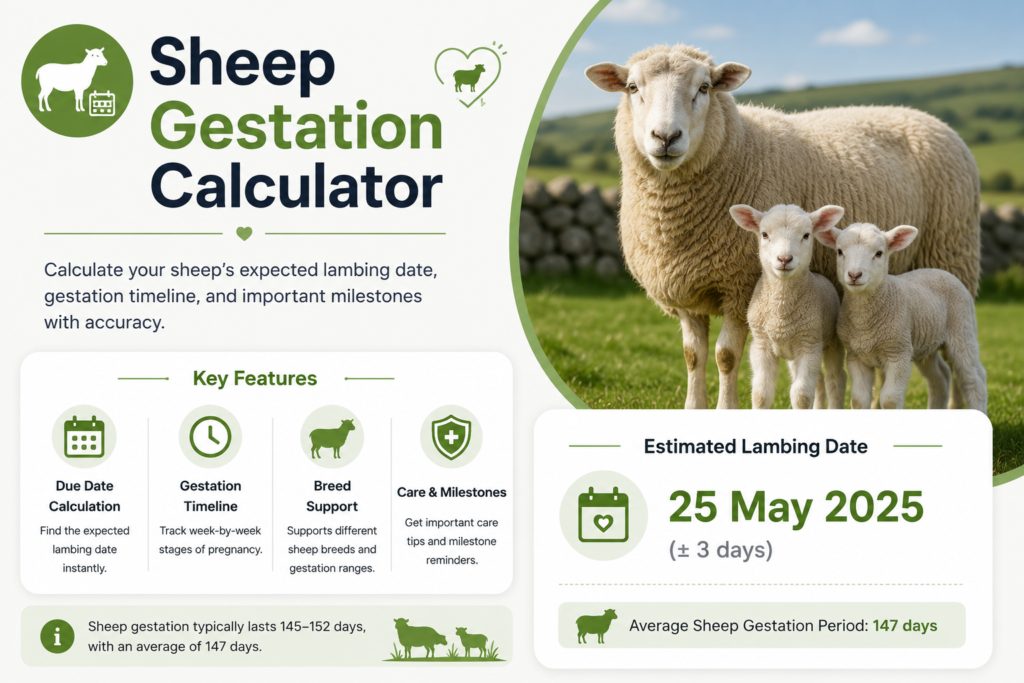
Sheep Gestation Calculator: Everything You Need to Know About Sheep Pregnancy
Few events on a farm carry as much weight as lambing season. When a ewe goes into labor, timing, preparation, and knowledge of her pregnancy journey can mean the difference between a thriving lamb and a heartbreaking loss. A sheep gestation calculator gives farmers, shepherds, and smallholders the one thing that makes all the difference — a reliable, date-specific pregnancy roadmap built around the individual ewe’s breeding date.
This guide covers the full picture: what a sheep pregnancy calculator does, how long sheep are pregnant, what to look for during each stage, how to care for a pregnant ewe, and how to prepare for a smooth lambing season.
What Is a Sheep Gestation Calculator?
A sheep gestation calculator is an online tool that takes a ewe’s breeding date as input and returns a projected lambing date along with a pregnancy timeline. Rather than counting days on a wall calendar or relying on rough estimates, a sheep lambing calculator does the arithmetic instantly and presents a structured week-by-week overview of what to expect throughout the ovine gestation period.
For farms managing multiple ewes bred at different times across the season, a sheep due date calculator becomes a genuinely practical record-keeping tool — removing ambiguity from the lambing calendar and helping farmers allocate time, feed, and facilities with greater precision.
These tools are part of the broader collection of Animal Pregnancy Calculators available on the biology hub, which covers gestation tracking for a wide range of livestock and companion animal species in one convenient location.
What Is the Sheep Gestation Period?
The sheep gestation period averages 147 days — approximately five months — though the normal range spans from 144 to 152 days depending on the breed, the ewe’s age and body condition, the number of lambs being carried, and seasonal factors.
Here’s a quick-reference overview:
| Parameter | Details |
|---|---|
| Average sheep gestation period | 147 days |
| Normal range | 144–152 days |
| Gestation period in months | Approximately 5 months |
| Gestation period in weeks | Approximately 21 weeks |
| Average litter size | 1–3 lambs (twins most common) |
| Typical breeding season | Autumn (short-day breeders) |
| Age of sexual maturity (ewe lambs) | 5–12 months depending on breed |
Understanding how long sheep are pregnant is foundational to building a well-timed lambing plan. Because most sheep breeds are short-day seasonal breeders — meaning they come into estrus as daylight shortens in autumn — ewes bred in October and November typically lamb in March and April, which aligns with improving pasture conditions in many regions.
Sheep gestation length varies slightly across breeds. Merino ewes, for example, often run at the longer end of the range, while some prolific breeds such as Finnish Landrace or Romanov may deliver slightly earlier. A sheep breeding calculator that accounts for breed-specific ranges offers a more refined estimate than a one-size-fits-all tool.
How to Use a Sheep Gestation Calculator
Using a sheep pregnancy calculator is a quick and straightforward process. Most tools work like this:
- Enter the breeding or mating date — the date the ewe was tupped (mated with the ram).
- Select breed if available — some calculators adjust the gestation estimate based on breed-specific data.
- View the projected lambing date — the tool calculates the estimated due date window.
- Review the pregnancy timeline — more detailed calculators map out key milestones across the sheep pregnancy timeline, flagging when nutritional changes, vaccinations, and facility preparations should occur.
Tips for more accurate results:
- On farms using a ram for several days of natural mating, use the first day of ram introduction as the earliest breeding date to get the widest lambing window.
- For synchronized flocks (where ewes are hormonally synchronized for batch breeding), the breeding date is typically tightly defined, making the calculator output highly reliable.
- Use the projected lambing dates to build a lambing roster — assigning overnight checks and pen assignments in advance of the season.
For farms running sheep alongside goats, the Goat Gestation Calculator is available on the same biology platform and follows the same straightforward input format — though it applies the caprine average of 150 days rather than the ovine 147-day baseline.
Signs and Symptoms of Sheep Pregnancy
Detecting pregnancy early allows farmers to separate pregnant ewes from the main flock, adjust nutrition, and begin close monitoring. Here are the most commonly observed pregnant ewe symptoms and signs of sheep pregnancy across the different stages:
Early Pregnancy Indicators (Weeks 1–6)
- Failure to return to estrus — a ewe that was successfully mated typically will not come back into heat 16–18 days after mating; this is one of the earliest and most reliable natural indicators
- Mild behavioral shift — some ewes become slightly calmer or more group-oriented in early pregnancy
- No visible physical changes — the abdomen shows no noticeable change at this stage, and weight gain is minimal
Mid-Pregnancy Signs (Weeks 7–14)
- Gradual abdominal rounding — the ewe’s belly begins to expand, particularly on the right side
- Weight gain — steady increases in body weight throughout this period, especially in ewes carrying multiple lambs
- Increased appetite — feed intake rises noticeably as fetal development accelerates
- Early udder development — faint udder filling may begin in experienced ewes from around week 12–14
Late Pregnancy Signs (Weeks 15–21)
- Significant udder engorgement — the udder fills noticeably in the final 2–4 weeks and becomes warm and firm as lambing approaches
- Pelvic ligament relaxation — the ligaments around the tailhead soften and sink in the final 12–24 hours before lambing
- Vulval swelling and discharge — mild swelling and clear mucus discharge indicate the cervix is beginning to dilate
- Nesting and restlessness — ewes in late pregnancy often seek isolation from the flock, paw at the ground, and lie down and rise repeatedly
- Reduced rumination — decreased cud-chewing activity close to lambing is a subtle but reliable pre-labor signal
Pregnancy Confirmation Methods
For more definitive confirmation, especially on commercial operations, several diagnostic approaches are available:
- Ultrasound scanning — the gold standard for pregnancy confirmation and litter-size estimation; effective from approximately day 35–45 onward and most accurate for litter counting between days 45–90
- Blood progesterone testing — detects pregnancy as early as day 17–18 post-mating, though false positives can occur
- Ram harness or raddle marking — marks ewes at the point of mating to create a written breeding record, which feeds directly into a sheep lambing date calculator
- Failure to return to estrus — practical and cost-free but not definitive
Sheep Pregnancy Stages: Week by Week
Understanding sheep pregnancy week by week allows farmers to match care inputs — nutrition, health interventions, and monitoring intensity — to what’s happening biologically at each phase.
Weeks 1–3: Fertilization and Early Embryonic Development
Fertilization occurs in the fallopian tubes within hours of mating. The embryos travel to the uterus and implant by approximately day 14–16. This is a fragile phase — stress, nutritional deficiency, or disease during implantation can lead to early embryo loss. The ewe’s routine should remain stable and calm, with no abrupt feed changes or social disruptions.
Weeks 4–8: Organ Formation
The embryos undergo rapid differentiation as major organ systems — the heart, brain, spinal cord, and limb buds — begin forming. By the end of week 8, the embryos are recognizable as lambs in miniature. Mineral nutrition, particularly selenium, iodine, and zinc, plays a critical role during this period in supporting healthy organogenesis.
Weeks 9–14: Skeletal Development and Growth
The fetal skeletons begin calcifying and muscular structure develops. The ewe’s body condition should be carefully monitored during this window. A body condition score (BCS) of 3.0–3.5 is ideal for mid-pregnancy ewes. Ewes that are too thin at this stage are at greater risk of pregnancy toxemia later, while over-conditioned ewes can experience more difficult lambings.
Weeks 15–18: Rapid Fetal Weight Gain — The Critical Nutrition Window
This phase represents the most nutritionally demanding period of the sheep gestation period. Approximately 70% of total fetal birth weight is gained in the final 4–6 weeks of gestation. Ewes carrying twins or triplets have dramatically higher energy requirements during this phase — and underfeeding during weeks 15–18 is the leading cause of pregnancy toxemia (twin lamb disease), one of the most common and serious metabolic conditions in late-pregnant ewes.
Energy density and feed quality must increase during this window. Farms monitoring large flocks may benefit from referencing the Feed Conversion Ratio Calculator to assess how efficiently ewes are converting supplementary feed into condition — a useful metric during the critical late-gestation feeding phase.
Weeks 19–21: Pre-Lambing Preparation
Lambs are fully developed and growing rapidly in size. The ewe’s abdomen is visibly large and heavy — ewes carrying triplets can appear remarkably round in this final stretch. Physical and behavioral signs of imminent lambing become increasingly evident. The ewe should be moved to a prepared lambing pen, and daily — or twice-daily — monitoring should begin by week 20 at the latest.
Sheep Pregnancy Care: Essential Management Practices
Comprehensive care throughout the sheep pregnancy timeline directly determines lamb survival rates and ewe recovery. Here are the most important management practices to follow across the gestation period:
Nutrition Management
- Early to mid-pregnancy (weeks 1–14): Maintain ewe BCS at 3.0–3.5 on good-quality pasture or hay; avoid dramatic feed changes
- Late pregnancy (weeks 15–21): Introduce supplementary concentrate feed (typically 200–500g/day depending on litter size) from around week 14–15 to support fetal growth and prevent pregnancy toxemia
- Water: Fresh, clean water should always be available; water intake increases significantly in late gestation, particularly in indoor-housed ewes
- Mineral supplementation: Selenium and vitamin E deficiency can cause white muscle disease in lambs; copper, iodine, and cobalt are also critical depending on regional soil conditions — soil testing and veterinary guidance should inform supplementation decisions
Health Interventions
- Clostridial booster vaccination (CD&T): Administer 4–6 weeks before the projected lambing date to transfer protective maternal antibodies to lambs via colostrum
- Liver fluke and intestinal worm management: The periparturient relaxation of immunity (PPRI) makes ewes particularly vulnerable to worm burden in late pregnancy; FECRT-guided anthelmintic use or strategic drenching should be planned in advance
- Foot health: Lame ewes eat less and are at greater risk of pregnancy toxemia; feet should be inspected and treated well before late gestation when handling becomes more stressful
- Scanning: Ultrasound pregnancy scanning between days 45 and 90 allows farmers to identify singles, twins, and triplets and feed accordingly — one of the highest-value investments in pregnancy management
Preparing the Lambing Area
The lambing area should be ready at least one to two weeks before the earliest projected lambing date from the sheep gestation calculator. Leaving this too late risks ewes lambing outdoors or in unsuitable conditions.
Lambing pen essentials:
- Clean, dry, deep straw bedding — replenished regularly throughout the lambing period
- Individual lambing pens of at least 4–5 square feet per ewe-and-lamb set
- Adequate lighting for overnight checks
- Fresh water and quality hay within easy reach of the ewe
- A heat lamp for cold-weather lambing or weak lambs
- Lamb warming box for chilled or hypothermic newborns
- Iodine spray for navel treatment immediately after birth
- Colostrum (fresh, frozen, or powdered) for lambs that fail to nurse or in cases of colostrum insufficiency
- Scale for recording lamb birth weights
- Lambing ropes and lubricant for assisted deliveries
- Emergency veterinary contact information posted visibly
Moving heavily pregnant ewes into the lambing facility a few days before their due date — rather than at the onset of labor — allows them to settle into the new environment without the added stress of relocation during an active birth.
What to Expect During Lambing
Lambing typically unfolds in three recognizable stages:
Stage 1: Cervical Dilation
The ewe becomes visibly uncomfortable — repeatedly lying down, rising, and circling. She may grind her teeth, strain without result, and vocalize softly. This stage can last from 1 to 6 hours in normal cases. The cervix is dilating and the lamb(s) are moving into position in the birth canal.
Stage 2: Active Delivery
The water sac ruptures and active straining begins. The first lamb is typically delivered within 30–60 minutes of vigorous pushing. Normal presentation is front feet first with the head resting on the legs. Subsequent lambs in a multiple litter are usually delivered within 15–45 minutes of each other.
If a ewe has been straining actively for 30 minutes or more without delivering a lamb, or if an abnormal presentation is suspected, veterinary or experienced shepherd assistance is needed without delay.
Stage 3: Placenta Expulsion
The placenta is typically passed within 1–3 hours of the final lamb being born. Retained placenta beyond 6–8 hours warrants veterinary attention, as it increases the risk of uterine infection (metritis).
Common Sheep Pregnancy Complications
Even on well-managed farms, complications arise. Recognizing them early is the key to effective intervention:
- Pregnancy toxemia (twin lamb disease) — energy deficiency in late pregnancy; most common in ewes carrying multiple lambs; symptoms include lethargy, teeth grinding, stargazing, and collapse; treatment involves glucose supplementation and veterinary support
- Hypocalcemia (milk fever) — low blood calcium around lambing; causes weakness, muscle tremors, and recumbency; responds well to calcium injection if caught early
- Malpresentation — incorrect positioning of the lamb(s) in the birth canal is a leading cause of dystocia (difficult birth); common malpresentations include head-back, legs-back, and breech presentations
- Prolapsed uterus — a serious post-lambing emergency requiring immediate veterinary attention
- Mastitis — udder infection most commonly occurring in the early post-lambing period; watch for heat, swelling, and discolored or watery milk
- Neonatal hypothermia — the leading cause of lamb death; cold, wet, or weak newborns must be dried, warmed, and fed colostrum within the first hour of life
When to Call a Veterinarian
Some situations during the ovine gestation period and lambing require immediate professional support:
- Ewe straining actively for more than 30 minutes without delivering a lamb
- A lamb is partially visible but delivery has stalled
- Any malpresentation that cannot be gently corrected
- Signs of pregnancy toxemia appearing in the final weeks of gestation
- Retained placenta beyond 6–8 hours post-lambing
- Heavy or persistent bleeding before, during, or after lambing
- The ewe collapses or becomes unresponsive
- A newborn lamb that is cold, limp, or unresponsive despite warming attempts
Having a veterinarian experienced with sheep on call — and ideally visited pre-season — before the lambing period begins is strongly recommended on any farm running ewes.
Related Livestock Pregnancy and Farm Tools
Managing ewe pregnancies is most effective when it’s part of a broader, integrated approach to herd health and farm planning. The Livestock Calculators section on the biology hub provides a range of practical tools for livestock farmers, including the Animal Mortality Rate Calculator, Feed Conversion Ratio Calculator, Cattle per Acre Calculator, and Livestock Fence Cost Calculator.
For farms raising cattle alongside sheep, the Cow Gestation Calculator provides the same straightforward due-date tracking for bovine pregnancies — applying the longer average bovine gestation of approximately 283 days to generate an accurate calving window.
Frequently Asked Questions About Sheep Gestation
How accurate is a sheep gestation calculator?
A sheep gestation calculator provides a reliable estimated lambing window based on the mating date and average ovine gestation length. Most ewes lamb within a few days of the projected date. Because the normal range spans 144–152 days, monitoring should begin a few days before the estimated date and continue until the ewe lambs.
Can a ewe get pregnant out of season?
Most sheep breeds are seasonally polyestrous — they cycle in response to decreasing day length. Out-of-season breeding is possible in some breeds (such as Dorset or Merino) and can be induced in others through melatonin implants or ram effect stimulation.
How many lambs can a ewe carry?
Twin lambs are the most common outcome in most domestic breeds. Singles and triplets are also frequent, and some prolific breeds (Finnsheep, Romanov) regularly produce quadruplets or even quintuplets. Ultrasound scanning between days 45 and 90 gives the most reliable litter-size count.
How soon after lambing can a ewe be rebred?
Most ewes will not return to estrus until the following breeding season, as post-lambing anestrus coincides with the long-day season in most breeds. On farms using accelerated lambing systems, specialized management techniques are needed to achieve more frequent lambing cycles.
What is the difference between a sheep gestation calculator and a goat gestation calculator?
Both tools calculate due dates from a breeding date, but they apply different average gestation lengths. Sheep average 147 days, while goats average 150 days — a three-day difference that matters when planning lambing or kidding facilities. Using the correct species-specific calculator ensures more accurate timeline planning.
How does litter size affect the sheep gestation period?
Ewes carrying triplets or quadruplets may lamb slightly earlier than those carrying singles, as the uterus reaches its maximum capacity sooner. This makes litter-size scanning an important companion tool to the sheep lambing calculator for more refined due-date prediction.
Conclusion
A sheep gestation calculator is far more than just a due-date tool — it’s the foundation of a well-organized lambing season. By converting a breeding date into a clear, week-by-week pregnancy timeline, it allows farmers to align nutritional management, health interventions, facility preparation, and monitoring schedules with exactly what’s happening inside the ewe at each stage of her 147-day gestation period.
When a sheep pregnancy calculator is used alongside good body condition management, targeted nutrition in late gestation, pre-lambing vaccination, and proactive lambing pen preparation, the results speak for themselves — higher lamb survival rates, healthier ewes, and a calmer, more manageable lambing season overall.