Protein Molecular Weight Calculator

Ahmad zee
Table of Contents
Toggle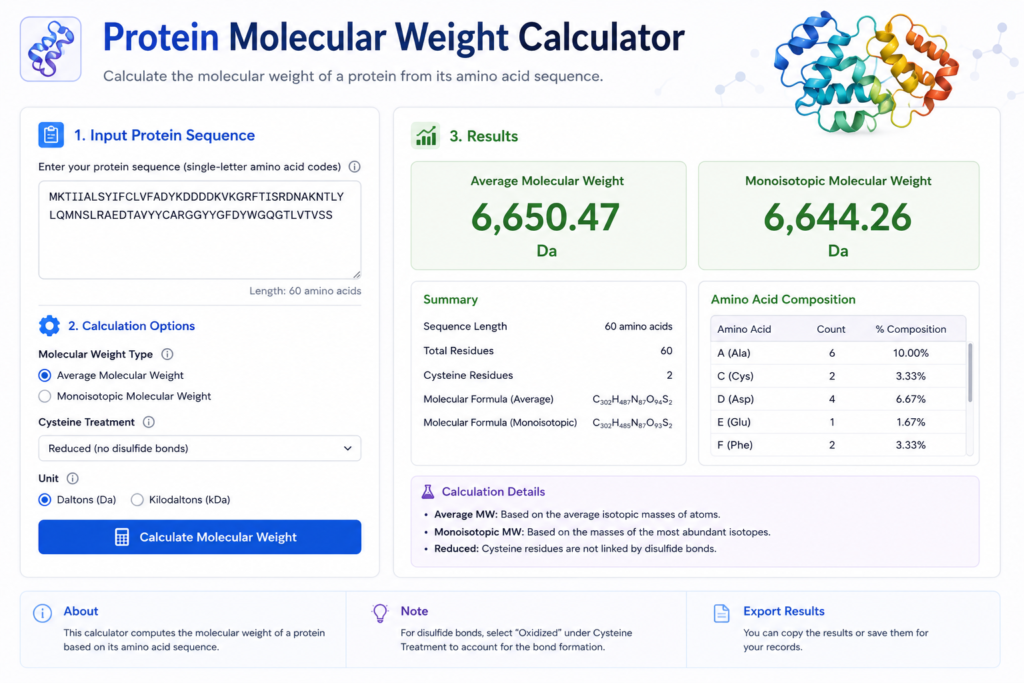
Protein Molecular Weight Calculator
A Protein Molecular Weight Calculator helps estimate the molecular weight (molar mass) of a protein based on its amino acid sequence. Knowing a protein’s molecular weight is essential for protein purification, gel electrophoresis, mass spectrometry, chromatography, and many other biochemical applications.
This calculator is useful for researchers, students, laboratory technicians, molecular biologists, and biochemists who work with proteins and peptides.
What Is a Protein Molecular Weight Calculator?
A Protein Molecular Weight Calculator estimates the molecular weight of a protein by summing the molecular masses of its amino acids while accounting for the loss of water molecules during peptide bond formation.
The calculator typically uses:
- Amino acid sequence
- Number of amino acids
- Terminal groups
- Measurement units
The result provides the estimated molecular weight, usually expressed in Daltons (Da) or kilodaltons (kDa).
How Does the Protein Molecular Weight Calculator Work?
The calculator analyses the entered amino acid sequence and calculates the combined molecular mass.
Users generally enter:
- Protein amino acid sequence
- Sequence format
- Optional terminal modifications
The calculator then estimates:
- Protein molecular weight
- Number of amino acids
- Molecular weight in Da
- Molecular weight in kDa
Protein Molecular Weight Formula
A simplified calculation is:
Protein Molecular Weight = Sum of Amino Acid Masses − Mass of Water Lost During Peptide Bond Formation
Because each peptide bond releases one water molecule, the calculator automatically adjusts the final molecular weight.
Why Use a Protein Molecular Weight Calculator?
Calculating protein molecular weight is important for many laboratory procedures.
Benefits include:
- Estimates protein mass quickly
- Supports protein purification
- Assists SDS-PAGE analysis
- Helps interpret mass spectrometry results
- Useful for protein engineering
- Saves laboratory calculation time
- Reduces manual errors
Common Uses of a Protein Molecular Weight Calculator
A Protein Molecular Weight Calculator is commonly used for:
- Molecular biology
- Biochemistry
- Proteomics
- Protein purification
- SDS-PAGE experiments
- Mass spectrometry
- Bioinformatics
- Academic research
Factors That Affect Protein Molecular Weight
Several factors influence the final molecular weight.
Amino Acid Sequence
Different amino acids contribute different molecular masses.
Protein Length
Longer proteins generally have higher molecular weights.
Peptide Bonds
Water molecules are removed during peptide bond formation, affecting the final mass.
Post-Translational Modifications
Phosphorylation, glycosylation, acetylation, and other modifications can increase molecular weight.
Signal Peptides
Some proteins lose signal peptides after synthesis, changing their mature molecular weight.
Protein Isoforms
Alternative splicing may produce proteins with different molecular weights.
Benefits of Using a Protein Molecular Weight Calculator
A Protein Molecular Weight Calculator offers several advantages.
- Fast calculations
- High accuracy
- Easy to use
- Supports laboratory planning
- Useful for students and researchers
- Compatible with protein sequences of various lengths
- Simplifies protein analysis
Tips for Accurate Protein Molecular Weight Calculations
For the most reliable results:
- Use the complete amino acid sequence.
- Check the sequence for typing errors.
- Include known terminal modifications if applicable.
- Account for post-translational modifications when necessary.
- Verify the protein sequence before analysis.
- Express results using consistent units.
- Compare calculated values with experimental data when available.
Frequently Asked Questions
What is a Protein Molecular Weight Calculator?
It is a tool that estimates the molecular weight of a protein from its amino acid sequence.
What units are used?
Protein molecular weight is commonly reported in Daltons (Da) or kilodaltons (kDa).
Why is protein molecular weight important?
It helps researchers identify proteins, design experiments, analyse electrophoresis results, and interpret mass spectrometry data.
Do post-translational modifications affect molecular weight?
Yes. Modifications such as glycosylation or phosphorylation increase the protein’s molecular weight.
Who can use this calculator?
Biochemists, molecular biologists, laboratory technicians, researchers, educators, and students can all benefit from this calculator.
Other Useful Calculators
Explore more biology calculators on Omni Calculator Store:
- Protein Concentration Calculator
https://omnicalculator.store/home/biology/protein-concentration-calculator/ - DNA Concentration Calculator
https://omnicalculator.store/home/biology/dna-concentration-calculator/ - DNA Copy Number Calculator
https://omnicalculator.store/home/biology/dna-copy-number-calculator/ - DNA to mRNA Converter
https://omnicalculator.store/home/biology/dna-to-mrna-converter/ - qPCR Efficiency Calculator
https://omnicalculator.store/home/biology/qpcr-efficiency-calculator/
Conclusion
A Protein Molecular Weight Calculator is a valuable tool for estimating the molecular mass of proteins from their amino acid sequences. By automatically accounting for amino acid composition and peptide bond formation, it provides fast and accurate results for laboratory research, protein purification, electrophoresis, and proteomics. Whether used in education or advanced biochemical research, this calculator simplifies an essential step in protein analysis.