Dog Harness Size Calculator

Ahmad zee
Table of Contents
Toggle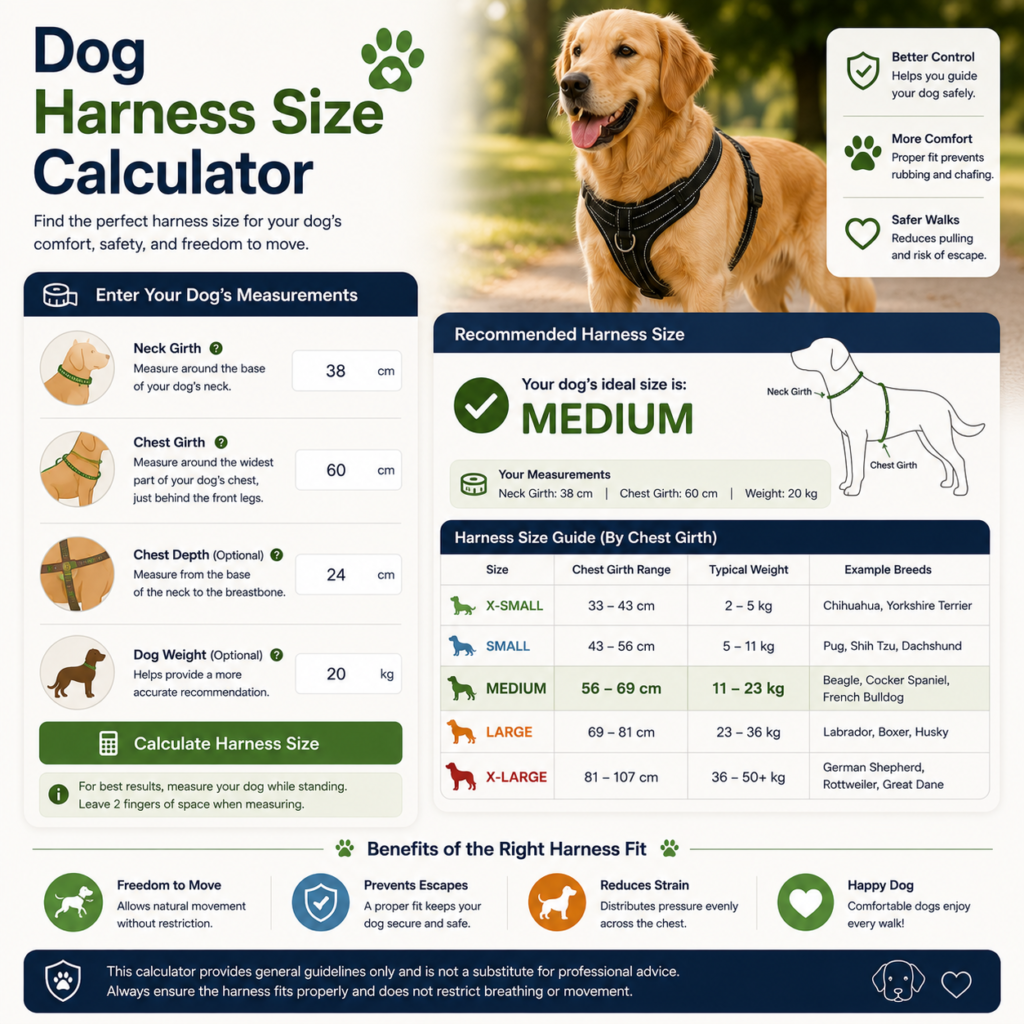
Dog Harness Size Calculator: Getting the Perfect Fit for Your Dog
A harness is one of the most important pieces of equipment a dog owner can invest in — but only when it fits correctly. Too loose and the dog can slip out, creating a dangerous situation on walks or near traffic. Too tight and it restricts movement, causes chafing, and makes wearing the harness an uncomfortable experience that the dog comes to dread. A dog harness size calculator takes the guesswork out of sizing, helping owners identify the right harness dimensions based on their dog’s actual measurements rather than relying on breed generalisations or vague size labels.
This guide covers everything worth knowing about harness sizing — from how the calculator works and which measurements matter most, to the different harness styles available and how to ensure a proper fit for dogs of every size, age, and body shape.
Why Harness Fit Matters More Than Most Owners Realise
Before exploring the calculator itself, it’s worth understanding why getting harness sizing right is so consequential. A poorly fitted harness isn’t just uncomfortable — it can be genuinely harmful.
Safety Risks of a Loose Harness
A harness that’s too loose creates an escape risk. Dogs — particularly anxious, reactive, or excitable dogs — can back out of an ill-fitting harness in seconds, especially when startled. An escaped dog near a road, in an unfamiliar area, or around other animals is immediately at risk. Proper fit eliminates this vulnerability entirely.
Physical Harm From a Tight Harness
A harness that’s too snug restricts the natural movement of the shoulders and front legs, which can interfere with a dog’s gait over time. Chronic restriction of shoulder movement has been linked to muscle soreness, altered movement patterns, and in some cases longer-term joint issues — particularly in active dogs that walk or run regularly while wearing their harness.
Chafing and Skin Irritation
Any harness that rubs consistently against the skin — particularly in the armpits, chest, and neck areas — can cause chafing, hair loss, and skin irritation. This is especially common with poorly sized harnesses on dogs with short or fine coats, or on puppies whose bodies are still changing shape rapidly.
The Two-Finger Rule
The universal benchmark for harness fit is the two-finger rule: a properly fitted harness should allow two fingers to slide comfortably beneath any strap, anywhere on the harness. If fewer than two fingers fit, the harness is too tight. If significantly more than two fingers fit, it’s too loose. This simple test is the most reliable real-world check for harness fit.
How Does a Dog Harness Size Calculator Work?
A dog harness size calculator uses one or more of a dog’s body measurements to recommend an appropriate harness size. Unlike clothing size charts that rely primarily on weight, harness calculators prioritise actual circumference measurements — because body shape varies enormously between dogs of the same weight.
The primary measurements used are:
Chest / Girth Measurement
The chest girth — measured at the widest point of the dog’s ribcage, typically just behind the front legs — is the single most important measurement for harness sizing. This is the circumference that most harness adjustment systems are built around, and it’s the number that should be matched most carefully to harness specifications.
Neck Measurement
For harnesses that include a neck loop or collar-style front section, the neck circumference — measured around the base of the neck where a collar would normally sit — is also required. This measurement ensures the front portion of the harness sits comfortably without pressing on the throat.
Back Length
Some harness styles — particularly vest-style and jacket harnesses — also use back length, measured from the base of the neck to the base of the tail, to ensure the harness body covers the right proportion of the dog’s torso.
Once measurements are entered, the calculator matches them to the manufacturer’s size specifications — which typically run from extra small through extra large or XXL — and recommends the most appropriate size. When measurements fall between two sizes, most calculators recommend sizing up to ensure freedom of movement and adjustability.
Taking Accurate Measurements: A Step-by-Step Guide
Accurate measurements are the foundation of a reliable harness size recommendation. Even small errors can mean the difference between a comfortable fit and one that chafes or slips. Here’s how to measure correctly.
Tools Needed
- A soft fabric measuring tape (the kind used in dressmaking)
- Treats to keep the dog calm and still
- A helper for wriggly or excitable dogs
Measuring Chest Girth
Have the dog stand naturally on a flat surface in a relaxed posture. Wrap the measuring tape around the widest part of the chest — this is typically just behind the front legs and shoulder blades, around the ribcage. The tape should sit snugly against the body without compressing the fur or pulling tight. Record the measurement in both inches and centimetres if possible, as different brands use different units.
Measuring Neck Circumference
Measure around the base of the neck — roughly where the top of a collar would sit. Keep the tape snug but not tight, and make sure the dog’s head is in a natural, forward-facing position rather than raised or lowered, as this can affect the measurement.
Measuring Back Length
For harnesses that require this measurement, have the dog stand naturally and measure along the spine from the base of the neck (where the collar sits) to the base of the tail. This gives the back length that the harness body needs to span.
Cross-Reference With Weight
While body measurements should always take priority over weight, knowing the dog’s current weight helps cross-reference size recommendations across brands. The dog weight calculator provides a reliable current weight that complements physical measurements when selecting between size options.
Standard Harness Size Categories and What They Cover
Harness sizing varies between manufacturers, but most brands follow a broadly similar size structure. Understanding these categories helps owners interpret calculator results and navigate product listings more confidently.
Extra Small (XS)
Chest girth typically 10 to 14 inches. Designed for very small toy breeds such as Chihuahuas, Pomeranians, tiny Yorkshire Terriers, and Teacup breeds. These harnesses are lightweight, minimal in construction, and prioritise comfort for delicate frames.
Small (S)
Chest girth typically 14 to 19 inches. Appropriate for small breeds including Shih Tzus, Pugs, Miniature Dachshunds, Bichon Frises, and French Bulldogs on the smaller end. Small harnesses begin to offer more adjustment range than XS options.
Medium (M)
Chest girth typically 19 to 25 inches. Covers a wide range of medium breeds including Beagles, Cocker Spaniels, Whippets, Bulldogs, and smaller Border Collies. Medium is often the most variable size category — dogs at the extremes of this range can have very different body shapes, so precise measurement matters especially here.
Large (L)
Chest girth typically 25 to 32 inches. Suited for larger breeds including Labrador Retrievers, Golden Retrievers, Siberian Huskies, German Shepherds, and Standard Poodles. At this size, harness construction quality and durability become increasingly important.
Extra Large (XL)
Chest girth typically 32 to 42 inches. Designed for large to giant breeds including Rottweilers, Bernese Mountain Dogs, and larger Labrador Retrievers. Hardware and stitching strength are critical at this size to handle the pulling force these dogs can generate.
XXL
Chest girth typically 42 inches and above. Reserved for giant breeds such as Great Danes, Saint Bernards, Mastiffs, and Newfoundlands. XXL harnesses are purpose-built for very large, heavy dogs and are typically made from heavy-duty materials with reinforced attachment points.
Using the dog size calculator alongside harness size recommendations helps confirm that the projected adult dimensions of a growing dog align with the harness being considered — particularly important when purchasing for a puppy.
Types of Dog Harnesses and How Sizing Applies to Each
Not all harnesses are built the same way, and the type of harness directly affects how measurements translate into fit. Understanding the main harness styles helps owners choose the right design for their dog before applying size calculator results.
Step-In Harness
The dog steps its front paws into two loops and the harness is fastened on the back. Step-in harnesses are typically sized primarily by chest girth and suit calm, cooperative dogs. They’re popular for small breeds and dogs that dislike having things pulled over their heads. Accurate chest measurement is especially critical for this style, as the loops must encircle each leg comfortably without restricting movement.
Overhead / Vest Harness
Slipped over the dog’s head and fastened under the belly, vest harnesses distribute pressure broadly across the chest and back. They’re available in a wide range of styles from simple nylon to padded neoprene and are among the most commonly used harness types. Both neck and chest measurements are typically required for this style.
Y-Front Harness
The Y-front design features a Y-shaped chest piece that sits between the dog’s front legs without crossing over the shoulder joint — a design that proponents argue better preserves natural shoulder movement. Y-front harnesses are popular among owners of sporting, working, and high-activity dogs. They require precise chest girth and sometimes back length measurements to ensure the Y sits in the correct anatomical position.
Front-Clip Harness
Front-clip harnesses feature a leash attachment point on the dog’s chest rather than the back. When the dog pulls, the design redirects them sideways rather than allowing forward momentum — making them effective tools for loose-leash training. They’re sized similarly to vest harnesses but require careful fit around the chest to ensure the front clip sits in the correct central position.
Back-Clip Harness
The most traditional harness design, with a single leash attachment point on the back. Back-clip harnesses are comfortable, easy to use, and appropriate for dogs that walk well on leash without significant pulling. Standard chest girth and neck measurements apply.
No-Pull Harness
No-pull harnesses typically combine front and back clip points with a design that applies gentle, redirecting pressure when the dog pulls. Sizing is generally similar to vest harnesses, but fit precision is more important because the pressure-distribution mechanism only works correctly when the harness sits in exactly the right position on the dog’s body.
Tactical and Working Harnesses
Designed for service dogs, working dogs, and dogs involved in search and rescue, tracking, or other professional roles, tactical harnesses are built for durability, load-bearing capacity, and handle attachment. They’re typically sized by chest girth with additional back length measurements and are available in a more limited size range skewed toward medium and large breeds.
Harness Sizing for Puppies: Planning for Growth
Sizing a harness for a puppy presents a unique challenge — puppies grow rapidly, and a harness that fits perfectly today may be outgrown within weeks. There are two broad approaches to puppy harness sizing:
Buy for Current Size and Replace as Needed
For very young puppies in the rapid early growth phase, buying a well-fitting harness at the current size and replacing it as needed is sometimes the most practical approach. This ensures the puppy always has a properly fitting harness during the critical early weeks of leash training, when comfort and correct fit matter most for building positive associations with the harness.
Buy an Adjustable Harness With Growth Room
Many harness brands offer highly adjustable designs with multiple adjustment points — at the neck, chest, and sometimes belly — that can accommodate several inches of growth. Choosing a harness with the widest possible adjustment range at the puppy’s current measurements can extend the harness’s useful life considerably.
The dog age calculator helps owners understand where their puppy is in its growth trajectory, making it easier to decide whether to invest in an adjustable harness that will last through adolescence or opt for a more basic option to be replaced at adult size.
For mixed-breed puppies whose adult size is uncertain, the dog size calculator provides a projected adult weight and size range — useful context when deciding how much adjustability to look for in a harness purchase.
Harness Sizing for Dogs With Unusual Body Proportions
Not every dog fits neatly into standard harness size categories. Certain breeds and body types present particular fitting challenges that a dog harness size calculator should account for.
Deep-Chested Breeds
Breeds like Greyhounds, Whippets, Boxers, and Dobermans have deep, narrow chests and slim waists — a body shape that makes standard harness sizing challenging. A harness sized by chest girth alone may be far too wide at the belly for these breeds. Purpose-designed greyhound or sighthound harnesses address this with narrower belly straps and adjusted proportions.
Barrel-Chested Breeds
English Bulldogs, French Bulldogs, and similar compact, wide-chested breeds have a chest girth that can be disproportionately large relative to their overall size. These dogs often measure into a larger harness category than their weight would suggest, and fit at the neck and shoulders requires careful attention to avoid restriction.
Long-Backed Breeds
Dachshunds, Basset Hounds, and Corgis have elongated backs relative to leg length. Vest-style harnesses need to be checked carefully for back length to ensure they don’t extend so far down the spine that they restrict movement or cause discomfort.
Brachycephalic Breeds
Flat-faced breeds — Pugs, Bulldogs, Shih Tzus, Boston Terriers — should always wear a harness rather than a collar, as these breeds are significantly more susceptible to breathing difficulties and tracheal damage from collar pressure. For these breeds, harness fit around the neck requires extra attention to ensure nothing presses on the throat or restricts the airway.
Muscular Breeds
Breeds like American Staffordshire Terriers, Rottweilers, and similar muscular dogs may have a chest girth that places them in one size category and a neck circumference that places them in another. When measurements straddle size categories, sizing up for the larger measurement and adjusting down is generally the safer approach.
Body Condition and Harness Fit
A dog’s body condition — whether it’s at an ideal weight, overweight, or underweight — directly affects harness fit. Body condition can shift measurements meaningfully, which is why harness sizing should be revisited whenever a dog’s weight changes significantly.
For dogs managing their weight, the dog BMI calculator provides an objective body condition assessment that helps owners track progress and understand when a harness re-measurement may be warranted. A dog that loses 10 to 15% of its body weight through a managed diet plan — guided by the dog food calculator — may find that a previously well-fitting harness becomes too loose as the chest girth decreases.
Conversely, dogs that gain weight due to overfeeding, reduced activity, or underlying health conditions may gradually grow out of a harness without the owner noticing — particularly if the harness has been on maximum adjustment for some time. Regular measurement checks prevent this from becoming a safety issue.
Checking and Maintaining Harness Fit Over Time
A harness that fits perfectly on day one needs to be checked regularly to ensure it continues to fit correctly as the dog’s body changes.
Check fit monthly for puppies. Puppies in active growth phases can change size noticeably within weeks. Monthly measurement checks — and harness adjustment or replacement as needed — ensure the harness always fits safely throughout puppyhood.
Check fit seasonally for adults. Adult dogs may experience seasonal weight fluctuations due to activity level changes. A brief fit check at the start of each season — using the two-finger rule across all straps — takes only a minute and catches any sizing drift before it becomes a problem.
Inspect hardware and stitching regularly. Beyond fit, the structural integrity of the harness should be inspected regularly. Frayed stitching, cracked buckles, or worn webbing can fail unexpectedly — a particular concern for strong, active dogs. Harnesses showing significant wear should be replaced regardless of whether they still fit.
Wash according to manufacturer instructions. Many harnesses can be hand-washed or machine-washed on a gentle cycle. Clean harnesses are more comfortable for the dog and allow owners to inspect the fabric and hardware more easily for signs of wear. Avoid harsh detergents that may degrade the webbing or cause skin irritation.
Common Harness Sizing Mistakes to Avoid
Even well-intentioned owners make sizing errors that undermine harness safety and comfort. These are the most frequent mistakes:
Sizing by weight alone. Weight is a useful reference point but a poor primary sizing tool. Two dogs of identical weight can have very different chest girths depending on their build. Always measure first.
Measuring over a thick coat. For heavily coated breeds, measuring over a full winter coat can add significant circumference that doesn’t reflect the dog’s actual body size. Parting the fur to measure against the skin — or accounting for coat thickness in the measurement — gives a more accurate result.
Ignoring breed-specific proportions. Using a generic size chart without accounting for the dog’s specific body shape can result in a harness that technically fits the chest but sits incorrectly on the shoulders, neck, or back. Breed-specific harness recommendations help navigate this.
Not adjusting after purchase. Most harnesses arrive in a neutral position and require adjustment to fit the individual dog. Owners who don’t spend time properly adjusting all straps after receiving a new harness often end up with a poor fit that could have been corrected easily.
Buying based on breed name alone. Breed size ranges are broad. A male Labrador and a female Labrador of the same breed can differ by 20 pounds and several inches of chest girth. Individual measurement always beats breed-based assumptions.
Final Thoughts
A dog harness size calculator is one of the most practical tools available for any dog owner navigating the harness market. By anchoring size recommendations to actual body measurements rather than weight approximations or breed generalisations, it helps owners find a harness that fits safely, comfortably, and correctly from the start.
Getting harness sizing right has real consequences — for safety on walks, for the dog’s comfort and movement, and for the long-term success of leash training. Combined with regular fit checks, thoughtful harness selection for the dog’s specific body type and activity level, and ongoing weight and body condition monitoring, a well-fitted harness becomes one of the most reliable tools in a responsible dog owner’s daily routine.