Tramadol For Dogs Calculator

Ahmad zee
Table of Contents
Toggle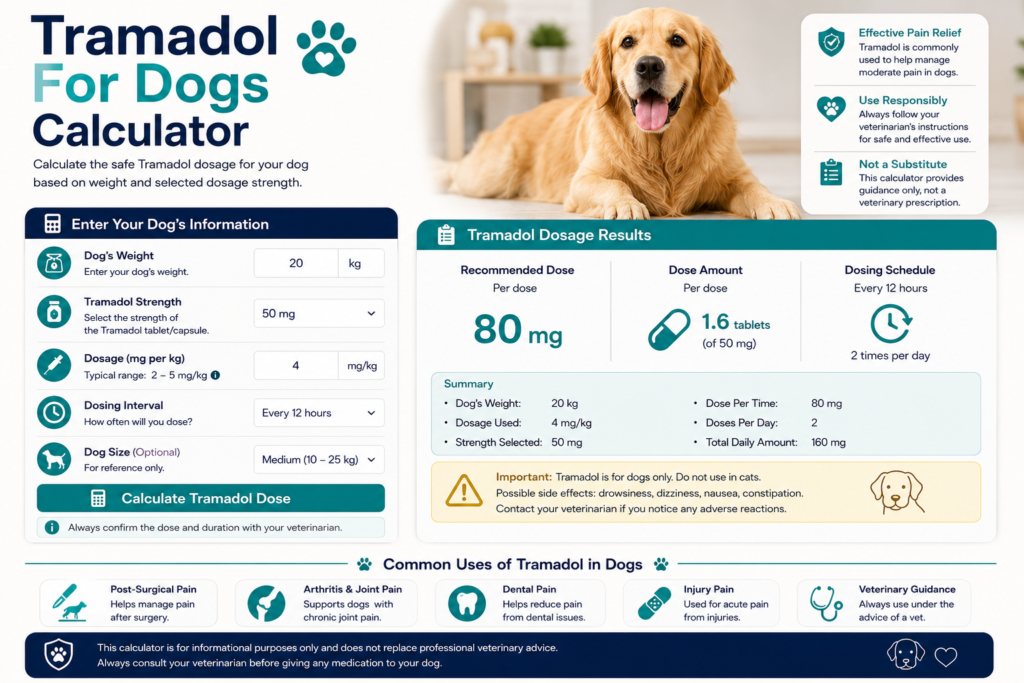
Tramadol for dogs calculator: how to use it safely and what every owner needs to knowPet Care Guide
Tramadol is one of the most commonly prescribed pain medications in veterinary medicine — but getting the dose right for your dog is not something to guess at. A tramadol for dogs calculator helps owners and caregivers work out a safe starting dose range, understand what factors influence dosing, and know exactly when to pick up the phone and call a vet instead.
What is tramadol and why is it prescribed for dogs?
Tramadol hydrochloride is a synthetic opioid analgesic — a pain reliever that works by binding to opioid receptors in the brain and spinal cord and by inhibiting the reuptake of serotonin and norepinephrine, two neurotransmitters involved in pain signaling. In humans it is a controlled substance; in dogs it is a prescription medication used widely under veterinary supervision.
Vets prescribe tramadol for dogs in a broad range of painful conditions, including post-surgical recovery, osteoarthritis and joint disease, cancer pain, soft tissue injuries, intervertebral disc disease, and chronic pain management in older dogs. It is often used alongside NSAIDs (non-steroidal anti-inflammatory drugs) as part of a multimodal pain protocol, where combining two different types of pain medication allows for better pain control at lower doses of each drug.
Tramadol offers a middle-ground option for moderate-to-severe pain in dogs who cannot tolerate NSAIDs due to kidney disease, gastrointestinal issues, or other contraindications. It is also useful for acute pain management when stronger opioids are not required.
It is worth noting that dogs metabolize tramadol differently from humans. Dogs convert tramadol into its active metabolite (O-desmethyltramadol, or M1) less efficiently than humans do, which means the pharmacokinetics — how the drug moves through the body — are meaningfully different. This is one of the reasons that dosing in dogs is based on body weight and is calibrated specifically for canine physiology, not simply scaled from human guidelines.
How tramadol dosing works
The standard dosing range for tramadol in dogs is 2 to 5 milligrams per kilogram of body weight (mg/kg), given every 8 to 12 hours. In certain clinical situations — particularly chronic cancer pain — veterinarians may prescribe up to 10 mg/kg, but this is the upper ceiling and should only be reached under close veterinary supervision.
| Use case | Typical dose range | Frequency | Notes |
|---|---|---|---|
| Acute pain (post-op, injury) | 2–5 mg/kg | Every 8 hrs | Often combined with an NSAID |
| Chronic pain (arthritis, joint disease) | 2–5 mg/kg | Every 8–12 hrs | Lower end of range often sufficient |
| Cancer pain | Up to 10 mg/kg | Every 6–8 hrs | Requires close vet monitoring |
| Intervertebral disc disease | 2–5 mg/kg | Every 8 hrs | Rest and restricted movement also critical |
Body weight is the single most important variable in calculating a tramadol dose. A 5 kg Chihuahua requires a fundamentally different dose from a 40 kg Labrador, even at the same mg/kg rate. This is why a calculator that takes the dog’s actual weight as its primary input is so valuable — it removes the arithmetic from the owner’s hands and reduces the risk of calculation errors.
Dosage ranges found online — including from a calculator — are reference guidelines only. Your veterinarian may prescribe a dose outside the standard range for valid clinical reasons specific to your dog. Always follow your vet’s prescription over any calculator output.
What a tramadol for dogs calculator does
A tramadol for dogs calculator is a digital tool that takes your dog’s weight as an input and outputs an estimated safe dose range based on the standard veterinary dosing parameters. A well-built calculator will give you several useful outputs at once:
Per-dose range
Low dose (2 mg/kg) and high dose (5 mg/kg) per administration, calculated from your dog’s weight.
Daily total
How much tramadol your dog would receive in a 24-hour period across all doses at your chosen frequency.
Tablet guidance
How many tablets of common sizes (50 mg, 100 mg, 200 mg) correspond to each end of the dose range.
Safety ceiling check
A visual indicator showing where the calculated dose sits relative to the 10 mg/kg maximum ceiling.
The best calculators also flag edge cases — very small dogs under 2 kg, for example, where dosing precision is critical and even a small error has outsized consequences, or very large dogs where tablet-splitting logistics become more complex.
How to use the calculator step by step
- 1Weigh your dog accurately
Use a proper scale — either a pet scale or weigh yourself holding the dog and subtract your own weight. Estimates are not good enough when calculating medication doses. A 2 kg error in a 10 kg dog changes the dose calculation by 20%.
- 2Select your unit (kg or lb)
Most veterinary dosing is expressed in mg/kg. If your scale gives pounds, a good calculator will convert automatically. If doing the conversion manually, divide pounds by 2.205 to get kilograms.
- 3Choose the dosing frequency
Your vet will specify how often to give the medication — every 8 hours, every 12 hours, or once daily. This changes the daily total but not the per-dose amount. Entering the correct frequency helps you see the full picture of daily drug load.
- 4Read the per-dose range
The calculator shows you the low and high dose in milligrams per administration. Compare this to your vet’s prescription. If the prescribed dose falls within the standard range, you can proceed with confidence.
- 5Use the tablet guide
Match the calculated dose to a tablet size. Tramadol commonly comes in 50 mg and 100 mg tablets for dogs. The guide tells you whether you need a whole tablet, half, or a quarter — reducing the risk of over- or under-dosing through imprecise splitting.
- 6Confirm with your vet before administering
The calculator is a reference tool, not a prescription. Present the output to your vet if you have any questions, particularly if your dog is also receiving other medications or has underlying health conditions.
Tablet sizes and how to split doses
Tramadol for dogs comes in several tablet sizes, and the mismatch between what a dog needs and what tablets are available means that splitting is common. Here is how the math works for some typical dog weights:
| Dog weight | Low dose (2 mg/kg) | High dose (5 mg/kg) | 50 mg tablet | 100 mg tablet |
|---|---|---|---|---|
| 5 kg (e.g. Chihuahua) | 10 mg | 25 mg | 0.2 – 0.5 tablets | 0.1 – 0.25 tablets |
| 10 kg (e.g. Beagle) | 20 mg | 50 mg | 0.4 – 1 tablet | 0.2 – 0.5 tablets |
| 20 kg (e.g. Cocker Spaniel) | 40 mg | 100 mg | 0.8 – 2 tablets | 0.4 – 1 tablet |
| 35 kg (e.g. Labrador) | 70 mg | 175 mg | 1.4 – 3.5 tablets | 0.7 – 1.75 tablets |
| 50 kg (e.g. Great Dane) | 100 mg | 250 mg | 2 – 5 tablets | 1 – 2.5 tablets |
When splitting tablets, use a proper pill cutter rather than breaking by hand — uneven halves can lead to inconsistent dosing. For very small dogs where even a half of a 50 mg tablet would be too much, ask your vet about compounding options — tramadol can be compounded into a liquid formulation at a specific concentration suited to your dog’s size.
Human tramadol often comes in extended-release (ER) formulations. These are not appropriate for dogs — do not split or crush ER tablets to give to your dog. Only use immediate-release (IR) tramadol as directed by your vet. The extended-release mechanism is designed for human metabolism and is not suitable for canine use.
Side effects to watch for
Tramadol is generally well tolerated in dogs, but side effects do occur, particularly when starting the medication or adjusting the dose. Knowing what to look for means you can respond quickly if your dog has an adverse reaction.
Common side effects
- Sedation and drowsiness — The most frequently observed effect, especially at higher doses. Mild sleepiness is expected; extreme unresponsiveness is not.
- Nausea and vomiting — Some dogs experience stomach upset, particularly if tramadol is given on an empty stomach. Giving the medication with food often reduces this.
- Constipation — As with most opioids, tramadol can slow gut motility. Ensure your dog has access to fresh water and maintains normal activity where possible.
- Decreased appetite — A mild reduction in appetite is common in the first few days and usually resolves as the dog adjusts to the medication.
- Anxiety or dysphoria — A minority of dogs respond to tramadol with restlessness, panting, or apparent discomfort rather than sedation. This paradoxical response should be reported to your vet.
Signs requiring immediate veterinary attention
- Seizures or muscle tremors
- Extreme difficulty breathing or slow, labored respiration
- Loss of consciousness or inability to be roused
- Rapid heart rate combined with agitation and high body temperature (possible serotonin syndrome)
- Signs of allergic reaction: hives, facial swelling, sudden vomiting
Tramadol inhibits serotonin reuptake, which means it can interact dangerously with other serotonergic drugs. If your dog is also receiving MAOIs, certain antidepressants, or other opioids, inform your vet before starting tramadol. Serotonin syndrome — characterized by agitation, muscle rigidity, rapid heart rate, and high body temperature — is a veterinary emergency.
When tramadol should not be used
A tramadol dosage calculator assumes the dog is an appropriate candidate for the medication. There are situations where tramadol is contraindicated or requires special caution:
Contraindicated Dogs with known hypersensitivity to tramadol or other opioids. Dogs receiving monoamine oxidase inhibitors (MAOIs). Dogs with a history of seizure disorders — tramadol lowers the seizure threshold.
Use with caution Dogs with liver or kidney disease (reduced metabolism and clearance require dose adjustment). Pregnant or nursing dogs. Senior dogs, who may be more sensitive to sedative effects and have slower drug clearance. Dogs receiving SSRIs, SNRIs, tricyclic antidepressants, or other opioids.
Discuss with your vet Dogs with respiratory disease. Dogs undergoing surgery (tramadol interacts with many anesthetic agents). Very young puppies, whose drug metabolism systems are immature.
Common questions
Can I give my dog human tramadol?
In most cases, tramadol tablets are the same pharmaceutical compound whether manufactured for humans or animals. However, you should only give tramadol to your dog under a valid veterinary prescription. Human formulations may contain different inactive ingredients, and extended-release human tablets are not safe for dogs. Never self-prescribe based on leftover human medication.
How long does tramadol take to work in dogs?
Tramadol typically begins to take effect within 30 to 60 minutes of administration. Peak plasma concentrations are reached around one to two hours after dosing. If your dog does not appear to show any pain relief after a few doses, contact your vet rather than increasing the dose on your own.
Can a dog overdose on tramadol?
Yes. Tramadol toxicity in dogs can occur and is a veterinary emergency. Signs of overdose include extreme sedation, pinpoint pupils, slowed or labored breathing, muscle weakness, vomiting, and in severe cases, seizures or respiratory depression. If you suspect your dog has received too much tramadol, contact your vet or an emergency animal poison control line immediately.
Can I stop tramadol suddenly?
Dogs on tramadol for extended periods — particularly at higher doses — can develop physical dependence. Abrupt discontinuation may cause withdrawal signs including restlessness, trembling, and gastrointestinal upset. Your vet will typically recommend a tapering schedule rather than an abrupt stop.
Does tramadol make dogs sleepy all the time?
Sedation is common when tramadol is first started or when the dose is increased, but many dogs acclimate to the medication after a few days and become less drowsy over time. Persistent extreme sedation throughout the course of treatment is a reason to call your vet and discuss a dose adjustment.