Quiz: Dog Size Calculator

Ahmad zee
Table of Contents
Toggle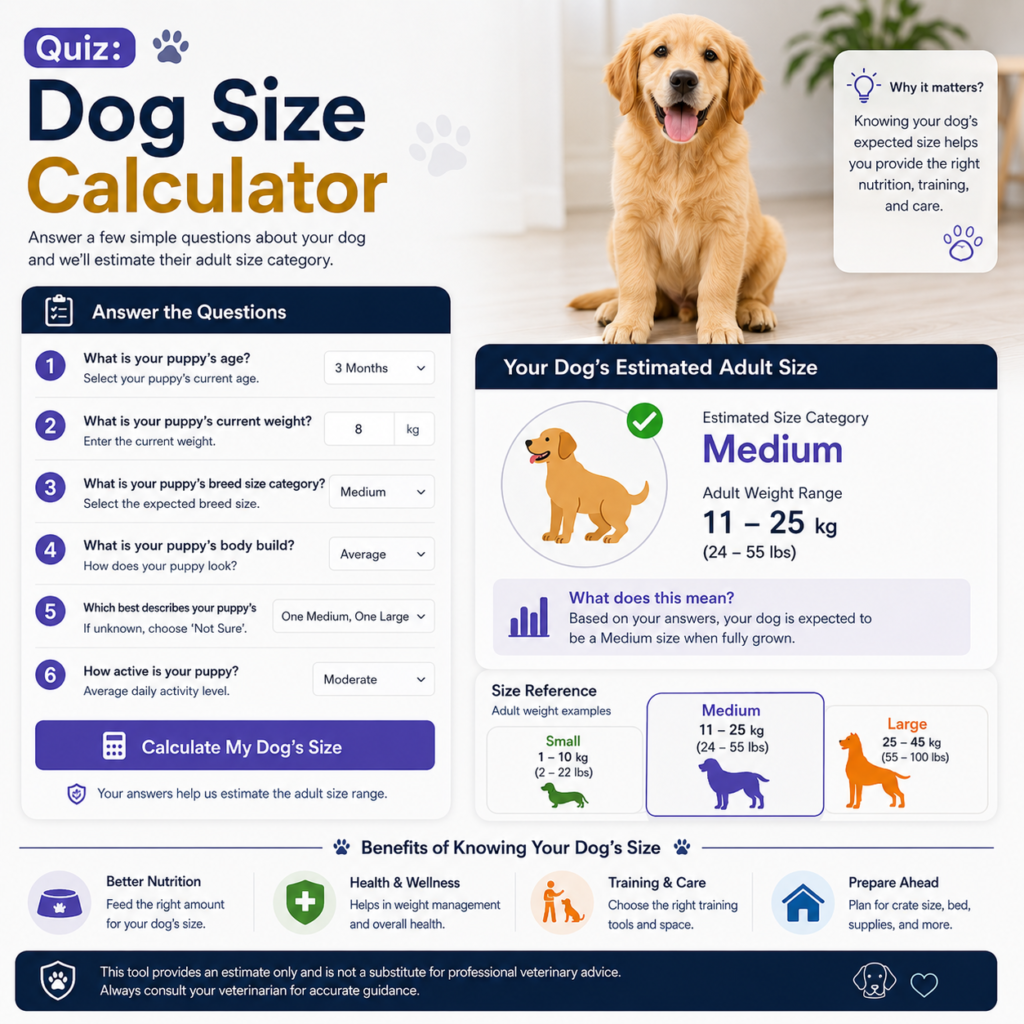
Quiz: Dog Size Calculator — Test Your Knowledge About Dog Sizes, Growth, and Breed Categories
How well does someone really know dog sizes? Whether a person is a lifelong dog owner, a first-time puppy parent, or simply a dog enthusiast who loves learning about canine biology, this quiz is a fun and informative way to test knowledge about dog growth, size categories, breed-specific development, and the science behind predicting how big a dog will get.
The questions below cover everything from basic size classifications to the biology of canine growth — all the kinds of things a dog size calculator is built around. Read through each question, note the answers, and check the answer key at the end. Some questions may be more surprising than expected.
Before the Quiz: What Is a Dog Size Calculator?
For anyone unfamiliar with the tool, a dog size calculator is an online resource that estimates a puppy’s adult size — including projected weight and sometimes height — based on inputs like current age, current weight, breed, sex, and parental sizes. It’s one of the most practically useful tools available to dog owners, helping with decisions about crates, food, living arrangements, and health planning.
The quiz below is designed around the same knowledge base that powers these calculators — making it both entertaining and genuinely educational for anyone who completes it.
The Quiz: 20 Questions on Dog Sizes, Growth, and Breed Categories
Section 1: Dog Size Basics
Question 1
What are the five main size categories that dogs are typically grouped into?
- A) Miniature, Small, Medium, Large, Extra Large
- B) Toy, Small, Medium, Large, Giant
- C) Tiny, Compact, Standard, Big, Massive
- D) Teacup, Mini, Standard, Large, Giant
Question 2
Approximately what weight range defines a “toy breed” dog?
- A) Under 5 lbs
- B) Under 12 lbs
- C) Under 20 lbs
- D) Under 25 lbs
Question 3
Which of the following breeds is classified as a giant breed?
- A) Basset Hound
- B) Siberian Husky
- C) Great Dane
- D) Labrador Retriever
Question 4
At approximately what age do toy breeds typically reach their full adult size?
- A) 3 to 4 months
- B) 6 to 8 months
- C) 12 to 14 months
- D) 18 months
Question 5
Giant breed dogs may not reach their full adult size until what age?
- A) 12 months
- B) 14 to 16 months
- C) 2 to 3 years
- D) 4 years
Section 2: Puppy Growth and Development
Question 6
Which of the following is the most reliable predictor of a purebred puppy’s adult size?
- A) The size of the puppy’s paws
- B) The puppy’s weight at 8 weeks
- C) The adult size of both parents
- D) The puppy’s appetite level
Question 7
A common simplified formula for estimating a puppy’s adult weight involves dividing current weight by age in weeks and multiplying by what number?
- A) 12
- B) 26
- C) 52
- D) 100
Question 8
At what age do most medium breed dogs reach approximately 75% of their adult body weight?
- A) 8 weeks
- B) 16 weeks
- C) 6 months
- D) 9 months
Question 9
Which of the following statements about “runt” puppies is most accurate?
- A) Runts always remain the smallest dog in adulthood
- B) Runts can sometimes catch up to or surpass littermates with proper care
- C) Runts are always the result of genetic defects
- D) Runts reach adult size faster than other puppies
Question 10
What does the growth plate in a puppy’s bones do, and why does it matter for size prediction?
- A) It determines coat color
- B) It closes when the puppy reaches adult size, marking the end of bone lengthening
- C) It controls the puppy’s appetite
- D) It determines how fast a puppy’s teeth develop
Section 3: Breed-Specific Size Knowledge
Question 11
Which of the following dog breeds is considered a medium breed?
- A) Chihuahua
- B) Border Collie
- C) Saint Bernard
- D) Pomeranian
Question 12
French Bulldogs are known for being a compact, muscular breed. Which size category do they fall into?
- A) Toy
- B) Small
- C) Medium
- D) Large
Question 13
Which large breed dog is often cited as one of the most prone to hip dysplasia, partly related to rapid growth rate?
- A) Maltese
- B) German Shepherd
- C) Dachshund
- D) Pug
Question 14
Labrador Retrievers are one of the world’s most popular dog breeds. What is their typical adult weight range?
- A) 20 to 35 lbs
- B) 40 to 55 lbs
- C) 55 to 80 lbs
- D) 85 to 110 lbs
Question 15
Which factor makes predicting the adult size of a mixed-breed dog more challenging than predicting the size of a purebred dog?
- A) Mixed breeds grow faster
- B) Mixed breeds don’t have growth plates
- C) The combination of multiple breed genetics can produce unpredictable size outcomes
- D) Mixed breeds always end up larger than either parent breed
Section 4: Size, Health, and Nutrition
Question 16
Why do large breed puppies require food with specific calcium-to-phosphorus ratios compared to small breed puppies?
- A) To support faster coat growth
- B) To prevent developmental orthopedic conditions linked to accelerated bone growth
- C) To improve their sense of smell
- D) To reduce shedding
Question 17
Which of the following health conditions is most commonly associated with giant breed dogs?
- A) Dental overcrowding
- B) Hypoglycemia
- C) Joint disease and shorter average lifespan
- D) Eye infections
Question 18
A dog food calculator and a dog size calculator are most directly connected by which shared variable?
- A) Coat type
- B) Body weight
- C) Breed popularity
- D) Eye color
Question 19
Toy breeds are sometimes described as having a “higher metabolic rate relative to body size.” What does this mean in practical feeding terms?
- A) They need less food than large breeds in total, but more calories per pound of body weight
- B) They need exactly the same calories per pound as large breeds
- C) They should only be fed once per day
- D) They require grain-free food exclusively
Question 20
When using a dog size calculator, which measurement — length or height — determines the minimum floor length a crate should have?
- A) Height, measured from the floor to the top of the head
- B) Length, measured from the tip of the nose to the base of the tail
- C) Weight, measured on a digital scale
- D) Chest circumference, measured around the widest part of the torso
Answer Key With Explanations
Question 1 — Answer: B) Toy, Small, Medium, Large, Giant
The five standard size categories used in canine health, nutrition, and breed classification are Toy, Small, Medium, Large, and Giant. These categories are widely used by veterinarians, breeders, and tool developers — including those behind the dog size calculator — to provide size-appropriate guidance across all aspects of dog care.
Question 2 — Answer: B) Under 12 lbs
Toy breeds are generally defined as dogs with an adult weight under 12 pounds. Breeds like Chihuahuas, Pomeranians, Yorkshire Terriers, and Papillons fall into this category. Despite their small stature, toy breeds are often known for long lifespans and remarkably big personalities.
Question 3 — Answer: C) Great Dane
The Great Dane is one of the world’s most recognizable giant breeds, with adult males commonly reaching 140 to 175 pounds and standing up to 32 inches at the shoulder. Basset Hounds and Siberian Huskies are large breeds, while Labrador Retrievers sit at the upper end of the large category but don’t typically qualify as giant.
Question 4 — Answer: B) 6 to 8 months
Toy breeds are among the fastest-maturing dog groups and typically reach their adult size by six to eight months of age. This rapid maturation is one reason toy breed puppies require careful feeding monitoring — they transition from puppy nutritional needs to adult needs relatively quickly.
Question 5 — Answer: C) 2 to 3 years
Giant breeds are the slowest to mature, with some — like Great Danes, Saint Bernards, and Mastiffs — not reaching full skeletal maturity until two to three years of age. This extended growth period has significant implications for nutrition, exercise, and joint health management during puppyhood.
Question 6 — Answer: C) The adult size of both parents
Parental size is the single strongest predictor of a purebred puppy’s adult size. Genetics drive growth potential more reliably than any physical characteristic visible in the puppy itself. This is why reputable breeders always share information about the sire and dam’s adult measurements. The dog age calculator complements this by helping owners track developmental milestones relative to expected growth timelines.
Question 7 — Answer: C) 52
The simplified puppy weight formula divides the puppy’s current weight by its age in weeks and multiplies by 52 (the number of weeks in a year). While this formula works reasonably well during certain growth windows, it becomes less accurate at the extremes of puppyhood and is best used as a rough estimate rather than a precise prediction.
Question 8 — Answer: C) 6 months
Most medium breed dogs reach approximately 75% of their adult body weight by around six months of age. Growth slows considerably after this point and typically plateaus at full adult size between twelve and fifteen months. Tracking weight at regular intervals during this phase helps confirm healthy development.
Question 9 — Answer: B) Runts can sometimes catch up to or surpass littermates with proper care
Runts — the smallest puppy in a litter — are often simply the last to access nutrition in utero or during early nursing. With attentive care, proper nutrition, and veterinary monitoring, many runts catch up significantly to their littermates and go on to live healthy, full-sized adult lives. The idea that runts are permanently stunted or genetically inferior is a common misconception.
Question 10 — Answer: B) It closes when the puppy reaches adult size, marking the end of bone lengthening
Growth plates are areas of cartilage near the ends of long bones where new bone tissue is produced during development. When a dog reaches skeletal maturity, these plates calcify and close — signaling that the bones have reached their final length. In giant breeds, growth plate closure can take up to two to three years. Monitoring this process is important for exercise planning, as high-impact activities before growth plates close can cause lasting joint damage.
Question 11 — Answer: B) Border Collie
Border Collies typically weigh between 30 and 55 pounds and stand 18 to 22 inches at the shoulder — firmly placing them in the medium breed category. Chihuahuas and Pomeranians are toy breeds, while Saint Bernards are giant breeds.
Question 12 — Answer: B) Small
Despite their muscular, stocky build that can make them appear larger than they are, French Bulldogs typically weigh between 20 and 28 pounds — placing them solidly in the small breed category. Their compact build and relatively low exercise needs make them popular apartment dogs.
Question 13 — Answer: B) German Shepherd
German Shepherds are among the breeds most commonly associated with hip dysplasia, a developmental condition where the hip joint doesn’t form correctly. Rapid growth in large breed puppies — particularly when combined with excessive calcium supplementation or high-calorie overfeeding — can exacerbate genetic predispositions to this condition.
Question 14 — Answer: C) 55 to 80 lbs
Adult Labrador Retrievers typically weigh between 55 and 80 pounds, with males tending toward the higher end of the range and females toward the lower end. Labs are one of the most popular large breeds globally and are well known for their tendency toward weight gain — making accurate feeding with the dog food calculator particularly important for this breed.
Question 15 — Answer: C) The combination of multiple breed genetics can produce unpredictable size outcomes
When two or more breeds are combined, the resulting offspring can inherit size traits from either parent or land anywhere between them — and occasionally outside the expected range entirely. This genetic variability is what makes mixed-breed size prediction inherently less precise than purebred prediction, though DNA breed testing has significantly improved accuracy in recent years.
Question 16 — Answer: B) To prevent developmental orthopedic conditions linked to accelerated bone growth
Large breed puppies are uniquely sensitive to calcium and phosphorus intake during their growth phase. Excessive calcium — whether from supplementation or adult food formulated for smaller dogs — can cause bone to develop faster than cartilage and connective tissue can support, increasing the risk of conditions like osteochondrosis and hypertrophic osteodystrophy. Large breed puppy foods are specifically formulated to deliver these minerals in controlled ratios.
Question 17 — Answer: C) Joint disease and shorter average lifespan
Giant breeds carry significantly higher rates of joint disease — particularly hip and elbow dysplasia and osteoarthritis — compared to smaller breeds. They also have notably shorter average lifespans, with many giant breed dogs living only seven to ten years compared to fifteen or more years for toy breeds. This size-lifespan relationship is one of the most consistent patterns in canine biology. The dog BMI calculator helps giant breed owners monitor body condition closely, as excess weight accelerates joint deterioration significantly.
Question 18 — Answer: B) Body weight
Body weight is the central variable connecting a dog size calculator to a dog food calculator. Size-appropriate feeding recommendations, caloric needs, supplement doses, and medication thresholds are all anchored to body weight. The dog weight calculator provides the accurate baseline measurement that feeds into both tools, ensuring recommendations across all areas of canine care are properly calibrated.
Question 19 — Answer: A) They need less food than large breeds in total, but more calories per pound of body weight
Smaller dogs have higher metabolic rates relative to their body mass — meaning they burn more calories per pound than larger dogs. In practical terms, a Chihuahua needs fewer total calories than a German Shepherd, but considerably more calories per pound of body weight. This is why toy breed foods are often more calorie-dense per serving than large breed formulas.
Question 20 — Answer: B) Length, measured from the tip of the nose to the base of the tail
When sizing a crate, the dog’s body length — measured from nose tip to the base of the tail — determines the minimum floor length the crate needs to accommodate comfortable stretching. Height is measured separately from the floor to the top of the head or ear tips and determines the minimum interior height. Both measurements typically have 2 to 4 inches added to ensure comfortable movement within the crate.
Quiz Score Interpretation
| Score | Result |
|---|---|
| 18 to 20 correct | Canine Size Expert — impressive depth of knowledge |
| 14 to 17 correct | Knowledgeable Dog Owner — solid understanding with a few gaps |
| 10 to 13 correct | Dog Enthusiast — good foundation, plenty of room to grow |
| 6 to 9 correct | Curious Learner — a great start, keep exploring |
| 0 to 5 correct | Beginner — every expert started somewhere |
What This Quiz Reveals About Dog Size Calculators
Every question in this quiz connects back to the knowledge base that makes a dog size calculator work. From breed-specific growth timelines and parental size genetics, to the relationship between body weight and nutrition, to the biology of growth plates and skeletal maturity — these are the principles that calculator developers draw on to generate accurate, personalized size predictions.
Understanding this knowledge doesn’t just help someone score well on a quiz — it helps them become a more informed, proactive dog owner. And informed owners make better decisions about everything from the crate they buy to the food they pour, the vet visits they schedule, and the activities they choose for their dog at each stage of life.