Feed Conversion Ratio Calculator

Ahmad zee
Table of Contents
Toggle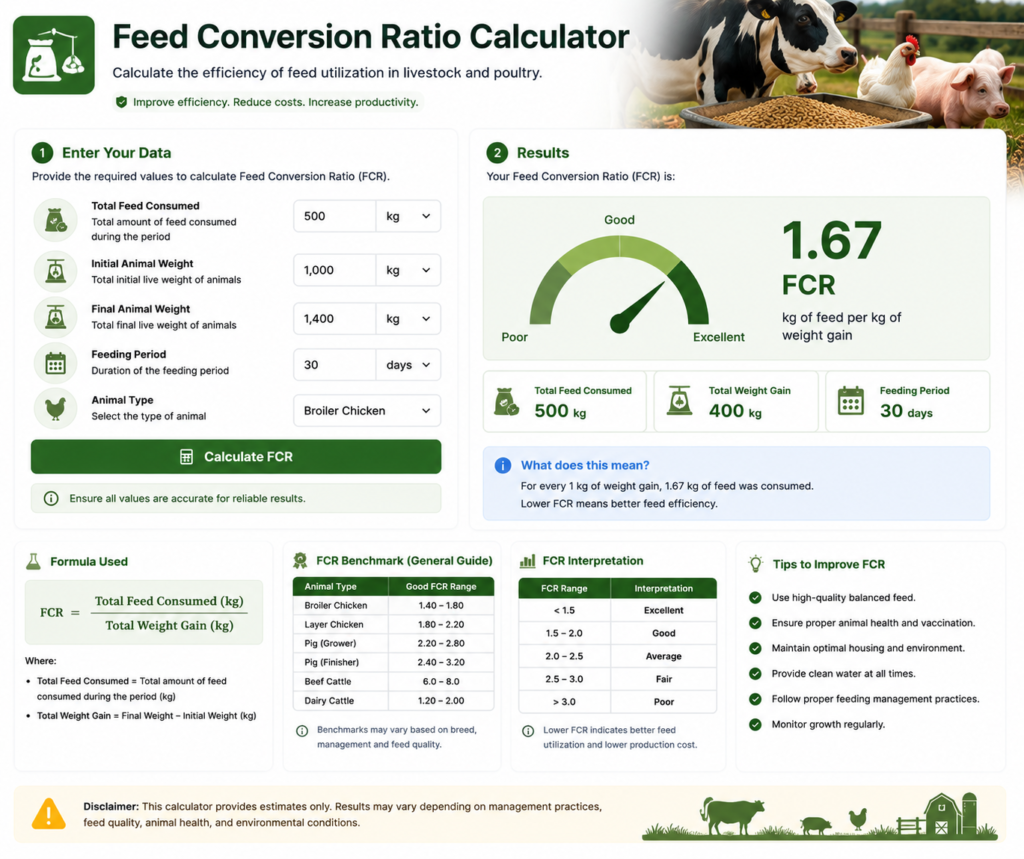
Feed Conversion Ratio Calculator
A Feed Conversion Ratio Calculator helps farmers, livestock producers, and animal nutritionists measure how efficiently animals convert feed into body weight. Feed Conversion Ratio (FCR) is one of the most important performance indicators in animal production because it directly affects feed costs, growth rates, and farm profitability.
Whether raising poultry, cattle, pigs, sheep, goats, rabbits, or fish, calculating FCR helps evaluate feeding programmes and identify opportunities to improve efficiency.
What Is a Feed Conversion Ratio Calculator?
A Feed Conversion Ratio Calculator determines the amount of feed required to produce a unit of body weight gain.
The calculator typically uses:
- Total feed consumed
- Total weight gain
It then calculates the Feed Conversion Ratio, allowing producers to compare animal performance and feeding efficiency.
How Does the Feed Conversion Ratio Calculator Work?
The calculator uses two simple values.
Users generally enter:
- Total feed intake (kg, lb, or tonnes)
- Total weight gain (kg or lb)
The calculator then estimates:
- Feed Conversion Ratio (FCR)
- Feed efficiency
- Cost effectiveness (when feed cost is considered)
Feed Conversion Ratio Formula
The Feed Conversion Ratio is calculated using the following formula:
Feed Conversion Ratio (FCR) = Total Feed Consumed ÷ Total Weight Gain
Example
If livestock consume 600 kg of feed and gain 300 kg of body weight:
FCR = 600 ÷ 300 = 2.0
This means 2 kilograms of feed are required to produce 1 kilogram of weight gain.
Generally, a lower FCR indicates better feed efficiency, as animals require less feed to gain the same amount of weight.
Why Calculate Feed Conversion Ratio?
Monitoring FCR provides valuable information about livestock performance.
It helps:
- Measure feed efficiency
- Reduce feeding costs
- Improve livestock productivity
- Compare different feeding programmes
- Evaluate animal performance
- Increase farm profitability
- Support better management decisions
Factors That Affect Feed Conversion Ratio
Several factors influence FCR.
Animal Species
Different species naturally have different feed conversion efficiencies.
Genetics
Animals with superior genetics often convert feed more efficiently.
Feed Quality
Balanced diets with high-quality ingredients generally improve FCR.
Health Status
Healthy animals grow more efficiently than those affected by disease or parasites.
Environment
Temperature, housing, and stress levels can influence feed utilisation.
Management Practices
Proper feeding schedules, clean water, and good husbandry all contribute to better feed conversion.
Typical Feed Conversion Ratios
Average FCR values vary depending on the animal species and production system.
| Animal | Typical Feed Conversion Ratio |
|---|---|
| Broiler Chickens | 1.4–1.8 |
| Pigs | 2.5–3.5 |
| Beef Cattle | 5–8 |
| Dairy Heifers | 6–9 |
| Rabbits | 3–4 |
| Farmed Fish | 1–2 |
Actual values may vary depending on genetics, nutrition, management, and production goals.
Benefits of Using a Feed Conversion Ratio Calculator
A Feed Conversion Ratio Calculator offers several advantages.
- Calculates FCR quickly
- Supports feed management
- Improves production efficiency
- Helps reduce feed waste
- Assists budgeting and cost control
- Suitable for multiple livestock species
- Supports better decision-making
Tips for Improving Feed Conversion Ratio
To improve feed efficiency:
- Feed a balanced, high-quality diet.
- Provide constant access to clean water.
- Minimise feed waste.
- Maintain a clean housing environment.
- Monitor animal health regularly.
- Reduce stress during handling.
- Use appropriate feeding schedules.
- Track animal growth consistently.
Frequently Asked Questions
What is Feed Conversion Ratio (FCR)?
Feed Conversion Ratio measures how much feed an animal consumes to gain one unit of body weight. It is a key indicator of feed efficiency.
Is a lower Feed Conversion Ratio better?
Yes. A lower FCR generally means animals require less feed to achieve the same weight gain, improving production efficiency.
Which animals can use this calculator?
The calculator can be used for poultry, cattle, pigs, sheep, goats, rabbits, fish, and many other livestock species.
Why is Feed Conversion Ratio important?
FCR helps producers monitor feed efficiency, control production costs, and evaluate the effectiveness of feeding programmes.
Can feed quality affect FCR?
Yes. High-quality, nutritionally balanced feed often improves growth and reduces the amount of feed required for weight gain.
Other Useful Calculators
Explore more biology and agriculture calculators on Omni Calculator Store:
– **Livestock Fence Cost Calculator**
https://omnicalculator.store/home/biology/livestock-fence-cost-calculator/– **Cattle per Acre Calculator**
https://omnicalculator.store/home/biology/cattle-per-acre-calculator/– **Grain Bin Calculator**
https://omnicalculator.store/home/biology/grain-bin-calculator/– **Animal Mortality Rate Calculator**
https://omnicalculator.store/home/biology/animal-mortality-rate-calculator/– **Horse Weight Calculator**
https://omnicalculator.store/home/biology/dog-nutrition-calculator/
https://omnicalculator.store/home/biology/horse-weight-calculator/
Conclusion
A Feed Conversion Ratio Calculator is an essential tool for measuring feed efficiency in livestock production. By comparing feed intake with body weight gain, farmers and producers can evaluate animal performance, reduce feeding costs, and improve overall productivity. Whether managing poultry, cattle, pigs, rabbits, fish, or other livestock, regularly monitoring FCR supports informed decision-making and contributes to more efficient and profitable farming operations.