Annealing Temperature Calculator

Ahmad zee
Table of Contents
Toggle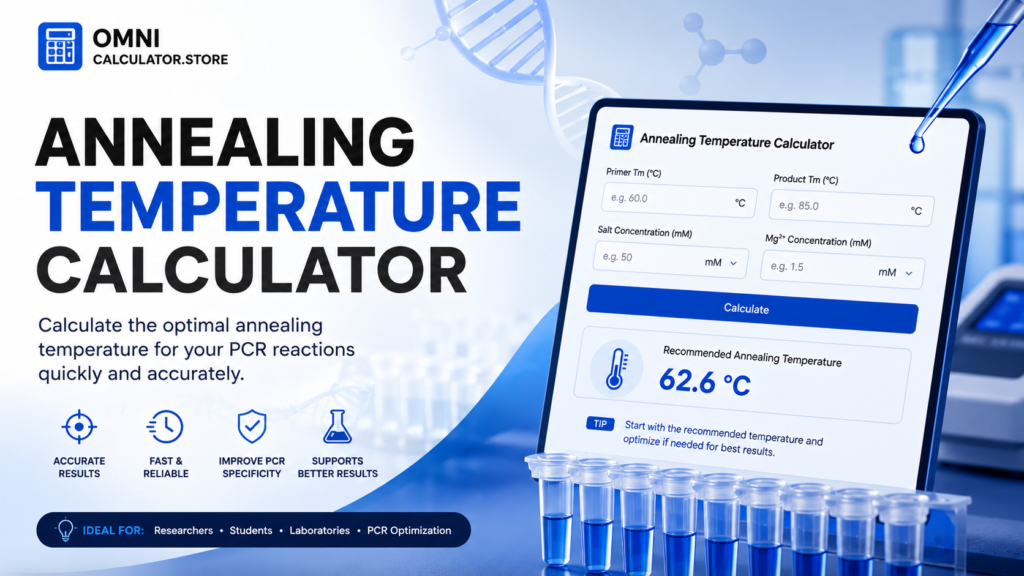
Annealing Temperature Calculator
What Is an Annealing Temperature Calculator?
An Annealing Temperature Calculator is a scientific tool used to estimate the optimal annealing temperature for a Polymerase Chain Reaction (PCR). Selecting the correct annealing temperature is one of the most important steps in a successful PCR experiment because it directly affects primer binding, amplification efficiency, and the accuracy of the final results.
Researchers, students, molecular biologists, and laboratory technicians commonly use this calculator to reduce trial-and-error during PCR optimization. By entering the melting temperatures (Tm) of the primers or using a standard calculation formula, the calculator quickly estimates an appropriate annealing temperature that supports efficient DNA amplification.
Using an annealing temperature calculator helps improve reproducibility while reducing non-specific amplification and unwanted primer-dimer formation.
Why Annealing Temperature Matters in PCR
PCR consists of three primary stages:
Denaturation
Annealing
Extension
During the annealing step, DNA primers attach to complementary sequences on the DNA template. This binding only occurs efficiently within a suitable temperature range.
If the annealing temperature is too low:
Primers may bind to incorrect DNA regions.
Non-specific PCR products can form.
Primer dimers become more common.
If the annealing temperature is too high:
Primers may fail to bind.
PCR yield decreases.
Little or no DNA amplification occurs.
Choosing the correct temperature significantly improves PCR specificity and amplification efficiency.
How an Annealing Temperature Calculator Works
An Annealing Temperature Calculator estimates the recommended PCR annealing temperature based on primer melting temperatures (Tm).
A commonly used approximation is:
Ta = 0.3 × Primer Tm + 0.7 × Product Tm − 14.9
Some laboratories use a simplified rule:
Annealing Temperature ≈ Lowest Primer Tm − 3°C to 5°C
Modern calculators may also consider:
Primer length
GC content
Salt concentration
DNA concentration
PCR buffer composition
Primer sequence characteristics
These additional variables improve prediction accuracy for complex PCR reactions.
Annealing Temperature Formula
One widely accepted equation is:
Ta = 0.3 × Tm (Primer) + 0.7 × Tm (Product) − 14.9
Where:
Ta = Annealing temperature
Tm (Primer) = Primer melting temperature
Tm (Product) = PCR product melting temperature
This equation provides an estimated annealing temperature suitable for many PCR applications.
How to Use an Annealing Temperature Calculator
Using the calculator is straightforward.
Step 1
Enter the forward primer melting temperature.
Step 2
Enter the reverse primer melting temperature if required.
Step 3
Provide the product melting temperature if the calculator requests it.
Step 4
Click the Calculate button.
Step 5
The calculator instantly displays the recommended annealing temperature.
Researchers can then fine-tune the PCR protocol based on laboratory conditions and experimental results.
Example Calculation
Suppose:
Primer Tm = 60°C
Product Tm = 85°C
Using the formula:
Ta = (0.3 × 60) + (0.7 × 85) − 14.9
Ta = 18 + 59.5 − 14.9
Ta = 62.6°C
The recommended annealing temperature is approximately 63°C.
Benefits of Using an Annealing Temperature Calculator
An annealing temperature calculator offers several advantages for PCR optimization.
Saves Time
Instead of manually estimating temperatures, users receive immediate results.
Improves PCR Accuracy
Proper temperature selection reduces amplification errors.
Reduces Non-Specific Products
Correct annealing temperatures minimize unwanted DNA amplification.
Better Primer Binding
Optimal temperatures increase primer specificity.
Useful for Beginners and Professionals
Whether performing educational laboratory work or advanced molecular biology research, the calculator simplifies PCR optimization.
Factors That Affect Annealing Temperature
Several variables influence the recommended annealing temperature.
Primer Length
Longer primers generally have higher melting temperatures.
GC Content
Primers with higher GC content typically require higher annealing temperatures because GC pairs form stronger hydrogen bonds.
Salt Concentration
Buffer salt concentration affects primer stability.
DNA Template
Template complexity may require slight adjustments to the calculated temperature.
Primer Design
Poorly designed primers often lead to inefficient amplification regardless of the calculated annealing temperature.
When Should an Annealing Temperature Calculator Be Used?
The calculator is useful in many molecular biology applications, including:
PCR optimization
Standard PCR
Quantitative PCR (qPCR)
Reverse transcription PCR (RT-PCR)
DNA cloning
DNA sequencing preparation
Mutation analysis
Genetic testing
Research laboratories
Educational laboratories
Common PCR Problems Caused by Incorrect Annealing Temperature
Temperature Too Low
Multiple PCR bands
Smearing
Primer dimers
Non-specific amplification
Temperature Too High
Weak amplification
Low DNA yield
No visible PCR product
Finding the optimal temperature often requires small adjustments around the calculated value.
Tips for Better PCR Results
For improved PCR performance:
Use high-quality primers.
Verify primer melting temperatures.
Keep forward and reverse primer Tm values similar.
Maintain clean laboratory practices.
Optimize magnesium concentration.
Use fresh PCR reagents.
Validate results using gel electrophoresis.
Applications of Annealing Temperature Calculations
Annealing temperature calculations support many scientific fields.
These include:
Molecular biology
Biotechnology
Clinical diagnostics
Forensic science
Agricultural genetics
Medical research
Pharmaceutical development
Academic research
Microbiology
Genomics
Advantages of Online Annealing Temperature Calculators
Online calculators provide several conveniences.
Fast calculations
User-friendly interface
Reduced manual errors
Accessible from any device
Helpful for teaching and research
Consistent calculation methods
Many researchers use online tools as part of routine PCR planning.
Frequently Asked Questions
What is the ideal annealing temperature?
The ideal temperature depends on primer melting temperature, primer sequence, and PCR conditions. Many PCR protocols use an annealing temperature approximately 3–5°C below the lowest primer Tm.
Can the calculated temperature be adjusted?
Yes. Researchers often perform gradient PCR to determine the best experimental temperature.
Why is annealing temperature important?
It controls primer binding specificity, amplification efficiency, and the overall success of PCR.
What happens if the temperature is incorrect?
An incorrect temperature can produce non-specific products, poor amplification, or complete PCR failure.
Is the calculator suitable for beginners?
Yes. Students, educators, laboratory technicians, and experienced researchers can all benefit from using an annealing temperature calculator.
Conclusion
An Annealing Temperature Calculator is an essential tool for optimizing PCR experiments. By estimating an appropriate annealing temperature based on primer melting temperatures and other reaction parameters, it helps improve amplification specificity, increase DNA yield, and reduce experimental errors. Whether used in academic research, biotechnology, clinical diagnostics, or teaching laboratories, this calculator simplifies one of the most critical steps in PCR setup. While calculated values provide an excellent starting point, researchers should always validate the recommended temperature experimentally to achieve the best possible results.
Related Calculators
Researchers working with PCR and molecular biology experiments often use several calculators together. The following tools can help streamline laboratory workflows:
DNA Concentration Calculator – Before setting up a PCR reaction, measuring DNA concentration helps ensure the correct amount of template DNA is used. Learn more with the DNA Concentration Calculator.
Cell Dilution Calculator – Preparing samples at the correct concentration is essential for many laboratory procedures. The Cell Dilution Calculator helps calculate accurate dilution volumes.
Ligation Calculator – After PCR amplification, DNA fragments are often inserted into vectors for cloning. The Ligation Calculator assists in determining the optimal insert-to-vector ratio.
Bacteria Growth Calculator – Following cloning experiments, bacterial cultures are commonly grown for plasmid amplification. The Bacteria Growth Calculator helps estimate bacterial growth and generation time.
Protein Concentration Calculator – Many molecular biology workflows continue with protein analysis. The Protein Concentration Calculator helps determine protein concentrations for downstream applications.