How Big Will My Cat Get Calculator

Ahmad zee
Table of Contents
Toggle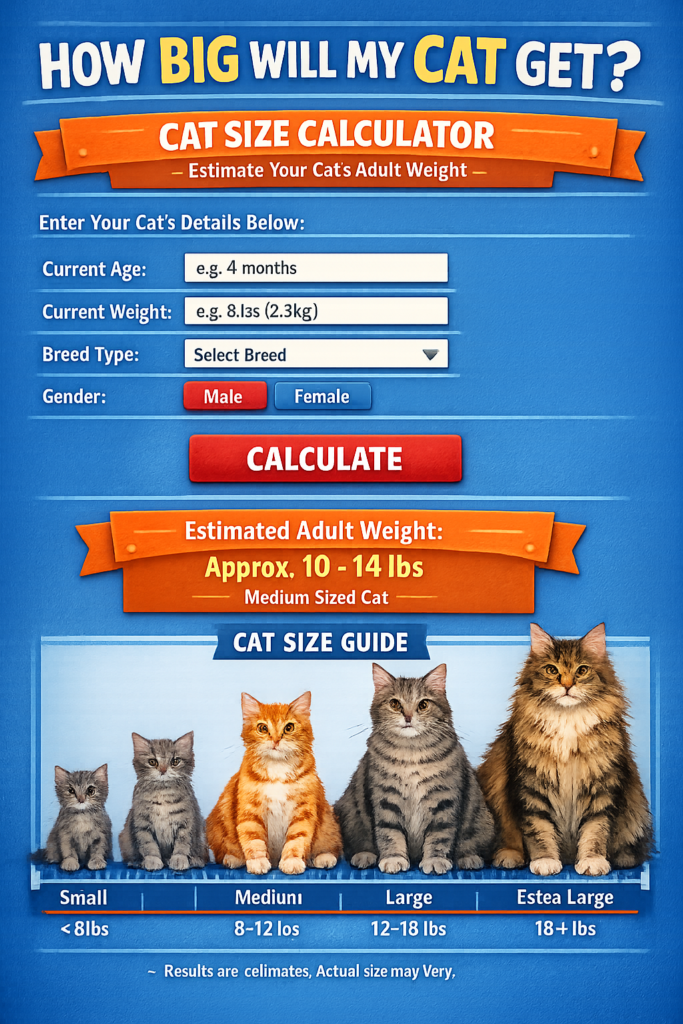
How Big Will My Cat Get Calculator: The Complete Guide to Feline Growth and Adult Size Prediction
Introduction to Cat Size Prediction
Bringing home a tiny, wide-eyed kitten is one of life’s most joyful experiences. Whether someone has just adopted a fluffy eight-week-old from a shelter or welcomed a purebred kitten from a breeder, one of the very first questions that comes to mind is: how big will my cat get? A how big will my cat get calculator answers exactly that question, using the kitten’s current age, current weight, and breed information to generate a reliable prediction of adult size — helping owners plan everything from the right carrier and bed size to appropriate food portions and space requirements.
A how big will my cat get calculator transforms what would otherwise be an anxious guessing game into a data-driven, science-backed prediction. Rather than spending months wondering whether that tiny tabby will stay petite or grow into a substantial cat, owners can use this practical tool to gain realistic expectations from the very early weeks of a kitten’s life. This matters more than many people realize — understanding a cat’s expected adult size directly influences purchasing decisions, living space preparation, veterinary care planning, and long-term nutritional management.
Why Knowing a Cat’s Adult Size Matters
Before exploring how a how big will my cat get calculator works, understanding why adult size prediction is genuinely useful helps owners appreciate the tool’s practical value beyond simple curiosity.
Space and Equipment Planning
Cat equipment — carriers, beds, litter boxes, cat trees, and feeding stations — comes in a range of sizes, and what works for a 3 kg cat may be completely inadequate for a 7 kg Maine Coon. Buying appropriately sized equipment from the beginning saves money and reduces the frustration of having to replace items as a kitten grows faster than expected. A how big will my cat get calculator gives owners the information they need to make smart, size-appropriate purchases right from the start.
Nutritional Management
A cat’s expected adult size directly informs how its caloric needs will evolve as it grows. Larger cats generally have higher maintenance caloric requirements than smaller cats, and understanding where a kitten is headed helps owners plan appropriate feeding programs across the growth phase and into adulthood.
Veterinary Care Preparation
Some health conditions have size-related associations. Very large breeds have increased risks of certain cardiac conditions and joint problems. Very small cats may have different anesthetic considerations during spay or neuter procedures. Knowing a cat’s expected adult size helps veterinarians and owners anticipate breed-specific health concerns and plan preventive care accordingly.
Adoption Decision Making
For prospective cat owners evaluating adoption options, knowing the likely adult size of a kitten — particularly a mixed-breed kitten whose adult size is harder to predict — helps ensure the right match between cat and household. A first-time owner in a small apartment may find a very large cat challenging to manage comfortably, while a family with ample space might specifically seek a large, substantial cat.
How Does a How Big Will My Cat Get Calculator Work?
A how big will my cat get calculator uses a combination of current measurements, age information, and breed characteristics to generate adult size predictions. Understanding the science and methodology behind the tool helps owners interpret its results with appropriate confidence.
The Core Calculation Method
The most widely used method for estimating a domestic cat’s adult weight from kitten measurements relies on a straightforward mathematical relationship observed across many cats: at approximately 16 weeks (four months) of age, most kittens have reached approximately half of their eventual adult weight.
This means that doubling a kitten’s weight at 16 weeks provides a reasonable estimate of adult weight:
Estimated Adult Weight ≈ Weight at 16 Weeks × 2
A how big will my cat get calculator typically refines this basic approach by:
- Adjusting for the kitten’s actual age at the time of measurement (since the 16-week benchmark is most reliable and requires adjustment if the kitten is younger or older)
- Incorporating breed-specific growth curves where available
- Accounting for sex differences in expected adult size
- Applying correction factors for known early growth patterns
Age-Specific Calculation Adjustments
Because the 16-week benchmark doesn’t apply perfectly at every age, a more precise how big will my cat get calculator applies age-specific formulas:
For kittens under 16 weeks: Growth rate in the early weeks is very rapid. A kitten at 8 weeks has typically reached approximately 25 to 30 percent of its adult weight, so multiplying the 8-week weight by approximately 3.5 to 4 provides a rough adult weight estimate. A calculator interpolates more precisely based on the exact week of age.
For kittens at 16 weeks: The 16-week doubling method applies most cleanly at this age, making it the most reliable single measurement point for adult weight prediction.
For kittens between 16 and 52 weeks: As kittens approach their adult size, the mathematical adjustment becomes more conservative. A six-month-old kitten has already reached approximately 75 percent of adult weight, so the multiplier decreases accordingly.
What Information Does the Calculator Need?
A well-designed how big will my cat get calculator typically requests:
- Current age: The kitten’s exact age in weeks or months at the time of measurement
- Current weight: Accurately measured body weight, ideally on a digital kitchen scale for small kittens
- Breed: The breed or suspected breed mix, since different breeds have very different adult size norms
- Sex: Male cats typically grow larger than females of the same breed, making sex an important variable in adult size prediction
- Parent size (if known): For purebred kittens, parental weights provide highly relevant genetic information for size prediction
What Does the Calculator Produce?
The output of a how big will my cat get calculator typically includes:
- Predicted adult weight range: A low-to-high estimate reflecting natural individual variation around the central prediction
- Expected adult length: Some calculators estimate body length as well as weight, particularly for breeds known for their body proportions
- Predicted timeline: An estimate of when the cat will reach its full adult size, which varies significantly between breeds
- Growth milestone chart: A week-by-week or month-by-month expected weight progression from current age to full maturity
Factors That Influence How Big a Cat Gets
Multiple biological and environmental factors determine a cat’s ultimate adult size. Understanding these factors helps owners use a how big will my cat get calculator more effectively and interpret its predictions in context.
Genetics and Breed
Genetics is the single most powerful determinant of a cat’s adult size. Different cat breeds have dramatically different adult size norms — from the delicate Singapura, one of the smallest recognized breeds with adults typically weighing just 2 to 3.5 kg, to the magnificent Maine Coon, where adult males commonly reach 7 to 10 kg or more.
A how big will my cat get calculator that incorporates breed-specific data generates substantially more accurate predictions than one applying a single generic formula across all breeds. For purebred cats, the breed is often known with certainty. For mixed-breed cats — the most common type in many regions — breed estimation may be based on physical appearance, known parentage, or genetic testing.
Sex
Male cats are consistently larger than females across virtually all cat breeds. This sexual dimorphism in body size is less extreme than in many other species but is nonetheless meaningful for adult size prediction. In most breeds, adult male cats weigh approximately 20 to 30 percent more than adult females of the same breed. A how big will my cat get calculator that doesn’t account for sex will produce less accurate predictions than one that uses sex as an input variable.
Parentage
For kittens whose parents are known — particularly purebred kittens from responsible breeders — parental size provides valuable predictive information beyond what breed averages alone can offer. Kittens with unusually large parents for their breed tend to grow larger than the breed average, while kittens from smaller-than-average parents often mature at the smaller end of the breed range.
Nutrition
A kitten’s nutritional status during the growth phase meaningfully influences its ultimate adult size. Kittens raised on adequate, high-quality nutrition grow to their full genetic potential. Kittens that experience nutritional deficiency during the growth phase — whether from poor-quality food, insufficient quantity, or health conditions affecting nutrient absorption — may be permanently smaller than their genetics would otherwise allow.
Conversely, overfeeding kittens doesn’t create larger cats — it creates overweight cats. The growth of skeletal frame and muscle mass is genetically programmed and doesn’t increase in response to caloric excess beyond what appropriate nutrition provides.
Reproductive Status and Timing of Neutering
The timing of spay or neuter surgery influences adult body size in cats. Cats neutered before puberty — before the hormonal surge associated with sexual maturity — continue growing for slightly longer than intact cats, potentially resulting in somewhat larger adult frames and longer limbs. This effect is modest in most cats but can be measurable, particularly in breeds that mature slowly.
Health Status
Kittens dealing with significant illness, parasite burden, or chronic health conditions during their growth phase may not reach their full genetic size potential. Intestinal parasites, in particular, are common in kittens and can significantly compromise nutrient absorption, affecting growth. Regular veterinary care and appropriate deworming support healthy growth toward the cat’s genetic adult size.
Breed-by-Breed Adult Size Guide
One of the most valuable contributions a how big will my cat get calculator makes is incorporating breed-specific growth data. Here is a comprehensive overview of adult size expectations across commonly kept cat breeds:
Extra-Small Breeds (Adult Weight: 2–4 kg)
Singapura: The smallest recognized domestic cat breed, adult Singapuras typically weigh just 2 to 3.5 kg. Their small size is a breed characteristic, not a sign of poor health, and their compact bodies are elegantly proportioned.
Devon Rex: Lightweight and fine-boned, adult Devon Rex cats typically weigh 2.5 to 4 kg. Their large ears and elfin faces make them appear substantial despite their modest weight.
Cornish Rex: Similar in size to the Devon Rex, adult Cornish Rex cats typically weigh 2.5 to 4 kg with a distinctively slim, fine-boned build.
Small to Medium Breeds (Adult Weight: 3–5 kg)
Abyssinian: Athletic and lean, adult Abyssinians typically weigh 3 to 5 kg. Their muscular build makes them feel heavier than they appear.
Siamese: Adult Siamese cats typically weigh 3.5 to 5 kg, with a characteristically long, lean, elegant body type that gives them a larger visual presence than their weight suggests.
Russian Blue: Adults typically weigh 3.5 to 5 kg, with a dense double coat that can make them appear heavier than they actually are.
Burmese: Deceptively dense and muscular, adult Burmese cats are often described as “bricks wrapped in silk” — they typically weigh 3.5 to 5.5 kg but feel much heavier when held.
Medium Breeds (Adult Weight: 4–6 kg)
Domestic Shorthair and Domestic Longhair (mixed breed): The most common cats in the world, mixed-breed cats show enormous size variation, with most adults falling between 3.5 and 6 kg. A how big will my cat get calculator for mixed-breed kittens relies heavily on current weight at a known age rather than breed averages.
American Shorthair: Adults typically weigh 3.5 to 7 kg, with males noticeably larger than females.
British Shorthair: Stocky and round-faced, adult British Shorthairs typically weigh 4 to 8 kg, with males often reaching the higher end of this range.
Scottish Fold: Adults typically weigh 4 to 6 kg, with a compact, rounded build that gives them a substantial appearance.
Bengal: Muscular and athletic, adult Bengals typically weigh 4 to 7 kg. Their athletic build gives them impressive physical presence relative to their weight.
Large Breeds (Adult Weight: 5–8 kg)
Norwegian Forest Cat: One of the larger naturally occurring cat breeds, adult Norwegian Forest Cats typically weigh 5 to 8 kg. They are slow to mature, often not reaching full adult size until three to four years of age.
Siberian: Powerfully built and substantial, adult Siberians typically weigh 5 to 8 kg. Like the Norwegian Forest Cat, Siberians are slow-maturing cats.
Ragdoll: Known for their docile temperament and large size, adult Ragdolls typically weigh 5 to 9 kg, with males often exceeding 7 kg. Ragdolls are famously slow to mature, not reaching full adult size until three to four years of age.
Turkish Van: Large and muscular, adult Turkish Vans typically weigh 5 to 8 kg with a distinctive semi-long coat.
Extra-Large Breeds (Adult Weight: 6–10+ kg)
Maine Coon: The largest domestic cat breed recognized by most registries, adult Maine Coons are substantial animals. Females typically weigh 5 to 8 kg, while males commonly reach 7 to 10 kg — and exceptional individuals may exceed even this range. Maine Coons are very slow to mature, often not reaching their full adult size until three to five years of age, making early weight-based predictions from a how big will my cat get calculator particularly important for this breed.
Savannah: A hybrid breed created from Serval and domestic cat crosses, Savannah cats vary in size depending on their generation (F1 through F5 and beyond). Earlier generation Savannahs can be very large — F1 males may weigh 8 to 12 kg — while later generations approach the size of large domestic breeds.
Chausie: Another hybrid with wild ancestry, adult Chausies typically weigh 6 to 10 kg with a lean, athletic build.
When Do Cats Stop Growing?
Understanding when a cat reaches its full adult size is as important as predicting what that size will be. A how big will my cat get calculator that provides growth timeline information helps owners understand when to expect growth to plateau.
Small and Medium Breeds: 12 to 18 Months
Most small and medium-sized cat breeds reach the majority of their adult body size by approximately 12 months of age, with growth essentially complete by 18 months. During the first year, growth is most rapid in the first six months, then slows significantly in the second half of the first year as the cat approaches its adult dimensions.
After 12 to 18 months, small and medium breeds may continue very modest muscle development and body filling, but their skeletal frame has reached its adult dimensions and major weight changes primarily reflect changes in body condition (fat levels) rather than continued growth.
Large Breeds: 18 to 24 Months
Larger cat breeds — including the British Shorthair, Bengal, American Shorthair, and similar — continue growing for longer than their smaller counterparts, often reaching full adult size between 18 and 24 months of age. This extended growth period means that weight-based adult size predictions from a how big will my cat get calculator at an early age carry somewhat more uncertainty for these breeds.
Slow-Maturing Giant Breeds: 3 to 5 Years
The Maine Coon, Norwegian Forest Cat, Ragdoll, and Siberian are notable for exceptionally extended growth periods. These breeds continue developing muscle mass, bone density, and body fullness well beyond the age at which smaller breeds have reached full maturity. A Maine Coon male may still be visibly growing at two years of age and may not reach his full, magnificent adult size until three to five years old.
For owners of these slow-maturing breeds, patience is essential. A how big will my cat get calculator for Maine Coons and similar breeds uses breed-specific growth curves that account for this extended timeline, generating predictions that reflect the full maturation process rather than plateauing at 12 months like predictions for faster-maturing breeds.
The Difference Between a Big Cat and an Overweight Cat
One of the most important distinctions that a how big will my cat get calculator helps owners understand is the difference between a genuinely large cat and an overweight cat of normal size. This distinction matters enormously for health management.
Body Frame vs. Body Fat
A truly large cat — a Maine Coon male at 8 kg in ideal body condition, for example — has a large skeletal frame, substantial muscle mass, and appropriate fat coverage. When examined, ribs are easily felt, the waist is visible from above, and the abdomen shows a gentle upward tuck when viewed from the side. This is a big, healthy cat.
An overweight cat of a smaller breed at 8 kg presents entirely differently. The skeleton underneath may be that of a cat that should weigh 4 to 5 kg, with excess body fat making up the additional weight. Ribs are difficult to feel, the waist is absent when viewed from above, and the abdomen may hang downward with fat deposits.
A how big will my cat get calculator helps owners calibrate realistic size expectations for their specific cat’s breed, making it much easier to distinguish healthy large size from unhealthy obesity. An owner who knows their medium-breed cat should top out at around 5 kg is much more likely to recognize a problem at 7 kg than an owner who simply assumes “he’s a big cat.”
Body Condition Scoring Alongside Size Prediction
Using a body condition score assessment alongside the how big will my cat get calculator provides a complete picture of a cat’s physical status. A BCS assessment evaluates the amount of body fat relative to the frame, independent of absolute body weight. A cat at 90 percent of its predicted adult weight but with a BCS of 8 out of 9 needs dietary management, while a cat at 110 percent of predicted adult weight but with a BCS of 5 out of 9 may simply be tracking toward the larger end of its breed’s normal range.
Mixed-Breed Cat Size Prediction
Mixed-breed cats — the most common cats in most parts of the world — present the greatest challenge for a how big will my cat get calculator because breed is often unknown or uncertain. Without knowing what breeds contribute to a mixed-breed cat’s genetic makeup, breed-specific growth curves cannot be applied with confidence.
Relying on Current Weight as the Primary Predictor
For mixed-breed kittens, a how big will my cat get calculator relies primarily on current weight at a known age, using the age-adjusted doubling formula as its primary tool. This approach is less precise than breed-specific prediction but still provides a useful estimate for the majority of mixed-breed cats, which typically fall within the medium-size range of 3.5 to 6 kg.
Physical Characteristics as Clues
A cat’s physical build during kittenhood provides additional clues about eventual adult size that supplement calculator predictions:
Paw size: Large paws relative to body size in a young kitten often indicate a large adult — the “puppy paws” phenomenon exists in cats as well as dogs.
Bone structure: A kitten with visibly heavy, dense bone structure is likely growing toward a larger adult frame than a delicate, fine-boned kitten of similar weight and age.
Head size: A kitten with a large, blocky head relative to its body often grows into a substantial adult cat.
Growth rate: Kittens that are consistently at the top of the normal weight range for their age throughout the first several months are more likely to become large adults than those tracking at the middle or lower range.
Genetic Testing for Mixed-Breed Cats
Cat DNA testing services have become increasingly available and affordable, offering the ability to identify breed contributions in mixed-breed cats. While breed identification alone doesn’t guarantee adult size prediction accuracy — breed mixes create their own unique size outcomes — knowing whether a kitten has large-breed ancestry like Maine Coon or Siberian in its background provides valuable context for adult size expectations.
Month-by-Month Kitten Growth Overview
Understanding normal kitten growth progression helps owners track whether their kitten is developing typically and provides context for the predictions generated by a how big will my cat get calculator.
Birth to 2 Weeks: The Neonatal Period
Healthy kittens gain approximately 10 to 15 grams per day during the first two weeks of life. Birth weight for domestic cat kittens typically ranges from 80 to 120 grams, with litter size influencing individual birth weight (larger litters often produce smaller individual kittens). By two weeks of age, most kittens have doubled their birth weight.
2 to 8 Weeks: Rapid Early Growth
The period from two to eight weeks is characterized by dramatic, rapid growth. Kittens typically gain approximately 100 grams per week during this phase, with their body weight increasing from approximately 200 grams at two weeks to approximately 800 grams to 1 kg by eight weeks. Eyes open, motor skills develop, and weaning begins during this period.
8 to 16 Weeks: The Exponential Phase
From eight to sixteen weeks, kittens continue rapid growth, typically gaining 50 to 100 grams per week. By sixteen weeks — the critical benchmark for how big will my cat get calculator predictions — most kittens have reached approximately half their adult weight. This is also the age when most kittens go to their new homes, making it the most common starting point for calculator-based adult size prediction.
4 to 6 Months: Adolescent Growth
Growth continues at a meaningful but slightly reduced rate during this phase. Kittens begin looking more like scaled-down adults than like babies, though their proportions may still appear slightly exaggerated — large ears, lanky limbs — compared to the more balanced proportions they will display as adults.
6 to 12 Months: Approaching Adult Size
For most small and medium breeds, the six-to-twelve-month period sees growth rate slowing significantly as cats approach their adult dimensions. Weight gain during this phase consists increasingly of muscle development and body filling rather than skeletal growth.
12 Months and Beyond: Breed-Dependent Maturation
As described earlier, the timeline beyond twelve months depends heavily on breed. Most small and medium breeds are essentially at adult size by twelve to eighteen months, while large and giant breeds continue developing for years beyond this point.
Connecting Size Prediction to Overall Cat Health Management
A how big will my cat get calculator works best as part of a comprehensive approach to understanding and managing a cat’s health across its lifetime. Adult size prediction connects naturally to several other aspects of feline health management.
Understanding how a cat’s expected adult size influences its caloric needs at different life stages helps owners plan appropriate nutrition from kittenhood through adulthood. The Cat Calorie Calculator translates adult size information into specific daily caloric targets based on weight, age, and activity level — providing the nutritional framework that supports healthy growth toward the predicted adult size.
Tracking how a cat’s weight compares to its expected adult size over time is made more meaningful when combined with body composition assessment. The Cat BMI Calculator helps owners evaluate whether their growing cat’s weight reflects appropriate muscle and frame development or excess body fat — a distinction that becomes increasingly important as kittens transition from their growth phase into young adulthood.
For cat owners who also want to understand how their cat’s biological age relates to human age equivalents at different points in its growth and maturity, the Cat Age Calculator provides a life stage framework that contextualizes the growth trajectory from kitten through senior life stages — helping owners understand what developmental phase their cat is actually in relative to the human life stage equivalent.
Monitoring a growing cat’s overall quality of life and wellbeing alongside its physical growth provides a complete picture of health. The Cat Quality of Life Calculator offers a structured framework for evaluating whether a cat is thriving across multiple dimensions — physical health, behavior, comfort, and happiness — at any stage of its development.
For female kittens that reach sexual maturity before being spayed, understanding the pregnancy and reproductive implications requires early planning. The Cat Pregnancy Calculator provides complete gestation management guidance should pregnancy occur, including nutritional guidance that connects directly to the dam’s body size and caloric needs.
Practical Tips for Accurate Adult Size Prediction
Getting the most accurate possible results from a how big will my cat get calculator requires attention to measurement accuracy and appropriate use of the prediction window.
Weigh Kittens Accurately
The quality of adult size predictions is directly dependent on the accuracy of the weight measurement entered into the calculator. For young kittens, a digital kitchen scale that measures in increments of one gram provides far more useful precision than a bathroom scale. Place the kitten in a small bowl or container on the scale for more stable readings.
Measure at Known Ages
The age-adjusted growth formulas used in a how big will my cat get calculator depend on knowing the kitten’s actual age with reasonable precision. For kittens with known birthdays — either because they were born in the home or because the shelter or breeder provided accurate information — this is straightforward. For kittens of unknown age, a veterinarian can estimate age from physical examination and dental development.
Use Multiple Measurement Points
Rather than relying on a single measurement, tracking weight at multiple ages and entering each into the calculator produces a pattern of predictions that can confirm or refine earlier estimates. If calculator predictions based on weights at 8 weeks, 12 weeks, and 16 weeks all converge on a similar adult weight estimate, that convergence increases confidence in the prediction.
Account for Breed Uncertainty
For mixed-breed kittens of uncertain ancestry, treat the calculator’s output as a range rather than a precise estimate. The adult weight window generated for mixed-breed cats is inherently broader than for purebreds with known genetics, and owners should mentally add additional uncertainty to either end of the predicted range.
Common Questions About Cat Size Prediction
My Kitten Is Smaller Than Average for Its Age — Will It Always Be Small?
Not necessarily. Kittens that start small sometimes catch up to typical adult sizes, particularly if their early small size reflected temporary nutritional or health challenges rather than permanent genetic factors. A how big will my cat get calculator uses current weight at current age as a predictor, which naturally generates smaller adult estimates for lighter kittens. Reassessing after addressing any health or nutritional issues may produce updated predictions that reflect the kitten’s improving trajectory.
My Kitten’s Paws Look Enormous — Does That Mean It’ll Be a Big Cat?
Large paws in young kittens are often a meaningful indicator of large adult size, particularly in mixed-breed cats of uncertain ancestry. Paw size reflects bone structure development, which correlates with overall frame size. However, paw size alone isn’t a reliable single predictor — it works best as a qualitative clue that supplements a how big will my cat get calculator’s quantitative prediction.
My Maine Coon Kitten Seems Small at One Year — Should I Be Concerned?
Maine Coons are the classic example of a slow-maturing large breed. A Maine Coon at one year of age is still very much a growing cat — potentially only 60 to 70 percent of his eventual adult weight — and comparing him to adult size norms for faster-maturing breeds can create unnecessary alarm. A how big will my cat get calculator with Maine Coon-specific growth curves will reflect this extended timeline and generate a more appropriate, realistic adult size prediction for this exceptional breed.
How Accurate Is the Calculator for Very Young Kittens?
Predictions based on very young kitten measurements — under six weeks of age — carry more uncertainty than those based on measurements at 16 weeks, which is the most reliable benchmark age. Very early predictions should be treated as rough directional estimates rather than precise forecasts, with the recommendation to rerun the calculator at 16 weeks for the most reliable adult size prediction.
Conclusion: Planning With Confidence From the Very First Weeks
A how big will my cat get calculator turns one of the most common questions in cat ownership into a clear, science-backed answer that cat owners can act on from the very earliest weeks of a kitten’s life. By combining current weight measurements with age-specific growth formulas and breed-appropriate development curves, this practical tool generates realistic adult size predictions that help owners make better decisions about equipment, nutrition, space, and health management from day one.
Understanding that a delicate Siamese kitten will likely stay in the 3.5 to 5 kg range as an adult means buying a carrier that fits that size from the beginning. Knowing that the fluffy kitten with enormous paws is a mixed-breed likely to reach 6 to 7 kg as an adult means planning for a larger litter box, a sturdier cat tree, and higher daily caloric needs than a smaller cat would require. Recognizing that a Maine Coon will still be growing at three years old means adjusting nutritional and physical development expectations far beyond the one-year mark.
These are the practical, real-world benefits that a how big will my cat get calculator delivers — not just satisfying a curious owner’s natural question, but providing genuinely useful information that shapes better care decisions across the entire arc of a cat’s life. Combined with regular veterinary check-ups, appropriate nutrition guided by tools like a cat calorie calculator, and attentive monitoring of body condition as the cat grows, a how big will my cat get calculator gives every cat owner a confident, well-informed foundation for a lifetime of loving, knowledgeable feline care.