Horse Gestation Calculator

Ahmad zee
Table of Contents
Toggle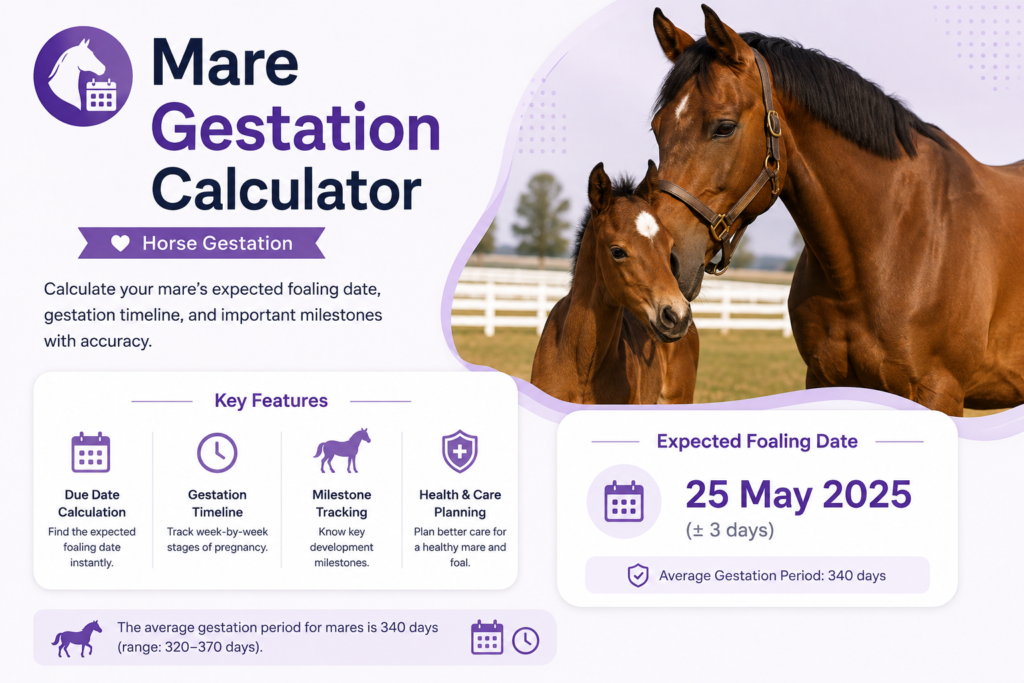
Horse Gestation Calculator: The Complete Guide to Mare Pregnancy and Foaling
Introduction to Horse Gestation
Few moments in equine management carry as much anticipation and joy as the arrival of a new foal. Whether someone is a seasoned horse breeder with decades of experience or a first-time mare owner navigating pregnancy for the very first time, having a reliable horse gestation calculator in their corner makes the entire journey far more manageable. This essential tool converts the breeding date into a predicted foaling date, creates a clear milestone timeline, and gives horse owners the preparation window they need to ensure both mare and foal receive excellent care from conception through birth and beyond.
A horse gestation calculator takes the complexity out of equine reproductive planning. Rather than relying on rough estimates or manually counting calendar days, horse owners and breeders can use this tool to generate precise foaling predictions, schedule veterinary appointments at exactly the right times, and plan nutritional programs that support healthy fetal development across every stage of the lengthy equine pregnancy.
Understanding Equine Gestation: The Fundamentals
Before exploring how a horse gestation calculator works in practice, building a strong foundation in equine reproductive biology helps horse owners use the tool effectively and interpret its results with genuine confidence.
How Long Is a Mare’s Gestation Period?
The equine gestation period is one of the longest among domestic animals, averaging approximately 340 days — just over eleven months. However, normal horse gestation spans a surprisingly wide range, with healthy foals born anywhere from 320 to 370 days after conception. This broad natural variation makes a horse gestation calculator even more valuable, since it sets clear expectation windows rather than promising a single fixed date.
Several biological factors influence exactly how long an individual mare carries her foal:
- Breed: Different horse breeds show characteristic gestation length tendencies that vary meaningfully from the average
- Sex of the foal: Colt foals (males) tend to be carried approximately two to seven days longer than filly foals (females) on average
- Season of conception: Mares bred early in the breeding season — when day length is still increasing — tend to carry foals slightly longer than mares bred later in the season
- Mare’s age and reproductive history: Older mares and maiden mares (those foaling for the first time) sometimes show slightly different gestation patterns than experienced middle-aged mares
- Nutritional status: Chronic nutritional deficiency can occasionally influence gestation length
- Genetics: Individual mares often show consistent personal gestation length patterns across multiple pregnancies, making their own history the best predictor for future pregnancies
Breed-Specific Gestation Variations
Just as breed influences gestation length in cattle and other livestock species, horse breeds show characteristic tendencies that a breed-aware horse gestation calculator can reflect:
Thoroughbreds average approximately 337 to 342 days of gestation, clustering tightly around the overall equine average. The racing industry’s meticulous record-keeping has produced extensive gestation data for this breed.
Warmbloods and sport horse breeds tend to average slightly longer gestations, often falling in the 340 to 345 day range, though individual variation remains substantial within these groups.
Draft breeds including Percherons, Clydesdales, and Belgian Drafts sometimes carry foals slightly longer than lighter breeds, with averages occasionally reaching 345 to 350 days.
Pony breeds often have shorter average gestation lengths than full-sized horse breeds, with many ponies foaling between 320 and 335 days after conception.
Miniature horses show some of the most variable gestation lengths in the equine world, with normal foaling occurring across a wide range that makes precise prediction more challenging.
Understanding these breed tendencies helps horse owners calibrate their expectations when using a horse gestation calculator and avoid unnecessary concern when a mare’s gestation falls slightly outside the generic average.
How a Horse Gestation Calculator Works
A horse gestation calculator transforms a single input — the breeding or conception date — into a comprehensive foaling prediction and pregnancy management timeline. Understanding the mechanics behind the tool helps users apply it correctly and trust what it tells them.
What Information Does the Calculator Need?
Most horse gestation calculators require just the breeding date — the specific day when natural covering or artificial insemination occurred. When a mare was covered multiple times during a single estrus cycle, using the last breeding date often provides the most conservative (latest) foaling estimate, which is generally the safest approach for preparation planning.
Some more sophisticated horse gestation calculator tools also accept:
- Breed selection: Allows breed-specific gestation adjustments rather than relying on the generic 340-day average
- Prior pregnancy history: Some calculators allow input of the mare’s personal gestation history to generate a more individualized prediction
- Conception confirmation date: When pregnancy is confirmed by ultrasound at a known gestational age, this information can substitute for an uncertain breeding date
What Output Does the Calculator Generate?
Once breeding date information is entered, a well-designed horse gestation calculator produces a detailed, practical output that typically includes:
- Predicted foaling date: The central estimate calculated by adding the standard gestation period to the breeding date
- Foaling window: A date range reflecting the normal variation in equine gestation, typically spanning from approximately day 320 to day 360 from breeding for a full-sized horse
- Key pregnancy milestones: Dates when specific management actions — veterinary examinations, nutritional changes, vaccination boosters, and foaling preparation steps — become appropriate
- Days remaining counter: A real-time countdown to the predicted foaling date that updates as the pregnancy progresses
Accuracy of Horse Gestation Calculator Predictions
A horse gestation calculator produces reliable estimates rather than certainties, and experienced horse owners understand and respect this distinction. The accuracy of the predicted foaling date depends primarily on the precision of the breeding date entered. Mares bred through carefully managed artificial insemination programs — where each insemination is precisely recorded — yield the most accurate calculator predictions.
In natural service situations where a stallion runs with a group of mares, or when the exact covering date is uncertain, a veterinarian can estimate gestational age through rectal examination or transrectal ultrasound, providing a close approximation that can feed usefully into the horse gestation calculator even without a precise breeding date.
The Equine Estrous Cycle and Breeding Season
Understanding the mare’s reproductive cycle gives horse owners the biological context needed to breed mares successfully and enter accurate data into the horse gestation calculator.
Seasonal Reproductive Patterns in Mares
Unlike cattle, which cycle year-round, mares are seasonally polyestrous — they cycle and are fertile primarily during the long-day months of spring, summer, and early autumn. This seasonal pattern is driven by photoperiod: increasing day length stimulates reproductive activity, while decreasing day length in late autumn and winter suppresses it.
The natural breeding season for horses in the Northern Hemisphere runs approximately from April through September, with peak fertility occurring from May through July. During this period, mares cycle regularly every 21 to 22 days on average, with each estrus (heat) period lasting approximately five to seven days.
The Transitional Period
In early spring and late autumn, mares pass through transitional periods characterized by irregular, prolonged estrus cycles and erratic ovulation patterns. Mares in the spring transitional period may show behavioral signs of estrus for extended periods — sometimes weeks — without actually ovulating, making it difficult to determine the correct breeding date for entering into a horse gestation calculator.
Monitoring follicular development through transrectal ultrasound during the transitional period helps breeders identify the first true ovulatory cycle of the season and time breeding precisely. Hormonal treatments including progesterone supplementation, artificial lighting programs, and prostaglandin or human chorionic gonadotropin (hCG) injections can help manage transitional mares and advance the onset of true cyclicity.
Artificial Lighting Programs
Thoroughbred and other performance horse breeders often implement artificial lighting programs to advance mares’ breeding seasons, since many breed registries use a universal January 1st birthday for all foals born in a given calendar year regardless of actual birth date. Foals born earlier in the year tend to be more physically mature when they compete as young horses, creating a competitive advantage.
Artificial lighting programs expose mares to extended day length beginning approximately December 1st using a light source of at least 200 lux for a minimum of 16 hours per day. This simulates long-day conditions and typically advances the onset of the first ovulatory cycle by 60 to 90 days compared to mares under natural lighting. When combined with a horse gestation calculator, this allows breeders to predict with reasonable confidence that mares bred in February will produce foals in late December or early January of the following year.
Month-by-Month Horse Gestation Timeline
A horse gestation calculator becomes most valuable when owners understand what is happening biologically month by month. This knowledge guides nutritional management, veterinary care timing, and foaling preparation across the entire eleven-month journey.
Month One (Days 1–30): Fertilization and Early Embryo Development
Following successful breeding and ovulation, fertilization occurs in the oviduct within hours. The resulting embryo — initially called a zygote — undergoes rapid cell division while traveling through the oviduct toward the uterus. By approximately day six after ovulation, the embryo enters the uterus as a morula or early blastocyst.
A unique feature of equine early pregnancy is the remarkable mobility of the early equine embryo. Unlike embryos of most other species, which implant quickly and remain fixed in place, the equine embryo migrates actively throughout the entire uterus for approximately 15 to 17 days before fixing in one location. This migration appears to be essential for maternal recognition of pregnancy — the biological signal that prevents the mare’s body from returning to estrus and destroying the developing embryo.
Pregnancy can be confirmed by transrectal ultrasound as early as day 14 to 16 after ovulation, when the embryonic vesicle (the fluid-filled sphere containing the embryo) becomes clearly visible. Early pregnancy examination at this stage identifies twin embryos — a significant concern in mares — at a time when one can be manually crushed with minimal risk.
Month Two (Days 31–60): Heartbeat and Organ Formation
By day 21 to 25, a beating embryonic heartbeat becomes visible on ultrasound examination, providing confirmation that the embryo is alive and developing normally. The embryo proper (distinct from the surrounding membranes and fluids) becomes visible within the vesicle around this time.
During the second month, all major organ systems begin forming during the embryonic period. The limbs, cardiovascular system, nervous system, digestive tract, and sensory organs all begin their development during this critical period. The embryo transitions to the fetal stage at approximately day 40 of gestation.
Around days 35 to 45, the endometrial cups — unique to equine pregnancy — develop and begin producing equine chorionic gonadotropin (eCG), formerly known as PMSG (pregnant mare serum gonadotropin). These temporary structures, visible as raised nodules within the uterine wall, produce eCG until approximately day 120 to 150 of gestation. eCG serves as the basis for several commercial blood pregnancy tests used in mares.
Month Three (Days 61–90): Rapid Growth and Placentation
The fetal period brings accelerating growth and the maturation of organ systems. By day 90, the foal fetus weighs approximately 300 grams and is clearly recognizable as equine in form, with all limbs, the head, and external features visible on ultrasound examination.
Placentation — the formation of the intimate connection between fetal membranes and the uterine wall — progresses throughout the third month and beyond. The equine placenta is diffuse and microcotyledonary, meaning it makes contact with the uterine wall across its entire surface rather than through discrete attachment points as in ruminants. This extensive surface area supports the enormous nutritional demands of a rapidly developing foal fetus.
Months Four Through Seven (Days 91–210): Mid-Gestation Steady Growth
Mid-gestation in the mare is characterized by steady, progressive fetal growth with relatively stable maternal nutritional requirements compared to late pregnancy. The fetus grows from approximately 300 grams at day 90 to several kilograms by day 210, and organ system maturation continues throughout this period.
Fetal sex determination by transrectal ultrasound is possible during mid-gestation, typically between days 60 and 70 of pregnancy when the genital tubercle can be identified in its characteristic position relative to either the umbilical cord (colts) or the tail (fillies). Many breeders take advantage of this early sex determination opportunity during routine mid-gestation examination.
Months Eight Through Eleven (Days 211–340+): Late Gestation and Final Preparation
The final quarter of equine pregnancy brings the most dramatic fetal growth of the entire gestation period. Approximately 60 to 65 percent of the foal’s birth weight is gained during the final three months of pregnancy, placing substantial and increasing nutritional demands on the mare. A foal born at an average birth weight of 45 to 55 kilograms (for a full-sized horse) accumulates most of that weight during the final 90 days of gestation.
The mare’s abdomen expands dramatically during this period as the growing foal occupies increasing space within the abdominal and pelvic cavities. Fetal movement becomes visible from the outside during the final months, with rippling movements across the mare’s flank often visible to attentive observers.
Nutritional Management During Equine Gestation
Proper nutrition throughout the mare’s pregnancy directly influences foal health at birth, mare health during and after foaling, and the quality of the mare’s milk during the nursing period that follows.
Early to Mid-Gestation Nutrition
During the first seven to eight months of pregnancy, a healthy mare in good body condition has nutritional requirements only modestly above her maintenance needs. Mares entering the breeding season in good body condition — a score of 5 to 6 on the standard 9-point Henneke scale — can typically meet their nutritional needs through good-quality hay and pasture during the first two-thirds of pregnancy without grain supplementation.
The most important nutritional goal during early to mid-gestation is maintaining appropriate body condition. Mares that lose significant body condition during early pregnancy have higher rates of early embryonic loss and reduced reproductive performance in subsequent seasons.
Late Gestation Nutrition: Months Nine Through Eleven
The final three months of equine pregnancy demand significant increases in nutritional intake to support rapid fetal growth, placental development, and colostrum accumulation in the udder. During this critical period, the mare’s requirements for digestible energy, crude protein, calcium, phosphorus, and several trace minerals increase substantially above maintenance levels.
A practical late gestation feeding program for mares typically involves:
Energy supplementation: Adding grain or a concentrated feed specifically formulated for broodmares to complement forage intake. The exact amount depends on the mare’s body condition, the quality of available forage, and the size of the expected foal.
Protein quality and quantity: Late gestation mares need not just adequate protein quantity but good protein quality — specifically, feeds providing sufficient lysine, the most limiting essential amino acid for equine development.
Mineral balance: Calcium and phosphorus supplementation becomes particularly important in late gestation as the rapidly mineralizing fetal skeleton draws heavily on maternal reserves. Trace mineral supplementation including copper, zinc, manganese, and selenium supports both fetal development and maternal immune function.
Vitamin E and selenium: These nutrients play critical roles in muscle development and immune function in the developing foal. Deficiency in selenium and vitamin E contributes to white muscle disease in newborn foals, a potentially life-threatening condition that is entirely preventable with appropriate maternal supplementation.
Avoiding Overconditioning
While adequate nutrition in late gestation is critical, overconditioning mares — allowing them to become excessively fat — creates its own problems. Overly fat mares have higher rates of dystocia, metabolic complications, and reduced milk production compared to mares in optimal body condition. The target body condition score at foaling is 5.5 to 6.5 on the 9-point scale — well-nourished but not obese.
Signs of Approaching Foaling
As the predicted foaling date from the horse gestation calculator approaches, recognizing the physical signs that indicate parturition is near allows owners and farm staff to intensify monitoring appropriately.
Signs Appearing Two to Four Weeks Before Foaling
Udder development: The mare’s mammary glands begin filling with colostrum and enlarging progressively during the final three to four weeks before foaling. This process, called “bagging up,” accelerates noticeably as the foaling date approaches. The rate and extent of udder development varies considerably between individual mares — maiden mares sometimes show very little udder development until close to foaling, while experienced mares often develop full udders a week or more before delivery.
Relaxation of the pelvic ligaments: The ligaments on either side of the tailhead relax and soften as foaling approaches, causing the muscular areas alongside the tail to become visibly sunken or hollowed. This change, sometimes called “waxing up” in common parlance though distinct from actual waxing, typically appears one to three weeks before foaling in most mares.
Vulvar elongation and relaxation: The vulva becomes progressively softer, longer, and more relaxed as the cervix begins softening and dilating in preparation for foaling.
Signs Appearing Within 24 to 48 Hours of Foaling
Waxing: Perhaps the most widely recognized pre-foaling sign, waxing refers to the accumulation of dried colostrum on the teat ends, forming waxy plugs or droplets that resemble candle wax. Waxing typically appears 12 to 48 hours before foaling, though some mares wax days before foaling while others never wax at all before the foal arrives.
Milk streaming: When colostrum begins actively dripping or streaming from the teats rather than just forming wax plugs, foaling is typically imminent — often within hours. Mares that stream significant milk before foaling may deliver foals with reduced passive immunity because substantial colostrum is lost before nursing can occur.
Behavioral changes: Most mares become noticeably restless and uncomfortable as active labor approaches. They may repeatedly get up and lie down, sweat along the neck and flanks, look at their flanks, and show signs of colic-like discomfort. Appetite typically decreases in the hours before foaling.
Temperature drop: Some mares show a slight drop in body temperature — from the normal range of 37.5 to 38.5°C (99.5 to 101.5°F) to below 37.2°C (99°F) — in the 12 to 24 hours before foaling, though this sign is less consistent in mares than the temperature drop seen in cattle.
Perineal softening: The muscles and tissues surrounding the vulva and beneath the tail become visibly soft and slack in the hours before active labor begins.
The Three Stages of Equine Labor
Understanding normal equine labor helps horse owners distinguish the progression of normal delivery from situations that require urgent veterinary assistance.
Stage One: Preparatory Labor
Stage one labor involves progressive uterine contractions, cervical dilation, and repositioning of the foal within the uterus. The mare appears increasingly uncomfortable and restless during this stage, frequently getting up and lying down, sweating, and showing signs of abdominal discomfort. She may urinate frequently in small amounts.
Stage one typically lasts one to four hours, though the duration varies considerably. Many mares in stage one labor appear to delay active delivery if they feel observed or disturbed — a behavior that reflects the evolutionary advantage of foaling under cover of darkness and away from potential predators. Providing a quiet, undisturbed environment during stage one encourages normal labor progression.
Stage Two: Active Delivery
Stage two begins when the chorioallantois (the outer fetal membrane) ruptures and releases the allantoic fluid — the “water breaking” — and concludes with delivery of the foal. The mare typically lies down for stage two delivery, though some mares deliver standing.
Stage two is the most time-critical phase of equine delivery. Active pushing, visible strong abdominal contractions, should result in delivery of the foal within 20 to 30 minutes. A critical rule in equine obstetrics states that if a mare has been in active pushing for more than 20 to 30 minutes without significant progress, veterinary assistance is urgently needed.
In a normal presentation, the foal’s front feet appear first, followed by the nose resting on the front cannon bones, then the head, shoulders, and finally the hindquarters. Any deviation from this presentation — including hind feet first, a head without feet, or feet without a head — signals malpresentation requiring immediate veterinary attention.
Stage Three: Placental Passage
Stage three involves expulsion of the fetal membranes (placenta and associated membranes), which normally occurs within one to three hours of foal delivery. Unlike cattle, where retained placentas are relatively common and managed conservatively for up to 24 hours, horses are much more sensitive to retained membranes. A placenta retained for more than three hours in a mare requires veterinary attention, as retained membranes predispose mares to severe laminitis and potentially life-threatening endotoxemia within hours.
Foal Care in the First Hours
The hours immediately following delivery represent the most critical period for establishing foal health and survival. Horse owners should know what normal foal behavior looks like and when to be concerned.
The First 30 Minutes
A normal, healthy foal should attempt to raise its head within minutes of birth, achieve sternal recumbency (chest on the ground, head up) within five minutes, attempt to stand within 30 minutes, and succeed in standing within one hour of birth. The mare should be allowed to lick and bond with her foal immediately after delivery — this bonding process is important for both mare-foal attachment and stimulating the foal’s circulatory and respiratory function.
Colostrum Intake: The Critical Window
Foals must receive adequate colostrum — the antibody-rich first milk — within the first six to eight hours of life to achieve adequate passive transfer of maternal immunity. A healthy foal should nurse within two hours of birth and consume colostrum multiple times during the first few hours.
Unlike ruminant neonates, equine foals can only absorb intact immunoglobulins from colostrum during a brief window — approximately the first 18 to 24 hours of life. After this window closes, colostrum’s protective proteins can no longer cross the gut wall into the bloodstream. Testing passive transfer adequacy through a blood IgG test at 18 to 24 hours of age confirms whether the foal received sufficient colostrum absorption.
The Foal Heat and Rebreeding
Approximately seven to nine days after foaling, most mares experience a foal heat — the first postpartum estrus. Breeding on the foal heat is practiced by many Thoroughbred breeders to maintain tight breeding schedules, though pregnancy rates from foal heat breeding are generally lower than from subsequent cycles, and mares whose uterine involution is incomplete should not be bred on the foal heat.
Using the Horse Gestation Calculator With Other Equine Management Tools
A horse gestation calculator works most effectively as part of a comprehensive equine management approach that integrates multiple tools and resources.
Farms managing both horses and other large animals benefit from comparing gestation timelines across species. The Cow Gestation Calculator helps cattle producers predict calving dates using the same systematic approach applied in equine management — particularly useful for mixed livestock operations that need to coordinate calving and foaling seasons to avoid scheduling conflicts.
Similarly, operations keeping both horses and small ruminants find the Goat Gestation Calculator valuable for managing the much shorter 150-day caprine gestation period alongside the much longer equine gestation, ensuring that kidding and foaling seasons are planned with adequate staffing and facility resources for both species.
For farms also maintaining sheep alongside horses, the Sheep Gestation Calculator provides equally precise lambing date predictions, allowing producers with multi-species operations to manage reproductive timelines across their entire livestock enterprise from a single management platform.
Horse owners interested in monitoring body weight changes in their mares throughout pregnancy — an important indicator of nutritional adequacy and fetal growth — find the Horse Weight Calculator a natural complement to the horse gestation calculator, providing the monitoring tools needed to verify that nutritional programs are meeting the mare’s changing needs across different gestational stages.
For farms managing feed efficiency and nutritional costs across their entire horse operation, the Feed Conversion Ratio Calculator helps evaluate how effectively different feeding programs support the increased nutritional demands placed on mares during late gestation and lactation.
Managing a Foaling Facility With a Horse Gestation Calculator
For breeding operations managing multiple mares simultaneously, a horse gestation calculator becomes an essential farm management tool that drives scheduling and resource allocation across the entire facility.
Staggering Foaling Dates
When managing multiple mares, a horse gestation calculator reveals which mares are due in any given week or month, allowing farm managers to stagger breeding dates strategically. Concentrating too many mares in a narrow foaling window strains staffing, veterinary resources, and foaling facility capacity. Spreading foaling dates across several weeks — where possible — creates a more manageable workload.
Foaling Watch Scheduling
Intensive foaling watch — checking mares at minimum every 30 to 60 minutes throughout the night — requires significant labor commitment. A horse gestation calculator helps farm managers identify exactly which mares need foaling watch on any given night based on their predicted foaling windows, allowing efficient deployment of overnight staffing.
Electronic foaling alarm systems offer an additional layer of monitoring security for large operations. Systems based on detecting the sweating that accompanies stage one labor, or the movement pattern changes associated with a mare lying down for delivery, can alert farm staff to impending delivery via smartphone notifications.
Record Keeping Integration
Modern farm management software integrates horse gestation calculator functionality directly into individual mare records, automatically generating predicted foaling dates from breeding records and tracking pregnancy examination results chronologically. This integration creates a complete reproductive history for each mare that becomes increasingly valuable over multiple breeding seasons.
Common Questions About Horse Gestation Calculators
What If a Mare Was Bred Multiple Times?
When a mare was covered by a stallion or inseminated multiple times during a single estrus cycle, the last breeding date is typically used in the horse gestation calculator to generate the most conservative (latest) foaling estimate. This approach prevents premature intensification of foaling monitoring and ensures preparation is in place before the foal arrives.
Can Twin Pregnancies Affect the Calculator’s Predictions?
Twin pregnancies in mares — though relatively common at conception, occurring in approximately 20 to 25 percent of cycles in some breeds — are almost always reduced to single pregnancies early in gestation, either naturally or through veterinary intervention. This is because twin pregnancies in mares carry a very high risk of abortion or delivery of nonviable foals. When twins are confirmed at early pregnancy examination and managed down to a single embryo, the horse gestation calculator continues to apply normally using the original breeding date.
How Accurate Are Horse Gestation Calculators for Pony Breeds?
Pony breeds show greater individual variation in gestation length than many full-sized horse breeds, making horse gestation calculator predictions somewhat less precise for ponies. Using an extended foaling window — perhaps day 310 through day 360 from breeding — provides more realistic expectations for pony owners than the generic 320–360 day window applied to larger breeds.
Conclusion: Foaling Season Confidence Through Better Planning
A horse gestation calculator transforms the prospect of foaling season from an exercise in uncertainty into a structured, organized, and genuinely enjoyable management process. By converting the breeding date into a reliable foaling prediction and month-by-month milestone timeline, this practical tool gives horse owners and farm managers everything they need to prepare thoroughly, respond appropriately, and give every mare and foal the best possible start.
The eleven-month journey of equine pregnancy is filled with remarkable biological milestones — from the remarkable mobility of the early equine embryo to the dramatic fetal growth of the final trimester to the joyful arrival of a healthy foal in the early morning hours. A horse gestation calculator keeps owners connected to this journey with clear, actionable information at every stage.
Whether managing a single beloved backyard mare or overseeing a large professional breeding operation with dozens of horses in foal simultaneously, using a horse gestation calculator consistently and accurately delivers meaningful management advantages — better-prepared foaling facilities, more precisely timed veterinary care, optimally managed mare nutrition, and ultimately more foals born healthy, vigorous, and ready to thrive.