Plant Spacing Calculator

Ahmad zee
Table of Contents
Toggle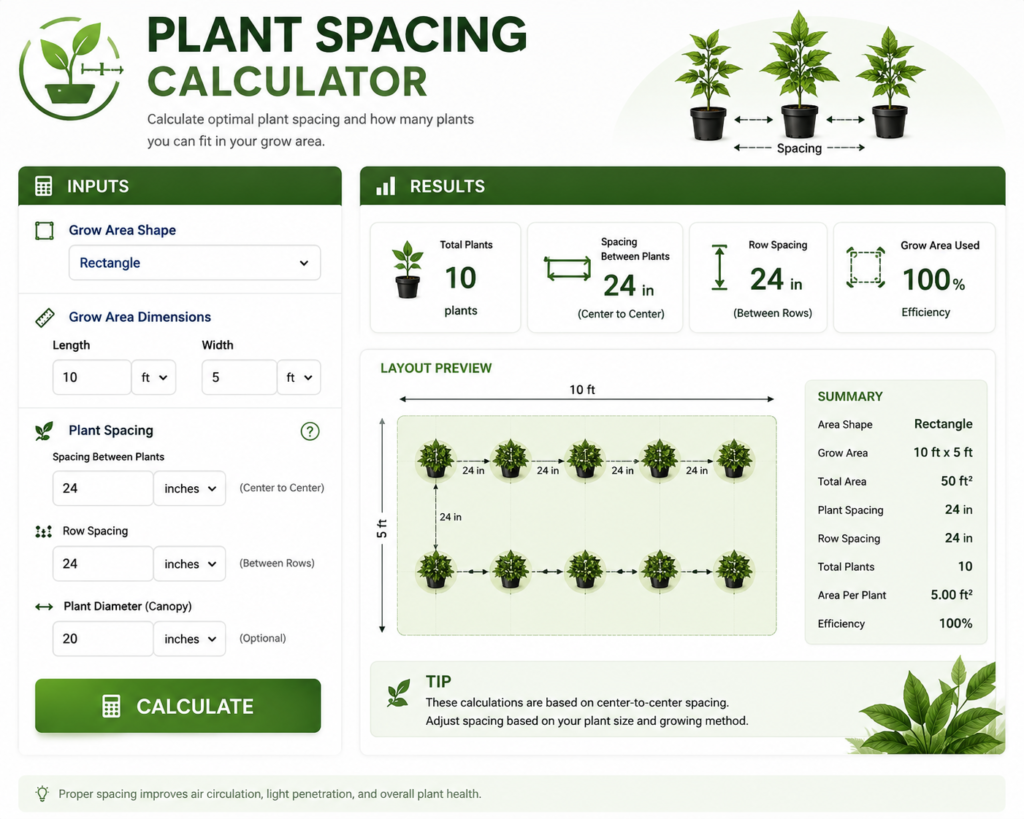
Plant Spacing Calculator
A Plant Spacing Calculator helps gardeners, farmers, landscapers, and horticulturists determine the ideal distance between plants to promote healthy growth and maximise available growing space. By entering the planting area, row spacing, and plant spacing, the calculator estimates the number of plants that can fit while ensuring each plant has sufficient room to develop.
Whether growing vegetables, flowers, herbs, shrubs, or field crops, proper spacing improves airflow, reduces competition for nutrients, and supports higher-quality harvests.
What Is a Plant Spacing Calculator?
A Plant Spacing Calculator estimates the recommended distance between plants and calculates how many plants can be grown in a specific area.
The calculator typically considers:
- Plant spacing
- Row spacing
- Garden or field dimensions
- Measurement units
The result helps users plan efficient planting layouts for gardens, raised beds, greenhouses, and agricultural fields.
How Does the Plant Spacing Calculator Work?
The calculator uses the dimensions of the planting area and the desired spacing to estimate plant placement.
Users generally enter:
- Length of the planting area
- Width of the planting area
- Distance between plants
- Distance between rows
The calculator then estimates:
- Total planting area
- Number of rows
- Number of plants per row
- Total number of plants
Plant Spacing Formula
A commonly used formula is:
Number of Plants = Planting Area ÷ (Plant Spacing × Row Spacing)
Where:
- Planting Area is measured in square feet or square metres.
- Plant Spacing is the distance between individual plants.
- Row Spacing is the distance between planting rows.
The calculator automatically performs these calculations for quick and accurate results.
Why Calculate Plant Spacing?
Proper spacing helps plants grow efficiently while making the best use of available space.
Benefits include:
- Encourages healthy root development
- Improves air circulation
- Reduces disease risk
- Maximises crop yield
- Simplifies watering and maintenance
- Prevents overcrowding
- Supports better sunlight exposure
Factors That Affect Plant Spacing
Several factors influence the ideal spacing between plants.
Plant Variety
Different plants have different mature sizes and spacing requirements.
Growth Habit
Bushy, climbing, and spreading plants require different amounts of space.
Soil Fertility
Fertile soil may support slightly denser planting than poor soil.
Irrigation Method
Drip irrigation and overhead watering systems can influence planting layouts.
Climate
Temperature, humidity, and sunlight affect plant growth and spacing needs.
Harvesting Method
Mechanical harvesting often requires wider row spacing than hand harvesting.
Benefits of Using a Plant Spacing Calculator
A Plant Spacing Calculator provides several advantages.
- Estimates plant numbers quickly
- Reduces seed and plant waste
- Improves garden planning
- Supports healthy plant growth
- Optimises land use
- Suitable for gardens and farms
- Simplifies planting decisions
Tips for Proper Plant Spacing
For the best results:
- Follow spacing recommendations for each plant species.
- Prepare well-drained soil before planting.
- Allow room for mature plant growth.
- Avoid overcrowding to improve airflow.
- Water consistently after planting.
- Remove weeds regularly.
- Monitor plant growth and thin seedlings if necessary.
Frequently Asked Questions
What is a Plant Spacing Calculator?
It is a tool that calculates the recommended distance between plants and estimates how many plants can fit within a given planting area.
Why is plant spacing important?
Proper spacing allows plants to receive enough sunlight, water, nutrients, and airflow, promoting healthier growth and better yields.
Can this calculator be used for vegetables and flowers?
Yes. It is suitable for vegetables, flowers, herbs, shrubs, fruit plants, and many agricultural crops.
Does closer spacing always produce higher yields?
Not always. Overcrowding can increase competition for resources and reduce plant health, ultimately affecting productivity.
Can gardeners use this calculator for raised beds?
Yes. The calculator works for raised beds, traditional gardens, containers, greenhouses, and agricultural fields.
Other Useful Calculators
Explore more biology and agriculture calculators on Omni Calculator Store:
- CO₂ Grow Room Calculator
https://omnicalculator.store/home/biology/co2-grow-room-calculator/ - Plant Population Calculator
https://omnicalculator.store/home/biology/plant-population-calculator/ - Bulb Spacing Calculator
https://omnicalculator.store/home/biology/bulb-spacing-calculator/ - Pine Straw Calculator
https://omnicalculator.store/home/biology/pine-straw-calculator/ - Acres Per Hour Calculator
https://omnicalculator.store/home/biology/acres-per-hour-calculator/
Conclusion
A Plant Spacing Calculator is an essential tool for planning efficient gardens, landscapes, and agricultural fields. By calculating the ideal spacing between plants and rows, it helps maximise growing space while promoting healthy development and higher yields. Whether planting vegetables, flowers, herbs, or field crops, using this calculator makes planting easier, more organised, and more productive.