GDU Calculator — Growing Degree Units

Ahmad zee
Table of Contents
Toggle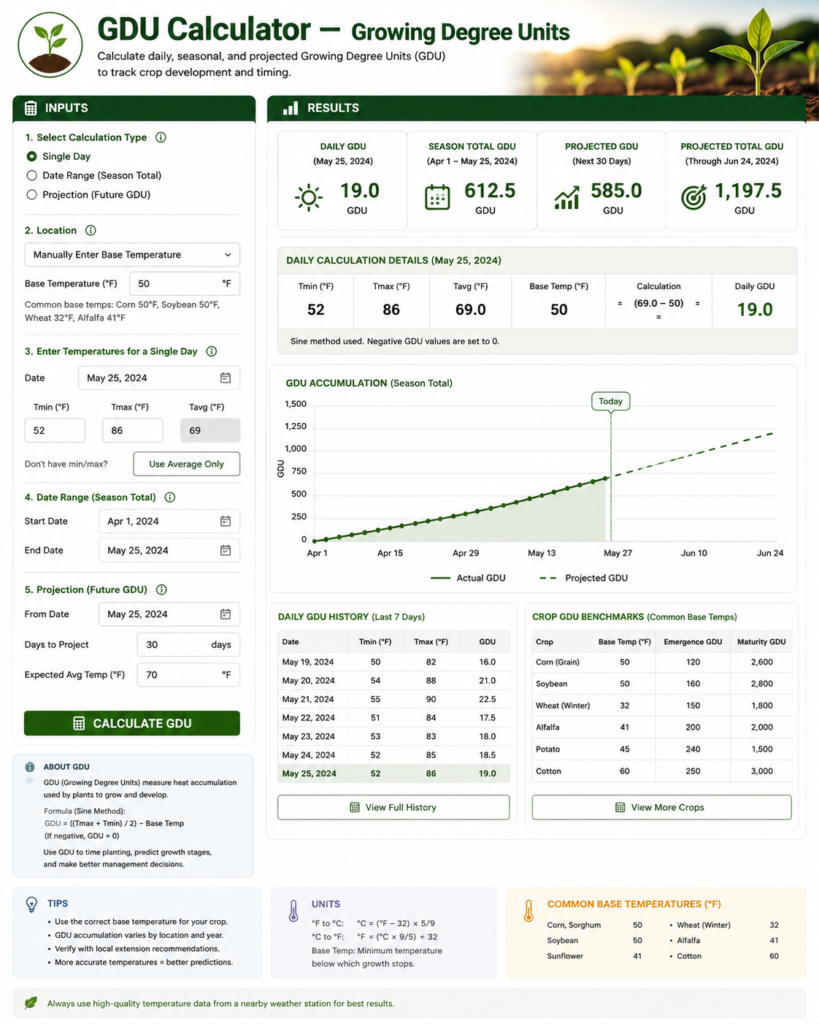
GDU Calculator (Growing Degree Units)
A GDU Calculator (Growing Degree Units) helps farmers, agronomists, gardeners, and agricultural professionals measure the amount of heat accumulated during a growing season. Growing Degree Units (GDUs), also known as Growing Degree Days (GDD), are used to estimate crop development by comparing daily temperatures with a crop’s base temperature.
Whether growing corn, soybeans, wheat, vegetables, or fruit crops, tracking GDUs helps growers predict plant growth stages, schedule field operations, and estimate harvest dates more accurately.
What Is a GDU Calculator?
A GDU Calculator estimates the number of Growing Degree Units accumulated over a day or an entire growing season.
The calculator typically considers:
- Daily maximum temperature
- Daily minimum temperature
- Base temperature for the crop
- Number of growing days
The result shows the accumulated heat units that contribute to plant growth.
How Does the GDU Calculator Work?
The calculator uses daily temperature data to estimate heat accumulation.
Users generally enter:
- Daily maximum temperature
- Daily minimum temperature
- Crop base temperature
- Time period (optional)
The calculator then estimates:
- Daily Growing Degree Units
- Total accumulated GDUs
- Estimated crop development progress
Growing Degree Units Formula
A commonly used formula is:
GDU = ((Maximum Temperature + Minimum Temperature) ÷ 2) − Base Temperature
Where:
- Maximum Temperature is the day’s highest temperature.
- Minimum Temperature is the day’s lowest temperature.
- Base Temperature is the minimum temperature at which crop growth begins.
If the calculated value is negative, it is generally recorded as zero because plant growth is assumed not to occur below the base temperature.
Why Use a GDU Calculator?
Tracking heat accumulation helps growers make better management decisions throughout the growing season.
Benefits include:
- Monitor crop development
- Estimate planting and harvest dates
- Improve irrigation planning
- Support fertiliser scheduling
- Predict flowering and maturity
- Compare seasonal crop performance
- Improve overall farm management
Factors That Affect Growing Degree Units
Several factors influence GDU accumulation.
Daily Temperature
Warmer days generally produce more Growing Degree Units.
Crop Type
Different crops require different base temperatures and total GDUs to reach maturity.
Seasonal Weather
Cool or unusually warm seasons affect the rate of heat accumulation.
Geographic Location
Climate and elevation influence average daily temperatures throughout the growing season.
Planting Date
Earlier or later planting changes the amount of available growing time.
Benefits of Using a GDU Calculator
A GDU Calculator offers several advantages.
- Calculates heat units quickly
- Supports crop monitoring
- Improves harvest planning
- Helps predict crop maturity
- Assists with field management
- Suitable for many crop types
- Simplifies seasonal planning
Tips for Using Growing Degree Units
For the best results:
- Use accurate daily temperature data.
- Select the correct base temperature for the crop.
- Record GDU values throughout the growing season.
- Combine GDU tracking with field observations.
- Monitor weather forecasts regularly.
- Keep historical GDU records for comparison.
- Adjust management practices as crop development changes.
Frequently Asked Questions
What is a GDU Calculator?
It is a tool that calculates Growing Degree Units using daily maximum and minimum temperatures to estimate crop growth and development.
What are Growing Degree Units?
Growing Degree Units are heat measurements that indicate how much warmth a crop has received during the growing season.
Why are GDUs important?
They help growers predict important growth stages, estimate harvest timing, and improve crop management decisions.
Can this calculator be used for different crops?
Yes. It can be used for corn, soybeans, wheat, vegetables, fruit crops, and many other plants by selecting the appropriate base temperature.
What happens if the calculated GDU is negative?
Negative values are generally treated as zero because temperatures below the crop’s base temperature do not contribute to growth.
Other Useful Calculators
Explore more biology and agriculture calculators on Omni Calculator Store:
- Soil Calculator
https://omnicalculator.store/home/biology/soil-calculator/ - Fertilizer Calculator
https://omnicalculator.store/home/biology/fertilizer-calculator/ - Corn Yield Calculator
https://omnicalculator.store/home/biology/corn-yield-calculator/ - Plant Population Calculator
https://omnicalculator.store/home/biology/plant-population-calculator/ - Daily Light Integral Calculator
https://omnicalculator.store/home/biology/daily-light-integral-calculator/
Conclusion
A GDU Calculator (Growing Degree Units) is an essential tool for monitoring crop development throughout the growing season. By calculating accumulated heat units from daily temperatures, growers can better predict growth stages, optimise field operations, and improve harvest planning. Whether managing a home garden or a commercial farming operation, this calculator provides valuable insights for making informed agricultural decisions.