
Ahmad zee
Table of Contents
Toggle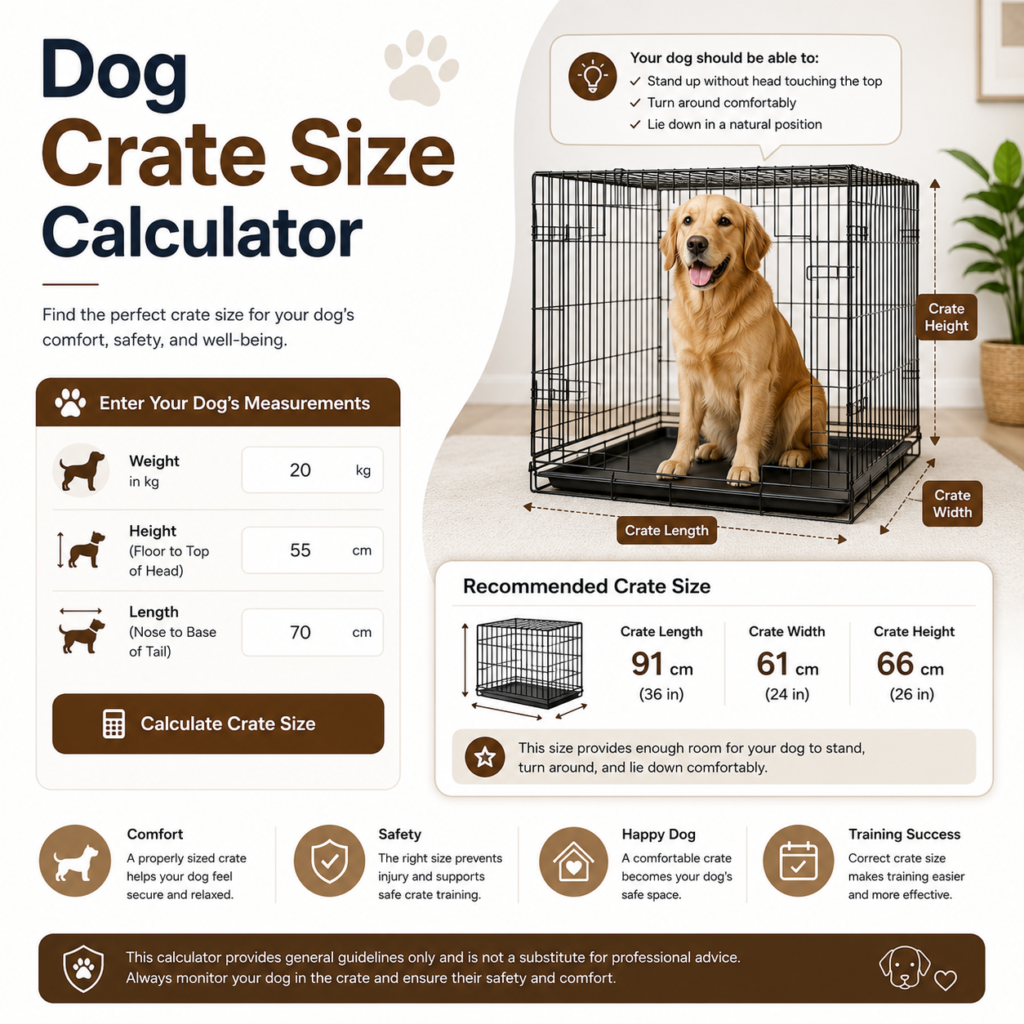
Dog Crate Size Calculator: Finding the Perfect Fit for Your Dog
One of the most common mistakes new dog owners make is choosing the wrong crate size. Too small and the dog feels cramped and stressed; too large and it loses the sense of security that makes crates such an effective training tool in the first place. A dog crate size calculator takes the guesswork out of this decision entirely — helping owners identify the ideal crate dimensions based on their dog’s measurements, breed, and life stage.
Whether someone is crate training a new puppy, setting up a safe space for an anxious dog, or preparing a comfortable travel enclosure, getting the size right from the start makes the entire process smoother for both dog and owner.
Why Crate Size Matters More Than Most Owners Realize
A crate isn’t just a cage — when chosen and introduced correctly, it becomes a dog’s personal sanctuary. Dogs are naturally den animals, and a well-sized crate taps into that instinct, providing a defined, secure space where a dog can rest, decompress, and feel safe.
But the benefits of crate training only materialize when the crate is properly sized. Here’s why dimensions matter so much:
Too Small
A crate that’s too small forces a dog into an uncomfortable, unnatural posture. Dogs need to be able to stand at full height, turn around completely, and lie down in a fully stretched position. When a crate restricts any of these movements, it causes physical discomfort and psychological stress — undermining the very sense of security a crate is supposed to provide.
Too Large
Counterintuitively, a crate that’s too large can also be problematic — especially during house training. Dogs instinctively avoid soiling their sleeping area, which is one of the principles that makes crate training effective. If the crate is excessively large, a puppy may use one end as a bathroom and sleep in the other, which defeats the purpose entirely. The right size encourages the dog to hold its bladder until it’s taken outside.
Just Right
A properly sized crate gives the dog enough room to stand, turn around, and lie comfortably — without offering so much extra space that it loses its den-like quality. This balance is exactly what a dog crate size calculator is designed to find.
How Does a Dog Crate Size Calculator Work?
A dog crate size calculator uses a dog’s physical measurements — primarily length and height — to recommend appropriate crate dimensions. The process is straightforward:
Step 1: Measure the dog’s length.
Measure from the tip of the nose to the base of the tail (not the tip of the tail). This gives the body length, which determines the minimum floor length the crate should have.
Step 2: Measure the dog’s height.
Measure from the floor to the top of the head or the tips of the ears, whichever is higher. This determines the minimum interior height the crate needs to accommodate comfortable standing.
Step 3: Apply the standard allowance.
Most calculators add 2 to 4 inches to both the length and height measurements. This buffer ensures the dog has comfortable room to move without the crate becoming unnecessarily spacious.
Step 4: Match to a standard crate size.
Crates are sold in standardized sizes — typically ranging from 18 inches for toy breeds up to 54 inches for giant breeds. The calculator matches the dog’s measurements to the nearest appropriate size, sometimes recommending the next size up when measurements fall between two standard options.
For growing puppies, the calculator may also suggest using a crate with a divider panel — allowing owners to purchase an adult-sized crate upfront and partition it to the appropriate smaller size during the puppy months, expanding the space as the dog grows.
Standard Crate Sizes and Which Dogs They Suit
Understanding the standard crate size categories helps owners cross-reference calculator results and make informed purchasing decisions.
Extra Small — 18 to 22 Inches
Suited for toy and very small breeds such as Chihuahuas, Pomeranians, Yorkshire Terriers, and Maltese. These compact crates are lightweight, easy to travel with, and ideal for dogs under 10 pounds.
Small — 24 Inches
A good fit for small breeds including Shih Tzus, Pugs, French Bulldogs, and miniature Dachshunds. Dogs in the 10 to 25 pound range typically do well in this size.
Medium — 30 Inches
Suitable for medium breeds such as Beagles, Cocker Spaniels, Whippets, and smaller mixed breeds. This size accommodates dogs roughly in the 26 to 40 pound range.
Large — 36 Inches
Designed for breeds like Border Collies, Siberian Huskies, Basset Hounds, and Bulldogs. Dogs weighing approximately 41 to 70 pounds typically fall into this category.
Extra Large — 42 Inches
Appropriate for larger breeds including Labrador Retrievers, Golden Retrievers, German Shepherds, and Standard Poodles. This size suits dogs in the 71 to 90 pound range.
XXL — 48 to 54 Inches
Reserved for giant breeds such as Great Danes, Saint Bernards, Mastiffs, Newfoundlands, and Irish Wolfhounds. These crates are substantial in size and weight, designed to contain dogs over 90 to 100 pounds comfortably.
Using the dog size calculator alongside crate size recommendations helps owners confirm that their dog’s projected adult dimensions align with the crate they’re considering — especially important when purchasing a crate for a puppy whose adult size hasn’t yet been reached.
Measuring Your Dog Correctly: A Step-by-Step Guide
Accurate measurements are the foundation of a reliable crate size calculation. Even a small error can mean the difference between a comfortable fit and an ill-suited crate. Here’s how to measure correctly:
Tools Needed
- A flexible measuring tape or a piece of string and a ruler
- A helper to keep the dog still (especially for puppies)
- Treats to keep the dog calm and cooperative
Measuring Length
Have the dog stand naturally on a flat surface. Place the tape measure at the very tip of the nose and extend it along the side of the body to the base of the tail — where the tail meets the body, not the tip of the tail. Record this measurement and add 2 to 4 inches to get the minimum recommended crate length.
Measuring Height
With the dog standing, measure from the floor to the highest point — either the top of the skull or the tip of the ears if the dog has upright ears. Breeds with naturally upright or pricked ears need the ear height measured, as this determines the clearance they’ll need inside the crate. Add 2 to 4 inches to this measurement for the minimum recommended interior height.
Measuring Weight
While weight alone doesn’t determine crate size, it provides a useful cross-reference. Crate manufacturers typically include weight guidelines alongside dimension specifications. An accurate weight reading from the dog weight calculator helps confirm that a chosen crate size aligns with the dog’s overall physical profile.
Choosing a Crate for a Puppy
Puppies present a unique challenge when it comes to crate sizing. Their adult size is often unknown or uncertain — particularly for mixed breeds — and their dimensions change rapidly during the first year of life. Buying a new crate every few months is neither practical nor economical.
The most cost-effective approach is to buy the adult-size crate upfront and use a divider. Most quality crates designed for puppies include adjustable divider panels that allow owners to section off a portion of the crate, creating a smaller, appropriately sized space that can be expanded incrementally as the puppy grows.
To make this work, owners need a reliable estimate of the puppy’s adult size. The dog age calculator helps owners understand where their puppy is in its development timeline, while breed-specific growth data provides guidance on when the dog is likely to reach its full adult dimensions.
For mixed-breed puppies whose final size is harder to predict, veterinary guidance and DNA breed testing can provide additional insight to inform the crate purchase.
Crate Types and Which Size Format Works Best
Once the right dimensions are established, owners also need to consider which type of crate best suits their situation. Different crate styles have their own size ranges, construction characteristics, and ideal use cases.
Wire Crates
Wire crates are the most versatile and popular option for home use. They offer excellent ventilation, are easy to clean, often fold flat for storage, and typically come with divider panels for puppy use. Wire crates are available across the full range of standard sizes and work well for most breeds and lifestyles.
Plastic Travel Crates
Also known as airline crates, these enclosed plastic crates provide a more den-like, enclosed environment that many anxious dogs find reassuring. They’re required for air travel and are popular for road trips. Sizing follows the same measurement principles, though the enclosed nature means ventilation should be considered alongside dimensions.
Soft-Sided Crates
Lightweight and portable, soft-sided crates are ideal for calm, well-trained dogs who travel frequently. They’re not suitable for dogs that chew or scratch, and they’re generally best for small to medium breeds. Size options are somewhat more limited than wire or plastic crates.
Heavy-Duty Crates
Designed for dogs that are strong, escape-prone, or highly anxious, heavy-duty crates are built from reinforced steel and feature multiple locking mechanisms. They’re more expensive but provide superior containment for dogs that have broken out of standard crates. Available in large and extra-large sizes primarily.
Furniture-Style Crates
These wooden crates are designed to blend into home décor, doubling as end tables or decorative furniture pieces. They work well for calm dogs who are already comfortable with crate environments. Size options tend to be more limited, and they’re best suited for small to medium breeds.
Crate Sizing for Special Circumstances
Beyond everyday crate training, certain life situations call for specific crate size considerations.
Travel and Airline Requirements
Airlines have strict regulations regarding pet carrier dimensions, and these vary between carriers. For cabin travel, carriers must fit under the seat in front — typically limiting usable space to approximately 17 by 11 by 11 inches, which accommodates only the smallest breeds and young puppies. For cargo travel, IATA (International Air Transport Association) guidelines specify that the dog must be able to stand, turn around, and lie down naturally — the same principles applied by a dog crate size calculator. Owners traveling by air should always verify their airline’s specific requirements before purchasing a travel crate.
Crates for Senior Dogs
Older dogs may have mobility limitations that affect how they enter and exit a crate. For senior dogs with arthritis or hip issues, a crate with a wider door opening or a front-loading design makes access easier and less painful. The crate size itself should allow for comfortable repositioning during rest, as senior dogs tend to shift position more frequently due to joint discomfort.
Whelping and Pregnant Dogs
Pregnant dogs approaching their due date need a larger, comfortable space for whelping — the process of giving birth and nursing a litter. While a standard whelping box is typically used rather than a traditional crate, the sizing principles are similar: enough room for the mother to move freely, lie on her side comfortably, and nurse puppies without restriction. Owners tracking a pregnancy with the dog pregnancy calculator should begin preparing appropriate whelping space in the final weeks of gestation, ensuring the mother has a secure, comfortable area well before delivery.
Multi-Dog Households
In households with multiple dogs, crate training each dog individually is generally recommended. Shared crates — even between dogs that get along well — can cause stress, resource guarding, and safety issues. Each dog should have its own properly sized crate, positioned in a way that allows all dogs to feel secure in their individual spaces.
Crate Training Tips to Complement Proper Sizing
Even the perfectly sized crate won’t be effective without a thoughtful introduction. Crate training is a gradual process that works best when approached with patience and positive reinforcement.
Introduce the crate gradually. Place the crate in a common area of the home and allow the dog to explore it at its own pace. Leave the door open initially and scatter treats or a favorite toy inside to build positive associations.
Never use the crate as punishment. The crate should always represent a safe, positive space. Using it as a consequence for bad behavior undermines the training process and creates anxiety around the crate.
Build duration slowly. Start with short periods of crate time — a few minutes — and gradually increase duration as the dog becomes more comfortable. Most healthy adult dogs can comfortably remain in a crate for four to six hours, but this tolerance is built incrementally.
Establish a feeding routine. Feeding meals inside or near the crate helps reinforce it as a positive space. The dog food calculator helps owners determine appropriate meal sizes and timing, which can be structured to align with crate training sessions for maximum effectiveness.
Provide appropriate enrichment. Safe chew toys, puzzle feeders, and comfort items like a worn piece of the owner’s clothing can make crate time more enjoyable and help dogs settle quickly.
Ensure adequate exercise before crating. A dog that has been well-exercised is far more likely to rest calmly in a crate than one with pent-up energy. Physical activity before crate time is one of the simplest and most effective ways to make training sessions successful.
Common Crate Sizing Mistakes to Avoid
Even well-intentioned owners sometimes make sizing errors that undermine crate training. Here are the most common pitfalls:
Relying on breed labels instead of measurements. Breed size guidelines on crate packaging are helpful starting points, but individual dogs vary significantly even within the same breed. Always measure the specific dog rather than relying solely on breed-based recommendations.
Forgetting to account for ear height. Dogs with upright ears — German Shepherds, Siberian Huskies, French Bulldogs — need extra vertical clearance that flat-eared or floppy-eared dogs don’t. Measuring to the tip of the ear rather than the top of the skull ensures an accurate height requirement.
Buying a crate that’s already too small for the puppy’s current size. Some owners choose a crate based on what seems right for a small puppy, only to find it’s inadequate within weeks. Measuring regularly during rapid growth phases and using the divider approach avoids this problem.
Ignoring crate depth. Standard crate size references focus on length and height, but depth (the side-to-side dimension) also matters for comfort — particularly for stocky or barrel-chested breeds. Always review full interior dimensions, not just the length measurement.
Final Thoughts
A dog crate size calculator is one of the most practical tools available for dog owners at any stage — from welcoming a new puppy to managing the needs of an older dog requiring a comfortable, accessible resting space. Getting the size right from the beginning saves money, reduces stress for the dog, and sets the foundation for effective crate training.
By combining a crate size calculator with complementary tools that track weight, age, growth, and nutrition, owners can approach every aspect of their dog’s environment with confidence and care. A well-chosen crate, introduced thoughtfully and sized correctly, becomes far more than a training device — it becomes a genuine place of comfort and security that a dog will return to willingly, day after day.