DNA to mRNA Converter

Ahmad zee
Table of Contents
Toggle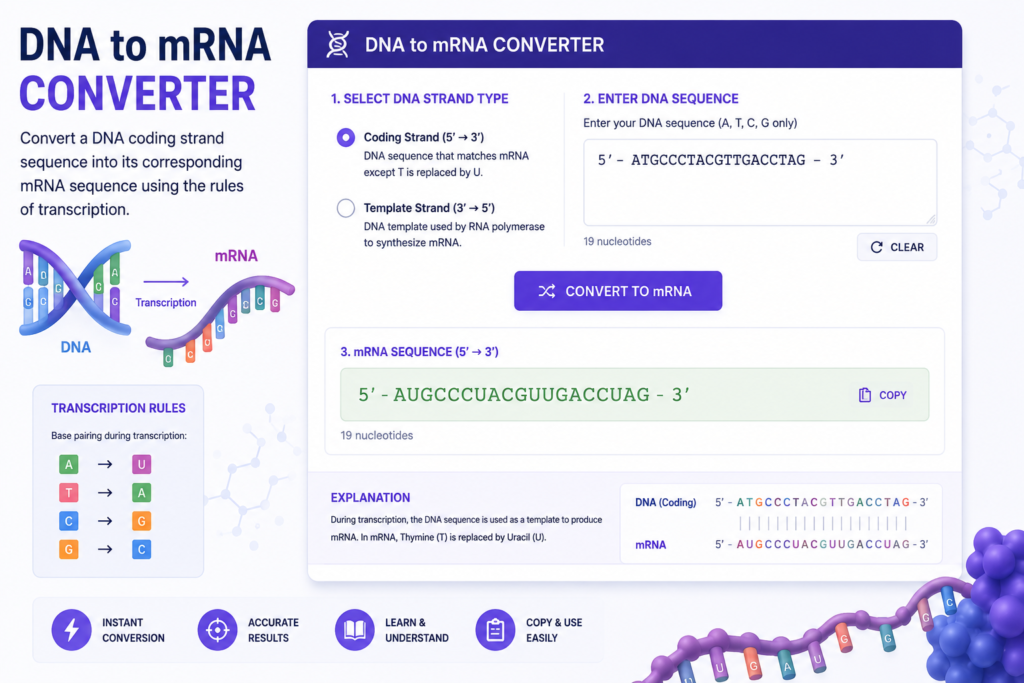
DNA to mRNA Converter: Understanding Transcription and Gene Expression
Introduction to DNA and mRNA Conversion
The journey from genetic instructions stored in DNA to functional proteins requires a crucial intermediate step: the conversion of DNA to mRNA. This fundamental biological process, known as transcription, forms the cornerstone of molecular biology and genetic expression. A DNA to mRNA converter tool helps students and researchers understand this essential transformation, making complex molecular concepts accessible and practical.
Modern molecular biology education relies heavily on visual and interactive tools. The DNA to mRNA converter represents one of the most valuable resources for comprehending how genetic information flows from the nucleus to the cytoplasm, ultimately leading to protein synthesis. Whether you’re a biology student tackling transcription for the first time or a researcher analyzing gene sequences, understanding DNA to mRNA conversion proves absolutely essential.
What Is the DNA to mRNA Conversion Process?
The DNA to mRNA conversion describes the transcription process, where DNA sequences are converted into messenger RNA (mRNA). This fundamental molecular process occurs in all living cells and forms the first step in the central dogma of molecular biology: DNA → RNA → Protein.
The Science Behind Transcription
During transcription, the enzyme RNA polymerase reads a DNA template strand and synthesizes a complementary mRNA strand. Unlike DNA, which remains relatively stable, mRNA serves as a temporary messenger carrying genetic instructions from the nucleus to ribosomes in the cytoplasm, where proteins are constructed.
Key Differences Between DNA and mRNA
Understanding the structural differences between DNA and mRNA proves crucial for proper conversion:
- Sugar component: DNA contains deoxyribose sugar, while mRNA contains ribose sugar
- Bases: DNA uses thymine (T), while mRNA uses uracil (U) in its place
- Structure: DNA is typically double-stranded, while mRNA is single-stranded
- Stability: DNA is stable for long-term information storage, while mRNA is temporary
- Location: DNA resides primarily in the nucleus, while mRNA travels throughout the cell
How the DNA to mRNA Converter Works
A DNA to mRNA converter tool automates the transcription process, taking DNA sequences as input and generating the corresponding mRNA sequences. These tools apply the base-pairing rules of molecular biology to perform accurate conversions.
Basic Conversion Principles
The DNA to mRNA converter operates on fundamental base-pairing rules:
- Adenine (A) in DNA converts to Uracil (U) in mRNA
- Thymine (T) in DNA converts to Adenine (A) in mRNA
- Guanine (G) in DNA converts to Cytosine (C) in mRNA
- Cytosine (C) in DNA converts to Guanine (G) in mRNA
Understanding Template and Coding Strands
DNA contains two strands: the template strand and the coding strand. The DNA to mRNA converter reads the template strand (also called the non-coding strand or antisense strand) to produce mRNA that matches the coding strand (also called the sense strand), except with uracil replacing thymine.
Step-by-Step Conversion Process
Step 1: Identify the Template Strand Locate the template strand of your DNA sequence. RNA polymerase uses this strand as the blueprint for mRNA synthesis.
Step 2: Input the DNA Sequence Enter your DNA sequence into the DNA to mRNA converter. Most converters accept sequences in standard FASTA format or simple text input.
Step 3: Specify the Direction Clarify whether your sequence runs 5′ to 3′ or 3′ to 5′. The DNA to mRNA converter requires directional information for accurate transcription.
Step 4: Execute the Conversion The converter automatically applies base-pairing rules, replacing thymine with uracil and reading the template strand to produce mRNA.
Step 5: Review the mRNA Output Examine the resulting mRNA sequence. Most converters highlight differences from the input DNA, making it easy to verify accuracy.
The Central Dogma and DNA to mRNA Conversion
The central dogma of molecular biology describes the flow of genetic information in living cells. The DNA to mRNA conversion represents the first major step in this fundamental principle.
DNA to mRNA to Protein
The process follows this sequence:
- Transcription: DNA is converted to mRNA in the nucleus
- Translation: mRNA carries instructions to ribosomes
- Protein Synthesis: Ribosomes read mRNA and synthesize proteins
Understanding DNA to mRNA conversion provides the foundation for comprehending how genetic information ultimately manifests as cellular proteins that perform essential biological functions.
Why This Matters Biologically
Every protein produced in your cells originates from this conversion process. Hair color, enzyme function, immune response, and countless other biological traits depend on accurate DNA to mRNA conversion. Any errors in this process can lead to non-functional proteins or genetic diseases.
Practical Applications of DNA to mRNA Converters
Beyond classroom instruction, DNA to mRNA converters serve multiple important functions:
Research and Analysis
Molecular biologists use DNA to mRNA converters when:
- Analyzing newly sequenced genes
- Predicting mRNA sequences from DNA data
- Designing molecular experiments
- Studying gene expression patterns
- Validating computational predictions
Medical and Biotechnology Applications
The pharmaceutical and biotechnology industries rely on DNA to mRNA conversion tools for:
- Developing gene therapies
- Creating mRNA vaccines
- Identifying disease-causing mutations
- Designing therapeutic proteins
- Understanding genetic variations
Educational Purposes
Students encounter DNA to mRNA converters when:
- Learning molecular biology fundamentals
- Completing homework assignments
- Preparing for standardized examinations
- Understanding genetics and heredity
- Exploring bioinformatics concepts
Using a DNA to mRNA Converter: A Practical Guide
Modern DNA to mRNA converter tools vary in complexity, but most share common features and capabilities.
Choosing the Right Converter
When selecting a DNA to mRNA converter, consider:
Essential Features
- Accepts multiple sequence formats (FASTA, plain text)
- Clearly displays input and output sequences
- Includes complementary strand information
- Shows base-pairing relationships visually
- Provides accurate, reliable conversions
User Experience
- Simple, intuitive interface
- Clear instructions for input
- Fast processing speeds
- Mobile-friendly design
- Option to save or export results
Educational Value
- Explanatory annotations
- Color-coding for different bases
- Visual representation of complementary strands
- Links to related molecular biology concepts
- Step-by-step process explanation
Common Input Formats
DNA to mRNA converters typically accept sequences in these formats:
FASTA Format
>Sequence_Name
ATGCGATCGATCG
Plain Text Format
ATGCGATCGATCG
With Directional Information
5'-ATGCGATCGATCG-3'
Codons and mRNA: The Next Step After Conversion
Once DNA has been converted to mRNA, the resulting sequence contains codons—three-base sequences that encode specific amino acids. Understanding this relationship proves crucial for students progressing beyond basic DNA to mRNA conversion.
Start and Stop Codons
The mRNA produced from DNA to mRNA conversion contains specific codons that signal where protein synthesis begins and ends:
- Start Codon: AUG (codes for Methionine)
- Stop Codons: UAA, UAG, UGA (signal translation termination)
Genetic Code Application
After DNA is converted to mRNA, researchers and students can consult the genetic code table to determine which amino acids correspond to each codon. This connection links the DNA to mRNA conversion step directly to protein synthesis.
Translation as the Next Step
The mRNA produced from DNA to mRNA conversion travels to ribosomes, where translation converts mRNA into protein sequences. Understanding this progression helps students grasp the complete information flow from DNA to functional proteins.
Common Errors in DNA to mRNA Conversion
Even with automated tools, misunderstandings about DNA to mRNA conversion can lead to errors:
Strand Confusion
Students sometimes confuse template and coding strands. Remember: the DNA to mRNA converter reads the template strand (3′ to 5′), producing mRNA that runs 5′ to 3′ and matches the coding strand (except U replaces T).
Directional Mistakes
Failing to specify sequence direction can produce reversed or incorrect mRNA. Always clarify whether your DNA sequence runs 5′ to 3′ or 3′ to 5′ before conversion.
Thymine-to-Uracil Substitution
This is the most common error: forgetting that mRNA contains uracil instead of thymine. Verify that your DNA to mRNA converter properly substitutes U for all T bases.
Misunderstanding Complementarity
DNA to mRNA conversion doesn’t simply copy the DNA sequence. The converter must apply base-pairing rules: A pairs with U, T pairs with A, G pairs with C, and C pairs with G.
Ignoring Non-Coding Regions
In eukaryotes, genes contain both coding and non-coding regions (introns and exons). A basic DNA to mRNA converter may not account for splicing that removes introns from the final mRNA product.
Advanced DNA to mRNA Conversion Concepts
Beyond basic conversion, several advanced topics build upon DNA to mRNA conversion principles:
Promoters and Regulatory Regions
DNA to mRNA conversion begins at promoter regions, specific DNA sequences where RNA polymerase binds. Understanding promoter function helps explain why DNA to mRNA conversion initiates at specific locations rather than randomly throughout the genome.
Transcription Factors
Proteins called transcription factors regulate where and when DNA to mRNA conversion occurs. These molecular switches control gene expression in response to cellular signals and environmental conditions.
Introns and Exons in Eukaryotes
Eukaryotic genes contain introns (non-coding sequences) and exons (coding sequences). While the DNA to mRNA converter creates mRNA from the entire gene region, cellular machinery removes introns before the mature mRNA leaves the nucleus—a process called splicing.
RNA Polymerase Types
Different RNA polymerase enzymes catalyze DNA to mRNA conversion for different types of genes:
- RNA Polymerase I: Converts DNA to most ribosomal RNA
- RNA Polymerase II: Converts DNA to mRNA for proteins
- RNA Polymerase III: Converts DNA to transfer RNA
Connecting DNA to mRNA Conversion with Other Molecular Biology Tools
DNA to mRNA converters rarely stand alone in molecular biology analysis. They connect seamlessly with related tools and concepts:
From DNA Analysis to Expression
Students often begin with DNA sequence analysis tools, which provide the raw sequences that DNA to mRNA converters then process. This workflow helps researchers understand gene structure before examining expression.
Connection to Protein Synthesis
After mRNA results emerge from the DNA to mRNA converter, students typically use codon tables and translation tools to predict which amino acids the mRNA encodes.
Mutation and Disease Analysis
Comparing normal DNA sequences with mutated sequences using a DNA to mRNA converter helps students understand how genetic mutations affect mRNA and ultimately protein function.
Real-World Examples of DNA to mRNA Conversion
Examining specific examples helps solidify understanding of DNA to mRNA conversion:
Example 1: Simple Gene Conversion
Original DNA Template Strand (3′ to 5′)
3'-TACGCGATCG-5'
Resulting mRNA (5′ to 3′)
5'-AUGCGCUAGC-3'
Notice how A→U, T→A, G→C, and C→G conversions apply, and the sequence direction reverses.
Example 2: Real Gene Sequence
Examining actual genes from model organisms like E. coli or S. cerevisiae shows how DNA to mRNA conversion applies to real biological systems. Online databases provide annotated sequences where students can verify DNA to mRNA conversion results.
Example 3: Disease-Causing Mutations
Analyzing how mutations alter DNA to mRNA conversion helps students understand genetic diseases. For instance, a single DNA base change can create a stop codon in mRNA, prematurely terminating protein synthesis.
The Role of DNA to mRNA Conversion in Modern Medicine
Contemporary medicine increasingly relies on understanding DNA to mRNA conversion at molecular levels:
Gene Therapy Development
Gene therapies sometimes use mRNA directly as therapeutic agents. Understanding DNA to mRNA conversion helps researchers design therapeutic mRNA sequences and predict their cellular effects.
mRNA Vaccines
The revolutionary mRNA vaccine technology depends entirely on understanding how to create functional mRNA sequences that encode viral proteins, allowing immune systems to recognize and neutralize pathogens without exposure to actual viruses.
Cancer Research
Cancer researchers analyze how mutations affect DNA to mRNA conversion in cancer cells. Understanding aberrant transcription helps identify therapeutic targets and develop personalized cancer treatments.
Genetic Counseling
Medical geneticists use DNA to mRNA conversion knowledge when counseling families about hereditary conditions. Understanding how specific mutations affect transcription helps predict disease severity and progression.
Challenges and Limitations in DNA to mRNA Conversion Tools
While DNA to mRNA converters provide invaluable assistance, they have important limitations:
Oversimplification of Biology
Many converters assume basic transcription rules without accounting for complex regulatory mechanisms, alternative splicing, or post-transcriptional modifications that real cells employ.
Limited to DNA Sequences
DNA to mRNA converters work only with DNA input. They cannot account for regulatory proteins, cellular signals, or environmental factors that influence actual transcription in living cells.
No Functional Predictions
A DNA to mRNA converter can show you the sequence produced, but cannot predict how that mRNA will function, fold, or be translated. Additional analysis tools address these limitations.
Species-Specific Variations
While base-pairing rules remain universal, different organisms may employ variations in codon usage, regulatory sequences, and splicing patterns that simple converters might miss.
The Future of DNA to mRNA Conversion Tools
As biotechnology advances, DNA to mRNA conversion tools continue to evolve:
Artificial Intelligence Integration
Future DNA to mRNA converters may incorporate machine learning to predict mRNA stability, translation efficiency, and functional outcomes based on sequence characteristics.
Structural Prediction
Advanced tools will predict mRNA secondary structures that affect translation and regulation, providing insights beyond simple sequence conversion.
Personalized Medicine Applications
As genomic medicine advances, DNA to mRNA converters will integrate with clinical data to predict how specific mutations affect individual patients’ gene expression and protein function.
Real-Time Monitoring
Emerging technologies may enable real-time monitoring of DNA to mRNA conversion, allowing researchers to observe transcription dynamics directly rather than inferring from static sequences.
Practice Problems and Applications
To strengthen your understanding of DNA to mRNA conversion, work through these problems:
Problem 1: Basic Conversion Convert the following DNA template strand to mRNA:
3'-ATGCGATCGA-5'
Problem 2: Identifying Errors A student produces this mRNA from a DNA template. Find and explain the error:
DNA Template: 3'-ATGC-5'
Student's mRNA: 5'-TGCA-3'
Problem 3: Codon Recognition Convert the DNA template to mRNA, then identify all start and stop codons:
3'-ATGCGATCGATAAATAG-5'
Problem 4: Mutation Analysis A point mutation changes one DNA base from T to G. How might this affect the resulting mRNA and the protein it encodes?
Connecting to Broader Molecular Biology
Understanding DNA to mRNA conversion provides the foundation for exploring related molecular biology concepts:
Regulation of Gene Expression
DNA to mRNA conversion can be regulated at multiple levels. Transcription factors, chromatin modifications, and epigenetic changes all influence whether and how often a particular gene undergoes conversion to mRNA.
Evolutionary Perspectives
Comparing DNA to mRNA conversion across different species reveals evolutionary relationships and helps scientists trace how genes evolved over time.
Synthetic Biology Applications
Synthetic biologists design novel genes and use DNA to mRNA conversion principles to create organisms with new capabilities, from bacteria that produce biofuels to cells engineered to detect and destroy cancer.
Troubleshooting DNA to mRNA Converter Problems
If your DNA to mRNA converter produces unexpected results:
Check Input Sequence Format Ensure your DNA sequence contains only A, T, G, and C. Remove any spaces, numbers, or special characters that might confuse the converter.
Verify Strand Direction Double-check whether you’ve specified the correct strand (template vs. coding) and direction (5′ to 3′ vs. 3′ to 5′).
Review Base Substitution Rules Manually verify a few bases to ensure thymine properly converts to uracil and complementary pairing occurs correctly.
Consider Biological Context Remember that simple converters may not account for introns, regulatory sequences, or other complex features of real genes.
Conclusion: Mastering DNA to mRNA Conversion
The DNA to mRNA converter represents far more than a simple computational tool—it serves as a gateway to understanding how genetic information flows through living cells. Mastering DNA to mRNA conversion equips students and researchers with knowledge that applies across molecular biology, medicine, biotechnology, and genetics.
Whether you’re just beginning your molecular biology journey or conducting advanced research, understanding the principles behind DNA to mRNA conversion transforms abstract concepts into concrete, applicable knowledge. The tools available today make this fundamental process accessible to learners at all levels, removing barriers to comprehension while maintaining scientific accuracy.
As biotechnology continues advancing and personalized medicine becomes increasingly central to healthcare, the ability to understand and analyze DNA to mRNA conversion will only grow more valuable. By engaging deeply with these concepts and practicing with DNA to mRNA converters, you’re investing in knowledge that will serve you throughout your scientific education and career.