Cell Dilution Calculator

Ahmad zee
Table of Contents
Toggle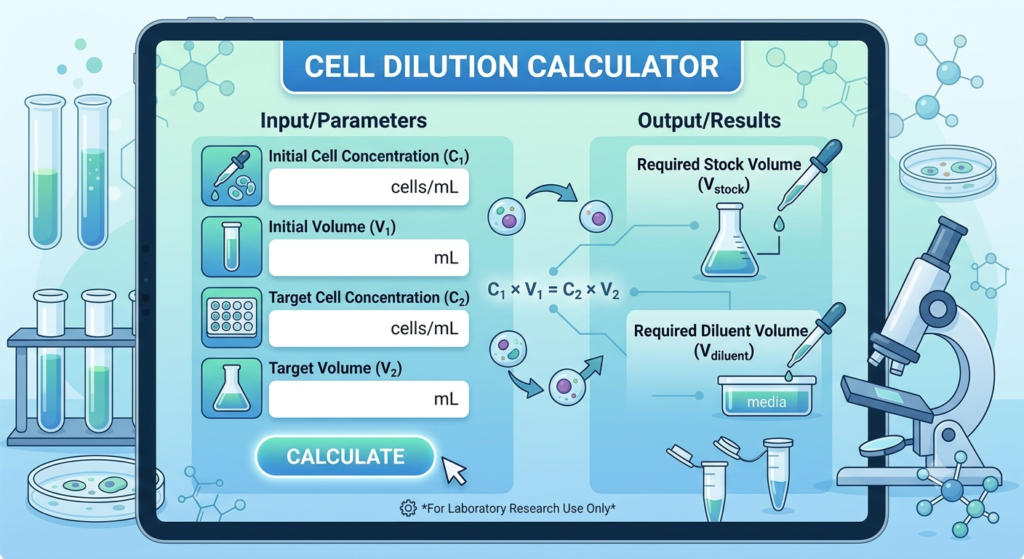
Cell Dilution Calculator
A Cell Dilution Calculator is a valuable laboratory tool that helps researchers determine the correct volume of cells and diluent needed to prepare samples at a desired concentration. Whether working in cell culture, microbiology, biotechnology, or biomedical research, accurate cell dilution is essential for obtaining reliable and reproducible experimental results.
Instead of performing manual calculations, this calculator quickly determines the required dilution using the standard dilution equation. It saves time, reduces calculation errors, and simplifies routine laboratory work for students, researchers, and laboratory professionals.
What Is a Cell Dilution Calculator?
A Cell Dilution Calculator calculates the amount of concentrated cell suspension and diluent required to achieve a target cell concentration.
It is commonly used before:
Cell culture experiments
Cell counting
Microscopy
Flow cytometry
Cell viability assays
Drug screening
Molecular biology experiments
Maintaining the correct cell concentration helps improve the accuracy of downstream laboratory procedures.
Why Cell Dilution Is Important
Preparing cells at the proper concentration ensures that experiments remain consistent and reproducible.
Proper cell dilution helps:
Improve experimental accuracy
Maintain healthy cell cultures
Prevent overcrowding of cells
Ensure reliable assay results
Standardize laboratory protocols
Reduce experimental variability
Accurate dilutions are especially important when comparing results between multiple experiments or laboratories.
Cell Dilution Formula
Most laboratory calculations use the standard dilution equation:
C₁ × V₁ = C₂ × V₂
Where:
C₁ = Initial cell concentration
V₁ = Volume of the original cell suspension
C₂ = Desired cell concentration
V₂ = Final volume after dilution
The calculator automatically rearranges this equation to determine the unknown value.
How to Use the Cell Dilution Calculator
Using the calculator requires only a few simple steps.
Step 1
Enter the initial cell concentration.
Step 2
Enter the desired final concentration.
Step 3
Enter the final volume required.
Step 4
Click the Calculate button.
Step 5
The calculator displays:
Volume of concentrated cells needed
Volume of diluent to add
Final dilution ratio
These results help prepare samples quickly and accurately.
Example Calculation
Suppose a laboratory has:
Initial concentration = 2 × 10⁶ cells/mL
Desired concentration = 5 × 10⁵ cells/mL
Final volume = 20 mL
Using the equation:
C₁ × V₁ = C₂ × V₂
V₁ = (5 × 10⁵ × 20) ÷ (2 × 10⁶)
V₁ = 5 mL
Diluent required:
20 − 5 = 15 mL
Therefore:
Cell suspension = 5 mL
Diluent = 15 mL
Benefits of Using a Cell Dilution Calculator
A Cell Dilution Calculator provides several advantages for laboratory work.
Saves Time
Calculations are completed instantly without manual formulas.
Reduces Human Error
Automatic calculations minimize mathematical mistakes.
Improves Accuracy
Correct cell concentrations improve experiment reliability.
Supports Reproducibility
Consistent sample preparation produces repeatable results.
Easy to Use
Researchers, laboratory technicians, educators, and students can all use the calculator with minimal effort.
Applications of Cell Dilution
Cell dilution is widely used in many scientific disciplines.
These include:
Cell biology
Molecular biology
Microbiology
Biotechnology
Clinical diagnostics
Pharmaceutical research
Immunology
Cancer research
Stem cell research
Academic laboratories
Factors That Affect Cell Dilution
Several factors should be considered before preparing diluted cell samples.
Cell Viability
Only healthy cells should be included in calculations.
Mixing Technique
Samples should be mixed thoroughly to ensure even distribution.
Accurate Cell Counting
Reliable cell counts produce accurate dilution calculations.
Sterile Technique
Maintaining sterile conditions prevents contamination.
Equipment Calibration
Properly calibrated pipettes improve measurement accuracy.
Common Mistakes During Cell Dilution
Errors during dilution can affect experimental outcomes.
Common mistakes include:
Incorrect cell counting
Pipetting inaccurate volumes
Mixing samples poorly
Using contaminated solutions
Miscalculating dilution ratios
Recording incorrect concentrations
Using a calculator helps reduce many of these errors.
Tips for Accurate Cell Dilution
Researchers often follow these best practices:
Count cells carefully before dilution.
Use calibrated pipettes.
Mix samples gently but thoroughly.
Work under sterile laboratory conditions.
Double-check concentration values before calculation.
Prepare fresh dilution media when possible.
These practices improve consistency across experiments.
Advantages of an Online Cell Dilution Calculator
An online calculator offers several benefits.
Fast calculations
Accessible from any device
User-friendly interface
Reduces manual work
Improves laboratory efficiency
Suitable for beginners and professionals
It serves as a practical resource for routine laboratory calculations.
Frequently Asked Questions
What is a Cell Dilution Calculator?
A Cell Dilution Calculator determines the amount of concentrated cell suspension and diluent required to achieve a desired final concentration.
What formula does the calculator use?
Most calculations use the standard dilution equation:
C₁ × V₁ = C₂ × V₂
Why is accurate cell dilution important?
Proper dilution improves experimental accuracy, reproducibility, and overall laboratory consistency.
Who uses a Cell Dilution Calculator?
The calculator is commonly used by researchers, laboratory technicians, microbiologists, students, educators, and biotechnology professionals.
Can this calculator be used for microbiology experiments?
Yes. It is useful for preparing bacterial, yeast, and other microbial suspensions, as well as mammalian cell cultures, depending on the experimental requirements.
Conclusion
A Cell Dilution Calculator is an essential laboratory tool that simplifies dilution calculations while improving accuracy and efficiency. By applying the standard C₁ × V₁ = C₂ × V₂ equation, it helps researchers prepare cell suspensions with confidence and consistency. Whether used in cell culture, microbiology, biotechnology, pharmaceutical research, or academic laboratories, this calculator reduces manual errors and supports reliable experimental outcomes. Combining it with other laboratory calculators, such as DNA concentration, annealing temperature, ligation, bacteria growth, and protein concentration calculators, creates a more efficient workflow for a wide range of biological experiments.