Dog Onion Toxicity Calculator

Ahmad zee
Table of Contents
Toggle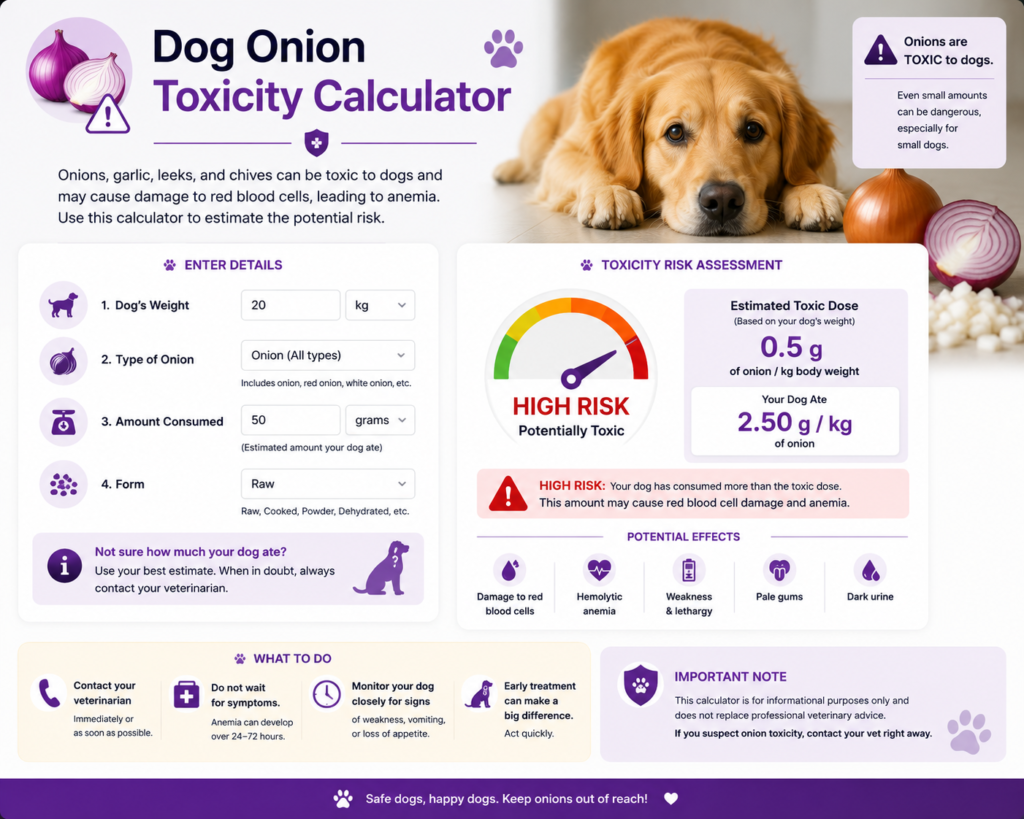
Dog Onion Toxicity Calculator: What Every Dog Owner Needs to Know
Dogs are famously curious, opportunistic eaters. They’ll sniff out a dropped piece of food before it hits the floor, nose through kitchen scraps, and help themselves to whatever accidentally falls within reach. Most of the time, this is harmless. But sometimes, what a dog eats can be genuinely dangerous — and one of the most commonly overlooked hazards hiding in everyday kitchens is the onion. Whether raw, cooked, powdered, or hidden inside a sauce or broth, onions are toxic to dogs, and the consequences of ingestion can range from mild digestive upset to life-threatening blood damage. A dog onion toxicity calculator is a fast, practical tool that helps dog owners assess the danger level based on how much their dog ate and how much it weighs — turning a frightening moment of uncertainty into a clear, informed next step.
This guide explains the science behind onion toxicity in dogs, how a toxicity calculator works, what symptoms to watch for, what to do in an emergency, and how to protect dogs from onion exposure going forward.
Why Are Onions Toxic to Dogs?
Onions belong to the Allium family of plants, which also includes garlic, leeks, chives, shallots, and scallions. All members of this plant family contain organosulfur compounds — specifically compounds called thiosulfates — that are harmless to humans but highly toxic to dogs (and cats).
When a dog ingests onion in any form, these thiosulfate compounds are absorbed into the bloodstream and begin attacking red blood cells. Specifically, they trigger a process called oxidative damage to hemoglobin — the protein inside red blood cells responsible for carrying oxygen throughout the body. This oxidative damage causes hemoglobin to form abnormal clumps known as Heinz bodies, which make red blood cells fragile, misshapen, and prone to rupturing prematurely.
As damaged red blood cells are destroyed faster than the body can replace them, the dog develops a condition called hemolytic anemia — a dangerous drop in healthy red blood cells that reduces the body’s ability to carry oxygen to vital organs. Without enough functional red blood cells, the heart, brain, kidneys, and other organs are deprived of adequate oxygen, which can rapidly become life-threatening if the underlying cause is not treated.
This toxic mechanism does not require a dog to eat a large amount of onion. The damage is cumulative, meaning repeated small exposures over time can be just as dangerous — or more so — than a single larger ingestion.
All Forms of Onion Are Dangerous
One of the most important things a dog owner can understand about onion toxicity is that the form of onion does not reduce its danger. Many people assume that cooked onions are safer than raw, or that small amounts are negligible. Neither assumption is accurate.
Raw Onions
Raw onions are toxic to dogs and can cause harm even in relatively small quantities, particularly in smaller dogs. Dogs that raid garden beds, steal onion scraps from a cutting board, or access kitchen waste bins are at risk from raw onion exposure.
Cooked Onions
Cooking does not destroy the thiosulfate compounds responsible for onion toxicity. Sautéed onions, caramelized onions, roasted onion pieces, and onions in casseroles, stews, soups, or pasta sauces are every bit as toxic as raw onion. This is a significant risk because cooked foods containing onion are far more likely to be offered to dogs as “leftovers” or table scraps, often without the owner realizing the danger.
Onion Powder
Onion powder is the most concentrated — and therefore most dangerous — form of onion for dogs. The dehydration process concentrates the toxic compounds significantly, making onion powder roughly five times more potent per gram than fresh onion. Foods that contain onion powder as a flavoring ingredient — including many soups, gravies, sauces, seasoned meats, snack foods, and baby foods — can pose a serious risk even in small quantities.
Onion Salt and Seasoning Blends
Many seasoning blends, garlic salts, and flavored seasonings contain onion powder or onion salt as an ingredient. Dog owners who use these in cooking should be especially careful to keep them away from dogs and avoid offering dogs any food seasoned with these products.
Dried or Dehydrated Onion
Like onion powder, dried or dehydrated onion flakes are more concentrated than fresh onion and should be treated as high-risk for dogs.
What Is a Dog Onion Toxicity Calculator?
A dog onion toxicity calculator is an online tool that estimates the level of toxicity risk a dog faces after consuming onion, based on two key inputs: the amount of onion ingested and the dog’s body weight. By comparing these two values, the calculator determines whether the ingested quantity falls within the range associated with mild, moderate, or severe toxicity.
This kind of risk assessment is genuinely valuable in the immediate aftermath of an onion ingestion incident. Rather than simply panicking — or, at the opposite extreme, doing nothing because the amount “seemed small” — dog owners can use the calculator to quickly contextualize the situation and determine whether urgent veterinary attention is needed.
The general toxicity threshold commonly cited in veterinary literature is approximately 5 grams of onion per kilogram of body weight for fresh onion. For onion powder, the threshold is considerably lower — around 1 gram per kilogram — due to its more concentrated nature. A dog onion toxicity calculator applies these thresholds automatically, giving a risk rating based on the specific combination of ingested quantity and the dog’s weight.
Because the toxic dose is directly tied to body weight, smaller dogs face a much higher risk from any given amount of onion than larger dogs do. An amount of onion that might cause only mild symptoms in a 30-kilogram Labrador could be seriously dangerous for a 5-kilogram Chihuahua or Yorkshire Terrier. This size-related risk difference is one of the most important reasons why a weight-based toxicity calculator is more useful than any general rule of thumb. Keeping track of a dog’s accurate weight — through tools like the Dog BMI Calculator — is therefore an important part of responsible pet ownership that directly supports accurate toxicity risk assessment.
How to Use a Dog Onion Toxicity Calculator
Using a dog onion toxicity calculator is fast and straightforward, even for someone who has never used one before. Here is how the process typically works:
Step 1 — Determine the Amount of Onion Ingested
The first input is how much onion the dog consumed, measured in grams. If the exact amount is not known, an estimate is better than nothing — try to think through what was in the food, how much the dog likely ate, and what proportion of it was onion. For packaged or prepared foods, the ingredient list or nutrition information may help estimate the onion content.
Step 2 — Identify the Form of Onion
Some calculators ask whether the onion ingested was raw, cooked, or in powdered form, since concentration levels differ significantly between forms. If onion powder was involved, even a small quantity may push the result into a higher-risk category.
Step 3 — Enter the Dog’s Body Weight
The dog’s current body weight in kilograms (or pounds, depending on the calculator) is the second key input. This should be as accurate as possible, since the entire risk calculation is based on the ratio of onion consumed to the dog’s body mass.
Step 4 — Review the Result
The calculator outputs a risk level — typically expressed as low, moderate, high, or toxic — along with guidance on next steps. Most calculators recommend contacting a veterinarian or animal poison control at any risk level above low, since even a “moderate” exposure can progress to serious toxicity, particularly in smaller dogs or those with underlying health conditions.
Toxic Dose Reference Table
The following table provides a general reference for estimated toxic thresholds based on body weight. These figures are approximate and intended for educational purposes only — a veterinarian should always be consulted after any onion ingestion.
| Dog’s Body Weight | Potentially Harmful Dose (Fresh Onion) | High-Risk Dose |
|---|---|---|
| 5 kg (11 lbs) | 12–25 g (less than 1 oz) | 25 g+ |
| 10 kg (22 lbs) | 25–50 g (approx. ½ onion) | 50 g+ |
| 15 kg (33 lbs) | 37–75 g | 75 g+ |
| 20 kg (44 lbs) | 50–100 g (approx. 1 small onion) | 100 g+ |
| 30 kg (66 lbs) | 75–150 g | 150 g+ |
| 40 kg (88 lbs) | 100–200 g (approx. 1–2 medium onions) | 200 g+ |
For onion powder, divide these thresholds by approximately five to reflect its much greater concentration of toxic compounds.
Symptoms of Onion Toxicity in Dogs
One of the more challenging aspects of onion toxicity is that symptoms do not always appear immediately. Because the damage occurs at the cellular level — gradually weakening and destroying red blood cells — signs of onion poisoning may not become visible for one to five days after ingestion. This delayed onset is one reason why immediate veterinary contact matters so much, even before symptoms appear.
Early Symptoms (Within Hours to Days)
Early signs of onion toxicity often reflect gastrointestinal irritation and may include:
- Vomiting
- Diarrhea or loose stools
- Drooling
- Abdominal discomfort or bloating
- Reduced appetite or complete refusal to eat
- Nausea (evidenced by lip licking, gulping, or restlessness)
These early gastrointestinal symptoms may resolve without specific treatment, which can falsely reassure dog owners that the crisis has passed. In reality, the more serious systemic effects — the destruction of red blood cells — may still be building in the background.
Symptoms of Hemolytic Anemia (Days 1–5 Post-Ingestion)
As red blood cell destruction accelerates, dogs begin to show signs of hemolytic anemia. These symptoms indicate the body is no longer able to deliver adequate oxygen to vital organs and require urgent veterinary attention:
- Pale, white, or yellowish gums — one of the clearest visible indicators of anemia
- Extreme lethargy or weakness — the dog may refuse to walk, struggle to stand, or seem profoundly tired
- Rapid or labored breathing — the body attempts to compensate for low oxygen by breathing faster
- Increased heart rate — the heart works harder to circulate depleted red blood cells
- Exercise intolerance — even minor physical activity causes pronounced fatigue
- Fainting or collapse
- Red or brown-tinged urine — a sign that damaged red blood cells are being excreted through the kidneys, which also indicates kidney stress
Signs of Severe Toxicity
In serious cases, onion toxicity can progress to:
- Organ dysfunction due to oxygen deprivation
- Jaundice (yellowing of skin, eyes, or gums) due to the breakdown of large numbers of red blood cells
- Severe dehydration from vomiting and reduced fluid intake
- Cardiovascular stress from prolonged anemia
- In extreme cases, multi-organ failure
The severity of symptoms is directly related to the amount consumed relative to the dog’s body weight, the form of onion ingested, whether the exposure was a single event or repeated over time, and the individual dog’s health status and age.
Other Allium Family Foods That Are Toxic to Dogs
The danger does not stop with onions. All members of the Allium family are toxic to dogs, and some are even more potent than onions. Dog owners should be aware of the full range of toxic Allium plants:
Garlic
Garlic is generally considered more toxic than onion on a per-gram basis — roughly three to five times more potent. This makes garlic powder especially dangerous, as even small quantities can cause significant harm. Dogs that are regularly given garlic as a supposed natural flea remedy or health supplement are at risk of cumulative toxicity.
Leeks
Leeks contain the same thiosulfate compounds as onions and should be considered equally dangerous. Their mild flavor makes them a common ingredient in soups, stews, and casseroles that owners might be tempted to share with their dogs.
Chives
Chives are a frequently overlooked toxic Allium. They are commonly used as garnishes on baked potatoes, in dips, and in savory dishes. Like other Allium plants, they are toxic to dogs and should never be offered intentionally or allowed to be consumed accidentally.
Shallots
Shallots are essentially a more pungent variety of onion and are equally toxic. They appear frequently in gourmet cooking and international cuisines.
Scallions (Green Onions / Spring Onions)
Scallions are another commonly overlooked risk. They are a popular topping for Asian dishes, salads, and soups, and while they contain less onion-per-gram than a full bulb, they still contain thiosulfates and should be considered toxic to dogs.
What to Do If a Dog Eats Onion
Speed and clarity of action are the most important factors when a dog has eaten onion. Here is a step-by-step guide to handling the situation appropriately.
Step 1 — Stay Calm and Assess the Situation
Panic makes it harder to think clearly. Take a breath and try to determine: what form of onion was consumed (raw, cooked, powdered), approximately how much was eaten, and when the ingestion occurred. These details are critical for both the toxicity calculator and the veterinarian.
Step 2 — Use a Dog Onion Toxicity Calculator
A dog onion toxicity calculator provides an immediate, evidence-based risk assessment. Enter the estimated amount consumed and the dog’s weight to get a risk level. Even a low-risk result should be followed up with a call to a veterinarian or poison control, since the calculator provides an estimate — not a diagnosis.
Step 3 — Contact a Veterinarian or Animal Poison Control
Any onion ingestion, regardless of the calculated risk level, warrants professional guidance. A veterinarian can advise on whether the dog should be brought in immediately, whether inducing vomiting at home is appropriate (it generally should only be done under veterinary guidance), and what monitoring to do at home if the risk appears low.
Animal poison control hotlines — such as the ASPCA Animal Poison Control Center or the Pet Poison Helpline — provide 24-hour expert guidance and are an excellent resource when a regular veterinarian is unavailable.
Step 4 — Do Not Induce Vomiting Without Veterinary Guidance
Inducing vomiting in dogs without professional guidance can be dangerous, particularly if the dog is already showing symptoms, has ingested a caustic substance, or if significant time has passed since ingestion. A veterinarian or poison control advisor should always confirm whether this is the appropriate step before it is attempted.
Step 5 — Monitor Closely and Return to the Vet If Symptoms Develop
Even if the initial assessment suggests low risk, dog owners should monitor their pet closely for the next several days. Since symptoms of hemolytic anemia may not appear until two to five days after ingestion, any changes in energy, appetite, gum color, breathing, or urine color should prompt an immediate return to the veterinarian.
Veterinary Treatment for Onion Toxicity in Dogs
The treatment approach for onion toxicity depends on how much onion was consumed, when ingestion occurred, and what symptoms the dog is currently showing.
Decontamination
If a dog is brought to a veterinarian within a few hours of ingesting onion, the first priority may be decontamination — specifically, inducing vomiting to remove as much of the onion from the stomach as possible before it is fully absorbed. This is typically followed by the administration of activated charcoal, which binds remaining toxins in the gastrointestinal tract and reduces further absorption.
Decontamination is most effective when performed promptly. It has limited benefit once several hours have passed after ingestion.
Supportive Care
Dogs showing symptoms of hemolytic anemia require supportive care to stabilize their condition while the body gradually eliminates the toxic compounds. Supportive care may include:
- IV fluids — to maintain hydration, support kidney function, and stabilize blood pressure. Adequate hydration is critically important during onion toxicity recovery, which is why dog owners should monitor water intake closely during home monitoring periods. The Dog Water Intake Calculator can help owners understand their dog’s baseline daily water needs and recognize when intake drops significantly — a potential sign of deteriorating condition.
- Rest and activity restriction — minimizing physical activity reduces the oxygen demand placed on the dog’s already-compromised red blood cell supply
- Nutritional support — maintaining adequate nutrition supports the body’s ability to produce new red blood cells
Blood Transfusion
In severe cases where the dog’s red blood cell count drops to a critically low level — a condition known as severe hemolytic anemia — a blood transfusion may be necessary to stabilize the dog while its body regenerates healthy red blood cells. Blood transfusions in dogs are complex procedures that require specialized veterinary care, but they can be life-saving in cases of severe toxicity.
Monitoring and Follow-Up
Dogs treated for onion toxicity typically require blood work to monitor red blood cell counts and assess the progression or resolution of anemia. Follow-up appointments allow the veterinarian to confirm that the dog is recovering appropriately and that no secondary complications are developing.
Which Dogs Are Most at Risk?
While onion toxicity affects all dogs, some are more vulnerable than others:
Small Breeds
Because toxicity is calculated based on the ratio of onion ingested to body weight, small breeds face a disproportionately higher risk from any given amount of onion. A single piece of onion-containing pizza, a spoonful of onion-flavored soup, or a small quantity of garlic bread can push a 4 or 5 kilogram dog into a moderate or high toxicity range. Small breed owners should be especially vigilant about keeping all Allium-containing foods out of reach.
Puppies
Puppies have less developed organ systems and immune function than adult dogs, which makes them more susceptible to the effects of toxins. Their smaller size also compounds the risk by reducing the threshold at which a dangerous dose is reached.
Senior Dogs
Older dogs may have reduced bone marrow activity, which means they produce new red blood cells more slowly. This makes them less resilient in the face of hemolytic anemia triggered by onion toxicity, as their bodies are less equipped to replace the red blood cells being destroyed.
Dogs with Pre-Existing Health Conditions
Dogs with anemia, kidney disease, liver disease, immune system disorders, or other chronic health conditions are at higher baseline risk and may experience more severe effects from onion exposure than otherwise healthy dogs.
Certain Breeds
Some dog breeds — particularly Japanese breeds such as Shiba Inus and Akitas — appear to have red blood cells that are more susceptible to oxidative damage than those of other breeds. While all dogs are vulnerable to onion toxicity, these breeds may develop more severe reactions at lower doses.
Hidden Sources of Onion in Everyday Foods
Many dog owners are diligent about keeping whole onions away from their dogs but overlook the many processed, prepared, and packaged foods that contain onion as an ingredient. Common hidden sources include:
- Baby food — many pureed baby food products use onion powder as a flavoring agent. These are sometimes given to sick dogs as an appetizing food source, which can inadvertently cause toxicity.
- Instant soups and broths — both dry and liquid varieties frequently contain onion powder or dehydrated onion
- Gravies and sauces — including commercially prepared gravies that might seem appropriate to pour over a dog’s food
- Seasoned meats and deli meats — many contain garlic or onion salt as a preservative or flavoring
- Fast food and takeout — burgers, sandwiches, and fries frequently contain onion or onion powder
- Flavored snack foods — chips, crackers, and savory snacks often list onion powder in their ingredient lists
- Pasta sauces and pizza — both frequently contain cooked onion or onion powder in significant quantities
- Soups and stews — almost universally contain onion as a base ingredient
The key takeaway is that dog owners should read ingredient labels on any prepared food before offering any portion to their dog, and should default to never sharing human food unless they are certain of every ingredient.
Comparing Onion Toxicity to Other Common Food Toxins in Dogs
Onion is far from the only household food that poses a danger to dogs. Understanding how it compares to other common food toxins helps dog owners maintain a broader sense of kitchen safety.
Onion vs. Garlic
As noted earlier, garlic is more toxic per gram than onion due to a higher concentration of thiosulfate compounds. Garlic powder is the most dangerous form. Dogs should never be given garlic in any form, despite persistent myths about garlic as a natural health supplement for dogs.
Onion vs. Chocolate
Chocolate toxicity in dogs is driven by compounds called theobromine and caffeine. Like onion, the severity depends on the dog’s weight and the amount consumed, with dark chocolate and baking chocolate posing much higher risks than milk chocolate. For cat owners who also want to understand this type of toxicity risk, the Cat Chocolate Toxicity Calculator provides a parallel assessment tool for feline companions.
Onion vs. Grapes and Raisins
Grapes and raisins can cause acute kidney failure in dogs, and the exact toxic compound has not yet been definitively identified. What makes grapes and raisins particularly alarming is that the toxic threshold is highly variable — some dogs have severe reactions to tiny amounts, while others appear unaffected by larger quantities. Any grape or raisin ingestion should always be treated as a veterinary emergency.
Onion vs. Xylitol
Xylitol is an artificial sweetener found in many sugar-free products — chewing gum, some peanut butters, dental care products, baked goods, and candies. It causes a dangerous and rapid drop in blood sugar (hypoglycemia) and can cause liver failure in dogs. Xylitol is considered one of the most acutely toxic food substances for dogs, with life-threatening effects possible from very small amounts.
Preventing Onion Exposure at Home
The best strategy for protecting dogs from onion toxicity is creating an environment where accidental ingestion is simply not possible. Here are practical prevention strategies:
Secure the Kitchen
Dogs should not have unsupervised access to kitchen counters, food preparation areas, or rubbish bins. Baby gates, closed doors, and purpose-built dog-proof rubbish bins can all help prevent opportunistic scavenging.
Store Onions and Allium Vegetables Properly
Onions, garlic, and leeks should be stored in closed containers, cabinets, or pantries rather than on open countertops or in accessible vegetable baskets where a curious dog might investigate.
Train “Leave It” Reliably
A well-trained “leave it” command is one of the most valuable safety tools a dog owner can have. Dogs that reliably respond to this command can be redirected away from dropped food, kitchen scraps, or anything else that falls within reach before they consume it.
Avoid Offering Table Scraps
Many cases of onion toxicity in dogs occur when owners offer well-meaning but inadvertently dangerous table scraps. Establishing a household rule that human food is not offered to the dog — and educating all family members and guests about this rule — significantly reduces the risk of accidental toxic exposure. Using a resource like the Dog Food Calculator helps owners understand exactly what a dog’s dietary needs are and creates a clear framework for meeting those needs without supplementing with potentially unsafe human food.
Read Labels on All Dog-Directed Products
Check ingredient labels on any commercial dog food, treats, or supplements. While reputable manufacturers formulate their products to avoid toxic ingredients, some lower-quality products have been found to contain garlic or onion derivatives. Choosing dog foods from trusted brands with transparent ingredient sourcing is a worthwhile investment in long-term safety.
Keep the Veterinarian’s Number and Poison Control Numbers Accessible
In the event of accidental ingestion, having emergency contact numbers readily available — the regular vet, an emergency veterinary clinic, and animal poison control — eliminates precious minutes spent searching for help. These numbers should be saved in every household member’s phone and posted somewhere visible in the home.
Frequently Asked Questions
How much onion is dangerous for a dog?
As a general guideline, approximately 5 grams of raw onion per kilogram of body weight is considered a potentially harmful dose for dogs. For onion powder, the threshold is approximately 1 gram per kilogram due to its concentrated nature. However, these are general estimates — a dog onion toxicity calculator provides a more precise risk assessment based on the actual amount consumed and the dog’s weight.
Can a small amount of onion hurt a dog?
Even small amounts of onion can be harmful, particularly in small dogs or when exposure occurs repeatedly over time. There is no proven safe threshold for onion in dogs, and any ingestion should be taken seriously.
My dog ate onion yesterday and seems fine — should I still see a vet?
Yes. The most serious effects of onion toxicity — hemolytic anemia — may not become visible for one to five days after ingestion. A dog appearing fine in the immediate aftermath of onion consumption can still go on to develop serious symptoms days later. Veterinary assessment, including baseline blood work, is recommended even when the dog seems normal.
Is onion powder more dangerous than raw onion?
Yes, significantly. Onion powder is concentrated and contains roughly five times the toxic compounds per gram compared to fresh onion. This makes it particularly hazardous, as even small quantities of foods flavored with onion powder can push a dog into a dangerous dose range.
Can repeated small amounts of onion cause toxicity?
Absolutely. Onion toxicity is cumulative. Dogs that receive small amounts of onion regularly — through table scraps, flavored foods, or unintentional exposure — can develop toxicity over time even if no single exposure was large enough to cause immediate symptoms.
What should dog owners do to help a dog recover from onion toxicity?
Recovery depends on the severity of exposure. Following veterinary treatment, dogs recovering from onion toxicity should rest, stay well hydrated, eat a nutritious and easily digestible diet, and avoid any further Allium exposure. Regular follow-up appointments allow the veterinarian to monitor blood counts and confirm that the dog is producing enough new red blood cells to recover fully. The Dog Life Expectancy Calculator can give owners broader context about their dog’s health baseline and long-term outlook as part of holistic recovery planning.
The Role of a Dog Onion Toxicity Calculator in Pet Safety
In a moment of panic — when a dog has just eaten something it shouldn’t have — clear information is invaluable. A dog onion toxicity calculator transforms a frightening situation into a manageable one by providing immediate, weight-based risk context that helps dog owners decide quickly and confidently what to do next.
It does not replace veterinary expertise, and it should never be used as a reason to avoid seeking professional help. But it does serve as an essential first step — a way of understanding the scale of the risk before making the call to the vet, and a way of communicating useful information (estimated dose, dog’s weight, calculated risk level) when that call is made.
For multi-pet households, similar toxicity awareness tools are available for other animals and other substances. The Cat Chocolate Toxicity Calculator, for example, provides the same kind of immediate risk assessment for cat owners dealing with chocolate exposure — a reminder that food toxicity awareness is an important part of caring for all kinds of pets.
Conclusion
Onions are one of the most underestimated dangers in a dog’s domestic environment. They are everywhere — in everyday cooking, in prepared foods, in leftovers and table scraps — and their toxicity is both cumulative and delayed, making it easy for the damage to occur before an owner realizes anything is wrong. Understanding the science behind onion toxicity, recognizing the symptoms of poisoning, and knowing exactly what to do after an exposure are all essential parts of responsible dog ownership.
A dog onion toxicity calculator is a practical, important safety tool that every dog owner should know about. Combined with a dog-safe kitchen environment, solid training, and a trusted veterinary relationship, it forms part of a broader commitment to keeping dogs safe from the hidden hazards that share their home.
Because when it comes to onion toxicity in dogs, what owners do in the first hours can make an enormous difference to what happens in the days that follow.
Explore the full collection of dog health and safety tools — including nutrition, weight, medication, and lifespan calculators — at OmniCalculator Store’s Biology section.