
Ahmad zee
Table of Contents
Toggle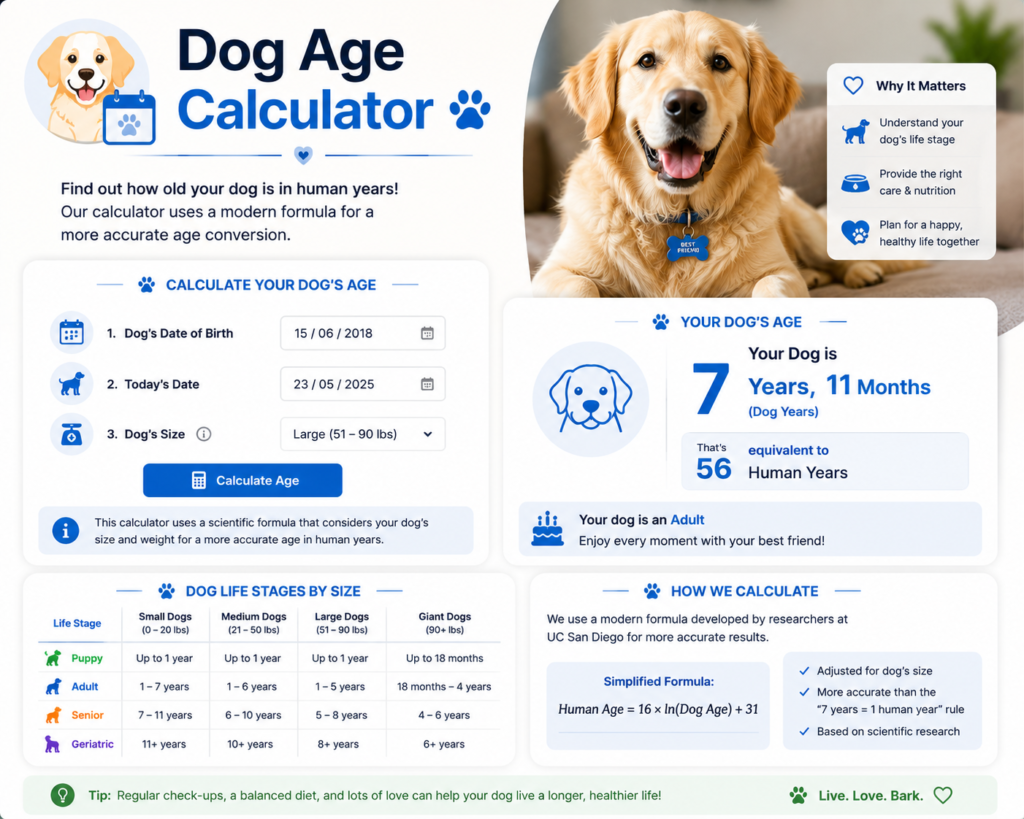
Dog Age Calculator — How Old Is Your Dog in Human Years?
Every dog owner has asked themselves the same question at some point: “How old is my dog in human years?” It’s one of those fun yet surprisingly meaningful questions that goes deeper than most people expect. The classic “multiply by 7” rule has been floating around for decades — but science tells a very different story. That’s where a Dog Age Calculator becomes genuinely useful — and honestly, pretty eye-opening.
What Is a Dog Age Calculator?
A Dog Age Calculator is an online tool designed to convert a dog’s chronological age into its estimated human-equivalent age. Rather than relying on outdated or oversimplified formulas, modern calculators factor in a dog’s size, breed category, and life stage to generate a far more accurate comparison.
Think of it this way: a 2-year-old Labrador and a 2-year-old Chihuahua are not at the same biological stage of life — and a smart calculator accounts for that difference with ease.
Why the “Multiply by 7” Rule Doesn’t Hold Up
For years, the widely repeated rule was simple: multiply a dog’s age by 7 to get its human equivalent. While this made for easy math, it was never particularly accurate.
Here’s why it falls short:
- Dogs mature much faster in their early years. A 1-year-old dog is already sexually mature and physically developed — closer to a 15-year-old human, not a 7-year-old.
- The aging rate slows down as dogs get older. In their senior years, the gap between dog years and human years narrows considerably.
- Breed size plays a major role. Larger breeds age faster and have shorter lifespans compared to smaller breeds, who tend to live longer.
A well-designed Dog Age Calculator takes all of these variables into account, giving owners a much more reliable picture of where their furry companion actually stands in life.
How Does a Dog Age Calculator Work?
Most modern Dog Age Calculators use a two-variable input system:
- The dog’s actual age (in years or months)
- The dog’s size or breed category (small, medium, large, or giant)
Once these values are entered, the calculator applies scientifically-informed formulas — some based on recent genomic research — to produce a human-age equivalent.
For instance, research published in Cell Systems found that canine DNA methylation patterns suggest a 2-year-old dog is roughly equivalent to a 42-year-old human. The aging curve then flattens somewhat as the dog continues to grow older.
This kind of insight matters not just for fun comparisons — it helps owners recognize when their dog enters puppyhood, adulthood, middle age, and senior status so that care can be adjusted accordingly.
Dog Life Stages and What They Mean
Understanding a dog’s life stage is one of the most practical benefits of using a Dog Age Calculator. Each stage comes with its own set of health priorities and behavioral traits.
Puppy Stage (0–1 Year)
This is the fastest growth phase. During the first year, a dog’s development is rapid and dramatic. A 6-month-old puppy is roughly equivalent to a 10–12-year-old child in terms of developmental milestones. Proper nutrition during this stage is critical — using a Dog Food Calculator can help owners ensure puppies receive the right balance of nutrients during this intense growth window.
Young Adult Stage (1–3 Years)
Dogs in this range are energetic, curious, and at their physical peak. They’re roughly equivalent to humans in their early-to-mid twenties. Behavioral training and physical activity tend to be most effective during this window.
Adult Stage (3–7 Years)
This is often described as a dog’s “prime” phase. Energy levels are consistent, health is generally stable, and personality is well-established. Caloric needs can shift subtly during this period — keeping an eye on weight using a Dog BMI Calculator helps owners track body condition and avoid the early creep of weight gain.
Senior Stage (7+ Years for Large Breeds / 10+ for Small Breeds)
Senior dogs require more frequent veterinary check-ups, adjusted diets, and often gentler exercise. A Dog Age Calculator helps owners identify this transition point, so they can begin proactive senior care before problems arise rather than after.
How Dog Size Affects the Aging Process
One of the most important — and often overlooked — factors in canine aging is body size. Unlike most mammals, where larger size tends to correlate with longer lifespan, dogs are a fascinating exception.
| Size Category | Weight Range | Average Lifespan |
|---|---|---|
| Small (Toy/Mini) | Under 20 lbs | 12–16 years |
| Medium | 20–50 lbs | 10–13 years |
| Large | 50–90 lbs | 9–11 years |
| Giant | 90+ lbs | 7–10 years |
A Great Dane at age 6 is already considered a senior dog. A Dachshund at 6 is still very much in its adult prime. Without accounting for size, age comparisons become misleading. A well-built Dog Age Calculator always includes size as a core input for this very reason.
Why Knowing Your Dog’s Equivalent Age Actually Matters
Beyond satisfying curiosity, understanding a dog’s human-equivalent age carries some real practical benefits.
Better Preventive Healthcare
Knowing a dog is in the biological equivalent of its late 50s or early 60s — even if it’s only 9 or 10 calendar years old — motivates owners to schedule bloodwork, joint assessments, and dental cleanings earlier. Many conditions in senior dogs, such as kidney disease, hypothyroidism, and arthritis, are far more manageable when caught early.
Smarter Nutritional Planning
A dog’s caloric and nutritional needs shift with age. Puppies need higher protein and fat; seniors often benefit from lower-calorie, joint-supportive diets. Using a Dog Calorie Calculator alongside a Dog Age Calculator helps owners align feeding habits with their dog’s actual biological stage — not just its birthday.
Recognizing Behavioral Changes
What looks like stubbornness or laziness in an older dog may actually be a normal, age-appropriate shift in energy and cognition. Knowing a dog is in its senior years helps owners respond with empathy rather than frustration.
Planning for Future Care
For those considering breeding, knowing a female dog’s biological age is especially relevant. Breeding a dog too late in life carries risks for both the mother and offspring. A Dog Pregnancy Calculator can assist in planning pregnancies responsibly when combined with a clear picture of the dog’s age and health status.
Safety Awareness Across Life Stages
Age-related care doesn’t stop at nutrition and exercise. Senior and even adult dogs can be more vulnerable to certain household dangers. Owners of dogs at any life stage should be aware that common human foods — like onions and garlic — can be genuinely dangerous for dogs. A Dog Onion Toxicity Calculator is a helpful tool for quickly assessing whether accidental exposure to onions or allium-family foods poses a health risk based on the dog’s weight.
How to Use a Dog Age Calculator — Step by Step
Using a Dog Age Calculator is refreshingly simple. Here’s a quick walkthrough:
- Enter the dog’s current age — most calculators accept input in years, some allow months for younger dogs.
- Select the dog’s size category — choose from small, medium, large, or giant, depending on the dog’s adult weight.
- Click calculate — the tool processes the inputs and returns the estimated human-equivalent age.
- Review the life stage note — many calculators also indicate whether the dog is in the puppy, adult, or senior stage.
The whole process takes under a minute, and the results can genuinely shift how an owner approaches care decisions.
Common Questions About Dog Age Conversion
Is the 7-year rule completely wrong?
Not completely — it produces a rough estimate that’s sometimes in the ballpark. But it’s far too uniform to be truly useful. It doesn’t account for breed size, rapid early development, or the slowing of aging in later years. Modern calculators offer meaningfully better estimates.
Do mixed-breed dogs age differently?
Mixed-breed dogs tend to follow aging patterns based on their approximate size, which is often the most reliable predictor when breed isn’t known. For mixed breeds, using the size category that best matches the dog’s adult weight is the recommended approach.
At what age is a dog considered “senior”?
This varies by size. Large and giant breeds are typically considered senior around 5–7 years. Small breeds may not reach senior status until 10–12 years. A Dog Age Calculator that factors in size will reflect these differences accurately.
Can knowing a dog’s age help with training?
Absolutely. Puppies, adolescents, and adults respond differently to training approaches. Understanding a dog’s developmental stage — not just its calendar age — helps owners and trainers set realistic expectations and choose appropriate methods.
Final Thoughts
A Dog Age Calculator might seem like a simple novelty at first glance, but it’s actually a genuinely useful tool that supports smarter, more compassionate dog ownership. When owners understand where their dog stands in its biological journey — not just how many candles are on the birthday cake — they make better decisions about nutrition, veterinary care, exercise, and even emotional support.
Whether someone is raising a bouncy 8-month-old pup or sharing their home with a distinguished 12-year-old companion, understanding the true biological equivalent of that age puts the relationship on a more informed footing. And for dogs who can’t tell their owners when something feels off, that informed care is one of the most loving things an owner can offer.