Raised Bed Soil Calculator

Ahmad zee
Table of Contents
Toggle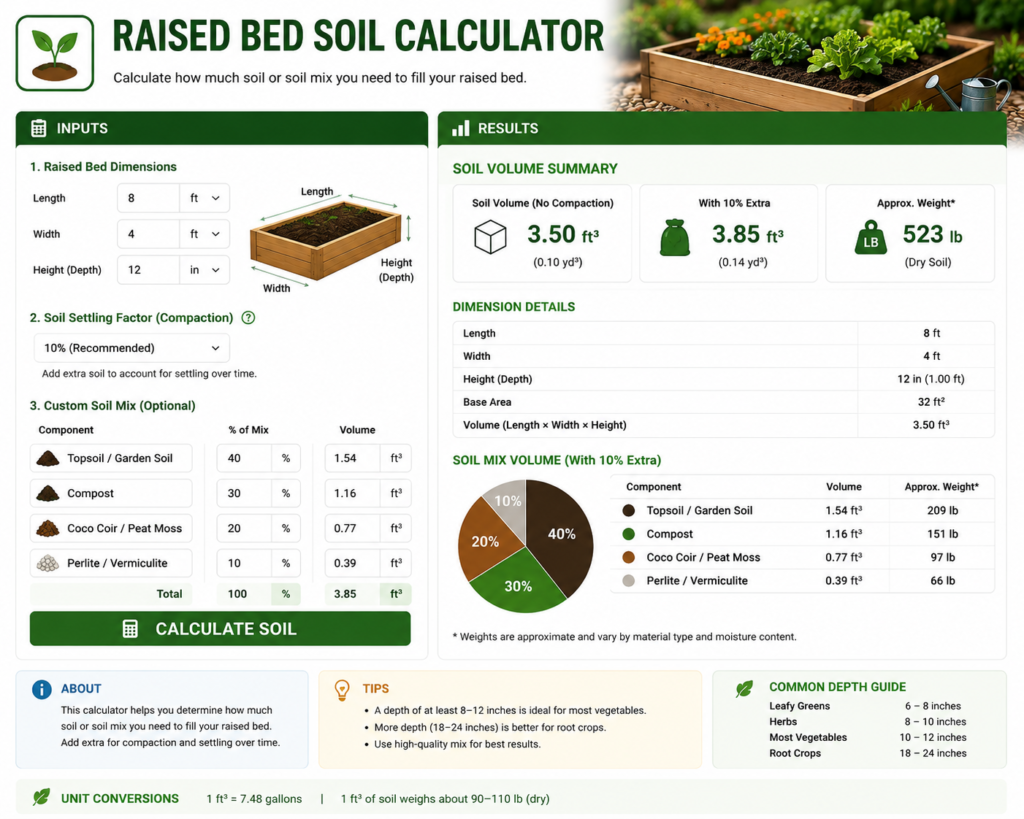
Raised Bed Soil Calculator
A Raised Bed Soil Calculator helps gardeners, homeowners, landscapers, and growers estimate the amount of soil required to fill a raised garden bed. By entering the bed’s length, width, and depth, the calculator determines the total soil volume needed, helping users purchase the correct amount while reducing waste and unnecessary expense.
Whether growing vegetables, herbs, flowers, or ornamental plants, using the right amount of soil creates an ideal growing environment and supports healthy root development.
What Is a Raised Bed Soil Calculator?
A Raised Bed Soil Calculator estimates the volume of soil required to fill one or more raised garden beds.
The calculator typically considers:
- Bed length
- Bed width
- Bed depth
- Number of raised beds
- Measurement units
It then calculates the amount of soil needed in cubic feet, cubic yards, litres, or cubic metres.
How Does the Raised Bed Soil Calculator Work?
The calculator uses the dimensions of the raised bed to estimate soil volume.
Users generally enter:
- Bed length
- Bed width
- Bed depth
- Number of beds
- Preferred unit of measurement
The calculator then estimates:
- Soil volume per raised bed
- Total soil required
- Approximate number of soil bags (based on bag size)
Raised Bed Soil Formula
The calculator uses a basic volume formula:
Soil Volume = Length × Width × Depth
Make sure all measurements are entered using the same unit before calculating the total soil volume.
Why Use a Raised Bed Soil Calculator?
Estimating soil requirements before purchasing materials offers several benefits.
Benefits include:
- Prevents buying excess soil
- Reduces material waste
- Simplifies garden planning
- Helps estimate project costs
- Supports healthy plant growth
- Improves planting efficiency
- Makes raised bed construction easier
Benefits of Raised Garden Beds
Raised beds provide many advantages for home gardens and small farms.
Some key benefits include:
- Improved soil drainage
- Better root development
- Reduced soil compaction
- Easier weed management
- Longer growing season
- Improved accessibility
- Better control over soil quality
Factors That Affect Soil Requirements
Several factors influence the amount of soil needed.
Bed Dimensions
Larger and deeper beds naturally require more soil.
Soil Mix
The composition of the soil mix can affect the total quantity needed if additional compost or organic matter is added.
Number of Beds
Multiple raised beds increase the total soil volume required.
Plant Type
Deep-rooted crops often require deeper soil than shallow-rooted plants.
Existing Fill Material
Some gardeners partially fill deep beds with organic materials before adding topsoil, reducing the amount of soil required.
Benefits of Using a Raised Bed Soil Calculator
A Raised Bed Soil Calculator offers several advantages.
- Calculates soil volume quickly
- Helps estimate bag quantities
- Reduces unnecessary purchases
- Supports garden planning
- Suitable for vegetable and flower beds
- Saves time and money
- Simplifies landscaping projects
Tips for Filling Raised Beds
For the best results:
- Measure each raised bed accurately.
- Use a high-quality soil mix.
- Add compost to improve soil fertility.
- Avoid compacting the soil too firmly.
- Water thoroughly after filling.
- Top up the soil as it settles over time.
- Choose plants suited to the bed depth.
Frequently Asked Questions
What is a Raised Bed Soil Calculator?
It is a tool that estimates how much soil is needed to fill one or more raised garden beds based on their dimensions.
Can this calculator estimate soil bags?
Yes. Once the total soil volume is calculated, it can be compared with the size of commercially available soil bags.
What type of soil is best for raised beds?
Many gardeners use a blend of topsoil, compost, and organic matter to create a nutrient-rich growing medium with good drainage.
Why does soil settle after filling a raised bed?
Newly added soil naturally settles over time as air pockets disappear and organic matter decomposes.
Can this calculator be used for flower beds and vegetable gardens?
Yes. It is suitable for raised beds used for vegetables, herbs, flowers, shrubs, and many other garden plants.
Other Useful Calculators
Explore more biology and agriculture calculators on Omni Calculator Store:
- Corn Yield Calculator
https://omnicalculator.store/home/biology/corn-yield-calculator/ - Potting Soil Calculator
https://omnicalculator.store/home/biology/potting-soil-calculator/ - Compost Calculator
https://omnicalculator.store/home/biology/compost-calculator/ - Plant Spacing Calculator
https://omnicalculator.store/home/biology/plant-spacing-calculator/ - Bulb Spacing Calculator
https://omnicalculator.store/home/biology/bulb-spacing-calculator/
Conclusion
A Raised Bed Soil Calculator is a practical tool for estimating the amount of soil needed for raised garden beds of any size. By calculating soil volume from the bed’s dimensions, gardeners can purchase the correct amount of soil, reduce waste, and create an ideal growing environment for healthy plants. Whether building a new vegetable garden, planting flowers, or expanding an existing landscape, this calculator makes raised bed planning simple, accurate, and efficient.