Cat Chocolate Toxicity Calculator

Ahmad zee
Table of Contents
Toggle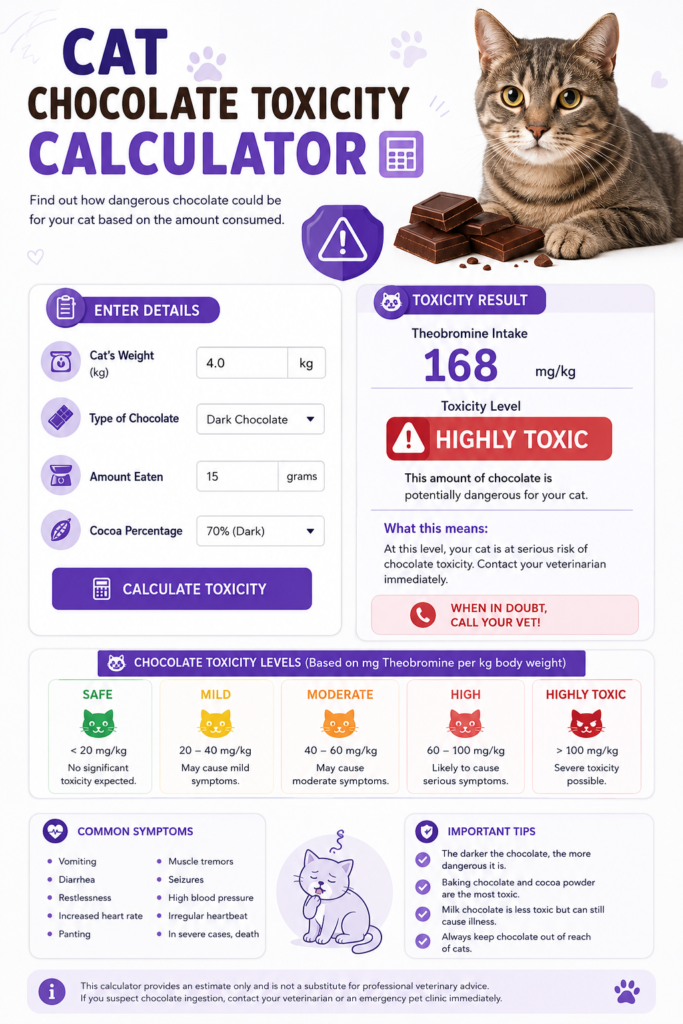
Cat Chocolate Toxicity Calculator: A Complete Guide for Cat Owners
Cats are notoriously selective eaters, and their natural dietary preferences tend to protect them from many of the foods that pose dangers to dogs. However, this doesn’t mean cats are immune to food toxicity — far from it. Chocolate is a perfect example. While dogs are statistically more likely to eat chocolate, cats that do consume it face a potentially serious medical emergency. Understanding chocolate toxicity in cats, recognizing when it’s a genuine threat, and knowing how to respond quickly are essential parts of responsible cat ownership. A cat chocolate toxicity calculator is a practical tool that helps cat owners assess the level of risk based on the type of chocolate consumed and their cat’s body weight — turning a moment of panic into a clear, evidence-based action plan.
This guide covers everything worth knowing about chocolate toxicity in cats: how it works, what symptoms to watch for, how a toxicity calculator works, when to seek emergency help, and how to keep cats safe from chocolate exposure.
Why Is Chocolate Toxic to Cats?
Chocolate contains two primary alkaloid compounds that are toxic to cats (and dogs): theobromine and caffeine. While humans metabolize these compounds relatively quickly and efficiently, cats lack sufficient liver enzymes to break them down effectively. This metabolic difference means that chocolate substances that would be harmless to a human can accumulate to toxic levels in a cat’s bloodstream and tissues.
Theobromine and caffeine work as stimulants and diuretics in the feline body. When present in high enough concentrations, they cause:
- Cardiovascular effects — increased heart rate and blood pressure, irregular heartbeat, and strain on the heart muscle
- Nervous system stimulation — anxiety, restlessness, tremors, and potentially seizures
- Muscle effects — muscle contractions, stiffness, and trembling
- Diuretic effects — increased urination and fluid loss, leading to dehydration and electrolyte imbalances
The severity of toxicity depends on multiple factors: the type of chocolate consumed, the amount ingested, the cat’s body weight, the cat’s age and overall health, and how long ago ingestion occurred. Understanding these variables is exactly what a cat chocolate toxicity calculator is designed to help with.
Types of Chocolate and Their Relative Toxicity
Not all chocolate poses the same level of risk. The concentration of toxic alkaloids varies dramatically between different types of chocolate, making some significantly more dangerous than others.
Dark Chocolate (Most Dangerous)
Dark chocolate contains the highest concentration of theobromine and caffeine. Baking chocolate and pure cocoa powder are even more concentrated, making them the most potent forms. A small amount of dark chocolate or cocoa powder can pose a serious risk to cats, particularly smaller individuals.
Milk Chocolate (Moderate Risk)
Milk chocolate contains substantially less theobromine and caffeine than dark chocolate due to its lower cocoa content and the addition of milk and other ingredients. While it is less toxic per ounce, it still contains enough of these compounds to potentially cause toxicity in cats, especially if a large amount is consumed or if a very small cat is involved.
White Chocolate (Minimal Risk)
White chocolate contains little to no theobromine or caffeine, as it is made from cocoa butter without the cocoa solids where the toxic compounds reside. While white chocolate poses minimal toxicity risk from theobromine and caffeine, it can still cause gastrointestinal upset and is not appropriate for cats due to its fat and sugar content.
Chocolate Derivatives and Hidden Sources
Many prepared foods contain chocolate in forms that cat owners might not immediately recognize. These include:
- Chocolate chips or chunks in baked goods
- Chocolate in brownies, cakes, and pastries
- Chocolate-flavored products (which may contain less actual chocolate but still carry some risk)
- Chocolate coatings on cookies, doughnuts, and candies
- Chocolate-containing ice cream or frozen treats
- Chocolate mousse or chocolate pudding
- Chocolate sauces and syrups
- Homemade or commercial chocolate fudge
Any of these products could potentially be consumed by a curious cat, particularly if left unattended on tables, counters, or accessible shelves.
What Is a Cat Chocolate Toxicity Calculator?
A cat chocolate toxicity calculator is an online tool designed to quickly assess the risk level of chocolate toxicity in cats based on two primary inputs: the type and amount of chocolate consumed, and the cat’s body weight in kilograms or pounds.
The calculator applies established toxicological thresholds to these inputs and generates a risk rating — typically categorized as low, moderate, high, or toxic — along with recommendations for next steps. This kind of immediate risk assessment is invaluable in the moments after a cat has eaten chocolate, when owners are often uncertain whether the situation requires emergency veterinary care.
It’s crucial to understand what the calculator does and does not do. It provides an estimate of risk based on widely accepted toxicological data. It does not replace professional veterinary judgment, and it should never be used as a reason to avoid calling a veterinarian when in doubt. Rather, the calculator is a starting point — a way of understanding the scale of the risk before making that call and providing useful information to the veterinarian about what was consumed and in what quantity.
Cat owners should also know that body weight is the most important variable in the risk calculation. Smaller cats are at disproportionately higher risk from any given amount of chocolate because the toxic compounds are dosed on a per-kilogram basis. Tracking a cat’s accurate weight is therefore an important part of responsible pet ownership that directly supports accurate toxicity assessment. The Cat BMI Calculator can help cat owners monitor their cat’s body weight and body condition on an ongoing basis, ensuring that any toxicity calculation is based on current, accurate information.
Chocolate Toxicity Thresholds for Cats
The toxic dose of theobromine for cats is estimated at approximately 20 milligrams per kilogram of body weight. For caffeine, the threshold is similar — roughly 10 milligrams per kilogram of body weight or potentially lower. The varying concentrations of these compounds in different types of chocolate mean that the actual amount of chocolate that becomes dangerous varies dramatically by type.
Here is a general reference table showing estimated toxic thresholds:
| Cat’s Body Weight | Dark Chocolate Toxic Dose | Milk Chocolate Toxic Dose | Cocoa Powder Toxic Dose |
|---|---|---|---|
| 3 kg (6.6 lbs) | 30–50 g | 150–250 g | 5–10 g |
| 4 kg (8.8 lbs) | 40–60 g | 200–330 g | 7–15 g |
| 5 kg (11 lbs) | 50–80 g | 250–400 g | 10–20 g |
| 6 kg (13 lbs) | 60–100 g | 300–500 g | 12–25 g |
These figures are approximations and serve purely as educational references. A cat chocolate toxicity calculator applies more precise calculations based on actual chocolate type and measured composition. Actual veterinary assessment should always be sought for any suspected chocolate ingestion.
How to Use a Cat Chocolate Toxicity Calculator
The process of using a cat chocolate toxicity calculator is straightforward and designed to be user-friendly, even in a stressful moment:
Step 1 — Identify the Type of Chocolate
The first input is identifying what type of chocolate was consumed. Most calculators present options such as:
- Dark chocolate (most toxic)
- Milk chocolate (moderately toxic)
- White chocolate (minimal toxicity risk)
- Cocoa powder (extremely concentrated and dangerous)
- Chocolate product (like a chocolate bar or baked good with chocolate)
If the exact type is unknown, choosing the most toxic option likely to be involved errs on the side of caution.
Step 2 — Estimate the Amount Consumed
Try to estimate how much chocolate was eaten. This might be expressed as:
- Weight in grams or ounces (e.g., “a 30-gram piece of a chocolate bar”)
- Number of items (e.g., “three chocolate chip cookies” or “half a chocolate bar”)
- A relative estimate (“about a mouthful” or “several licks”)
If an exact amount is unknown, making the most conservative estimate — assuming the cat ate as much as would be plausible given the circumstances — is the safest approach.
Step 3 — Enter the Cat’s Current Body Weight
Accuracy here is critical, as the entire risk calculation depends on the ratio of chocolate consumed to body weight. The cat’s weight should be in kilograms or pounds, depending on the calculator’s format.
Step 4 — Review the Risk Assessment
The calculator outputs a risk level and typically provides guidance on next steps. Even a “low” risk result should prompt a call to a veterinarian or poison control to confirm that no action is necessary, since the calculator provides an estimate rather than a definitive diagnosis.
Symptoms of Chocolate Toxicity in Cats
The symptoms of chocolate toxicity in cats typically develop within 2 to 4 hours of ingestion, though they can appear as quickly as 30 minutes in some cases. This relatively rapid onset is one of the things that makes chocolate toxicity different from some other feline toxicities.
Early Symptoms (First 2–4 Hours)
Early signs of chocolate toxicity often involve gastrointestinal distress and nervous system stimulation:
- Vomiting or retching — one of the earliest signs
- Diarrhea — sometimes containing blood or appearing black and tarry
- Increased thirst — the cat may drink excessively
- Increased urination — due to the diuretic effects of theobromine and caffeine
- Restlessness or anxiety — the cat seems agitated, unable to settle
- Rapid or irregular breathing — breathing that is noticeably faster than normal or irregular in pattern
- Rapid heart rate — the cat’s heartbeat is elevated and noticeable
- Muscle tremors or twitching — involuntary muscle contractions, particularly in the limbs or around the mouth
Moderate Toxicity Symptoms (4–12 Hours)
As toxicity progresses, more serious signs may develop:
- Hypersensitivity to sounds or touch — the cat is startled easily or reacts strongly to normal stimuli
- Pacing or excessive movement — constant activity and inability to rest
- Increased body temperature — the cat feels hot to the touch; fever may develop
- More pronounced tremors — shaking becomes more visible and persistent
- Irregular or rapid heartbeat — arrhythmias become more pronounced
- Abdominal pain — the cat may crouch, cry out, or refuse to be touched on the abdomen
Severe Toxicity Symptoms (12+ Hours)
In cases of severe chocolate toxicity, life-threatening complications can develop:
- Seizures — uncontrolled muscle contractions; a medical emergency
- Loss of consciousness — the cat becomes unresponsive
- Coma
- Cardiac arrhythmias — dangerous irregular heartbeats that can lead to sudden collapse
- Respiratory distress — difficulty breathing, gasping, or blue-tinged gums indicating lack of oxygen
What to Do If a Cat Eats Chocolate
The first hours after suspected chocolate ingestion are critical. Here is a step-by-step guide to managing the situation:
Step 1 — Stay Calm and Assess
Panic is understandable but can interfere with clear thinking. Take a moment to identify what was eaten, how much was likely consumed, and when the ingestion occurred. These details are essential for both the toxicity calculator and for veterinary professionals.
Step 2 — Use a Cat Chocolate Toxicity Calculator
A cat chocolate toxicity calculator provides an immediate, evidence-based risk assessment. Enter the information about what chocolate was consumed and the cat’s weight to get a risk level. Even if the result indicates low risk, it should still prompt a call to a veterinarian to confirm.
Step 3 — Contact a Veterinarian or Poison Control Immediately
Any suspected chocolate ingestion warrants professional guidance. Do not wait for symptoms to develop. Call a veterinarian, an emergency veterinary clinic, or an animal poison control hotline (such as the ASPCA Animal Poison Control Center or Pet Poison Helpline) right away.
- If the consumption occurred within the last 2–4 hours and appears significant, the veterinarian may recommend decontamination procedures.
- If symptoms are already present, the situation is more urgent and may require emergency treatment.
Step 4 — Do Not Induce Vomiting Without Professional Guidance
While inducing vomiting can sometimes be helpful after chocolate ingestion, this should only be done under direct veterinary guidance. The veterinarian will assess whether vomiting is appropriate based on timing, the cat’s health status, and other factors.
Step 5 — Monitor Closely and Provide Updates to the Vet
Closely observe the cat for the development of any symptoms, particularly over the first 12 hours after ingestion. Note any changes in behavior, appetite, urination, vomiting, or other signs. Share this information with the veterinarian, as it helps them assess the situation’s severity and guide treatment decisions.
Veterinary Treatment for Chocolate Toxicity in Cats
The approach to treating chocolate toxicity depends on how recently the ingestion occurred and what symptoms the cat is currently showing.
Decontamination
If a cat is brought to a veterinarian within a few hours of chocolate ingestion, the first step may involve decontamination — measures aimed at preventing further absorption of the toxic compounds.
Inducing vomiting can be effective if performed soon after ingestion, as it removes unabsorbed chocolate from the stomach. This is typically followed by activated charcoal, which binds theobromine and caffeine in the gastrointestinal tract and reduces their absorption into the bloodstream.
Decontamination is most effective when performed within 4 hours of ingestion, though the veterinarian may still recommend it up to 6 hours after consumption in cases involving significant amounts of dark chocolate or cocoa powder.
Supportive Care
Once the toxic compounds have been absorbed into the bloodstream, there is no specific antidote. Treatment focuses on supportive care — managing symptoms and allowing the cat’s body to metabolize and eliminate the toxins.
Supportive care may include:
- IV fluids — to maintain hydration, support kidney function, help eliminate toxins through urine, and maintain blood pressure
- Medication to manage symptoms — including treatments for rapid heart rate (beta-blockers), anti-seizure medications if needed, and stomach protectants
- Cardiac monitoring — continuous or periodic monitoring of heart rate and rhythm to detect dangerous arrhythmias
- Temperature management — cooling measures if the cat develops fever
- Rest and a quiet environment — minimizing stimulation and allowing the body to recover
Monitoring and Recovery
Recovery from chocolate toxicity is typically gradual as the cat’s body metabolizes and excretes the theobromine and caffeine. Most cats begin showing improvement within 12–24 hours of symptom onset, though complete recovery may take several days.
The cat’s veterinarian may recommend follow-up appointments to confirm continued recovery and assess for any complications. In severe cases, multiple days of hospitalization and monitoring may be necessary.
Factors That Increase Risk in Cats
While all cats can develop chocolate toxicity, some are at substantially higher risk than others:
Smaller Cats
Because toxicity is calculated on a per-kilogram basis, smaller cats — including kittens and small breed cats — are at dramatically higher risk from any given amount of chocolate. A piece of chocolate that might cause mild symptoms in a 5-kilogram cat could be life-threatening for a 2-kilogram kitten or small adult cat. Tracking accurate weight through tools like the Cat BMI Calculator helps owners understand their cat’s individual risk profile.
Younger Cats (Kittens)
Kittens have immature organ systems and metabolic processes, which may affect how they process and eliminate toxic compounds. Kittens also tend to be smaller, compounding their risk from any given amount of chocolate.
Older Cats
Senior cats may have reduced organ function — particularly declining liver and kidney function — which slows their ability to metabolize and eliminate theobromine and caffeine. This can allow these compounds to accumulate to dangerous levels. Additionally, older cats may have underlying heart conditions that make them more vulnerable to the cardiac effects of chocolate toxicity.
Cats with Pre-Existing Health Conditions
Cats with existing heart disease, kidney disease, liver disease, or other chronic health conditions are at elevated risk from chocolate toxicity. Cats with heart conditions are particularly at risk, as the cardiac stimulation caused by theobromine and caffeine can trigger dangerous arrhythmias or heart failure.
Cats with Certain Sensitivities
Some cats appear to have heightened sensitivity to theobromine and caffeine, developing more severe symptoms at lower doses than other cats. This individual variation in toxin sensitivity means that even the calculated risk assessment should be considered an estimate rather than a definitive prediction.
Preventing Chocolate Exposure in the Home
The best strategy for managing chocolate toxicity risk in cats is prevention — making it essentially impossible for a cat to access chocolate in the first place.
Store Chocolate Securely
All chocolate products should be stored in closed cabinets, drawers, or containers that cats cannot access. Counter-top storage or open dishes are not secure enough; determined or curious cats can knock items over or gain access.
Be Cautious with Shared Treats and Desserts
Chocolate-containing foods like brownies, cookies, cakes, and candies should be kept secure. Many human desserts contain chocolate in forms that might not be immediately obvious to someone not specifically looking for it. Educate all household members about the danger and ensure chocolate treats are put away properly after meals.
Check Ingredient Labels
Some less obvious sources of chocolate include:
- Certain breakfast cereals or granolas
- Some protein bars or nutrition bars
- Chocolate-flavored milk or milk substitutes
- Certain medications (though this is rare)
- Some plants and gardening products that contain cocoa mulch (which is toxic to cats)
Reading labels and checking ingredients helps identify hidden sources of chocolate that might not be immediately obvious.
Use a Cat Calorie Calculator to Plan Safe Nutrition
Using a resource like the Cat Calorie Calculator helps cat owners understand their cat’s actual nutritional needs and provides a framework for providing appropriate treats and food. Cats given appropriate, species-appropriate nutrition are less likely to scavenge for inappropriate foods.
Restrict Access to Common Problem Areas
Keep chocolate and other toxic foods off tables, counters, and shelves where cats can reach them. Many cats are capable of jumping to surprising heights and accessing items owners assumed were out of reach. Secure storage is the best protection.
Educate Family Members and Guests
Everyone in the household should understand the danger of chocolate to cats. Guests, babysitters, and pet sitters should also be informed that no chocolate should be offered to the cat, even as a treat or “just a little bit.”
Maintain an Emergency Contact List
Keep veterinary emergency contact information readily accessible. This includes the regular veterinarian’s phone number, the nearest 24-hour emergency veterinary clinic, and animal poison control phone numbers. These should be in every household member’s phone and posted somewhere visible in the home.
Chocolate Toxicity in Cats vs. Dogs
While this guide focuses on cats, it’s worth noting that dogs are statistically at higher risk of chocolate toxicity than cats, for a simple reason: dogs are more likely to eat it. Dogs are opportunistic scavengers that will actively seek out and consume chocolate given the opportunity. Cats, being more selective eaters with different taste preferences, are less likely to actively seek chocolate but will consume it if given the chance or if it’s in a food they’re eating.
The toxicology of chocolate is the same in both species — theobromine and caffeine cause the same types of damage in feline and canine bodies. However, because cats are generally smaller and less likely to consume large quantities, they may face different risk profiles in practice. For dog owners who also want to assess toxicity risk in their canine companions, parallel toxicity calculators are available for species-specific guidance.
Chocolate Toxicity vs. Other Feline Food Toxins
Chocolate is only one of many substances that pose dangers to cats. Understanding how it compares to other toxins helps cat owners maintain a broader sense of home safety:
Chocolate vs. Grapes and Raisins
Grapes and raisins can cause acute kidney failure in cats and dogs. The exact toxic compound has not been identified, and the toxin appears to affect individual animals unpredictably — some cats have severe reactions to small amounts while others appear unaffected by larger quantities. Any grape or raisin ingestion should be treated as a potential emergency.
Chocolate vs. Xylitol
Xylitol is an artificial sweetener found in many human food products — sugar-free gum, some peanut butters, baked goods, and candies. It causes a dangerous and rapid drop in blood sugar (hypoglycemia) in cats and can cause liver failure. Xylitol is considered one of the most acutely toxic substances for cats and dogs, with potentially life-threatening effects from very small amounts.
Chocolate vs. Onions and Garlic
Onions and garlic contain thiosulfate compounds that damage red blood cells in cats, leading to hemolytic anemia. Cooked, raw, powdered, or in any other form, they are toxic. However, cats are generally less likely to consume large quantities of onions or garlic than dogs are, making toxicity less common in feline populations.
Chocolate vs. Lilies
Lilies are acutely toxic to cats, causing kidney failure. Even small amounts of lily pollen, leaves, or flowers can trigger serious kidney damage. Lilies represent a particular threat in households where they are kept as cut flowers or houseplants. Exposure requires immediate veterinary attention.
Frequently Asked Questions
How much chocolate is toxic to a cat?
The toxic threshold for chocolate in cats is approximately 20 milligrams of theobromine per kilogram of body weight. However, this varies based on chocolate type. For a 4-kilogram cat, approximately 40–80 grams of dark chocolate could be toxic, while a similar amount of milk chocolate would pose less risk. A cat chocolate toxicity calculator provides a more precise assessment based on the specific type and amount of chocolate involved.
Will a small lick of chocolate hurt a cat?
A single small lick of chocolate is unlikely to cause serious toxicity in most cats, though the actual risk depends on the chocolate type and the cat’s size. However, even small exposures carry some risk, and it’s better to err on the side of caution. If a cat has licked chocolate, the situation should be monitored closely and a veterinarian should be contacted for guidance.
My cat ate chocolate and seems fine — should I still see a vet?
Yes. Symptoms of chocolate toxicity may not appear for several hours — the onset is typically 2–4 hours after ingestion but can be delayed. A cat appearing fine in the immediate aftermath can still develop serious symptoms hours later. Veterinary assessment, potentially including baseline blood work, is recommended even when the cat seems normal.
Is dark chocolate more dangerous than milk chocolate for cats?
Yes, dark chocolate is substantially more dangerous than milk chocolate due to its higher concentration of theobromine and caffeine. Cocoa powder is the most dangerous form of all. A much smaller amount of dark chocolate or cocoa can reach toxic levels compared to an equivalent amount of milk chocolate.
What should I do if my cat ate chocolate?
First, try to identify what type and amount of chocolate was consumed. Use a cat chocolate toxicity calculator to assess the risk level. Then contact a veterinarian or animal poison control immediately, regardless of the calculated risk level. Do not induce vomiting without professional guidance. Monitor the cat closely for symptoms, particularly over the first 12 hours.
Can chocolate cause long-term health problems in cats?
If a cat receives prompt appropriate treatment after chocolate toxicity, long-term complications are uncommon. However, severe or untreated chocolate toxicity that causes significant cardiovascular or neurological effects could potentially result in lasting complications. Early intervention is key to preventing serious outcomes.
The Role of a Cat Chocolate Toxicity Calculator in Feline Safety
A cat chocolate toxicity calculator serves a specific and valuable purpose: it translates a scary, uncertain situation into a clear, evidence-based risk assessment. When a cat has eaten chocolate, owners often face a confusing mix of questions — How much is dangerous? Should I panic? Should I call the vet right now? The calculator helps answer these questions quickly and reliably.
Like any tool, the calculator is most valuable when used as intended: as a starting point for professional consultation rather than as a substitute for it. Even a low-risk assessment should prompt confirmation from a veterinarian or poison control, since individual variation in toxin sensitivity and other individual factors can affect the actual outcome.
By providing rapid, accessible risk information, the calculator empowers cat owners to make informed decisions quickly — potentially making the difference between prompt intervention and a situation that deteriorates while owners are trying to figure out what to do.
For cat owners interested in understanding other aspects of their cat’s health and safety, parallel assessment tools are available. The Cat Age Calculator helps owners understand their cat’s life stage, while the Cat Quality of Life Calculator supports broader health and wellness assessment.
Conclusion
Chocolate toxicity in cats is a preventable emergency. While cats are less likely than dogs to actively seek out and consume chocolate, accidental exposure happens, and when it does, the consequences can be serious. Understanding why chocolate is dangerous, recognizing the early symptoms, knowing how and when to use a toxicity calculator, and having a clear action plan if ingestion occurs are all essential parts of keeping cats safe.
A cat chocolate toxicity calculator is a practical, accessible tool that helps translate a moment of panic into a clear next step. Combined with prevention strategies that keep chocolate out of reach, education of all household members and visitors, and a trusted veterinary relationship, it forms part of a comprehensive approach to feline safety.
Because when it comes to chocolate toxicity, what cat owners do in the first hours truly can make the difference between a frightening moment that resolves quickly and a serious medical crisis.
Explore more cat health and safety tools — including age, weight, medication, and quality of life calculators — in the complete cat health collection at OmniCalculator Store’s Biology section.