Log Reduction Calculator

Ahmad zee
Table of Contents
Toggle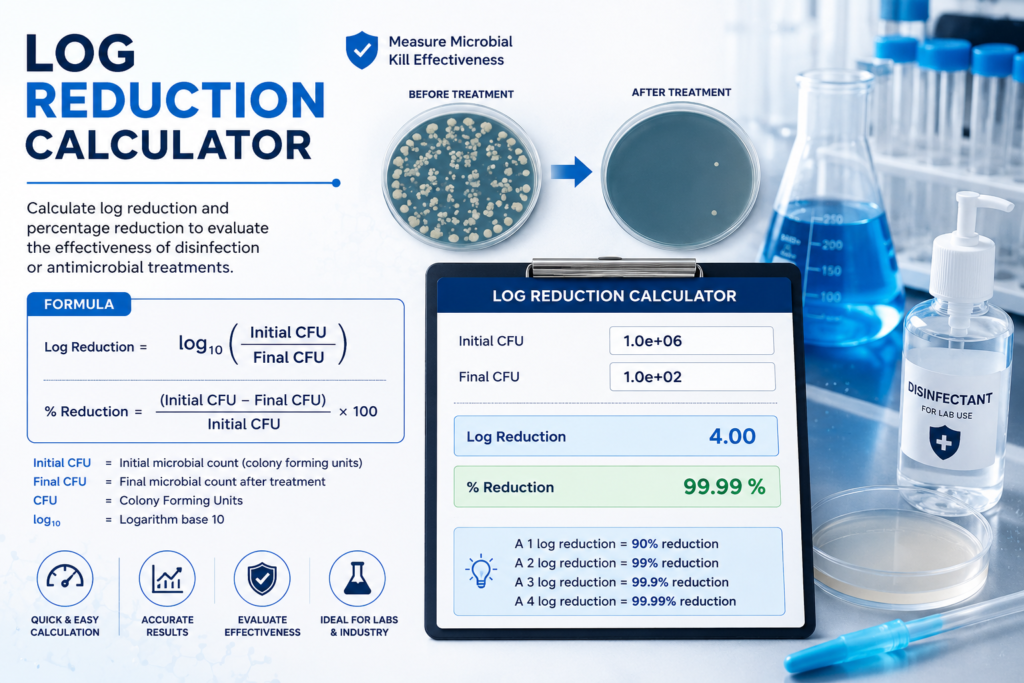
Log Reduction Calculator: A Complete Guide to Measuring Disinfectant Effectiveness
Introduction
When it comes to maintaining safety in laboratories, hospitals, and industrial facilities, understanding how effectively disinfectants eliminate microorganisms is absolutely crucial. This is where the concept of log reduction becomes invaluable. The log reduction calculator has become an essential tool for professionals who need to validate disinfectant performance and ensure that microorganisms are being eliminated at the expected rates. Whether someone is working in pharmaceutical development, food safety, or facility sanitation, grasping the fundamentals of log reduction measurement can mean the difference between adequate and exceptional hygiene standards.
What is Log Reduction and Why Does It Matter?
Log reduction is a mathematical approach to expressing how many microorganisms have been eliminated by a disinfectant or sterilization process. Rather than simply saying “we eliminated 90% of bacteria,” professionals use log reduction because it provides a more precise and standardized way to communicate microorganism elimination across industries.
The term “log” refers to logarithmic scale, which is a base-10 measurement system. A one log reduction means 90% of microorganisms have been eliminated, leaving 10% of the original population. A two log reduction represents 99% elimination, and a three log reduction means 99.9% of the original microorganism count has been destroyed. This exponential scale makes it easier to compare the effectiveness of different disinfectants and to understand the magnitude of reduction at a glance.
Healthcare facilities, testing laboratories, and manufacturing plants all rely on log reduction measurements to establish whether their disinfection protocols meet regulatory standards. Understanding this concept allows organizations to make data-driven decisions about which disinfectants provide the most effective microbial reduction for their specific needs.
The Mathematics Behind Log Reduction
The calculation itself is surprisingly straightforward, though it relies on logarithmic principles. The basic formula for log reduction is:
Log Reduction = Log₁₀(N₀) – Log₁₀(N)
Where:
- N₀ represents the initial number of microorganisms (before disinfection)
- N represents the final number of microorganisms (after disinfection)
For example, if a laboratory starts with 1,000,000 bacteria and after disinfection treatment ends up with 1,000 bacteria, the calculation would be:
Log Reduction = Log₁₀(1,000,000) – Log₁₀(1,000) = 6 – 3 = 3
This three log reduction indicates that 99.9% of the bacteria have been eliminated by the disinfectant process. The beauty of using logarithmic reduction is that it can handle incredibly large numbers and make meaningful comparisons between different disinfectant trials or products.
How the Log Reduction Calculator Simplifies the Process
Rather than manually performing logarithmic calculations by hand or using complex spreadsheet formulas, professionals can use a dedicated log reduction calculator to instantly determine disinfectant effectiveness. These tools eliminate the possibility of mathematical errors and provide immediate results, which is especially valuable when processing multiple samples or running validation studies.
A typical log reduction calculator requires only two inputs: the starting microbial count and the final microbial count after treatment. The tool then automatically computes the log reduction value and often provides additional useful information, such as the percentage reduction achieved. This automation is particularly beneficial in high-volume testing environments where accuracy and speed are both critical.
The practical advantage of using a calculator tool is that it removes guesswork and ensures consistency in how disinfectant performance is measured across different batches, products, or testing sessions. Researchers can focus on the validity of their test methodology rather than worrying about calculation accuracy.
Practical Applications in Different Industries
Laboratory and Research Settings
In microbiology labs and research facilities, scientists regularly test new disinfectants or validate existing ones against various bacterial and viral species. The log reduction calculator becomes an indispensable part of their toolkit, helping them quantify results that inform product development and safety protocols. When a lab is developing a new surface disinfectant, for instance, they might test it against common pathogens like E. coli or Staphylococcus aureus, using the log reduction calculation to verify that their formula meets industry benchmarks.
Healthcare Facility Operations
Hospitals and clinics use log reduction measurements to ensure that their environmental cleaning procedures and sterilization processes maintain the highest safety standards. When a hospital validates that their disinfection method achieves a 5-log reduction against specific pathogens, they can confidently state that their infection control measures are working as intended. This data becomes part of their quality assurance documentation and regulatory compliance records.
Food and Beverage Manufacturing
Food safety professionals rely on log reduction calculations to demonstrate that their sanitization processes eliminate harmful pathogens. For instance, ensuring a certain log reduction of Listeria monocytogenes or Salmonella on production equipment is often a regulatory requirement. The log reduction calculator helps these professionals quickly demonstrate compliance with food safety standards.
Pharmaceutical Manufacturing
The pharmaceutical industry strictly regulates microbial control, and log reduction measurements are central to validating sterilization and disinfection procedures. When a pharmaceutical manufacturer uses a disinfectant in their cleanroom, they must document the log reduction achieved to guarantee that their manufacturing environment remains sterile and free from contaminating microorganisms.
Interpreting Log Reduction Results
Understanding what different log reduction values actually mean is essential for making informed decisions about disinfectant effectiveness. Here’s a practical breakdown:
- 1-log reduction: 90% of microorganisms eliminated
- 2-log reduction: 99% of microorganisms eliminated
- 3-log reduction: 99.9% of microorganisms eliminated
- 4-log reduction: 99.99% of microorganisms eliminated
- 5-log reduction: 99.999% of microorganisms eliminated
- 6-log reduction: 99.9999% of microorganisms eliminated
For most general cleaning purposes, a 2 or 3-log reduction is considered acceptable. However, more sensitive environments such as surgical suites, cleanrooms, and areas where immunocompromised patients are treated typically require higher log reductions, often 5 or 6-log. The specific target depends on the type of microorganism being eliminated and the risk tolerance of the environment.
Factors That Influence Log Reduction Performance
Several variables can affect how well a disinfectant achieves log reduction results:
Contact Time
The duration that a disinfectant remains in contact with microorganism-laden surfaces significantly impacts how many organisms are eliminated. Longer contact times generally result in higher log reductions. The log reduction calculator results should always be paired with documentation of the contact time used during testing.
Disinfectant Concentration
Using the proper concentration of the disinfectant product is critical. A solution that’s too dilute may only achieve 2-log reduction, while the same product at its recommended concentration might deliver 5-log reduction. Always follow manufacturer guidelines for optimal results.
Environmental Conditions
Temperature, pH, and humidity all play roles in disinfectant effectiveness. Cold temperatures, for example, typically reduce how quickly a disinfectant can eliminate microorganisms, potentially affecting the log reduction achieved during a fixed time period.
Microbial Species and Load
Different microorganisms have varying susceptibility to disinfectants. Gram-positive bacteria may be eliminated more easily than gram-negative species or spore-forming organisms. The initial microbial load (how many organisms are present before treatment) also influences the achievable log reduction.
Organic Matter Interference
Proteins, blood, soil, or other organic materials on surfaces can interfere with disinfectant performance by reducing the log reduction that can be achieved. This is why many protocols include a cleaning step before disinfection.
Best Practices for Conducting Log Reduction Validation Tests
Organizations planning to validate their disinfection processes should follow these established best practices:
Establish a clear baseline: Take accurate measurements of your initial microbial count before applying any disinfectant. The accuracy of your baseline directly impacts the reliability of your log reduction calculation.
Use standardized test organisms: Select microorganisms that are relevant to your industry or environment. Many industries have standard challenge organisms that are recognized by regulatory bodies.
Document all conditions: Record contact time, temperature, humidity, concentration, and any other factors that might influence results. This documentation is vital when the log reduction calculator shows unexpected results.
Run multiple trials: Don’t rely on a single test. Conduct multiple validation runs and calculate the average log reduction achieved to ensure consistency and reliability.
Compare against standards: Know what log reduction values are required for your specific industry and application. This helps determine whether your disinfection process is meeting necessary safety thresholds.
Limitations and Considerations
While the log reduction calculator is an excellent tool, it’s important to recognize its limitations. The calculator provides accurate mathematical results based on the microbial counts provided, but the accuracy of the overall result depends entirely on the quality of the data input. If samples are improperly collected or microbial counts are miscalculated, the resulting log reduction value will be misleading.
Additionally, log reduction values only tell part of the story about a disinfectant’s effectiveness. A high log reduction achieved through extended contact time might not be practical for rapid turnover environments like busy surgical suites, where contact times must be limited.
Connecting Protein Measurements to Broader Laboratory Practice
Understanding protein concentration complements many other important laboratory calculations and techniques. Researchers working with protein concentrations often also use a DNA concentration calculator when studying the protein expression from specific genes, since the relationship between DNA sequence and protein production is central to molecular biology.
For those investigating how proteins function in biological systems, knowledge of protein concentration pairs naturally with understanding cell dilution principles, particularly when researchers need to deliver specific amounts of protein to cell cultures or tissue samples.
Researchers involved in protein evolution studies or comparative analyses often benefit from a protein concentration calculator alongside tools that help quantify genetic variation, since protein expression levels can vary based on genetic differences.
Additionally, those studying microbial protein production or bacterial protein expression systems frequently use information about generation time and bacterial growth rates to predict how much time is needed for microorganisms to produce sufficient quantities of recombinant proteins.
Conclusion
The log reduction calculator represents a straightforward yet powerful tool for validating disinfectant effectiveness and maintaining rigorous safety standards across laboratories, healthcare facilities, manufacturing plants, and countless other professional environments. By converting complex microbial elimination into a standardized, easy-to-understand logarithmic scale, these calculators enable professionals to communicate results clearly, make informed decisions about disinfection protocols, and demonstrate regulatory compliance.
Whether someone is developing new disinfectants, validating existing sterilization procedures, or simply ensuring that their facility maintains proper hygiene standards, understanding how to use and interpret log reduction results is invaluable. The mathematics may involve logarithms, but the practical benefits are straightforward: consistency, accuracy, and confidence in knowing that microorganism elimination meets established safety standards.