Dihybrid Cross Punnett Square Calculator

Ahmad zee
Table of Contents
Toggle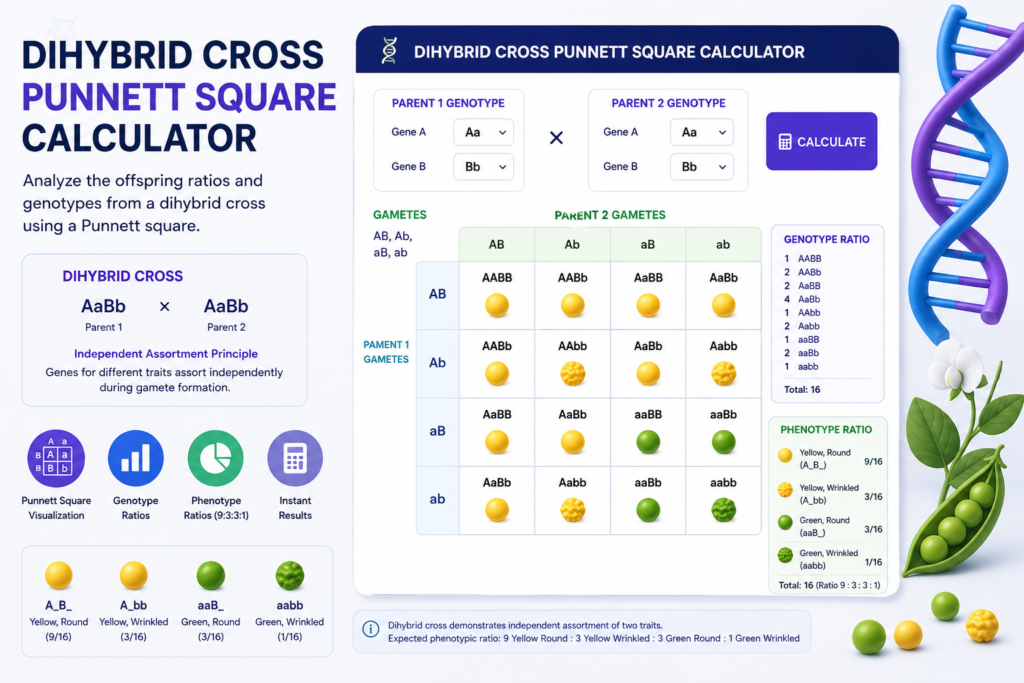
Dihybrid Cross Punnett Square Calculator: A Complete Guide to Genetics
Introduction to Dihybrid Crosses
Understanding heredity and genetics can feel overwhelming at first, but modern tools make learning about inheritance patterns much more accessible. The dihybrid cross Punnett square calculator represents one of the most valuable resources available for students and educators alike. This innovative tool simplifies complex genetic calculations and helps learners visualize how traits pass from parents to offspring across two different genes simultaneously.
A dihybrid cross involves tracking two distinct traits at the same time, which creates significantly more combinations than a simple monohybrid cross. Rather than manually calculating every possible genetic combination, a Punnett square calculator does the heavy lifting, allowing students to focus on understanding the underlying biological principles that govern inheritance.
What Is a Dihybrid Cross?
The dihybrid cross represents a fundamental concept in classical genetics introduced by Gregor Mendel. When two organisms that differ in two separate traits reproduce, scientists and students use dihybrid crosses to predict the genetic outcomes of their offspring.
Understanding the Basics
In a typical dihybrid cross scenario, consider a pea plant that has two traits under examination: seed color and plant height. One parent plant might have yellow, tall seeds while the other parent has green, short seeds. The dihybrid cross examines how both traits segregate and assort independently during reproduction.
Why Dihybrid Crosses Matter
Dihybrid crosses reveal Mendel’s law of independent assortment, demonstrating that genes for different traits segregate independently during gamete formation. This foundational principle explains why genetic diversity exists and why offspring display such varied combinations of parental traits.
How the Dihybrid Cross Punnett Square Works
A traditional Punnett square calculator for dihybrid crosses uses a 16-square grid (4×4) instead of the 4-square grid (2×2) used for monohybrid crosses. This larger grid accommodates all possible combinations when tracking two genes simultaneously.
The Grid Structure
The top of the Punnett square lists one parent’s possible gametes, while the left side shows the other parent’s gametes. Each cell within the grid represents a potential offspring genotype. A dihybrid cross Punnett square calculator automates this process, generating results instantly without requiring manual entry of each combination.
Interpreting Results
Once the dihybrid cross calculator completes its calculations, users receive:
- Genotypic ratios: The proportion of different genetic combinations (typically 9:3:3:1 for a classic dihybrid cross between heterozygous parents)
- Phenotypic ratios: The observable trait combinations visible in offspring
- Probability percentages: The likelihood of each genetic outcome occurring
Using a Dihybrid Cross Calculator Effectively
Modern Punnett square calculators simplify genetics education dramatically. A quality dihybrid cross Punnett square calculator requires only basic information about parental genotypes, then generates comprehensive results automatically.
Step-by-Step Guide
Step 1: Identify the Alleles Determine which alleles represent each trait. For example, ‘A’ might represent dominant yellow seeds while ‘a’ represents recessive green seeds.
Step 2: Input Parent Genotypes Enter each parent’s genotype into the calculator. If you’re examining a cross between AaBb × AaBb, you’d input both parents’ genetic information.
Step 3: Review the Generated Grid The dihybrid cross calculator automatically generates a 16-square Punnett square displaying all possible offspring genotypes.
Step 4: Analyze the Results Study the resulting ratios and probabilities. The calculator typically highlights phenotypic outcomes, making patterns easier to recognize.
Common Applications
Students use dihybrid cross calculators for:
- Completing homework assignments
- Preparing for biology exams
- Understanding inheritance patterns
- Conducting virtual lab experiments
- Exploring “what-if” genetic scenarios
The Mathematical Elegance Behind Dihybrid Crosses
The beauty of using a dihybrid cross Punnett square calculator lies in its ability to reveal mathematical patterns in genetics. The classic 9:3:3:1 phenotypic ratio emerges from the independent assortment of two genes, creating four distinct phenotypic classes.
Breaking Down the Ratios
When examining a dihybrid cross between two heterozygous parents (AaBb × AaBb):
- 9 offspring display the dominant phenotype for both traits
- 3 offspring show the dominant first trait but recessive second trait
- 3 offspring demonstrate the recessive first trait but dominant second trait
- 1 offspring displays recessive phenotypes for both traits
This 9:3:3:1 ratio represents one of genetics’ most elegant mathematical relationships, and a dihybrid cross calculator helps students visualize how this ratio emerges from simple Mendelian principles.
Educational Benefits of Dihybrid Cross Calculators
Using a dihybrid cross Punnett square calculator offers numerous advantages for learners at all levels:
Time Efficiency
Rather than spending hours manually drawing Punnett squares, students complete calculations in seconds, leaving more time for actual learning and analysis.
Accuracy
Human error in manual calculations decreases substantially. A calculator eliminates mistakes from misaligned gametes or miscounted offspring combinations.
Visual Learning
Most dihybrid cross calculators present results in color-coded grids, helping visual learners understand genetic concepts more intuitively.
Exploratory Learning
Students can quickly test multiple scenarios, asking questions like “What if both parents were homozygous recessive?” and immediately seeing results.
Comparing Monohybrid and Dihybrid Crosses
Understanding the difference between monohybrid and dihybrid crosses proves essential for genetics students. While monohybrid crosses examine single traits, dihybrid crosses track two traits simultaneously, creating greater complexity but also deeper insight into inheritance.
A monohybrid cross typically uses a 2×2 Punnett square, while a dihybrid cross requires a 4×4 grid. This difference reflects the increased number of possible gamete combinations when tracking multiple genes.
Independent Assortment and the Dihybrid Cross
Mendel’s law of independent assortment forms the theoretical foundation for dihybrid cross analysis. This principle states that alleles for different genes assort independently during gamete formation, assuming the genes are located on different chromosomes.
Why This Matters
When genes assort independently, each trait’s inheritance doesn’t influence the other trait’s inheritance. This independence creates the predictable ratios observed in dihybrid crosses and explains why genetic diversity in populations remains so extensive.
Linked Genes Exception
Occasionally, genes on the same chromosome don’t assort independently, and ratios deviate from the expected 9:3:3:1 pattern. A dihybrid cross calculator typically assumes independent assortment, so students should understand this limitation when analyzing real-world genetics.
Real-World Applications of Dihybrid Cross Analysis
While often taught in classroom settings, dihybrid cross concepts have practical real-world applications:
Agricultural Breeding
Farmers and plant breeders use dihybrid cross principles to develop crop varieties with desired trait combinations, such as disease resistance combined with higher yield.
Animal Husbandry
Livestock breeders apply dihybrid cross concepts when selecting animals with multiple desirable characteristics, like meat quality combined with rapid growth rates.
Medical Genetics
Understanding how multiple genetic traits pass through families helps genetic counselors predict inheritance patterns for heritable conditions.
Evolutionary Biology
Dihybrid crosses illustrate how genetic variation maintains itself in populations, a crucial concept for understanding evolution and natural selection.
Choosing the Right Dihybrid Cross Calculator
Several dihybrid cross Punnett square calculators exist online, each with different features and user interfaces. When selecting a calculator, consider:
Essential Features
- Clear input fields for parental genotypes
- Automatic generation of the 16-square grid
- Display of both genotypic and phenotypic ratios
- Probability calculations for each outcome
User Experience
- Intuitive interface requiring minimal instruction
- Clear labeling of alleles and gametes
- Color-coding to distinguish different genotypes
- Mobile compatibility for on-the-go learning
Educational Value
- Explanatory text accompanying results
- Options to explore multiple scenarios
- Save or print functionality for study materials
- Connection to related concepts and topics
Common Mistakes When Using Dihybrid Cross Calculators
Even with automated tools, students sometimes misinterpret results or input incorrect information:
Allele Representation Errors
Students occasionally confuse which alleles represent dominant versus recessive traits. Establishing clear notation before using the dihybrid cross calculator prevents confusion.
Genotype Input Mistakes
Incorrectly entering parental genotypes produces incorrect results. Always double-check that both parents’ genotypes are entered accurately before analyzing outcomes.
Misunderstanding Ratios
Some students struggle to connect the numerical ratios to actual phenotypes. Taking time to understand what each ratio represents prevents this common error.
Ignoring Assumptions
Remember that standard dihybrid cross calculators assume complete dominance and independent assortment. Real genetics sometimes reveals more complex inheritance patterns.
Advanced Dihybrid Cross Scenarios
Beyond the classic AaBb × AaBb cross, students encounter more complex scenarios:
Test Crosses
A dihybrid test cross examines one individual with a dominant phenotype (AaBb) crossed with a homozygous recessive individual (aabb). This produces only eight distinct genotypes instead of sixteen, revealing the heterozygous parent’s genetic makeup.
Homozygous × Heterozygous Crosses
Crossing AABB × AaBb produces different ratios than the classic dihybrid cross, demonstrating how parental genotypes influence offspring distribution.
Multiple Generations
Some dihybrid cross problems require analyzing F1 and F2 generations separately. A quality dihybrid cross calculator helps track inheritance patterns across multiple generations.
The Future of Genetics Education Tools
As technology advances, dihybrid cross Punnett square calculators become increasingly sophisticated. Future tools may include:
- Virtual reality representations of genetic inheritance
- Integration with DNA sequencing data
- Simulation of linked genes and crossing over
- Artificial intelligence tutoring components
- Predictive modeling for complex multi-gene inheritance
Connecting to Broader Genetics Concepts
The dihybrid cross serves as a stepping stone to understanding more complex genetics topics. Understanding dihybrid crosses prepares students for exploring trihybrid crosses and beyond, which examine three or more traits simultaneously.
Additionally, mastering dihybrid cross principles provides foundation for studying linkage and genetic mapping, where genes on the same chromosome don’t assort independently, creating modified ratios.
Practice Problems and Applications
To solidify understanding, students should work through multiple dihybrid cross problems:
Problem 1: A plant with AaBb genotype (yellow, tall) crosses with another AaBb plant. What proportion of offspring will display yellow, short phenotype?
Problem 2: An AaBB plant crosses with an aaBb plant. Use the dihybrid cross calculator to determine all possible offspring genotypes and their frequencies.
Problem 3: Two organisms with unknown genotypes produce offspring in a 9:3:3:1 ratio. What were the most likely parental genotypes?
Working through these problems reinforces how dihybrid cross calculators work and deepens understanding of Mendelian genetics.
Conclusion: Empowering Genetics Learners
The dihybrid cross Punnett square calculator represents more than just a convenience tool—it’s an educational resource that empowers students to engage deeply with genetic principles. By automating calculations, these calculators free learners to focus on conceptual understanding, pattern recognition, and real-world applications of Mendelian genetics.
Whether you’re a high school student tackling your first genetics unit or an advanced learner exploring inheritance patterns, a quality dihybrid cross calculator enhances learning experiences and builds confidence in genetic analysis. As you continue your genetics education journey, remember that these tools exist to support understanding, not replace it. The real value emerges when students use calculators to explore, question, and ultimately master the elegant principles governing heredity.
By combining modern technology with classical genetic principles, dihybrid cross calculators help bridge the gap between theoretical knowledge and practical understanding, making genetics more accessible and engaging for learners everywhere.