Vapor Pressure Deficit (VPD) Calculator

Ahmad zee
Table of Contents
Toggle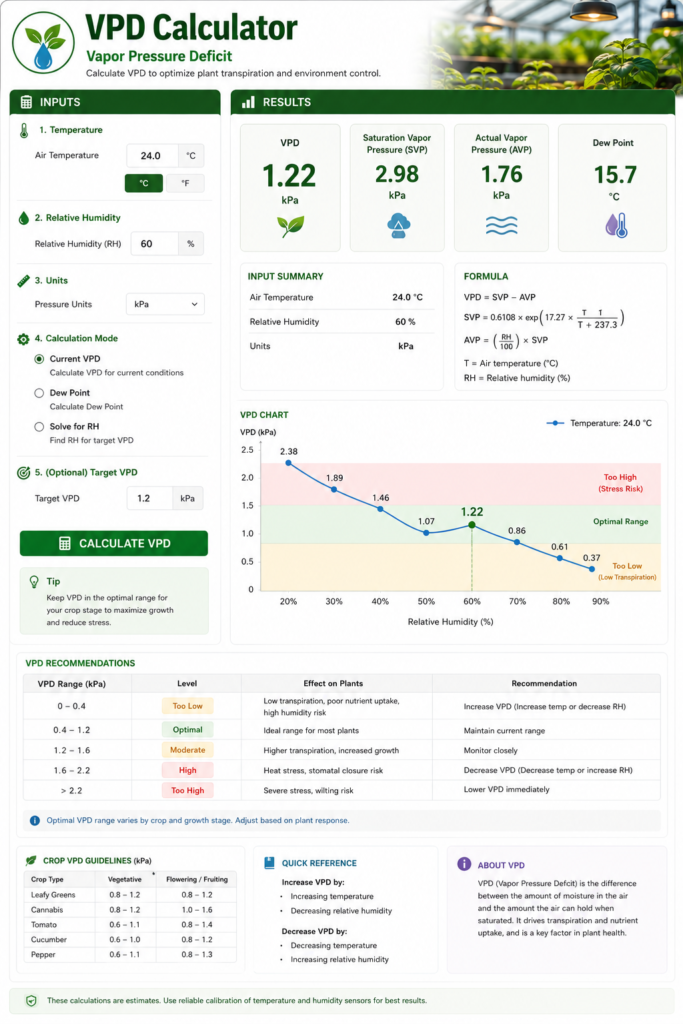
VPD Calculator (Vapor Pressure Deficit)
A VPD Calculator (Vapor Pressure Deficit) helps growers, greenhouse operators, horticulturists, and indoor gardeners determine the difference between the amount of moisture the air can hold and the amount it currently contains. Vapor Pressure Deficit (VPD) is an important environmental measurement that influences plant transpiration, nutrient uptake, and overall plant health.
Whether managing a greenhouse, hydroponic system, vertical farm, or indoor grow room, monitoring VPD helps create ideal growing conditions for healthier plants and improved crop performance.
What Is a VPD Calculator?
A VPD Calculator estimates the Vapor Pressure Deficit (VPD) using environmental conditions inside a growing space.
The calculator typically considers:
- Air temperature
- Leaf temperature (optional)
- Relative humidity
- Measurement units
The result is usually displayed in kilopascals (kPa).
How Does the VPD Calculator Work?
The calculator uses temperature and humidity measurements to estimate the difference between saturated and actual water vapour pressure.
Users generally enter:
- Air temperature
- Relative humidity
- Leaf temperature (if applicable)
The calculator then estimates:
- Vapor Pressure Deficit (VPD)
- Saturation vapor pressure
- Actual vapor pressure
- Growing environment conditions
Vapor Pressure Deficit Formula
A commonly used calculation is:
VPD = Saturation Vapor Pressure − Actual Vapor Pressure
Where:
- Saturation Vapor Pressure (SVP) depends on air or leaf temperature.
- Actual Vapor Pressure (AVP) is calculated using relative humidity.
The calculator performs these calculations automatically to provide an accurate VPD value.
Why Use a VPD Calculator?
Monitoring VPD helps growers maintain balanced environmental conditions.
Benefits include:
- Improve plant transpiration
- Support nutrient uptake
- Optimise greenhouse conditions
- Enhance indoor growing performance
- Reduce plant stress
- Improve irrigation management
- Promote healthy growth
Factors That Affect Vapor Pressure Deficit
Several environmental conditions influence VPD.
Air Temperature
Higher temperatures increase the air’s ability to hold moisture, affecting VPD.
Relative Humidity
Humidity has a direct impact on the amount of water vapour present in the air.
Leaf Temperature
Leaf temperature may differ slightly from air temperature and can influence the calculated VPD.
Ventilation
Air movement helps regulate both humidity and temperature.
Plant Density
Dense plant canopies can increase local humidity around the leaves.
Irrigation
Watering practices affect moisture levels within the growing environment.
Benefits of Using a VPD Calculator
A VPD Calculator offers several advantages.
- Calculates VPD quickly
- Supports greenhouse management
- Helps optimise indoor growing conditions
- Improves environmental monitoring
- Reduces plant stress
- Suitable for commercial and home growers
- Simplifies climate control decisions
Tips for Maintaining an Ideal VPD
For the best results:
- Monitor temperature and humidity regularly.
- Use accurate environmental sensors.
- Adjust ventilation when necessary.
- Maintain proper irrigation schedules.
- Monitor leaf health throughout the growing cycle.
- Avoid sudden changes in temperature or humidity.
- Keep grow room equipment properly maintained.
Frequently Asked Questions
What is a VPD Calculator?
It is a tool that calculates Vapor Pressure Deficit using air temperature, relative humidity, and, when available, leaf temperature.
What is Vapor Pressure Deficit?
VPD measures the difference between the maximum amount of moisture the air can hold and the amount of moisture actually present.
Why is VPD important for plants?
VPD influences transpiration, water movement, and nutrient uptake, making it an important factor in plant growth.
Can this calculator be used in greenhouses?
Yes. It is suitable for greenhouses, indoor gardens, hydroponic systems, vertical farms, and controlled-environment agriculture.
Does higher humidity always improve plant growth?
Not necessarily. Excessively high humidity can reduce transpiration and increase the likelihood of fungal diseases, while very low humidity may cause excessive water loss. Maintaining an appropriate VPD helps balance these conditions.
Other Useful Calculators
Explore more biology and agriculture calculators on Omni Calculator Store:
- GDU Calculator (Growing Degree Units)
https://omnicalculator.store/home/biology/gdu-calculator-growing-degree-units/ - Daily Light Integral Calculator
https://omnicalculator.store/home/biology/daily-light-integral-calculator/ - CO₂ Grow Room Calculator
https://omnicalculator.store/home/biology/co2-grow-room-calculator/ - Plant Spacing Calculator
https://omnicalculator.store/home/biology/plant-spacing-calculator/ - Fertilizer Calculator
https://omnicalculator.store/home/biology/fertilizer-calculator/
Conclusion
A VPD Calculator (Vapor Pressure Deficit) is an essential tool for monitoring environmental conditions in greenhouses, indoor gardens, and other controlled growing spaces. By calculating the relationship between temperature and humidity, it helps growers optimise plant transpiration, improve nutrient uptake, and support healthy development. Whether cultivating vegetables, herbs, flowers, or specialty crops, this calculator makes climate management more accurate and efficient.