Goat Gestation Calculator

Ahmad zee
Table of Contents
Toggle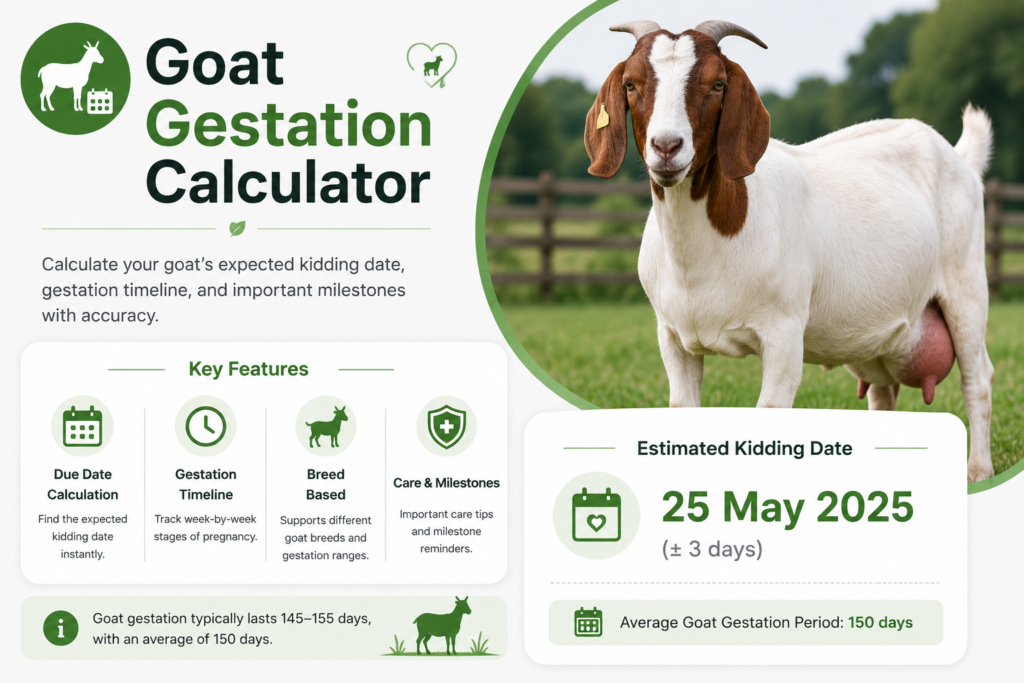
Goat Gestation Calculator: The Complete Guide to Tracking Goat Pregnancy
For goat farmers and backyard breeders alike, keeping track of a doe’s pregnancy timeline is one of the most important parts of herd management. Miss the kidding window by even a day or two and a vulnerable kid — or the mother herself — could be left without the support she needs. A goat gestation calculator solves this problem cleanly and efficiently, turning a breeding date into a full pregnancy roadmap in seconds.
This guide walks through everything a goat owner needs to know about using a goat pregnancy calculator, understanding the goat gestation period, recognizing signs of pregnancy, and preparing confidently for kidding season.
What Is a Goat Gestation Calculator?
A goat gestation calculator is a digital planning tool that estimates a doe’s kidding date based on her breeding or mating date. By entering the date the doe was bred, the calculator applies the average caprine gestation period to project when kidding is likely to occur and map out the key stages of the pregnancy.
Rather than manually counting days on a calendar or relying on guesswork, a goat due date calculator gives farmers and breeders a structured, reliable timeline to plan around. It’s especially useful on farms where multiple does are bred at different times throughout the season, making organized record-keeping a real challenge without the right tools.
These calculators sit within the larger family of Animal Pregnancy Calculators — a collection of species-specific gestation tools that support everything from small backyard pet care to full-scale livestock breeding operations.
What Is the Goat Gestation Period?
The goat gestation period averages around 150 days — roughly five months — though the normal range spans from approximately 145 to 155 days depending on the breed, the doe’s age, litter size, and overall health status.
Here’s a quick reference overview:
| Parameter | Details |
|---|---|
| Average goat gestation period | 150 days |
| Normal range | 145–155 days |
| Gestation in months | Approximately 5 months |
| Average litter size | 1–3 kids (twins most common) |
| Breeding season | Typically late summer to early winter |
| Sexual maturity (does) | 4–12 months depending on breed |
Understanding how long goats are pregnant is the foundation of effective herd planning. A 150-day average means that does bred in the fall will typically kid in the late winter or early spring — which is why many farmers carefully time their breeding season to align kidding with more manageable weather conditions.
Different breeds can show slight variations in goat gestation length. Nigerian Dwarf does, for instance, tend to fall on the shorter end of the range, while larger breeds like Boer or Nubian goats may run slightly longer. A good goat breeding calculator will account for these nuances when one is available.
How to Use a Goat Gestation Calculator
Using a goat pregnancy calculator is a fast and intuitive process. Most tools follow these steps:
- Enter the breeding date — the date the doe was mated with the buck.
- Select breed (if the tool supports it) — some calculators adjust for breed-specific variations in goat gestation length.
- Generate the kidding date estimate — the calculator adds the average gestation period to produce a projected due date window.
- Plan ahead using the timeline — use the estimated dates to schedule vet checks, adjust feeding, and prepare the kidding area.
Practical tips for getting the most out of a goat due date calculator:
- If the doe was exposed to a buck over multiple days, use the first day of exposure to get the earliest possible estimate.
- Cross-reference the calculator’s output with physical signs of pregnancy for greater confidence.
- Mark the projected kidding window on the farm calendar and set reminders for key preparation milestones, such as booster vaccinations and pre-kidding nutritional changes.
For farms managing multiple animal species, the same biology hub also offers tools like the Sheep Gestation Calculator and the Cow Gestation Calculator — making it easy to track pregnancies across the entire herd in one place.
Signs and Symptoms of Goat Pregnancy
Identifying a pregnant doe early on can help farmers adjust care routines sooner and monitor the pregnancy more closely. Here are the most reliable pregnant goat symptoms and signs to watch for:
Early Signs (Weeks 1–6)
- Return to heat not observed — a doe that was successfully bred typically won’t return to estrus (heat) 18–24 days after mating, which is one of the earliest indicators of a successful pregnancy
- Behavioral changes — some does become calmer or slightly more withdrawn in early pregnancy
- Subtle appetite increase — nutritional demand begins rising, though gradually at first
Mid-Pregnancy Signs (Weeks 7–16)
- Abdominal enlargement — the doe’s belly visibly rounds out, particularly on the right side where the rumen is located
- Weight gain — a steady increase in body weight throughout the mid-pregnancy phase
- Udder development — the udder begins filling out, especially in does approaching their final weeks
- Fetal movement — from around week 12 onward, gentle pressing against the doe’s right side may reveal fetal movement
Late Pregnancy Signs (Weeks 17–22)
- Significant udder engorgement — the udder becomes noticeably larger and firmer as kidding approaches
- Ligament relaxation — the ligaments on either side of the tailhead soften noticeably in the final 12–24 hours before kidding
- Discharge — a clear or slightly cloudy vaginal mucus discharge indicates the cervix is preparing for birth
- Nesting behavior — the doe may become restless, paw at the ground, and seek out a quiet, isolated spot
- Vocalizing — increased soft bleating or distress sounds are common as labor begins
Pregnancy Confirmation Methods
For more certainty, especially on large farms, several methods can confirm pregnancy beyond visual signs:
- Ultrasound — the most reliable method, typically effective from around day 30–45 onward
- Blood or milk progesterone testing — can detect pregnancy as early as day 18–22
- Rectal-abdominal palpation — performed by an experienced veterinarian in later pregnancy
- Doe’s failure to return to estrus — a straightforward but non-definitive early indicator
Goat Pregnancy Stages: Week by Week
The goat pregnancy week by week breakdown helps farmers understand what’s happening inside the doe at each phase — and what care adjustments are needed as the pregnancy progresses:
Weeks 1–4: Fertilization and Implantation
After mating, fertilization takes place in the fallopian tubes and the embryos travel to the uterus for implantation. No visible changes occur during this window, and the doe’s routine should remain consistent. Stress should be minimized during early implantation.
Weeks 5–8: Early Fetal Development
Basic organ systems begin forming. The embryos are small but developing rapidly. Nutritional quality matters more than quantity at this stage — a balanced diet with adequate minerals, particularly selenium and copper, supports healthy early development.
Weeks 9–14: Skeletal and Muscular Growth
Fetal skeletons begin calcifying and muscles develop. The doe’s abdomen starts to show visible rounding. Body condition scoring becomes important during this phase — does should be maintained at a body condition score (BCS) of 2.5–3.5 throughout the pregnancy.
Weeks 15–18: Rapid Fetal Weight Gain
This is one of the most nutritionally demanding phases of goat pregnancy. The majority of fetal weight is gained in the final 6–8 weeks of gestation. Underfeeding during this window can lead to pregnancy toxemia (ketosis) — a potentially life-threatening metabolic condition in late-pregnant does carrying multiple kids.
Monitoring feed intake and energy density is critical here. Farms managing large herds may find it useful to reference the Feed Conversion Ratio Calculator to estimate how efficiently the doe is converting feed into body mass and milk production.
Weeks 19–22: Pre-Kidding Phase
The kids are fully formed and growing rapidly in size. The doe’s abdomen is visibly large and heavy. Udder engorgement, ligament relaxation, and behavioral changes signal that kidding is imminent. The kidding area should be fully prepared by this point, and the doe should be moved to a clean, quiet pen for close monitoring.
Goat Pregnancy Care Tips
Sound management throughout the goat pregnancy timeline directly determines the health outcomes of both the doe and her kids. Here are the most important care practices to follow:
- Maintain proper body condition — avoid both over-conditioning and underfeeding; excessive body fat increases kidding complications while underfeeding leads to metabolic disease
- Provide high-quality forage — good-quality hay should form the foundation of the diet, supplemented with grain in the final 4–6 weeks of gestation
- Supplement key minerals — selenium, copper, zinc, and vitamin E are particularly important for reproductive health and kid vitality; consult a veterinarian for region-specific supplementation guidance
- Administer CD&T booster vaccination — typically given 4–6 weeks before the due date to protect both the doe and pass maternal immunity to the kids
- Deworm strategically — the periparturient rise in worm burden is well-documented in goats; FAMACHA scoring or fecal egg counts should guide deworming decisions
- Provide fresh, clean water at all times — water intake increases significantly as pregnancy progresses, particularly in does carrying multiple kids
- Limit stress and transport — particularly in the final 4–6 weeks when the risk of pregnancy toxemia and premature kidding is highest
Preparing the Kidding Area
A well-prepared kidding space is one of the most important contributions a farmer can make to a smooth delivery. Ideally, the kidding pen should be set up and ready at least one week before the projected due date from the goat kidding calculator.
Kidding pen checklist:
- Clean, dry bedding (straw works well for warmth and absorption)
- Adequate space — at least 16–25 square feet per doe and her expected litter
- Heat lamp for cold-weather kidding
- Fresh water and high-quality hay readily accessible
- Clean towels for drying newborns
- Iodine solution for navel dipping
- Colostrum supplement on hand in case of nursing difficulties
- A scale for weighing kids at birth
- Emergency contact for a veterinarian experienced with small ruminants
Moving the doe into the kidding pen a few days before her projected due date allows her to settle in without the added stress of relocation during active labor.
What to Expect During Kidding
Kidding generally progresses through three stages:
Stage 1: Early Labor
The doe becomes restless, vocalizes more, and may repeatedly lie down and stand back up. This stage can last anywhere from 1 to 12 hours in normal cases. The cervix is dilating during this phase.
Stage 2: Active Delivery
The water sac ruptures and kids are delivered. The first kid typically arrives within 30–60 minutes of active pushing. Subsequent kids in the litter follow within 15–30 minutes of each other. Normal presentation is front feet first with the head resting on the legs.
Stage 3: Passing the Placenta
The placenta (afterbirth) is typically passed within 1–4 hours of the final kid being born. If the placenta is retained beyond 12 hours, veterinary attention is recommended.
Common Goat Pregnancy Complications
Even with careful management, complications can occur. Knowing what to watch for allows for faster intervention:
- Pregnancy toxemia (ketosis) — occurs in late pregnancy, most commonly in does carrying multiple kids; caused by inadequate energy intake; symptoms include lethargy, loss of appetite, and neurological signs
- Hypocalcemia (milk fever) — calcium deficiency that can occur around kidding; causes weakness, muscle tremors, and collapse
- Malpresentation — a kid positioned incorrectly in the birth canal may require manual repositioning or veterinary assistance
- Mastitis — udder infection that can occur post-kidding; watch for heat, swelling, and abnormal milk
- Retained placenta — failure to pass the afterbirth within 12 hours warrants veterinary consultation
When to Call a Veterinarian
Prompt veterinary intervention can save lives during complicated pregnancies or deliveries. Contact a vet immediately if:
- The doe has been in active labor for more than 30–60 minutes without delivering a kid
- A kid is partially presented but delivery has stalled
- Signs of pregnancy toxemia appear in late gestation
- Heavy bleeding occurs before, during, or after kidding
- The doe appears in severe distress or loses consciousness
- The placenta is retained beyond 12 hours post-kidding
- A newborn kid is weak, unable to stand, or fails to nurse within the first hour
Related Livestock Pregnancy and Farm Tools
Managing goat pregnancies is just one piece of a larger farm management picture. The Livestock Calculators section offers practical tools for herd health and production planning — including the Animal Mortality Rate Calculator, Feed Conversion Ratio Calculator, and Livestock Fence Cost Calculator — all designed to support small and large-scale farm operations.
For farmers also managing sheep alongside their goat herds, the Sheep Gestation Calculator provides the same reliable due-date tracking for ewes, with gestation timelines tailored to ovine biology.
Frequently Asked Questions About Goat Gestation
How accurate is a goat gestation calculator?
A goat gestation calculator provides a solid estimate based on the breeding date and average caprine gestation period. Most does kid within a few days of the projected date, though the normal range of 145–155 days means a week-long monitoring window is recommended on either side.
Can a doe get pregnant while still nursing?
Yes, does can return to estrus while nursing, though milk production may affect reproductive efficiency. Most breeders wait until kids are weaned before rebreeding to support full recovery.
How many kids do goats typically have?
Twins are the most common litter size in most domestic breeds. Singles and triplets are also common, and some prolific breeds occasionally produce quadruplets. Litter size tends to increase with age and proper nutrition.
How soon after kidding can a doe be rebred?
Most does are ready to return to estrus within 4–8 weeks of kidding, though allowing a full recovery period of 3–4 months before rebreeding is generally considered better practice for long-term reproductive health.
What’s the difference between a goat gestation calculator and a sheep gestation calculator?
The core function is the same — both calculate due dates based on breeding dates. The key difference is the input gestation length: goats average 150 days, while sheep average 147 days. Using the wrong calculator for a species can produce a due date that’s off by several days.
Conclusion
A goat gestation calculator is one of the simplest and most effective tools a goat farmer can add to their herd management routine. By turning a breeding date into a clear, actionable due-date window, it helps owners plan veterinary care, nutritional adjustments, kidding pen preparations, and post-birth monitoring well in advance — reducing the chance of preventable losses.
Combined with attentive observation of pregnant goat symptoms, proper nutritional support through the goat pregnancy timeline, and a well-stocked kidding area, the calculator becomes the starting point for a confident, well-managed kidding season.
Explore the full suite of Animal Pregnancy Calculators and Livestock Tools to keep every pregnancy on the farm tracked and on schedule.