Fertilizer Calculator

Ahmad zee
Table of Contents
Toggle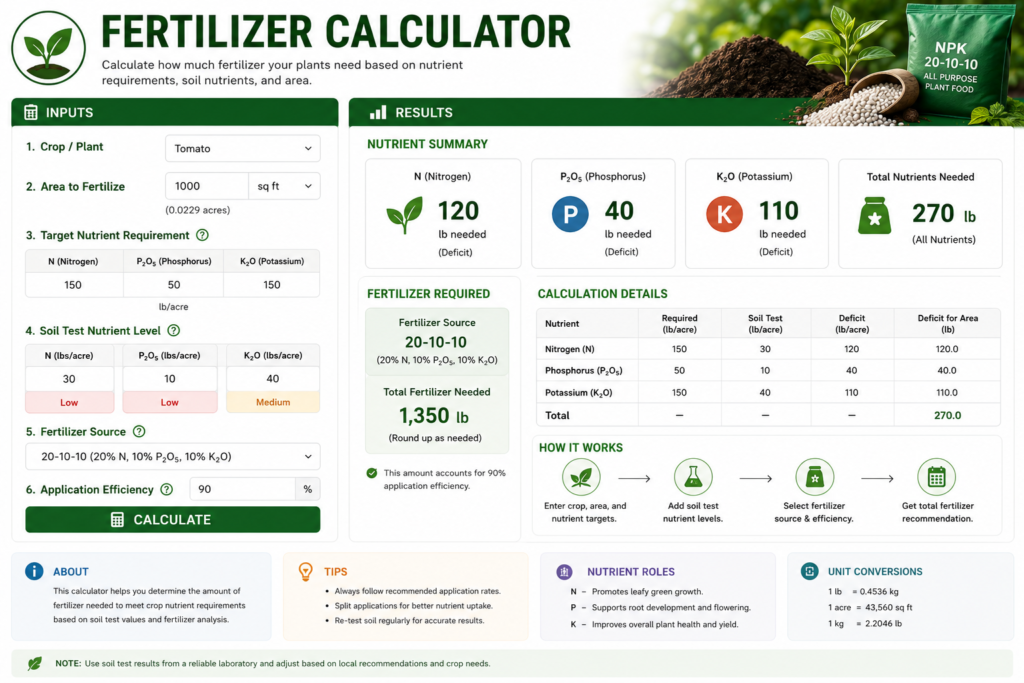
Fertilizer Calculator
A Fertilizer Calculator helps gardeners, farmers, landscapers, and agricultural professionals determine the correct amount of fertilizer needed for lawns, gardens, crops, and landscapes. By entering the application area, desired nutrient rate, and fertilizer analysis, the calculator estimates how much fertilizer should be applied to support healthy plant growth while reducing waste.
Whether fertilising vegetables, flowers, turfgrass, fruit trees, or field crops, using the right amount of fertilizer improves nutrient management and promotes stronger, healthier plants.
What Is a Fertilizer Calculator?
A Fertilizer Calculator estimates the amount of fertilizer required to supply a specific amount of nutrients over a given area.
The calculator typically considers:
- Application area
- Fertilizer analysis (N-P-K)
- Desired nutrient application rate
- Measurement units
The result provides the estimated amount of fertilizer required for the selected area.
How Does the Fertilizer Calculator Work?
The calculator uses the fertilizer’s nutrient analysis and the recommended application rate to estimate the total amount needed.
Users generally enter:
- Area size
- Desired nutrient rate
- Fertilizer grade (N-P-K)
- Unit of measurement
The calculator then estimates:
- Total fertilizer required
- Nutrients applied
- Fertilizer needed per unit area
Fertilizer Calculation Formula
A commonly used formula is:
Fertilizer Required = Required Nutrient ÷ Nutrient Percentage
For example, if nitrogen is the target nutrient, the calculator divides the required amount of nitrogen by the percentage of nitrogen in the selected fertilizer.
The calculator automatically performs this calculation after the required information is entered.
Why Use a Fertilizer Calculator?
Applying the correct amount of fertilizer helps improve plant health and reduces unnecessary applications.
Benefits include:
- Prevents over-fertilisation
- Reduces nutrient waste
- Supports healthy plant growth
- Improves crop productivity
- Helps manage fertilizer costs
- Protects soil quality
- Promotes efficient nutrient use
Understanding N-P-K Values
Most fertilizers display an N-P-K analysis.
- Nitrogen (N): Supports leafy growth and green foliage.
- Phosphorus (P): Encourages strong root development and flowering.
- Potassium (K): Improves overall plant health and stress tolerance.
Selecting the appropriate fertilizer depends on the nutrient needs of the plants and the results of a soil test.
Factors That Affect Fertilizer Requirements
Several factors influence how much fertilizer is needed.
Plant Type
Vegetables, flowers, lawns, trees, and field crops all have different nutrient requirements.
Soil Fertility
Soil testing helps determine existing nutrient levels before fertiliser is applied.
Growing Season
Plants require different nutrient levels during various growth stages.
Climate
Rainfall and temperature affect nutrient availability and fertilizer efficiency.
Irrigation
Water management influences nutrient movement within the soil.
Fertilizer Type
Granular, liquid, and slow-release fertilizers may have different application recommendations.
Benefits of Using a Fertilizer Calculator
A Fertilizer Calculator offers several advantages.
- Calculates fertilizer requirements quickly
- Supports efficient nutrient management
- Reduces unnecessary applications
- Improves budgeting
- Suitable for gardens, lawns, and farms
- Simplifies fertilization planning
- Encourages sustainable growing practices
Tips for Applying Fertilizer
For the best results:
- Test the soil before fertilising.
- Follow recommended application rates.
- Apply fertilizer evenly across the area.
- Water after application if recommended.
- Avoid fertilising immediately before heavy rainfall.
- Store fertilizers in a dry location.
- Follow all product label instructions for safe use.
Frequently Asked Questions
What is a Fertilizer Calculator?
It is a tool that estimates the amount of fertilizer needed based on the application area, nutrient requirements, and fertilizer analysis.
Why is fertilizer analysis important?
The N-P-K analysis indicates the percentage of nitrogen, phosphorus, and potassium contained in the fertilizer, allowing accurate application calculations.
Can this calculator be used for lawns and gardens?
Yes. It is suitable for lawns, vegetable gardens, flower beds, orchards, landscaping projects, and agricultural fields.
Should fertilizer always be applied at the maximum rate?
No. Applying more fertilizer than recommended can waste nutrients and may negatively affect plant health and soil quality.
Is a soil test recommended before fertilising?
Yes. Soil testing provides valuable information about existing nutrient levels and helps determine the appropriate fertilizer application.
Other Useful Calculators
Explore more biology and agriculture calculators on Omni Calculator Store:
- Sod Calculator
https://omnicalculator.store/home/biology/sod-calculator/ - Daily Light Integral Calculator
https://omnicalculator.store/home/biology/daily-light-integral-calculator/ - Raised Bed Soil Calculator
https://omnicalculator.store/home/biology/raised-bed-soil-calculator/ - Corn Yield Calculator
https://omnicalculator.store/home/biology/corn-yield-calculator/ - Compost Calculator
https://omnicalculator.store/home/biology/compost-calculator/
Conclusion
A Fertilizer Calculator is an essential tool for estimating the correct amount of fertilizer needed for gardens, lawns, crops, and landscaping projects. By considering the application area, nutrient requirements, and fertilizer analysis, it helps users apply nutrients accurately, reduce waste, and support healthy plant growth. Whether managing a home garden or a large agricultural operation, this calculator simplifies fertilizer planning and promotes more efficient nutrient management.