DNA Copy Number Calculator

Ahmad zee
Table of Contents
Toggle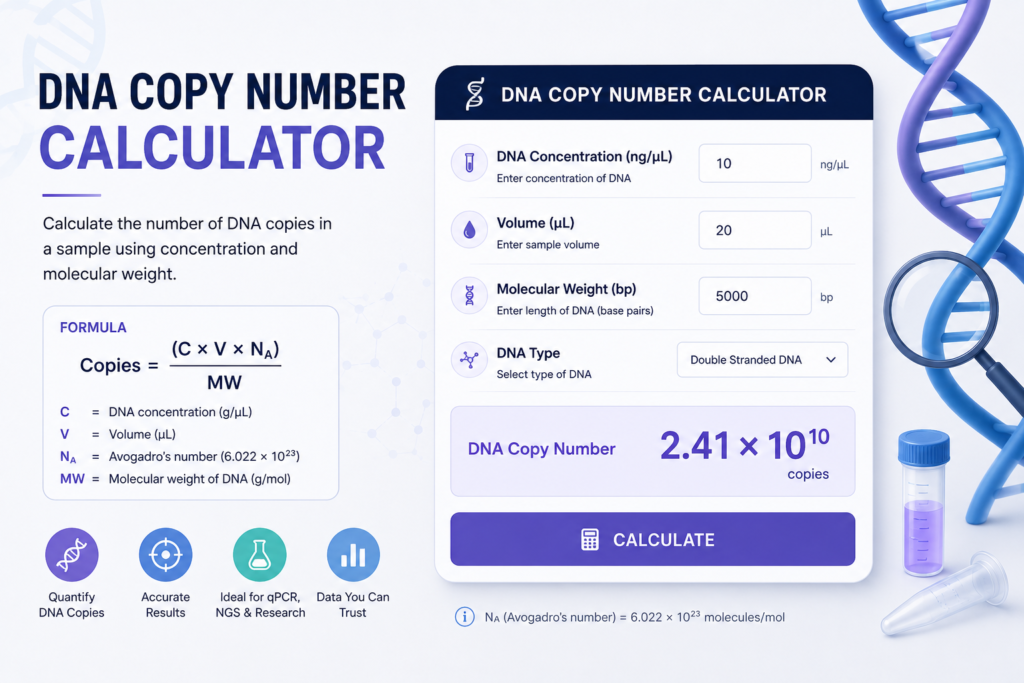
DNA Copy Number Calculator: A Complete Guide
Before a DNA sample goes into a qPCR reaction, a cloning workflow, or a sequencing run, it often needs to be expressed as a specific number of molecules rather than a mass or concentration. A DNA Copy Number Calculator handles that conversion, turning a straightforward measurement into the exact copy count a protocol calls for.
What Is a DNA Copy Number Calculator?
A DNA Copy Number Calculator converts a DNA sample’s mass, or its concentration and volume, into the actual number of DNA molecules present in that sample. This comes up constantly in molecular biology, since many protocols specify a target number of template copies rather than a target mass, and the two numbers aren’t the same thing once fragment length is factored in.
The Formula Behind Copy Number Conversion
The calculation combines the DNA’s average molecular weight per base pair, its total length in base pairs, and Avogadro’s number. In simple terms, the DNA’s mass gets converted into moles using its molecular weight, and that mole value gets converted into an actual molecule count using Avogadro’s number. A shorter DNA fragment packs more copies into the same mass than a longer one, which is why fragment length matters just as much as mass or concentration here.
How to Use It: A Step-by-Step Example
Suppose a researcher has 50 nanograms of a linear DNA fragment that is 1,000 base pairs long. Running that mass and length through the underlying formula returns roughly 46 billion copies. Reaching that number by hand involves several unit conversions between nanograms, grams, moles, and molecules, so it’s easy to make a small error along the way. Entering the same two values into the calculator produces the result in one step.
DNA Copy Number vs. DNA Concentration
These two numbers are related but not interchangeable. A DNA Concentration Calculator answers how much DNA is present in a sample, typically expressed as nanograms per microliter. A DNA Copy Number Calculator takes that concentration a step further and converts it into an actual molecule count for a given fragment or plasmid length. Two samples with identical concentrations can have very different copy numbers if their fragment lengths differ, which is why copy number, not concentration alone, is often the number that matters most for quantitative work.
Why Copy Number Matters for qPCR and Cloning
Building an accurate qPCR standard curve depends on knowing exactly how many template copies are going into each reaction, since the whole point of a standard curve is comparing known copy numbers against measured amplification. Getting there also depends on a solid Annealing Temperature Calculator result, since even a perfectly quantified template won’t amplify cleanly if the primers are annealing at the wrong temperature. In cloning workflows, copy number calculations also connect to the insert-to-vector ratios produced by a Ligation Calculator, since both numbers ultimately come from the same DNA quantification step earlier in the process.
Common Applications
Beyond qPCR and cloning, DNA Copy Number Calculators show up in copy number variation research in cancer biology, where gains or losses of gene copies can drive disease progression. Forensic and diagnostic labs use copy number data to confirm sample quality before moving on to sequencing. Researchers preparing plasmid DNA from a bacterial culture also use copy number figures to judge extraction yield, often after tracking the culture’s growth with a Generation Time Calculator to make sure the bacteria were harvested at the right density.
Tips for Getting Accurate Results
It helps to double-check that the fragment or plasmid length entered into the calculator reflects the full construct, insert plus vector backbone, since leaving out part of the sequence throws off the final copy count. It’s also worth confirming whether a protocol expects total copies or copies per microliter, since mixing up the two can lead to a reaction that’s under- or over-loaded with template.
Final Thoughts
A DNA Copy Number Calculator turns a multi-step unit conversion into a one-step answer, which matters anywhere a protocol calls for an exact number of template molecules rather than a mass or concentration. From qPCR setup to cloning to copy number variation research, this is one of the more quietly essential tools in a molecular biology workflow. It sits alongside the rest of the biology calculators available for anyone who needs a fast, accurate answer.