Allele Frequency Calculator

Ahmad zee
Table of Contents
Toggle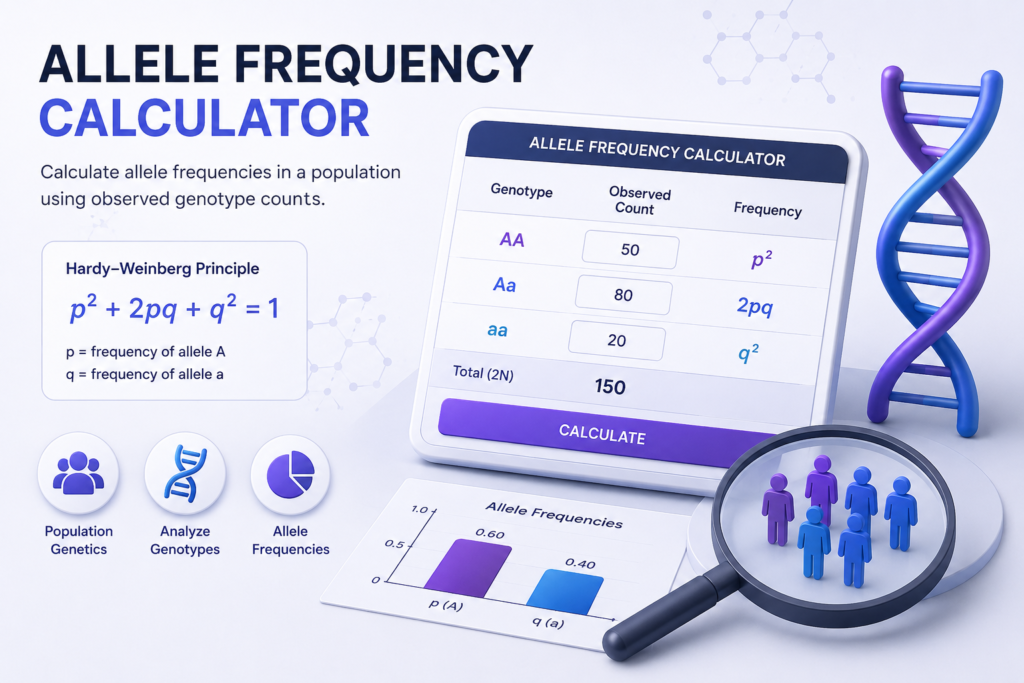
Allele Frequency Calculator: A Complete Guide
Population genetics runs on one core question: how common is a particular version of a gene within a group of individuals? Answering that by hand means counting genotypes, applying the Hardy-Weinberg equation, and double-checking the arithmetic before trusting the result. An Allele Frequency Calculator handles that entire process in seconds, which is exactly why it shows up so often in genetics classrooms and research labs alike.
What Is an Allele Frequency Calculator?
An Allele Frequency Calculator takes genotype counts, or sometimes allele counts directly, and returns how frequently each version of a gene appears across a population. Rather than manually tallying dominant and recessive alleles across dozens or hundreds of individuals, a user enters the counts once and receives the frequency breakdown along with the expected genotype distribution for comparison.
The Hardy-Weinberg Formula Behind It
The math behind this tool comes from the Hardy-Weinberg principle. For a gene with two alleles, p represents the frequency of one allele and q represents the frequency of the other, with p + q always equaling 1. Expected genotype frequencies then follow p² + 2pq + q² = 1, covering homozygous dominant, heterozygous, and homozygous recessive individuals respectively. A population that matches these expected ratios is considered to be in Hardy-Weinberg equilibrium, meaning no major evolutionary forces are actively reshaping its gene pool.
How to Use It: A Step-by-Step Example
Picture a population of 400 ladybugs surveyed for a wing-color gene, where red is dominant and black is recessive. Counting genotypes across the group turns up 210 red homozygotes, 140 heterozygotes, and 50 black homozygotes. Multiplying those counts out gives 560 copies of the red allele and 240 copies of the black allele out of 800 total alleles, which works out to a red allele frequency of 0.7 and a black allele frequency of 0.3. Entering the same three genotype counts into the calculator produces that result instantly, without needing to track the arithmetic by hand.
Allele Frequency vs. Genotype Frequency
It’s easy to mix these two terms up, but they answer different questions. Genotype frequency describes how many individuals in a population carry a specific genotype combination, such as heterozygous or homozygous. Allele frequency instead looks at the gene pool itself, counting individual gene copies rather than whole individuals. A calculator built for this task typically reports both figures side by side, since researchers often need genotype frequency to describe the population as it exists today and allele frequency to track how the underlying gene pool is shifting over time.
Who Relies on This Calculator
Genetics students use it to check Hardy-Weinberg homework, and instructors use it to build quick in-class examples without reaching for a whiteboard. Conservation biologists monitoring an endangered species’ genetic diversity rely on the same frequency math, and evolutionary biologists use it to spot whether a population might be drifting away from equilibrium. Before any of that genotyping work happens, researchers usually need a clean, well-quantified DNA sample to work from, which is where a DNA Concentration Calculator typically comes in earlier in the workflow. Population geneticists studying microorganisms often pair allele frequency tracking with tools like a Bacteria Growth Calculator or a Cell Doubling Time Calculator to understand how fast the underlying population is expanding in the first place.
Tips for Getting Accurate Results
Results are only as reliable as the sample behind them. A small or non-random sample can produce a frequency that doesn’t reflect the broader population, so it helps to survey as many individuals as reasonably possible before running the numbers. It also helps to double-check that genotype counts add up to the full sample size before entering them, since a small counting error early on will throw off every downstream calculation.
Final Thoughts
An Allele Frequency Calculator turns a formula that used to require careful hand calculation into a quick, reliable process. Whether the goal is checking a homework problem, tracking genetic diversity in a conservation program, or studying how a population is evolving over time, this tool covers a core piece of population genetics work. It sits alongside the rest of the biology calculators available for students, educators, and researchers who need a fast, dependable answer.