Protein Concentration Calculator

Ahmad zee
Table of Contents
Toggle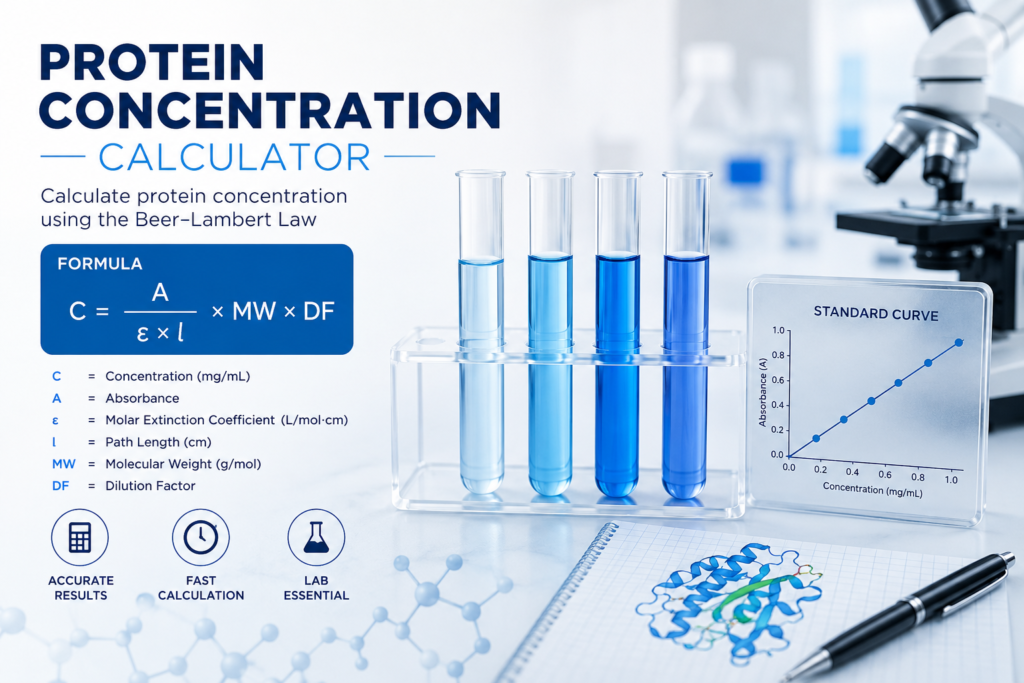
Protein Concentration Calculator : A Guide to Measuring and Optimizing Protein Solutions
Introduction
Protein concentration is one of the most fundamental measurements in molecular biology, biochemistry, and related research fields. Whether researchers are preparing protein samples for experiments, developing therapeutic drugs, or conducting quality control tests, knowing the exact concentration of protein in a solution is absolutely essential. This is where a protein concentration calculator becomes an indispensable laboratory tool. By automating complex calculations and providing instant results, these calculators help scientists work more efficiently and minimize the risk of experimental errors that could compromise their research.
The ability to accurately determine and adjust protein concentration directly impacts the success of countless laboratory procedures, from enzyme assays to antibody studies to recombinant protein production. Understanding how to use a protein concentration calculator—and the principles behind it—empowers researchers to maintain the precision that modern science demands.
Understanding Protein Concentration: The Basics
Protein concentration refers to the amount of protein present in a specific volume of solution, typically expressed in units such as milligrams per milliliter (mg/mL), micrograms per milliliter (μg/mL), or micromolar (μM). Rather than simply knowing that “there’s protein in this tube,” scientists need exact quantitative data to design experiments, scale reactions, and ensure reproducibility across multiple trials.
The protein concentration calculator takes raw measurement data and performs the mathematical conversions needed to express protein quantity in standardized units. This might involve converting absorbance readings into concentration values, adjusting for dilution factors, or accounting for the molecular weight of specific proteins. What could take several minutes with manual calculations happens instantaneously through the calculator interface.
Different fields and applications demand different levels of precision regarding protein concentration. A researcher preparing a working solution for routine lab procedures might be satisfied with concentration accuracy to two decimal places, while a pharmaceutical company manufacturing a protein therapeutic drug must achieve far more precise measurements to meet regulatory standards.
Why Precise Protein Concentration Matters
Impact on Experimental Reproducibility
One of the core principles of scientific research is reproducibility. If an experiment can’t be repeated with the same results, it raises serious questions about the findings. Protein concentration plays a critical role in reproducibility because most molecular biology experiments depend on having consistent starting conditions. If the protein concentration varies between experiments, researchers can’t be sure whether differences in results come from legitimate experimental variables or simply from inconsistent protein quantities.
When using a protein concentration calculator to carefully track and standardize protein levels, researchers create a foundation for truly comparable experiments. This attention to detail transforms scattered observations into meaningful, reproducible science.
Quality Control in Manufacturing
In pharmaceutical and biotechnology manufacturing facilities, maintaining consistent protein concentration isn’t just important—it’s a regulatory requirement. Products like monoclonal antibodies, recombinant hormones, and vaccine components all require protein concentration specifications that must be met for every batch. The protein concentration calculator helps quality control laboratories rapidly test numerous samples and verify that production processes are consistently meeting specifications.
Optimizing Reaction Efficiency
Enzymatic reactions, protein-protein interactions, and many other biochemical processes operate most efficiently within specific protein concentration ranges. Too much protein might cause aggregation or precipitation, while too little might result in negligible reaction rates. By using a protein concentration calculator to maintain optimal concentrations, researchers can maximize the efficiency of their experimental procedures and achieve better results with less waste.
Methods for Measuring Protein Concentration
Before a protein concentration calculator can be useful, scientists need actual concentration data to input. Several established methods exist for measuring protein levels, each with specific advantages and limitations:
UV-Visible Spectrophotometry
This is one of the most common methods for determining protein concentration in laboratory settings. The technique relies on the fact that proteins absorb light at specific wavelengths, particularly at 280 nm where aromatic amino acids (tryptophan and tyrosine) absorb strongly. A spectrophotometer measures this absorbance, and researchers can then use a protein concentration calculator to convert the absorbance reading into actual concentration values.
The main advantage of UV spectrophotometry is that it’s rapid, requires only small sample volumes, and is non-destructive (the sample can be used for additional experiments afterward). The primary limitation is that substances other than proteins (such as certain nucleic acids or small molecule dyes) can also absorb at 280 nm, potentially causing overestimation of protein concentration.
Bradford Assay
The Bradford assay uses a chemical reaction between the protein and Coomassie brilliant blue dye to produce a color change that correlates with protein concentration. Researchers incubate their protein sample with the dye reagent, measure the absorbance at 595 nm, and then use a protein concentration calculator to determine the actual protein concentration based on a standard curve.
This method is popular because it’s relatively inexpensive, works well with dilute protein solutions, and is less sensitive to interfering substances than UV spectrophotometry. However, it requires longer incubation times and can be affected by certain additives commonly used in protein storage buffers.
Lowry Assay
Named after the researcher who developed it, the Lowry assay is another colorimetric method for protein quantification. It involves two chemical reactions that produce a color change proportional to protein concentration. While historically very popular, this method has declined in use somewhat due to the availability of more convenient alternatives, though it remains valuable in specific applications.
Bicinchoninic Acid (BCA) Assay
The BCA assay is a more recent alternative that combines elements of the Lowry method with improved characteristics. It produces a purple color when proteins are present and can be measured at 562 nm. The protein concentration calculator makes it easy to convert these absorbance readings into actual concentration values. Many laboratories prefer this method because it’s more tolerant of interfering substances and provides good sensitivity across a wide concentration range.
HPLC and Other Separation Methods
For highest precision applications, particularly in pharmaceutical manufacturing, high-performance liquid chromatography (HPLC) and related separation techniques can determine protein concentration with exceptional accuracy. These methods physically separate proteins based on their properties and can identify specific protein components within a mixture. While these approaches are more time-consuming and expensive than colorimetric methods, they provide unparalleled accuracy when precision is non-negotiable.
How to Use a Protein Concentration Calculator Effectively
Most protein concentration calculators follow a similar operating principle, though the specific inputs may vary depending on which measurement method was used to generate the data:
Step 1: Select Your Measurement Method Begin by choosing which protein quantification method was used to generate your data. This selection informs what inputs the calculator will request.
Step 2: Enter Your Raw Data Depending on your chosen method, you might input absorbance readings, standard curve reference points, or other measurement values. For instance, if using UV spectrophotometry, you’d enter the absorbance at 280 nm; if using a Bradford assay, you’d enter the absorbance at 595 nm.
Step 3: Input Reference Parameters Many calculations require reference values such as the extinction coefficient (for UV-based methods) or the molecular weight of your protein (for certain calculation approaches). These parameters help the calculator translate raw measurements into concentration values.
Step 4: Account for Dilutions If your protein sample was diluted before measurement (a common practice when initial concentrations are very high), you must inform the calculator about the dilution factor. For example, if you diluted your sample 1:10, the dilution factor would be 10.
Step 5: Obtain Your Results The calculator instantly provides the protein concentration in your preferred units, often with additional derived values such as the total protein quantity in your solution or the volume needed to achieve a target concentration.
Real-World Applications of Protein Concentration Calculations
Preparing Enzyme Solutions
Enzymologists frequently need to prepare working solutions of enzymes at specific concentrations to establish controlled reaction conditions. A protein concentration calculator helps them determine exactly how much stock enzyme solution to dilute and to what final volume to achieve their target concentration. This precision ensures that enzyme reactions proceed at predictable rates and that results are comparable between experiments.
Antibody Development and Validation
Researchers developing monoclonal antibodies use protein concentration calculators to standardize antibody preparations before testing their specificity and affinity. By ensuring consistent antibody concentrations, researchers can distinguish between changes in binding behavior due to antibody quality versus simple concentration differences.
Protein Crystallography Studies
Scientists working on X-ray crystallography to determine protein structures often need protein solutions at very specific concentrations—typically high concentrations to promote crystal formation without causing protein aggregation. A protein concentration calculator helps them precisely achieve these demanding specifications.
Cell Culture and Protein Addition Studies
Researchers studying how cells respond to external proteins or protein supplements need to add precise amounts of protein to cell culture media. By using a protein concentration calculator to determine exactly how much protein is present in their stock solutions, they can add the precise quantities needed for their experiments.
Diagnostic Test Development
Companies developing protein-based diagnostic tests (such as immunoassays or point-of-care tests) rely on protein concentration calculations to ensure that test components are present at consistent levels. This standardization is critical for test reliability and regulatory approval.
Connecting Protein Measurements to Broader Laboratory Practice
Understanding protein concentration complements many other important laboratory calculations and techniques. Researchers working with protein concentrations often also use a DNA concentration calculator when studying the protein expression from specific genes, since the relationship between DNA sequence and protein production is central to molecular biology.
For those investigating how proteins function in biological systems, knowledge of protein concentration pairs naturally with understanding cell dilution principles, particularly when researchers need to deliver specific amounts of protein to cell cultures or tissue samples.
Researchers involved in protein evolution studies or comparative analyses often benefit from a protein concentration calculator alongside tools that help quantify genetic variation, since protein expression levels can vary based on genetic differences.
Additionally, those studying microbial protein production or bacterial protein expression systems frequently use information about generation time and bacterial growth rates to predict how much time is needed for microorganisms to produce sufficient quantities of recombinant proteins.
Common Mistakes to Avoid When Using Protein Concentration Calculators
Overlooking interference from sample buffers: Many protein storage buffers contain substances that can interfere with protein concentration measurements, particularly in colorimetric assays. Always account for these potential interferences, either by using blank samples containing only the buffer or by choosing measurement methods known to be tolerant of your specific buffer composition.
Forgetting to account for dilution factors: This is a surprisingly common mistake that can lead to dramatically incorrect concentration values. Always remember to multiply by your dilution factor when diluted samples are measured.
Using incorrect extinction coefficients: For UV spectrophotometry, the extinction coefficient is critical to accurate calculations. Using a generic value rather than the specific extinction coefficient for your protein can introduce significant errors. Always look up or determine the extinction coefficient for your specific protein.
Mixing up volume and concentration units: Some calculators work in milliliters while others work in microliters. Ensure that all your inputs use consistent units to avoid unit conversion errors that would make your final concentration calculations meaningless.
Ignoring instrument calibration: Spectrophotometers and other measurement instruments require regular calibration to maintain accuracy. If your instrument hasn’t been recently calibrated, any measurements it produces—and therefore any protein concentration calculations based on those measurements—may be unreliable.
Protein Concentration in the Context of Modern Research
As research methods become increasingly sophisticated, protein concentration determination remains as essential as ever. Advanced techniques like mass spectrometry and high-resolution imaging all depend on having proteins at precisely controlled concentrations. A protein concentration calculator ensures that researchers maintain the quantitative precision that these modern methods demand.
The democratization of molecular biology—making advanced techniques accessible to smaller laboratories and educational institutions—has made protein concentration calculators more important than ever. As more researchers gain access to powerful techniques, they need reliable tools to maintain the standards of precision and accuracy that scientific research requires.
Optimization and Practical Laboratory Tips
Batch testing protocol: When determining protein concentration for multiple samples, process them consistently. Measure all samples using the same method, the same instrument settings, and within a short timeframe to minimize variability between measurements.
Maintaining reference standards: Keep well-characterized protein standards available to validate your measurement methods periodically. This helps catch any issues with measurement accuracy before they compromise your experimental results.
Documentation practices: Always record which protein concentration measurement method was used, the raw measurement values, and the dilution factors applied. This documentation becomes invaluable if results need to be verified or if experiments need to be repeated months or years later.
Temperature considerations: Protein measurements can be affected by temperature, both in terms of how solutions are prepared and how they’re stored. Maintain consistent conditions and record the temperature at which measurements were taken.
Conclusion
The protein concentration calculator represents one of the most straightforward yet powerful tools in a researcher’s toolkit. By instantly converting raw measurement data into standardized concentration values, these calculators eliminate calculation errors, save time, and enable researchers to maintain the exacting standards that modern science demands. Whether someone is optimizing enzyme reactions, developing therapeutic proteins, or conducting quality control tests, understanding how to properly measure and calculate protein concentration is fundamental to success.
The ability to accurately determine protein concentration forms the foundation for countless important research projects, from basic science investigations to pharmaceutical product development to diagnostic test creation. By mastering protein concentration calculations and leveraging available tools like protein concentration calculators, scientists and technicians ensure that their work meets the precision and reliability standards that scientific integrity requires.