Cell Doubling Time Calculator

Ahmad zee
Table of Contents
Toggle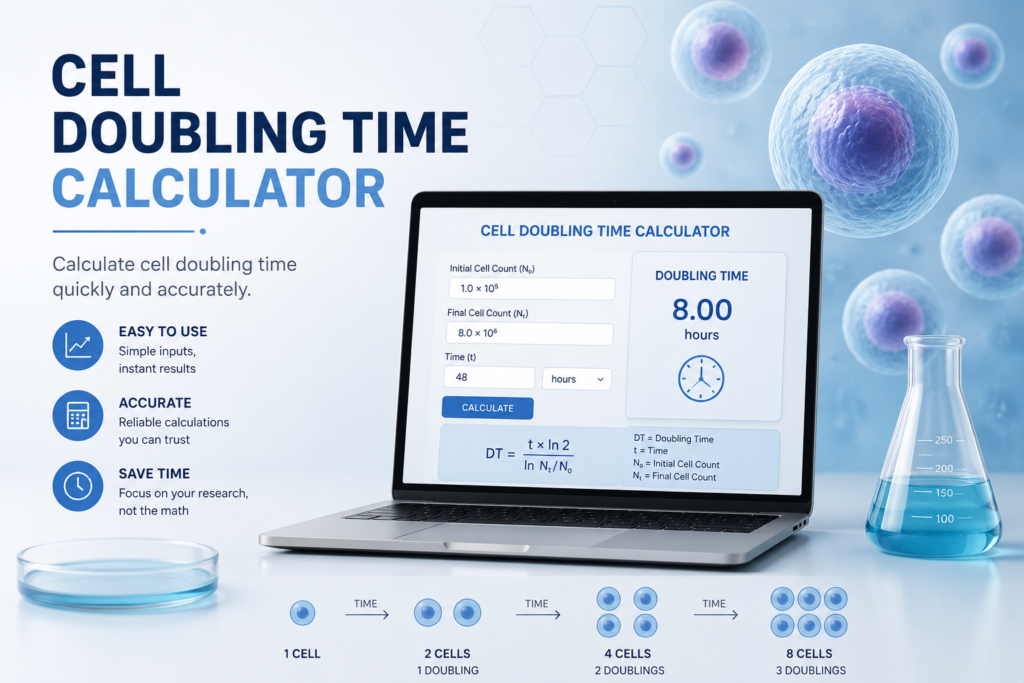
Cell Doubling Time Calculator: The Complete Guide to Measuring and Interpreting Cell Proliferation
What Is a Cell Doubling Time Calculator and Why Does It Matter?
In the world of cell biology, few measurements carry as much weight as the rate at which a cell population grows. Whether the goal is to optimize a cell culture protocol, characterize a newly established cell line, monitor the health of a bioreactor, or assess the aggressiveness of a tumor, understanding how quickly cells divide is fundamental to making good scientific decisions. That is precisely what a cell doubling time calculator is built to do.
A cell doubling time calculator is a mathematical tool that determines how long it takes for a population of cells to double in number under a given set of conditions. By inputting a few measured values — typically an initial cell count, a final cell count, and the elapsed time between the two measurements — the calculator returns the population doubling time, expressed in hours or days. This single number encapsulates a wealth of biological information and serves as a reliable benchmark for comparing cell behavior across experiments, laboratories, and treatment conditions.
For researchers working with mammalian cell lines, bacterial cultures, yeast, or any other proliferating biological system, a cell doubling time calculator is not a luxury — it is a core part of the experimental toolkit.
The Biology Behind Cell Doubling Time
What Doubling Time Actually Represents
Doubling time is the time required for a cell population to increase twofold in number during the exponential phase of growth. It is the cellular equivalent of compound interest — each doubling produces twice as many cells as the previous cycle, leading to exponential increases in population size over time.
During the exponential growth phase, cells divide at a constant, maximum rate determined by the organism and its environment. A cell doubling time calculator models this phase mathematically, using the assumption that each cell divides at the same average rate throughout the measurement window. This makes doubling time a clean, interpretable metric that strips away the complexity of individual cell variability and reduces population behavior to a single, actionable number.
It is worth noting that doubling time is not a fixed biological constant. It changes with temperature, nutrient availability, oxygen levels, pH, passage number, and the presence of growth factors or inhibitory compounds. That is why using a cell doubling time calculator consistently — rather than estimating based on intuition or historical values — is so important for generating reproducible data.
The Relationship Between Doubling Time and Growth Rate
Doubling time and specific growth rate are two sides of the same coin. The specific growth rate (μ) describes how quickly the population expands per unit time, while doubling time (Td) describes the time required for one complete doubling event. The two are mathematically related by:
Td = ln(2) / μ ≈ 0.693 / μ
A cell doubling time calculator uses this relationship — along with the exponential growth equation — to convert raw cell count measurements into a meaningful proliferation metric. The exponential growth equation itself takes the form:
N(t) = N₀ × e^(μt)
Where N(t) is the cell count at time t, N₀ is the initial cell count, and e is Euler’s number. Rearranging this equation to solve for Td gives the core formula embedded in every cell doubling time calculator:
Td = t × ln(2) / ln(N(t) / N₀)
This formula is simple to apply but requires careful attention to ensuring that the measurements used fall within the true exponential phase of growth — a point that experienced cell biologists emphasize repeatedly.
Key Inputs for a Cell Doubling Time Calculator
Initial and Final Cell Counts
The two primary inputs for a cell doubling time calculator are the cell count at the start of the measurement window and the cell count at the end. These are typically obtained by direct counting using a hemocytometer, an automated cell counter, or an indirect method such as absorbance measurement at 600 nm (OD₆₀₀) in microbial cultures.
The quality of these measurements has a direct and proportional effect on the accuracy of the calculated doubling time. Inaccurate counts — caused by clumped cells, poor mixing, or a non-representative sample — introduce error that the calculator cannot correct. For this reason, replicate counts and thorough mixing before sampling are considered best practice when preparing inputs for a cell doubling time calculator.
Elapsed Time
The time interval between the initial and final cell counts is the third essential input. For most mammalian cell lines, measurements taken 24 to 72 hours apart during exponential growth provide a reliable window for doubling time calculation. For faster-dividing organisms like E. coli, intervals of 1 to 4 hours are more appropriate.
One practical consideration is ensuring that the measurement window genuinely captures the exponential phase. If the initial count is taken while cells are still in the lag phase, or the final count is taken after cells have entered the stationary phase, the calculated doubling time will be artificially inflated and will not reflect the true proliferative capacity of the culture.
Viability Considerations
A detail that is often overlooked when using a cell doubling time calculator is whether the cell counts used represent total cells or only viable cells. In most biological applications, the relevant metric is the viable cell count — the number of living, membrane-intact cells capable of dividing. Using total cell counts that include dead cells introduces a systematic overestimate of the true cell number, which in turn leads to an underestimate of the doubling time.
Trypan blue exclusion, which stains dead cells blue while leaving live cells clear, is the simplest and most widely used viability assessment method. Pairing it with a cell doubling time calculator ensures that the proliferation data reflects the biology of live cells rather than the accumulated debris of a mixed population.
Practical Applications of a Cell Doubling Time Calculator
Cell Line Characterization and Quality Control
Every time a new cell line is established or obtained from an external source, characterizing its growth kinetics is one of the first steps in a thorough quality control process. A cell doubling time calculator makes this straightforward — a growth curve experiment spanning several days, with cell counts taken at regular intervals, provides all the data needed to calculate doubling time with confidence.
Knowing the baseline doubling time for a cell line allows researchers to detect deviations that might signal mycoplasma contamination, genetic drift, nutrient depletion, or suboptimal culture conditions. A cell line that was doubling every 24 hours in previous passages but has slowed to 36 hours is sending a clear signal that something has changed — and a cell doubling time calculator is what makes that signal visible.
Drug and Treatment Response Assessment
In pharmacology and oncology research, the cell doubling time calculator is a valuable tool for quantifying how cells respond to treatments. A chemotherapy agent, a targeted inhibitor, or a novel experimental compound that slows cell proliferation will produce a measurable increase in doubling time compared to untreated controls.
By calculating doubling time in treated and untreated populations in parallel, researchers can generate a quantitative measure of growth inhibition that complements endpoint assays like MTT or ATP viability tests. This dynamic approach captures information about proliferation kinetics that static endpoint measurements can miss.
Bioprocessing and Bioreactor Management
In the bioprocessing industry, maintaining cells in the exponential phase of growth for as long as possible is the key to maximizing productivity. A cell doubling time calculator integrated into process monitoring workflows helps bioprocess engineers track growth kinetics in real time, identify deviations from expected growth curves, and make informed decisions about feeding schedules, passaging intervals, and harvest timing.
For CHO cells used in recombinant protein manufacturing, HEK293 cells used in viral vector production, or hybridoma cells used for monoclonal antibody generation, knowing the precise doubling time under current process conditions is directly linked to product yield and batch-to-batch consistency.
Tumor Biology and Cancer Research
In cancer biology, the doubling time of tumor cells — both in vitro and in vivo — is a clinically significant parameter. Faster-doubling tumor cell lines are generally associated with more aggressive phenotypes, greater resistance to therapy, and poorer prognosis. A cell doubling time calculator allows oncology researchers to compare the proliferative behavior of different tumor cell lines, assess the effect of oncogene overexpression or tumor suppressor knockdown, and quantify the antiproliferative activity of novel therapeutic candidates in a standardized, reproducible way.
Common Mistakes When Calculating Cell Doubling Time
Even with a reliable cell doubling time calculator, several common errors can undermine the accuracy of results.
Measuring outside the exponential phase is the most consequential mistake. Doubling time is only a meaningful metric during the period of logarithmic growth. Measurements taken during the lag or stationary phase will yield inflated doubling times that do not reflect the cell’s true proliferative capacity.
Using inconsistent counting methods between the initial and final time points introduces systematic bias. If the initial count is performed manually on a hemocytometer and the final count is performed with an automated counter calibrated differently, the apparent change in cell number may partly reflect the difference in counting methodology rather than actual growth.
Neglecting to account for cell death in fast-dividing cultures with significant death rates means that the net doubling time calculated reflects the balance of division and death rather than the intrinsic division rate. In such cases, tracking viable cell count separately and using it as the input for the cell doubling time calculator gives a more biologically accurate result.
Choosing the Right Cell Doubling Time Calculator
Online and Software-Based Options
A range of user-friendly cell doubling time calculators are available online, including tools offered by ATCC, Roper Technologies, and various academic institutions. These platforms typically require only three inputs — initial count, final count, and elapsed time — and return the doubling time instantly.
For more complex workflows, laboratory information management systems (LIMS) and bioprocess control platforms often include embedded doubling time calculation modules that can process data from multiple time points simultaneously, fitting the exponential growth curve to the full dataset rather than relying on just two measurements. This multi-point approach reduces the influence of measurement noise on the calculated doubling time and is considered more statistically robust.
Building a Growth Curve for Greater Accuracy
Rather than relying on a single pair of time points, experienced researchers often build a full growth curve by counting cells at multiple intervals and then using a cell doubling time calculator — or curve-fitting software — to extract the doubling time from the slope of the log-linear portion of the growth curve. This approach is more labor-intensive but provides a more reliable and reproducible estimate, particularly for cell lines with variable lag phases or those being characterized for the first time.
Final Thoughts
A cell doubling time calculator is one of the most straightforward yet scientifically powerful tools available to anyone working with proliferating cells. It distills complex growth dynamics into a single, comparable metric that drives decisions in cell biology, drug development, biomanufacturing, and cancer research alike. Used correctly — with careful attention to measurement timing, counting accuracy, and viability assessment — it transforms raw cell count data into actionable biological insight. For any laboratory that takes reproducibility seriously, making the cell doubling time calculator a standard part of the experimental workflow is a simple step with substantial rewards.