Basal Area Calculator

Ahmad zee
Table of Contents
Toggle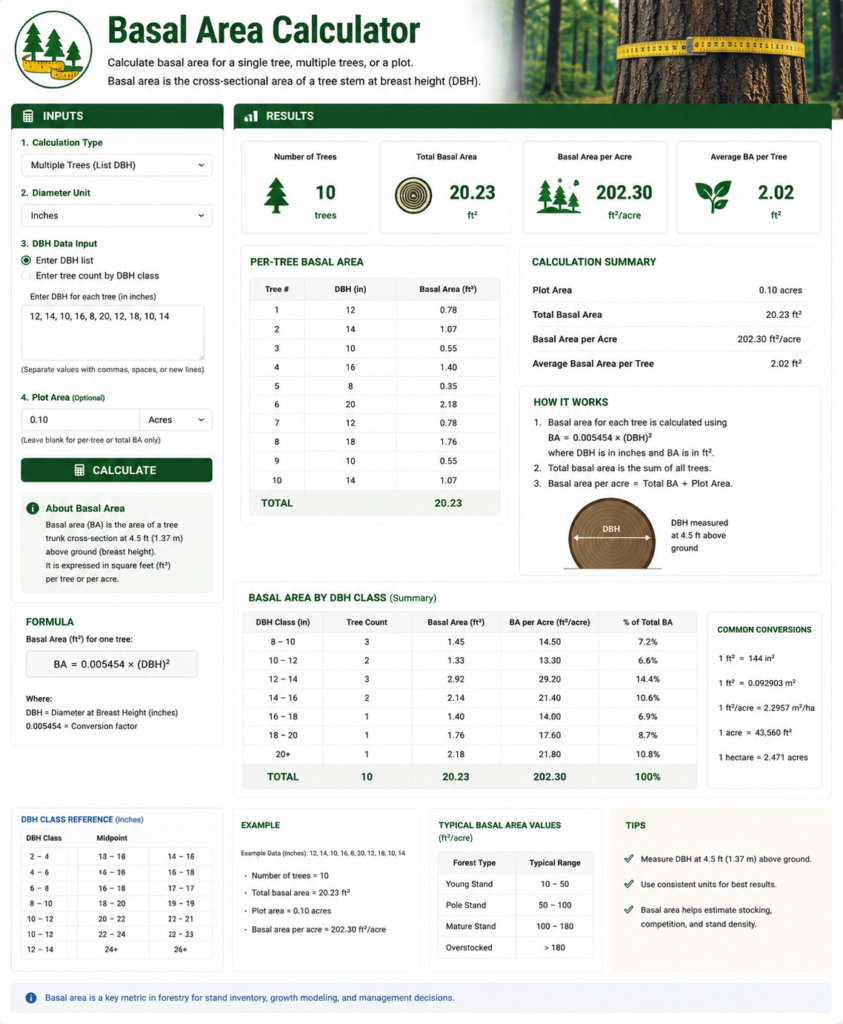
Basal Area Calculator
A Basal Area Calculator helps foresters, landowners, arborists, ecologists, and students calculate the cross-sectional area of a tree trunk at breast height (DBH). Basal area is one of the most important measurements in forestry because it helps estimate forest density, timber volume, stand productivity, and tree competition.
Whether managing a commercial forest, conducting ecological research, or evaluating woodland health, this calculator provides quick and accurate basal area estimates.
What Is a Basal Area Calculator?
A Basal Area Calculator estimates the cross-sectional area of a tree trunk measured at Diameter at Breast Height (DBH), which is typically measured 4.5 feet (1.37 metres) above the ground.
The calculator typically considers:
- Tree diameter (DBH)
- Measurement units
- Number of trees (optional)
- Area units (acres or hectares)
The result is commonly displayed in square feet, square metres, or basal area per acre/hectare.
How Does the Basal Area Calculator Work?
The calculator uses the tree’s diameter to determine its cross-sectional area.
Users generally enter:
- Diameter at breast height (DBH)
- Unit of measurement
- Number of trees (optional)
The calculator then estimates:
- Basal area of a single tree
- Total basal area
- Basal area per acre or hectare (if stand data is provided)
Basal Area Formula
The basal area of a tree is calculated using the area of a circle.
Basal Area = π × (DBH ÷ 2)²
Where:
- π = 3.1416
- DBH = Diameter at Breast Height
The calculator automatically performs the calculation after the diameter is entered.
Why Use a Basal Area Calculator?
Calculating basal area helps evaluate forest structure and tree growth.
Benefits include:
- Estimates forest density
- Assists timber inventory
- Supports sustainable forest management
- Evaluates stand productivity
- Helps monitor tree competition
- Simplifies forestry calculations
- Improves woodland planning
Common Uses of Basal Area
A Basal Area Calculator is commonly used for:
- Forest management
- Timber cruising
- Woodland inventories
- Ecological research
- Wildlife habitat assessment
- Silviculture planning
- Tree growth monitoring
- Forestry education
Factors That Affect Basal Area
Several factors influence basal area measurements.
Tree Diameter
Larger tree diameters produce greater basal area.
Number of Trees
More trees within a stand increase the total basal area.
Forest Age
Older forests generally contain trees with larger diameters.
Species
Different tree species grow at different rates and sizes.
Site Conditions
Soil fertility, rainfall, and climate influence tree growth.
Forest Management
Thinning and harvesting practices directly affect stand basal area.
Benefits of Using a Basal Area Calculator
A Basal Area Calculator offers several advantages.
- Calculates basal area instantly
- Reduces manual calculation errors
- Supports forestry planning
- Useful for timber valuation
- Suitable for students and professionals
- Simplifies forest inventory work
- Improves management decisions
Tips for Measuring Basal Area
For accurate results:
- Measure DBH at 4.5 feet (1.37 metres) above ground.
- Use a diameter tape or tree caliper for precise measurements.
- Measure all representative trees in the sample area.
- Keep measurement units consistent.
- Record measurements carefully during field surveys.
- Recalculate after thinning or harvesting operations.
- Compare basal area over time to monitor forest growth.
Frequently Asked Questions
What is basal area?
Basal area is the cross-sectional area of a tree trunk measured at breast height and is commonly used to evaluate forest density.
What is DBH?
DBH stands for Diameter at Breast Height, which is the standard method for measuring tree diameter approximately 4.5 feet (1.37 metres) above the ground.
Why is basal area important?
It helps estimate timber volume, assess stand density, evaluate competition between trees, and guide forest management decisions.
Can this calculator be used for a single tree?
Yes. It can calculate the basal area of an individual tree or an entire forest stand.
Who uses a Basal Area Calculator?
Foresters, arborists, landowners, forestry students, ecologists, conservationists, and timber managers commonly use this calculator.
Other Useful Calculators
Explore more biology and agriculture calculators on Omni Calculator Store:
- Mulch Calculator
https://omnicalculator.store/home/biology/mulch-calculator/ - Grass Seed Calculator
https://omnicalculator.store/home/biology/grass-seed-calculator/ - Plant Population Calculator
https://omnicalculator.store/home/biology/plant-population-calculator/ - Soil Calculator
https://omnicalculator.store/home/biology/soil-calculator/ - Vegetable Yield Calculator
https://omnicalculator.store/home/biology/vegetable-yield-calculator/
Conclusion
A Basal Area Calculator is an essential forestry tool for estimating the cross-sectional area of trees and assessing forest stand density. By using tree diameter measurements, it provides valuable information for timber management, ecological studies, and woodland planning. Whether managing a private woodland, conducting forest inventories, or studying tree growth, this calculator offers a fast and reliable way to evaluate forest health and productivity.