Compost Calculator

Ahmad zee
Table of Contents
Toggle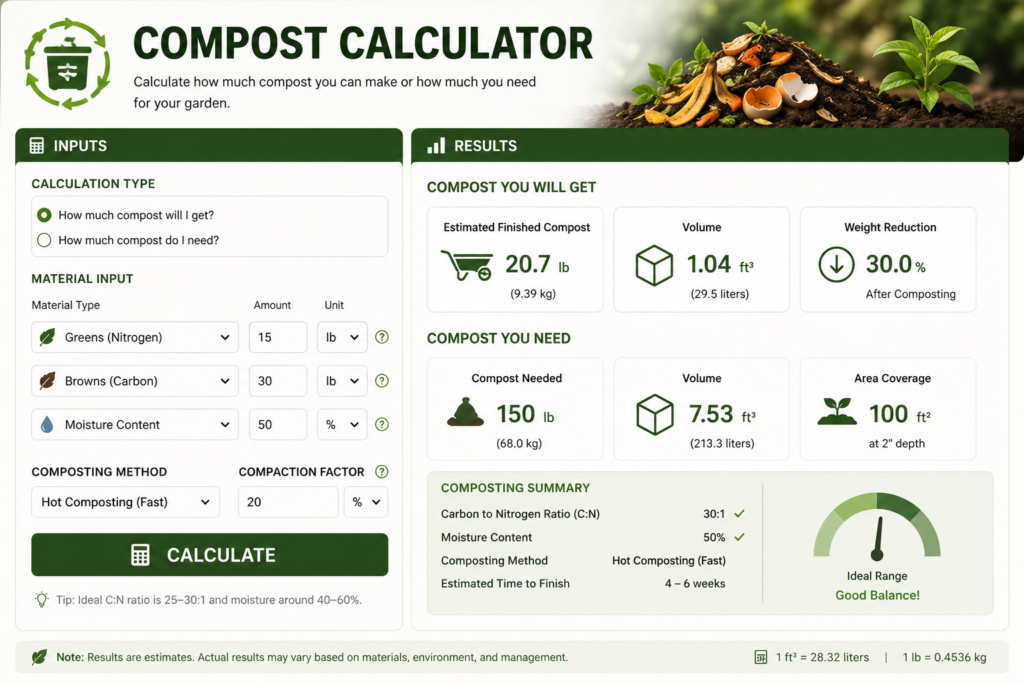
Compost Calculator
A Compost Calculator helps gardeners, landscapers, farmers, and homeowners estimate the amount of compost required for a planting area. By entering the length, width, and desired compost depth, the calculator determines the volume of compost needed, helping users purchase the right amount while reducing waste and unnecessary costs.
Whether preparing vegetable gardens, flower beds, lawns, raised beds, or landscaping projects, calculating compost requirements ensures plants receive the nutrients they need for healthy growth.
What Is a Compost Calculator?
A Compost Calculator estimates the volume of compost required to cover a specific area at a chosen depth.
The calculator typically considers:
- Length of the area
- Width of the area
- Compost depth
- Measurement units
It then calculates the amount of compost needed in cubic feet, cubic yards, or cubic metres.
How Does the Compost Calculator Work?
The calculator uses the dimensions of the planting area to estimate compost volume.
Users generally enter:
- Area length
- Area width
- Desired compost depth
- Unit of measurement
The calculator then estimates:
- Total area
- Required compost volume
- Approximate cubic yards or cubic metres of compost
Compost Volume Formula
The calculator uses a simple volume formula:
Compost Volume = Length × Width × Depth
Ensure all measurements use the same unit before calculating the total volume.
Why Use a Compost Calculator?
Estimating compost requirements before purchasing materials offers several advantages.
Benefits include:
- Prevents buying too much compost
- Reduces material waste
- Improves garden planning
- Supports healthy soil development
- Saves time and money
- Ensures even compost application
- Helps estimate delivery requirements
Benefits of Adding Compost
Compost improves soil quality and supports healthy plant growth.
Some of the key benefits include:
- Adds valuable organic matter
- Improves soil structure
- Increases water retention
- Enhances drainage in heavy soils
- Supports beneficial microorganisms
- Supplies essential nutrients
- Encourages strong root development
Factors That Affect Compost Requirements
Several factors influence how much compost is needed.
Garden Size
Larger planting areas naturally require more compost.
Application Depth
A deeper compost layer increases the total volume required.
Soil Condition
Poor or compacted soils may benefit from additional compost.
Plant Type
Vegetables, flowers, shrubs, and lawns often have different compost requirements.
Existing Organic Matter
Soils with high organic content may require less additional compost.
Benefits of Using a Compost Calculator
A Compost Calculator offers several advantages.
- Calculates compost volume quickly
- Supports landscaping projects
- Helps budget material costs
- Reduces unnecessary waste
- Suitable for gardens and farms
- Simplifies soil preparation
- Improves planting efficiency
Tips for Applying Compost
For the best results:
- Measure the planting area accurately.
- Spread compost evenly across the surface.
- Mix compost into the top layer of soil when appropriate.
- Apply compost before planting whenever possible.
- Water thoroughly after application.
- Reapply compost annually to maintain soil health.
- Store unused compost in a dry, covered location.
Frequently Asked Questions
What is a Compost Calculator?
It is a tool that estimates how much compost is needed based on the size of the planting area and the desired application depth.
Why should compost be added to soil?
Compost improves soil structure, increases nutrient availability, enhances moisture retention, and promotes healthier plant growth.
Can this calculator be used for raised garden beds?
Yes. It is suitable for raised beds, vegetable gardens, flower beds, lawns, and landscaping projects.
How deep should compost be applied?
The ideal depth depends on the project and soil condition. Many gardeners apply a layer before planting and incorporate it into the soil when appropriate.
Can compost replace fertiliser?
Compost provides valuable nutrients and organic matter, but some plants may still benefit from additional fertilisers depending on their nutritional requirements.
Other Useful Calculators
Explore more biology and agriculture calculators on Omni Calculator Store:
- Plant Spacing Calculator
https://omnicalculator.store/home/biology/plant-spacing-calculator/ - CO₂ Grow Room Calculator
https://omnicalculator.store/home/biology/co2-grow-room-calculator/ - Plant Population Calculator
https://omnicalculator.store/home/biology/plant-population-calculator/ - Bulb Spacing Calculator
https://omnicalculator.store/home/biology/bulb-spacing-calculator/ - Pine Straw Calculator
https://omnicalculator.store/home/biology/pine-straw-calculator/
Conclusion
A Compost Calculator is a practical tool for estimating the amount of compost needed for gardens, lawns, flower beds, and landscaping projects. By calculating compost volume based on area and application depth, gardeners and growers can purchase the correct amount, minimise waste, and create healthier soil conditions for long-term plant growth. Whether working on a small home garden or a large agricultural project, this calculator makes soil preparation more accurate and efficient.