Rat Cage Calculator

Ahmad zee
Table of Contents
Toggle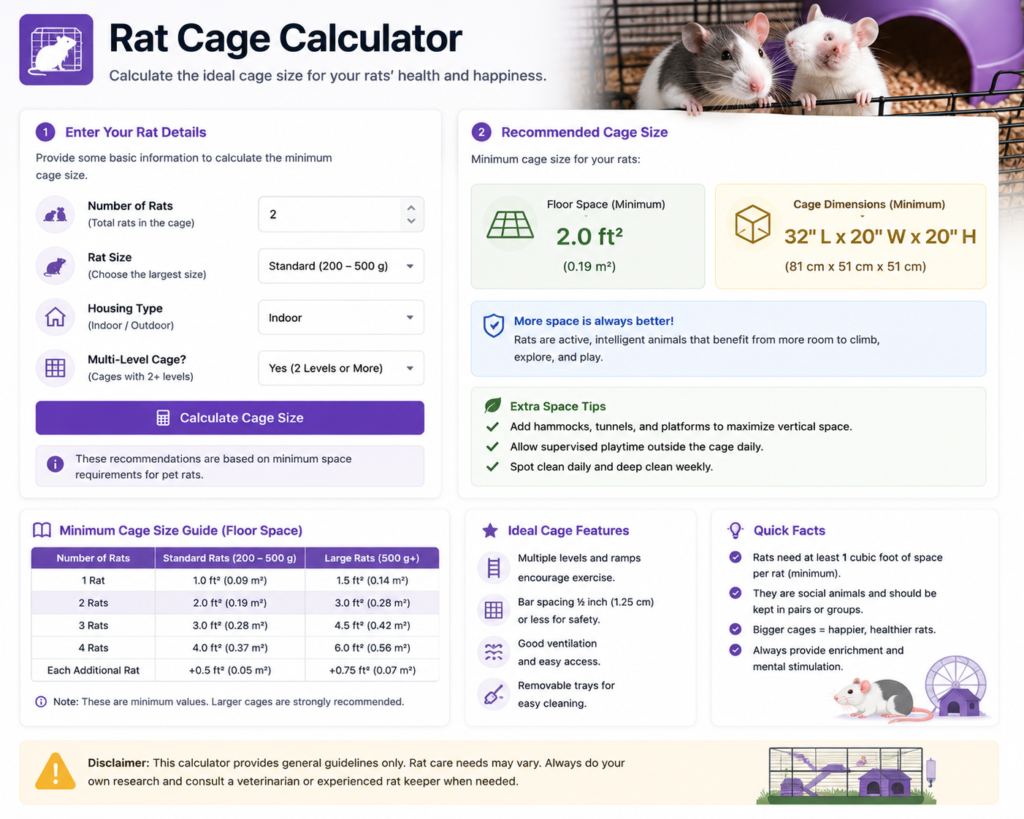
Rat Cage Calculator
A Rat Cage Calculator helps pet owners determine the ideal cage size based on the number, size, and activity level of their pet rats. Providing an appropriately sized enclosure is one of the most important aspects of responsible rat ownership, as it directly affects their health, behaviour, and overall quality of life.
Pet rats are highly intelligent, social, and energetic animals. They require plenty of room to climb, explore, exercise, and interact with their companions. A well-sized cage supports both their physical and mental well-being while reducing stress and boredom.
What Is a Rat Cage Calculator?
A Rat Cage Calculator estimates the minimum recommended cage dimensions and living space for pet rats. It considers factors such as the number of rats, their size, and whether the enclosure includes multiple levels.
The calculator helps owners choose a cage that provides enough room for sleeping, climbing, playing, and eating without overcrowding.
How Does the Rat Cage Calculator Work?
The calculator uses information about your pets to recommend an appropriate enclosure size.
Typically, you’ll enter:
- Number of rats
- Rat size or breed
- Age (optional)
- Number of cage levels (optional)
The calculator then estimates the minimum cage dimensions and total living space recommended for your pets.
Why Cage Size Is Important
Rats spend a significant amount of time inside their enclosure, making cage size essential for their health.
A properly sized cage helps:
- Encourage daily exercise
- Prevent obesity
- Reduce stress
- Support natural climbing behaviour
- Minimise territorial disputes
- Improve mental stimulation
- Promote healthier social interactions
Recommended Cage Sizes
The following table provides general recommendations for pet rats.
| Number of Rats | Recommended Minimum Cage Size |
|---|---|
| 2 Rats | 80 × 50 × 80 cm |
| 3 Rats | 90 × 60 × 100 cm |
| 4 Rats | 100 × 60 × 120 cm |
| 5–6 Rats | 120 × 60 × 150 cm |
These recommendations represent minimum sizes. Larger cages with multiple levels are always preferable.
What Should a Rat Cage Include?
A suitable rat cage should provide more than just floor space.
Essential accessories include:
- Hammocks
- Climbing ropes
- Shelves and platforms
- Food bowls
- Water bottles
- Hideouts
- Chew toys
- Tunnels
- Exercise wheels (solid surface only)
- Soft bedding
Enrichment items help prevent boredom and encourage natural behaviours.
Factors That Affect Cage Size
Several factors influence how much space pet rats require.
Number of Rats
Because rats are social animals, they should generally be kept in pairs or groups. More rats require larger enclosures.
Rat Size
Larger rat breeds naturally require additional space for comfortable movement.
Activity Level
Active rats benefit from taller cages with multiple climbing opportunities.
Cage Design
Vertical space is just as important as floor space because rats enjoy climbing.
Daily Free-Roam Time
Rats that spend time outside the cage each day still require a spacious enclosure for resting and sleeping.
Benefits of Using a Rat Cage Calculator
Using a Rat Cage Calculator helps owners make informed decisions before purchasing a cage.
Benefits include:
- Prevents overcrowding
- Supports healthy exercise
- Encourages natural behaviours
- Simplifies cage selection
- Improves overall welfare
- Suitable for both new and experienced rat owners
Common Cage Size Mistakes
Many owners unintentionally choose cages that are too small.
Avoid these common mistakes:
- Housing rats alone
- Choosing cages designed for hamsters
- Ignoring cage height
- Overcrowding the enclosure
- Providing too few climbing structures
- Skipping daily enrichment
Tips for Creating the Perfect Rat Habitat
To provide a safe and stimulating home:
- Choose a tall cage with multiple levels.
- Provide plenty of climbing opportunities.
- Add tunnels and hammocks.
- Rotate toys regularly.
- Clean the cage weekly.
- Provide fresh food and water daily.
- Allow supervised playtime outside the cage.
- Keep the enclosure well ventilated.
Frequently Asked Questions
How many rats should live together?
Pet rats are highly social and generally thrive when kept in pairs or small groups rather than alone.
Is a taller cage better than a wider one?
Ideally, a rat cage should offer both adequate floor space and plenty of vertical climbing opportunities.
Can rats live in hamster cages?
Most hamster cages are too small for pet rats. Rats require significantly larger enclosures with greater height and stronger construction.
How often should a rat cage be cleaned?
Spot cleaning should be done daily, while a full cage cleaning is typically recommended once each week.
Do rats need time outside their cage?
Yes. Supervised daily exercise outside the cage provides additional physical activity and mental stimulation.
Other Useful Calculators
Explore more biology and pet care calculators available on Omni Calculator Store:
- Rabbit Cage Size Calculator
https://omnicalculator.store/rabbit-cage-size-calculator/ - Dog Crate Size Calculator
https://omnicalculator.store/home/biology/dog-crate-size-calculator/ - Guinea Pig Years to Human Years Calculator
https://omnicalculator.store/guinea-pig-years-to-human-years-calculator/ - Dog Size Calculator
https://omnicalculator.store/home/biology/dog-size-calculator/ - Horse Weight Calculator
https://omnicalculator.store/horse-weight-calculator/
Conclusion
A Rat Cage Calculator is a valuable tool for selecting an enclosure that meets the needs of pet rats. By considering the number of rats, their size, and their natural behaviours, owners can provide a spacious and enriching environment that supports long-term health and happiness. Combined with proper nutrition, regular cleaning, and daily interaction, the right cage helps pet rats thrive throughout their lives.