Crickets Chirping Thermometer

Ahmad zee
Table of Contents
Toggle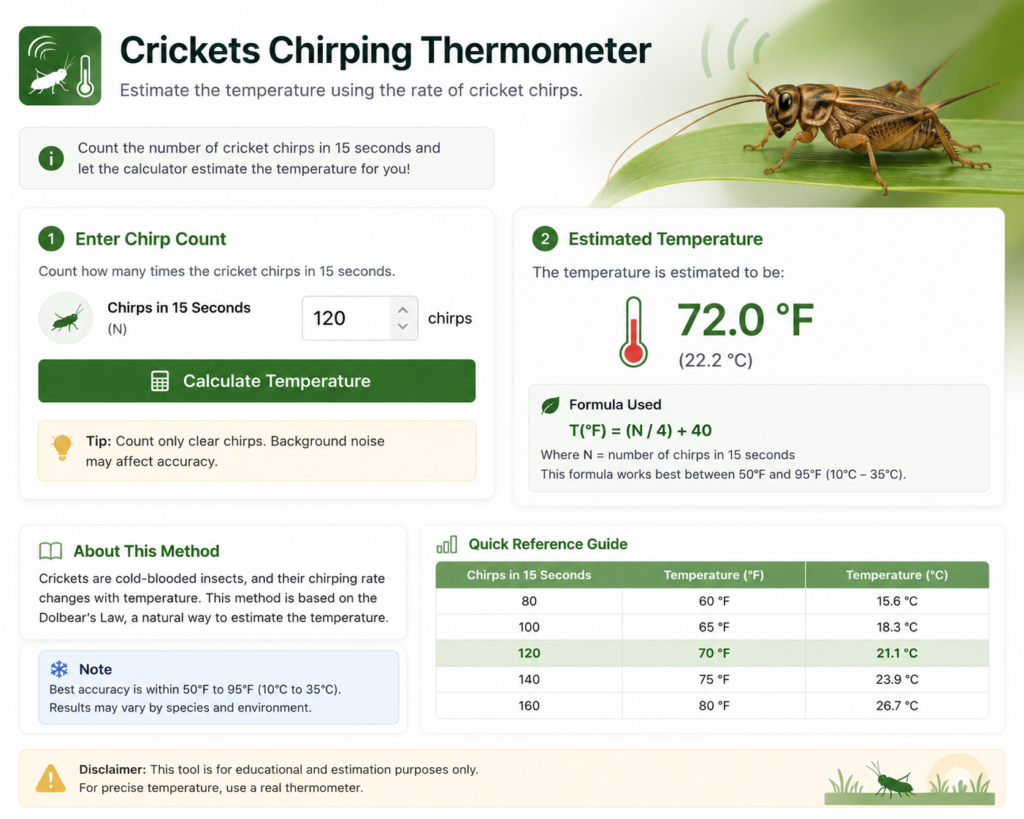
Crickets Chirping Thermometer
The Crickets Chirping Thermometer is a fascinating tool that estimates the outdoor temperature by counting how often crickets chirp. Because crickets are cold-blooded insects, their activity changes with the surrounding temperature. As the air becomes warmer, crickets chirp more frequently. When temperatures drop, their chirping slows down.
This natural relationship has been observed for more than a century and forms the basis of the well-known “cricket thermometer.” While it cannot replace a weather station, it offers a surprisingly accurate way to estimate temperature outdoors.
What Is a Crickets Chirping Thermometer?
A Crickets Chirping Thermometer uses the number of chirps produced by certain cricket species over a specific period to estimate the surrounding air temperature.
The calculator is based on the principle that a cricket’s metabolism depends on environmental temperature. Since warmer conditions increase metabolic activity, crickets produce chirps more rapidly.
This simple calculator helps users convert chirp counts into an estimated temperature in either Fahrenheit or Celsius.
How Does It Work?
To use the calculator:
- Find a chirping cricket outdoors.
- Count the number of chirps during the selected time period.
- Enter the chirp count into the calculator.
- View the estimated air temperature instantly.
The calculation is most accurate when using species such as the Snowy Tree Cricket, which closely follows Dolbear’s Law.
Why Do Crickets Chirp More in Warm Weather?
Crickets produce chirps by rubbing their wings together, a process known as stridulation.
As temperatures rise:
- Muscle movement becomes faster.
- Metabolism increases.
- Chirping frequency rises.
- Mating activity becomes more active.
When temperatures fall, these biological processes slow down, resulting in fewer chirps.
Factors That Affect Cricket Chirping
Although temperature is the primary factor, several other conditions can influence chirping rates.
Species
Different cricket species chirp at different rates. Some follow temperature-based formulas more accurately than others.
Time of Day
Most crickets chirp during the evening and nighttime when they are more active.
Humidity
High humidity can slightly influence insect behaviour, although temperature remains the dominant factor.
Age
Younger and older crickets may chirp differently than healthy adult males.
Season
Cricket activity is highest during warmer months and decreases significantly during colder seasons.
Is the Cricket Thermometer Accurate?
The calculator provides a reliable estimate under the right conditions.
Accuracy depends on:
- Correct cricket species
- Accurate chirp counting
- Stable outdoor conditions
- Minimal background noise
For casual observations, the estimated temperature is often surprisingly close to readings from a traditional thermometer.
Benefits of Using a Crickets Chirping Thermometer
Using this calculator offers several advantages.
- Quick and easy temperature estimation
- No electronic equipment required
- Educational for students and nature enthusiasts
- Demonstrates the relationship between biology and weather
- Great for outdoor learning activities
Common Uses
People use a Crickets Chirping Thermometer for various purposes.
- Outdoor science experiments
- School biology projects
- Nature observation
- Camping trips
- Environmental education
- Wildlife studies
Tips for Better Results
To obtain the most accurate estimate:
- Count chirps from a single cricket whenever possible.
- Measure during a calm evening.
- Avoid noisy surroundings.
- Count chirps multiple times and calculate the average.
- Use healthy, actively chirping crickets.
Frequently Asked Questions
What is a Crickets Chirping Thermometer?
It is a calculator that estimates outdoor temperature using the number of cricket chirps recorded over a specific time period.
Why do crickets chirp faster in warm weather?
Warmer temperatures increase a cricket’s metabolism and muscle activity, allowing it to chirp more frequently.
Does every cricket species work the same way?
No. Some species, especially the Snowy Tree Cricket, produce chirp rates that closely correspond with temperature, while others vary more.
Can this replace a regular thermometer?
No. It provides an estimate rather than a precise temperature reading, but it is remarkably accurate under suitable conditions.
Is this calculator useful for education?
Yes. It is commonly used in biology, ecology, and environmental science lessons to demonstrate how animal behaviour changes with temperature.
Other Useful Calculators
Explore more biology and animal calculators available on Omni Calculator Store:
- Horse Weight Calculator
https://omnicalculator.store/horse-weight-calculator/ - Bird Age Calculator
https://omnicalculator.store/bird-age-calculator/ - Dog Water Intake Calculator
https://omnicalculator.store/home/biology/dog-water-intake-calculator/ - Cat BMI Calculator
https://omnicalculator.store/home/biology/cat-bmi-calculator/ - Horse Gestation Calculator
https://omnicalculator.store/home/biology/horse-gestation-calculator/
Conclusion
The Crickets Chirping Thermometer is a simple yet fascinating way to estimate outdoor temperature using one of nature’s own indicators. By counting cricket chirps, users can gain insight into the relationship between environmental conditions and insect behaviour. Whether used for education, outdoor exploration, or curiosity, this calculator provides an engaging way to experience the connection between biology and weather.