Bird Age Calculator image

Ahmad zee
Table of Contents
Toggle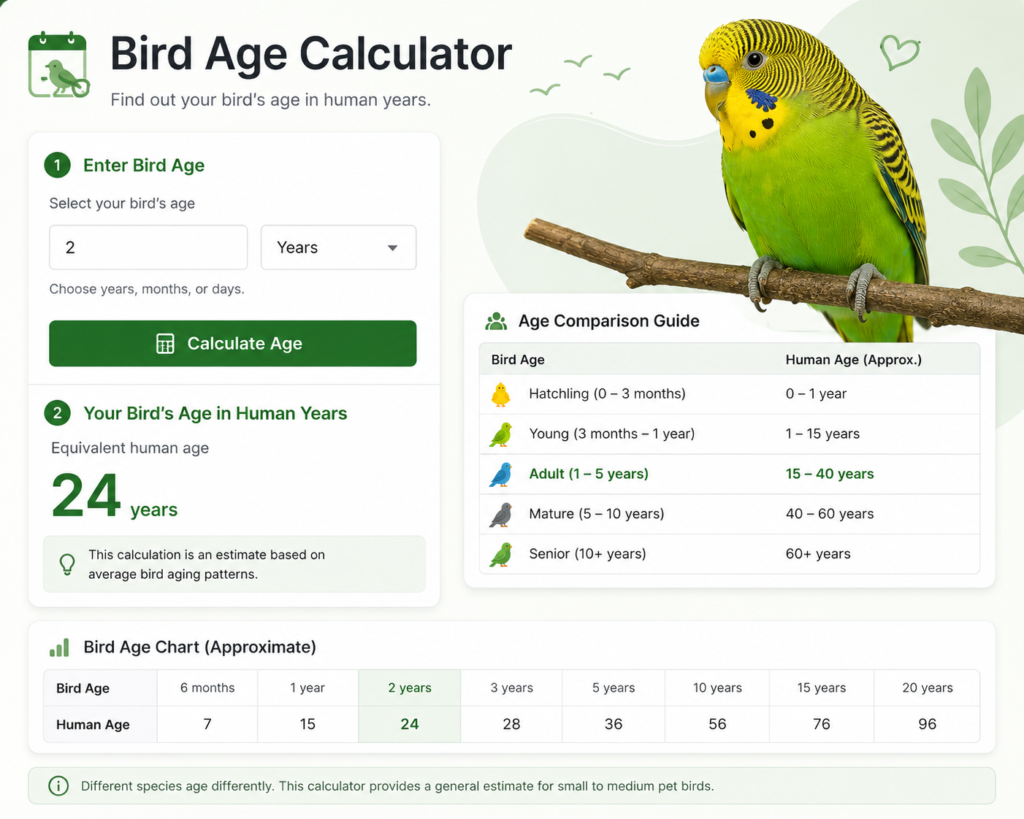
Bird Age Calculator: How Old Is Your Feathered Friend, Really?
Figuring out a bird’s true age isn’t nearly as simple as it is for cats or dogs. Birds don’t grey around the muzzle, slow their walk, or show the same obvious physical cues that mammals do as they age. Some parrot species can live well past 50 years, while smaller birds like finches or budgies may only live five to ten. A bird age calculator helps bridge that gap, giving owners a much clearer sense of where their bird actually sits in its lifespan and what that means for its care.
Why Bird Aging Is So Different From Other Pets
Unlike cats and dogs, where a fairly reliable “years to human years” conversion exists, birds don’t age on a single universal curve. Lifespan varies dramatically by species — a budgerigar might live 5 to 10 years, a cockatiel 15 to 20, an African grey parrot 40 to 60, and some larger macaws can live 60 years or more, occasionally outliving their owners entirely.
This wide variation is exactly why a generic “multiply by X” rule doesn’t work for birds the way it might loosely apply to other pets. A bird age calculator instead needs to account for species, since a 10-year-old budgie is essentially a senior citizen, while a 10-year-old macaw is still relatively young.
How a Bird Age Calculator Works
Most bird age calculators follow a simple, structured process:
- Select the species or species group — Since lifespan varies so widely, the calculator first narrows down an expected life expectancy range based on the type of bird.
- Enter the bird’s current age — Owners input how long they’ve had the bird or its known age, if documented.
- Get a life-stage estimate — The calculator places the bird within a life stage (young, adult, mature, or senior) relative to that species’ typical lifespan, rather than comparing it to an arbitrary universal number.
This species-aware approach is what makes the tool genuinely useful, rather than just a novelty.
Common Bird Life Stages
While exact ranges shift by species, most bird age calculators organize results into recognizable stages.
Juvenile
Newly fledged or very young birds, still developing full plumage, coordination, and independence from parental feeding.
Young Adult
Physically mature and often at peak energy and activity levels, though not necessarily at full behavioral maturity, especially in longer-lived species like parrots.
Adult
The most stable period of a bird’s life, generally corresponding to consistent behavior, established routines, and peak health.
Mature
The early signs of slowing may begin here — slightly reduced activity, changes in molting patterns, or a more settled temperament.
Senior
Comparable to old age in mammals, this stage often comes with a higher likelihood of age-related health issues and typically calls for closer monitoring.
Why Knowing Your Bird’s Life Stage Matters
Diet adjustments. Nutritional needs shift over a bird’s life, and knowing whether a bird is a young, active adult or a slowing senior can help guide feeding decisions discussed with an avian vet.
Behavioral expectations. A young, energetic parrot naturally needs more mental stimulation and activity than an older bird settling into a calmer routine. Misreading this can lead owners to assume a slowdown is a health problem when it’s simply part of normal aging — or the reverse, mistaking a health issue for “just getting older.”
Veterinary care planning. Birds are known for hiding illness well, a survival instinct carried over from the wild. Knowing a bird has entered its senior years is a good prompt to increase the frequency of avian veterinary checkups, since early detection matters enormously with birds.
Long-term planning. Because many parrot species can live several decades, understanding a bird’s age and expected lifespan also helps owners plan realistically for long-term care, including what happens to the bird later in life.
Factors That Influence a Bird’s Aging Process
A few variables affect how accurately a bird age calculator can estimate a bird’s life stage:
Species and size. As a general pattern, smaller birds tend to have shorter lifespans and age faster, while larger parrot species age more slowly and live considerably longer.
Diet and environment. Birds with consistent access to a balanced diet, mental stimulation, and a low-stress environment tend to age more gracefully than those with poor nutrition or chronic stress.
Genetics. Just as with people, individual genetic factors play a role in how quickly or slowly a particular bird ages, even within the same species.
Known versus estimated age. Calculators work best with an accurate starting age. For birds adopted as adults with an unknown history, an avian vet can sometimes estimate age using physical indicators like beak condition, feather quality, and eye clarity.
Tips for Getting the Most Useful Results
- Select the correct species rather than a general “bird” category, since lifespan expectations differ so dramatically between types.
- Use documented age when available, such as a hatch date from a breeder, rather than a rough guess.
- Revisit the calculator periodically, since a bird’s life stage — and its associated care needs — shifts gradually over what can be a very long lifespan.
- Pair results with regular avian vet visits, since a calculator provides a helpful general estimate rather than a clinical assessment.
Bringing It All Together
A bird age calculator offers something genuinely useful in a space where age-related guesswork is common: a species-aware, realistic sense of where a bird actually sits in its lifespan. Given how differently birds age compared to more commonly understood pets, and how long some species can live, this kind of tool helps owners make better day-to-day decisions about diet, enrichment, and veterinary care — while also encouraging the kind of long-term thinking that a multi-decade companion genuinely deserves.