Metacam Dosage Calculator for Cats

Ahmad zee
Table of Contents
Toggle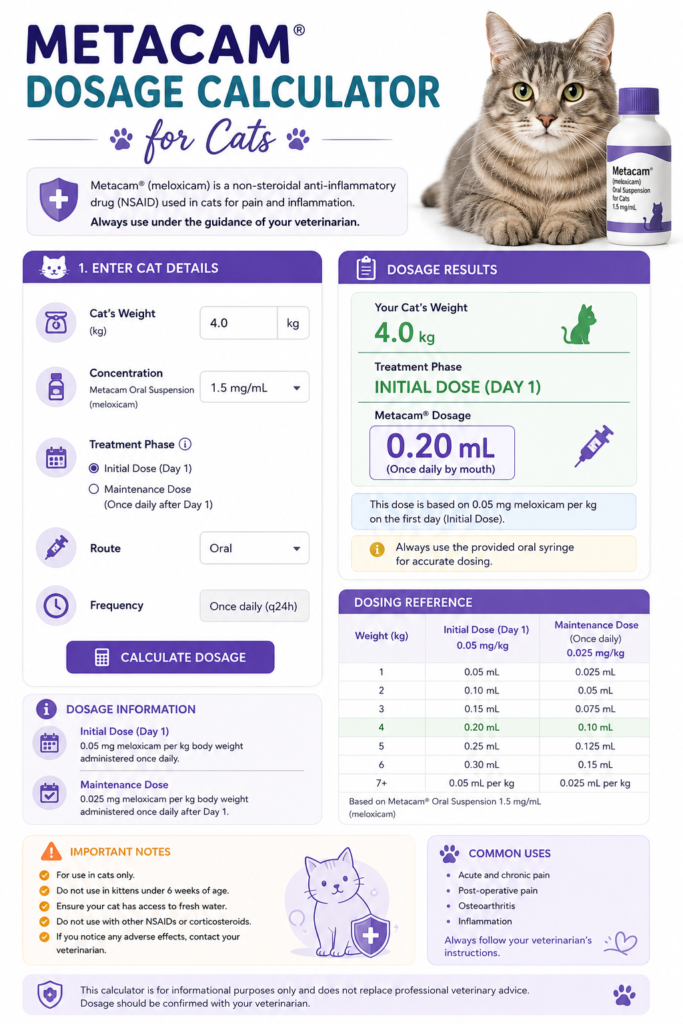
Metacam (Meloxicam) for Cats: A Complete Safety Guide for Owners
Cat owners searching for dosage information are almost always coming from a place of genuine care — a cat recovering from surgery, managing arthritis pain, or dealing with a chronic condition where a vet has already mentioned Metacam as part of the treatment plan. That instinct to understand the medication more fully is a good one. But when it comes to meloxicam, sold under the brand name Metacam, the safest and most responsible way to approach dosage looks a little different from most other pet-care topics. Rather than offering a formula or calculator, this guide focuses on what actually matters most: understanding why dosing must come directly from a veterinarian, what factors influence that decision, and how to recognize warning signs early if something goes wrong.
What Is Metacam and Why Is It Prescribed for Cats?
Metacam is the brand name for meloxicam, a non-steroidal anti-inflammatory drug (NSAID) commonly used in veterinary medicine to manage pain and inflammation. It’s often prescribed for cats following surgical procedures, such as spaying or neutering, where a single injectable dose helps control post-operative discomfort. In other cases, vets may prescribe it short-term for pain related to an injury or acute inflammation.
Longer-term or repeated oral use is far less common in cats than in dogs, and tends to come up most often with older cats managing chronic conditions like osteoarthritis. Owners curious about where their own cat sits in its life stage — since this often shapes how a vet approaches long-term pain management — can get a quick sense of that with a Cat Age Calculator. When a vet does prescribe ongoing use, it typically comes with a carefully monitored plan, including regular bloodwork to track kidney and liver function throughout treatment.
Why Cats Require Extra Caution With NSAIDs Like Metacam
Cats aren’t simply “small dogs” when it comes to drug metabolism, and this is especially true for NSAIDs. Feline livers process certain compounds far more slowly than canine or human livers, meaning a dose that might be perfectly manageable in a dog could build up to dangerous levels in a cat over time. This slower clearance rate is the central reason meloxicam carries a notably narrow safety margin in cats — the gap between an effective dose and a harmful one is much smaller than owners might expect.
Regulatory agencies, including the FDA, have specifically highlighted the risks associated with repeated meloxicam dosing in cats, citing reports of kidney injury and, in serious cases, death linked to inappropriate or repeated use. This is why single-dose, post-surgical use is viewed very differently from ongoing daily dosing — the two scenarios carry meaningfully different risk profiles, and only a veterinarian is positioned to judge which approach fits an individual cat.
Why There’s No Safe “One-Size-Fits-All” Dosage Calculator
It’s completely understandable why owners search for a simple calculator — plug in a weight, get a number, done. But meloxicam dosing doesn’t work safely that way, for several important reasons:
Body weight alone isn’t enough. Weight plays a role in dosing decisions, but it’s only one piece of a much larger picture a vet evaluates before prescribing. Tools like a Cat BMI Calculator are genuinely useful for tracking whether a cat’s weight reflects a healthy body condition over time, but that’s a separate question from what dose of medication is safe — the two shouldn’t be conflated.
Kidney function varies enormously between cats. Many cats, especially those in their senior years — a stage worth checking with something like a Quiz: Cat Age Calculator — have some degree of reduced kidney function that isn’t obvious from the outside. Since meloxicam is processed through the kidneys, this hidden factor can dramatically change what’s safe for one cat versus another of the exact same weight.
Hydration status matters. A dehydrated cat faces significantly higher risk of NSAID-related kidney injury, which is part of why vets often recommend bloodwork and a physical exam before starting treatment, particularly for anything beyond a single post-surgical dose.
Other medications and conditions change the equation. Cats already taking corticosteroids, other NSAIDs, or medications affecting blood flow to the kidneys face compounded risks that a generic calculator simply can’t account for.
Formulation and concentration differ. Metacam comes in different strengths and forms (injectable versus oral suspension, for instance), and mixing up concentrations is a known source of accidental overdose.
Because of these overlapping variables, veterinary guidance — not a generic online tool — is the only responsible way to determine an individual cat’s dose.
Recognizing the Signs of Meloxicam Overdose or Toxicity
Even with careful veterinary dosing, it helps for owners to know what warning signs to watch for, since early recognition can make a meaningful difference in outcome. Signs of meloxicam toxicity in cats can include:
- Vomiting, which may sometimes contain blood or resemble coffee grounds
- Diarrhea, including dark or tarry stools, which can indicate gastrointestinal bleeding
- Noticeable loss of appetite or complete refusal to eat
- Unusual lethargy or weakness beyond normal tiredness
- Increased or decreased urination, or visibly reduced urine output
- Pale or yellowish gums
- Signs of abdominal discomfort, such as a hunched posture or reluctance to be touched near the belly
- General dehydration, which can show up as sunken eyes or skin that’s slow to spring back when gently pinched
These symptoms can develop gradually over a day or two, or in more severe overdose situations, appear more suddenly. Any combination of these signs in a cat that has recently received Metacam warrants prompt veterinary attention rather than a wait-and-see approach. This same “know the warning signs, don’t guess” principle applies to other common household risks too — a Cat Chocolate Toxicity Calculator follows a similar logic for a different, equally urgent scenario.
What to Do If You Suspect an Overdose
If there’s any concern that a cat has received too much meloxicam — whether through a dosing error, accidental double-dosing, or getting into a bottle unsupervised — time matters. The right response is to contact a veterinarian or an emergency animal hospital immediately, along with a pet poison control hotline if one is available in the region. Having details on hand helps enormously: the strength of the medication, roughly how much may have been ingested, and when it happened. Owners should never try to induce vomiting or give a home remedy without direct guidance from a vet or poison control professional, since some interventions can make certain situations worse rather than better.
General Best Practices for Administering Metacam Safely
While this guide intentionally avoids specific dosing figures, there are several broad safety habits responsible owners can follow once a vet has prescribed the medication:
Use only the exact device provided. Oral meloxicam for cats often comes with a specially calibrated syringe. Household teaspoons or unrelated measuring tools aren’t accurate enough and should never be substituted.
Store it securely. Keeping the medication somewhere the cat can’t access on their own prevents accidental ingestion of an entire bottle, which is far more dangerous than a single missed or doubled dose.
Never share medication between pets. A dose appropriate for one cat, or for a dog in the household, isn’t automatically safe for another animal, even at a similar weight — feline and canine bodies process this drug differently enough that cross-species dosing is never a safe shortcut.
Keep all follow-up appointments. When a vet prescribes ongoing use, follow-up bloodwork isn’t optional paperwork — it’s an active safety check to catch early signs of kidney or liver stress before they become serious.
Never adjust the dose without consulting the vet first, even if the cat seems to be in more or less discomfort than expected. Pain levels can be misleading, and a well-meaning adjustment can quickly become unsafe.
Common Mistakes Owners Should Avoid
A few missteps come up repeatedly and are worth calling out directly:
- Reusing leftover medication from a previous prescription without checking in with a vet first, since circumstances like weight changes, kidney function, or other medications may have shifted.
- Assuming a human or dog NSAID is a safe substitute. Drugs like ibuprofen are significantly more toxic to cats and should never be given under any circumstances.
- Skipping recommended bloodwork for cost or convenience reasons, even though it’s one of the most important safety checks available.
- Estimating a cat’s weight rather than using an accurate, recent measurement, since even small discrepancies can matter with a drug that has such a narrow safety margin.
When to Contact Your Veterinarian
Beyond emergency situations, it’s worth reaching out to a vet whenever any of the following come up: the cat seems unusually lethargic or “off” after starting the medication, there’s uncertainty about how much was given or when, a dose was accidentally missed or doubled, or the cat has a pre-existing kidney, liver, or gastrointestinal condition that wasn’t part of the original conversation with the vet. For cats managing chronic pain long-term, resources like a Cat Quality of Life Calculator can also help owners track overall wellbeing between visits, giving the vet more useful context at each check-in. Vets would always rather field a precautionary call than have an owner guess in a situation involving a narrow-margin medication like this one.
Final Thoughts
Metacam can be a genuinely effective tool for managing pain and inflammation in cats when used correctly, and the vast majority of cats who receive it under proper veterinary supervision do well. But because feline bodies process NSAIDs so differently — and because the gap between a therapeutic dose and a harmful one is relatively small — this is one area of pet care where a personalized, vet-guided approach isn’t just the safer option, it’s the only responsible one. Understanding the “why” behind that caution, recognizing warning signs, and knowing when to reach out for help are the most valuable things an owner can take away, regardless of what a generic calculator might promise to simplify.