Cat Calorie Calculator

Ahmad zee
Table of Contents
Toggle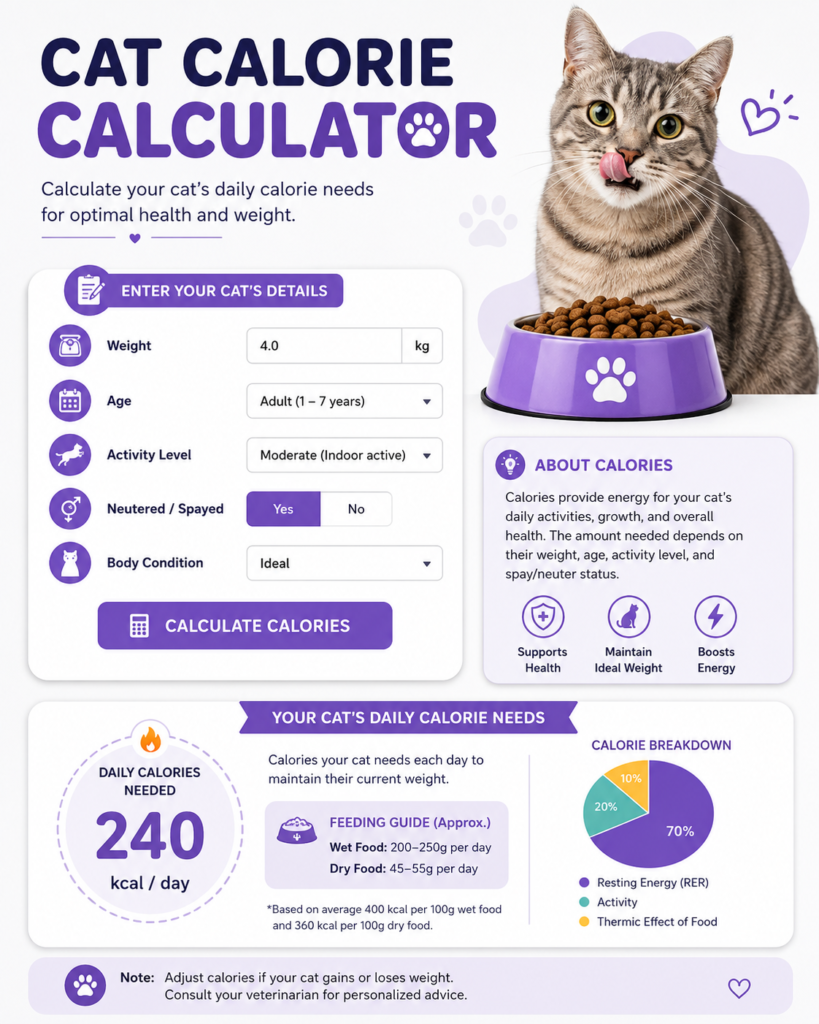
Cat Calorie Calculator: The Complete Guide to Feline Nutrition and Healthy Weight Management
Introduction to Cat Calorie Counting
Every cat owner wants their feline companion to live a long, healthy, and happy life. One of the most powerful ways to support that goal is through proper nutrition — and at the heart of proper feline nutrition lies an understanding of caloric intake. A cat calorie calculator gives cat owners a practical, science-based tool for determining exactly how many calories their cat needs each day based on their individual characteristics, health status, and lifestyle.
Without a clear understanding of feline caloric needs, even the most well-intentioned cat owners often find themselves inadvertently overfeeding or underfeeding their pets. Overfeeding is particularly common — studies consistently show that a significant percentage of domestic cats are overweight or obese, a condition that dramatically shortens lifespan and degrades quality of life. A cat calorie calculator takes the guesswork out of daily feeding decisions, replacing vague portion estimates with precise, personalized nutritional guidance.
This comprehensive guide explores everything cat owners need to know about feline caloric requirements, how a cat calorie calculator works, what factors influence a cat’s daily energy needs, and how to use caloric information to support healthy weight management across every stage of a cat’s life.
Understanding Feline Caloric Needs
Cats have unique nutritional requirements that differ meaningfully from dogs, humans, and other domestic animals. Understanding what drives a cat’s energy needs helps owners appreciate why a cat calorie calculator considers multiple individual factors rather than applying a single universal calorie recommendation.
What Is a Calorie?
A calorie, in the context of pet nutrition, represents a unit of energy. When food is metabolized by the body, the chemical energy stored in its nutrients is converted into the energy that powers every biological process — from cellular function and temperature regulation to physical movement and organ operation. A cat calorie calculator works by estimating how much energy a specific cat needs to maintain its current weight, gain weight, or lose weight depending on its goals.
In pet food, energy content is typically expressed in kilocalories (kcal), where one kilocalorie equals the amount of energy required to raise one kilogram of water by one degree Celsius. When pet food labels list “calories,” they almost always mean kilocalories. A cat calorie calculator uses kilocalorie values in its calculations, and the same unit is used when reading cat food packaging.
The Resting Energy Requirement
The foundation of any cat calorie calculator is the Resting Energy Requirement, commonly abbreviated as RER. The RER represents the number of calories a cat needs to sustain basic physiological functions — breathing, circulation, cellular maintenance, temperature regulation, and organ function — while at complete rest in a thermoneutral environment.
The formula most widely used in veterinary nutrition to calculate feline RER is:
RER (kcal/day) = 70 × (body weight in kg)^0.75
This formula accounts for the non-linear relationship between body size and metabolic rate — larger animals don’t need proportionally more energy than smaller ones because their metabolic rate per unit of body weight actually decreases as body size increases.
For example, a 4 kg cat has an RER of approximately 70 × (4)^0.75 = 70 × 2.83 = 198 kcal per day. A cat calorie calculator applies this formula automatically when the cat’s weight is entered, eliminating the need for manual calculation.
From RER to Daily Energy Requirements
The RER represents only the baseline metabolic need. A cat calorie calculator multiplies the RER by an appropriate life stage and activity factor — sometimes called the Daily Energy Requirement (DER) multiplier — to calculate the total daily caloric need for that specific cat’s situation. Different life stages, reproductive status, activity levels, and health conditions all require different multipliers.
Key Factors That Influence a Cat’s Calorie Needs
A cat calorie calculator considers several critical individual factors to generate accurate, personalized caloric recommendations. Understanding each factor helps cat owners provide the right information when using the calculator.
Body Weight
Body weight is the starting point for every cat calorie calculation. However, a cat calorie calculator needs to know not just the current body weight but also the ideal body weight — the weight at which the cat would be in optimal condition. For overweight cats, calculating calories based on current body weight would perpetuate overfeeding, while calculating based on ideal weight (sometimes estimated from body condition score assessment) provides appropriate restriction for healthy weight loss.
Age and Life Stage
A cat’s age dramatically influences its caloric requirements:
Kittens (birth to 12 months): Kittens are growing rapidly and have the highest caloric requirements relative to body weight of any life stage. A growing kitten may need two to three times the calories of an adult cat of the same weight. A cat calorie calculator applies a growth multiplier to account for the energy demands of tissue synthesis, skeletal development, and organ maturation during kittenhood.
Young adult cats (1 to 7 years): Adult cats in good health have relatively stable caloric requirements based primarily on body weight and activity level. This is the life stage during which many cats become overweight if caloric intake isn’t carefully managed.
Middle-aged cats (7 to 10 years): As cats enter middle age, metabolism begins slowing and activity levels often decrease naturally. Caloric needs may decrease modestly during this period even without dramatic changes in body weight.
Senior cats (10 to 15 years): Senior cats show more individual variation in caloric needs than younger adults. Some senior cats become overweight due to decreasing activity and metabolic rate, while others lose weight due to dental problems, reduced appetite, or age-related health conditions that reduce nutrient absorption. A cat calorie calculator tailored to senior cats accounts for this variability.
Geriatric cats (over 15 years): Very old cats often struggle to maintain body weight and may actually need increased caloric density — more calories packed into smaller meal volumes — to maintain adequate nutrition. This is the one life stage where underfeeding becomes as much of a concern as overfeeding.
Reproductive Status
Whether a cat is spayed, neutered, or reproductively intact significantly influences daily caloric needs:
Intact (unspayed) females: Intact female cats not in a reproductive state have caloric needs similar to other adult cats. However, pregnancy and nursing dramatically increase caloric requirements.
Pregnant cats: Energy requirements increase progressively throughout pregnancy, reaching approximately 1.6 to 2.0 times the normal maintenance requirement by the final weeks of gestation. A cat calorie calculator for pregnant cats accounts for this progressive increase.
Nursing cats (queens): Lactation is the most energetically demanding state in a female cat’s life. A queen nursing a large litter may need three to four times her normal maintenance caloric intake to produce sufficient milk for all kittens. Free-choice feeding is typically recommended for nursing queens rather than measured portions.
Spayed females: Spaying significantly reduces a female cat’s caloric needs — studies suggest that ovariohysterectomy reduces DER by approximately 20 to 25 percent compared to intact females. A cat calorie calculator that doesn’t account for spayed status will significantly overestimate caloric needs for these cats.
Neutered males: Castration similarly reduces metabolic rate and caloric requirements in male cats, with reductions comparable to those seen in spayed females. This reduction in caloric need combined with reduced activity following neutering is a major contributor to the high prevalence of obesity in neutered cats.
Activity Level
A cat’s daily physical activity level meaningfully influences total caloric expenditure. While cats are famously independent and self-directed in their activity choices, there is genuine variation between individual cats in how active they are:
Sedentary indoor cats: Many indoor cats sleep 16 to 18 hours per day and engage in very limited physical activity during waking hours. These cats have among the lowest caloric requirements of any adult feline group.
Moderately active indoor cats: Cats that engage in regular play sessions, explore their environment actively, or have access to vertical space like cat trees may burn meaningfully more calories than completely sedentary cats.
Active indoor-outdoor cats: Cats with outdoor access or those living in large, enriched environments where they hunt, climb, run, and patrol territories have substantially higher activity-related caloric expenditure.
Working cats: Farm cats actively hunting prey, cats in active working or training programs, and similar situations represent the highest activity category with corresponding caloric needs.
Body Condition Score
Body condition score (BCS) is a structured assessment of a cat’s body fat level and muscle condition, typically rated on a 5-point or 9-point scale. A BCS assessment, often performed during veterinary examination but also learnable by cat owners, provides more nuanced information than body weight alone — a cat can be at a “normal” body weight while still having excessive body fat and insufficient muscle mass.
A cat calorie calculator that incorporates body condition score can adjust caloric recommendations more precisely than one based solely on weight:
- BCS 1-3 (underweight): Increased caloric intake to restore appropriate body composition
- BCS 4-5 on a 5-point scale, or BCS 5 on a 9-point scale (ideal): Maintenance calories to preserve current healthy condition
- BCS 6-7 on a 9-point scale (mildly overweight): Modest caloric restriction to achieve gradual, healthy weight loss
- BCS 8-9 on a 9-point scale (obese): More significant caloric restriction, typically under veterinary supervision
Health Status and Medical Conditions
Several health conditions directly influence a cat’s caloric needs, making veterinary input important when using a cat calorie calculator for cats with known health issues:
Hyperthyroidism: The most common endocrine disorder in older cats, hyperthyroidism dramatically increases metabolic rate and caloric requirements. Hyperthyroid cats often lose weight rapidly despite excellent appetite, and their caloric needs may be 1.5 to 2 times normal until the condition is treated.
Diabetes mellitus: Diabetic cats require careful coordination of caloric intake and insulin therapy. A cat calorie calculator provides useful baseline information, but the feeding plan for a diabetic cat should be developed in collaboration with a veterinarian.
Chronic kidney disease (CKD): Cats with CKD have modified protein and phosphorus requirements, and maintaining adequate caloric intake is critical to preventing muscle wasting. Caloric needs in CKD cats are typically similar to other senior cats, but the source and composition of those calories matters significantly.
Cancer: Many cats with cancer experience cancer cachexia — a metabolic syndrome that increases caloric requirements while simultaneously reducing appetite. Managing caloric intake in cancer patients requires close veterinary guidance.
Osteoarthritis: Cats with painful joints tend to reduce activity, lowering caloric expenditure. Managing body weight through appropriate caloric restriction helps reduce mechanical stress on arthritic joints.
How to Use a Cat Calorie Calculator
A well-designed cat calorie calculator guides owners through the caloric assessment process in a straightforward, user-friendly way. Knowing exactly what information to have ready before using the calculator streamlines the process and improves accuracy.
Step 1: Weigh the Cat Accurately
Accurate body weight is the essential starting point for any cat calorie calculation. A digital kitchen scale or a veterinary-style scale provides much better accuracy than a bathroom scale for measuring small animals. Many veterinarians will allow quick weight checks between appointments, and some pet stores offer free weight checks as well.
For cats that resist being placed on a scale, weighing the owner while holding the cat and then weighing the owner alone, then subtracting the difference, provides a reasonable approximation.
Step 2: Estimate Ideal Body Weight
For cats in ideal body condition, the current weight serves as the ideal body weight for calculation purposes. For overweight or obese cats, estimating the ideal body weight — the weight the cat should be at healthy body condition — is important for setting appropriate caloric targets.
A veterinarian can help estimate ideal body weight through body condition score assessment. As a rough guide, each point of excess on a 9-point BCS scale above the ideal BCS of 5 corresponds to approximately 10 to 15 percent excess body weight.
Step 3: Input All Relevant Information
Enter the following into the cat calorie calculator:
- Current body weight (and ideal body weight if different)
- Age and life stage
- Sex and reproductive status (intact, spayed, or neutered)
- Activity level (sedentary, moderately active, or active)
- Any known medical conditions
- Reproductive status (pregnant or nursing, if applicable)
Step 4: Review the Calculator’s Recommendation
The cat calorie calculator will generate a daily caloric recommendation. Review this recommendation in the context of your cat’s individual situation. For most healthy adult cats, the calculator’s output provides a reliable starting point for feeding management.
Step 5: Translate Calories to Portions
The daily caloric recommendation from the cat calorie calculator must be translated into actual food portions based on the caloric density of the specific food being fed. Every cat food should list caloric content — expressed as kcal per cup for dry food or kcal per can for wet food. Dividing the daily caloric target by the food’s caloric density produces the correct daily portion.
For example, if a cat needs 250 kcal per day and the dry food provides 400 kcal per cup, the daily portion is 250 ÷ 400 = 0.625 cups per day, divided into however many meals are offered.
Step 6: Monitor and Adjust
No calorie calculator — however well-designed — can account for every individual variable that influences a specific cat’s metabolism. The calculator provides an evidence-based starting point, not a permanent fixed prescription. Monitoring body weight and body condition every two to four weeks and adjusting food portions by 10 to 15 percent in response to weight trends creates a dynamic, responsive feeding management system.
Caloric Needs Across Different Cat Life Stages
Understanding how caloric recommendations from a cat calorie calculator change across different life stages helps owners adapt their feeding approach as their cats age and their circumstances change.
Kitten Nutrition: Fueling Rapid Growth
Kittens have the most dramatic caloric requirements of any feline life stage. From birth through approximately 12 months of age, a kitten’s body is engaged in simultaneous rapid growth across all body systems — skeletal development, muscle formation, organ maturation, and immune system development all proceed concurrently and all require substantial energy and nutrient inputs.
A typical DER multiplier for a growing kitten ranges from approximately 2.5 times RER for young kittens to approximately 2.0 times RER for kittens approaching their adult size at 9 to 12 months. A cat calorie calculator will assign age-appropriate multipliers within this range based on the kitten’s age and growth stage.
Practically, most kittens under six months do best with free-choice access to high-quality kitten food, since their appetite regulation tends to be accurate and their risk of overeating is low compared to adult cats. Between six and twelve months, transitioning to measured meals provides better weight management as growth rate slows and the risk of overconditioning increases.
Adult Cat Nutrition: Maintaining Healthy Weight
For spayed or neutered adult cats living indoors with moderate activity — the most common situation for pet cats — typical DER ranges from approximately 1.2 to 1.6 times RER. Many sedentary spayed or neutered indoor cats do best at the lower end of this range, particularly those with a tendency toward weight gain.
The challenge with adult cat nutrition is that the transition from kitten to adult is often accompanied by changes in metabolism and activity that aren’t matched by equivalent reductions in feeding. Owners who fed their cats freely during kittenhood and don’t adjust portions after the kitten phase often find their cats becoming overweight by two to three years of age. A cat calorie calculator helps owners make this transition intentionally rather than reactively.
Pregnant Cat Nutrition: Supporting Growing Lives
The caloric needs of pregnant cats increase progressively throughout the nine-week gestation period. In the early weeks of pregnancy, a cat’s caloric needs increase only modestly. By the final two to three weeks of gestation, when fetal growth accelerates dramatically, energy requirements reach approximately 1.6 times normal maintenance — and continue increasing into lactation.
A cat calorie calculator designed for pregnant cats generates trimester-appropriate caloric targets, helping owners avoid both underfeeding (which compromises fetal development) and overfeeding (which creates excessive maternal weight gain and increases whelping difficulties).
Switching a pregnant cat to a high-quality kitten food from mid-pregnancy onward provides the increased caloric density and nutrient levels needed to support both maternal health and fetal development without requiring enormous meal volumes.
Senior and Geriatric Cat Nutrition: Adapting to Aging
Senior cats present the most nutritionally diverse population of any age group, with individual variation in caloric needs much greater than in younger adults. Some senior cats maintain excellent body condition on the same caloric intake they consumed in their younger adult years. Others gain weight as activity decreases and metabolism slows. Still others lose weight due to dental disease, reduced digestive efficiency, or age-related health conditions.
A cat calorie calculator for senior cats should be used in conjunction with regular body weight monitoring and veterinary assessment. Senior cats benefit from health checks at least twice yearly — more frequently for those with known health conditions — partly to allow early detection of weight changes that may signal developing health problems before they become serious.
Managing Feline Obesity With a Cat Calorie Calculator
Feline obesity is one of the most prevalent and consequential health problems in companion cats. Studies suggest that 35 to 60 percent of domestic cats are overweight or obese, depending on the population studied and the criteria used. A cat calorie calculator is an essential tool for both preventing obesity and managing weight loss in already overweight cats.
Health Consequences of Feline Obesity
The health consequences of obesity in cats are substantial and well-documented:
Diabetes mellitus: Obese cats are four times more likely to develop diabetes mellitus than cats of healthy weight. The association between obesity and feline diabetes is so strong that successful weight loss alone sometimes resolves early-stage diabetes without requiring insulin therapy.
Hepatic lipidosis (fatty liver disease): Overweight cats that stop eating — whether due to illness, stress, or sudden food restriction — rapidly mobilize fat stores to the liver, where fat accumulates faster than it can be processed, causing potentially fatal hepatic lipidosis. This condition makes rapid weight loss in obese cats medically dangerous and underscores why gradual, carefully managed caloric restriction is essential.
Osteoarthritis: Excess body weight increases mechanical stress on joints, accelerating cartilage breakdown and worsening arthritis pain. Many cats that appear “lazy” are actually in chronic pain from arthritic joints exacerbated by excess weight.
Urinary tract disease: Obese cats have higher rates of urinary tract problems, including feline idiopathic cystitis and urethral obstruction.
Reduced life expectancy: Studies in cats, as in other species, demonstrate that obesity meaningfully reduces life expectancy. Lean cats consistently outlive their overweight counterparts.
Healthy Weight Loss Rates for Cats
The rate of weight loss in overweight cats matters enormously. The physiological vulnerability to hepatic lipidosis means that rapid weight loss in cats is genuinely dangerous — unlike most other species where aggressive caloric restriction is merely unpleasant.
The appropriate weight loss rate for cats is approximately 0.5 to 2 percent of body weight per week. For a 6 kg obese cat targeting a healthy weight of 4.5 kg, this means losing approximately 30 to 120 grams per week — a gradual process that may take six months to a year or more to complete. A cat calorie calculator provides the caloric target for achieving this gradual rate of loss, typically around 80 percent of the maintenance calories for the cat’s ideal body weight.
Avoiding Common Weight Loss Mistakes
Several common mistakes undermine feline weight loss programs:
Cutting calories too aggressively: Restricting calories below approximately 60 to 70 percent of maintenance creates hepatic lipidosis risk. Gradual restriction is always safer and more sustainable.
Free-choice feeding of calorie-dense food: Free-choice or ad libitum feeding works poorly for weight management in cats prone to obesity. Measured, portioned meals based on cat calorie calculator recommendations provide much better control.
Feeding based on label recommendations alone: Cat food labels typically provide feeding guidelines based on the average cat, which may significantly overestimate the needs of sedentary, spayed or neutered, or metabolically efficient cats. A cat calorie calculator provides more individualized guidance than label recommendations.
Neglecting treats in the caloric budget: Treats are calories. Any treats fed should be counted toward the daily caloric budget calculated by the cat calorie calculator, with the main meal portions adjusted downward accordingly. Treats should generally not exceed 10 percent of total daily calorie intake.
Wet Food vs. Dry Food: Caloric Density and Volume Considerations
The choice between wet food and dry food — or a combination — has important implications for feline caloric management that a cat calorie calculator helps navigate.
Caloric Density Comparison
Dry cat foods are typically much more calorically dense than wet foods on a per-volume basis. Most dry cat foods provide approximately 300 to 500 kcal per cup (240 ml), while most wet cat foods provide approximately 150 to 250 kcal per 170 g (6 oz) can. This difference in caloric density means that equal volumes of wet and dry food contain very different amounts of energy.
For overweight cats being managed with caloric restriction, the higher moisture content and lower caloric density of wet food can make it easier to feed satisfying meal volumes while maintaining appropriate caloric restriction. Wet food also provides additional dietary water, which supports urinary tract health.
Using the Cat Calorie Calculator With Different Food Types
When using a cat calorie calculator recommendation to determine food portions, the caloric density of the specific food being fed is essential information. Check the cat food label or manufacturer’s website for the kilocalorie content per cup (for dry food) or per can (for wet food), then divide the calculator’s daily caloric recommendation by this density to determine the correct daily portion.
For cats eating a combination of wet and dry food, assign a portion of the daily caloric budget to each food type and calculate appropriate portions for both based on their respective caloric densities.
Connecting Cat Calorie Management to Overall Feline Health
A cat calorie calculator works best as part of a comprehensive feline health management approach that integrates nutrition, veterinary care, and monitoring tools across all aspects of a cat’s wellbeing.
Understanding how a cat’s age affects both its caloric needs and its overall health picture is fundamental to long-term nutritional planning. The Cat Age Calculator helps owners understand their cat’s biological age equivalent in human years, providing valuable perspective on which life stage nutritional approach is most appropriate and when health monitoring should be intensified as the cat ages.
Monitoring a cat’s body composition alongside caloric intake provides a more complete picture of nutritional status than weight alone. The Cat BMI Calculator offers a structured way to assess whether a cat’s weight-to-frame ratio falls within a healthy range, complementing the cat calorie calculator’s daily energy recommendations with a broader body composition assessment.
For cat owners managing a pregnant queen alongside her caloric needs, the Cat Pregnancy Calculator provides week-by-week gestation milestones that help owners time nutritional transitions — like switching to kitten food — at exactly the right point in the pregnancy, coordinating reproductive management with caloric management for the best possible outcomes for both dam and kittens.
Cats with serious health conditions benefit from the kind of holistic quality of life assessment that the Cat Quality of Life Calculator provides, helping owners evaluate whether their nutritional management plan is contributing positively to their cat’s overall wellbeing — particularly important for senior cats, cats with chronic disease, or cats undergoing treatment for serious illness.
For owners concerned about specific toxin exposures that might affect appetite and caloric intake, the Cat Chocolate Toxicity Calculator provides immediate risk assessment guidance, since toxic exposures can disrupt normal appetite and feeding patterns in ways that temporarily alter caloric management needs.
Feeding Frequency and Meal Structure
Beyond total daily caloric intake, how those calories are divided across the day influences feline health and wellbeing in meaningful ways.
How Many Meals Per Day?
Cats in the wild are solitary hunters that consume multiple small prey items throughout the day — studies of feral cat feeding behavior suggest they typically make 10 to 20 small kills per day when food is available. This natural feeding pattern contrasts sharply with the once or twice daily large meal pattern many pet owners follow for convenience.
For healthy adult cats, two meals per day represents a reasonable minimum that accommodates most owners’ schedules while avoiding the extended fasting periods that can contribute to obesity and digestive issues. Three or four smaller meals per day more closely mimics natural feline feeding patterns and may support better weight management in some cats by reducing the hunger-driven overeating that can occur after long fasting intervals.
Puzzle Feeders and Enrichment Feeding
Puzzle feeders — devices that require cats to work for their food by manipulating a structure to release kibble — slow eating rate, extend meal duration, provide mental stimulation, and increase activity level simultaneously. For overweight cats managed with caloric restriction through a cat calorie calculator, puzzle feeders make smaller portions feel more satisfying by extending the time and effort required to consume them.
Scheduled vs. Free-Choice Feeding
Free-choice feeding — leaving food available at all times — works reasonably well for a minority of cats with excellent self-regulation, but creates weight management problems for the majority of domestic cats. Scheduled, portioned meals based on cat calorie calculator recommendations provide far better caloric control and are strongly recommended for cats with any tendency toward overweight.
When to Consult a Veterinarian
While a cat calorie calculator provides valuable, evidence-based nutritional guidance, several situations call for professional veterinary input alongside calculator use:
- Cats losing weight unexpectedly despite adequate or increased caloric intake
- Cats that continue gaining weight despite caloric restriction recommended by the calculator
- Cats with any known health condition including diabetes, kidney disease, hyperthyroidism, or cancer
- Senior cats showing significant changes in appetite or body condition
- Cats being treated with medications that may affect metabolism or appetite
- Obese cats requiring medically supervised weight loss programs
- Cats with very unusual body compositions (extremely muscular, or very small frame with heavy weight)
Veterinary nutritionists represent the highest level of expertise in feline nutrition and are available for consultation — either directly or through referral from a general practice veterinarian — for cats with complex nutritional needs.
Conclusion: Precision Nutrition for a Longer, Healthier Life
A cat calorie calculator is one of the most practical and impactful tools available to cat owners who want to give their feline companions the best possible nutritional foundation for a long, healthy life. By moving from vague label guidelines and rough estimates to precise, individualized caloric targets based on each cat’s unique characteristics, owners can meaningfully reduce the risk of obesity, support healthy weight management across all life stages, and provide appropriate nutrition during the specific demands of pregnancy, nursing, growth, and aging.
The relationship between caloric balance and feline health is clear and well-established. Cats that maintain healthy body weight throughout their lives are less likely to develop diabetes, less likely to suffer from joint disease, less likely to experience urinary tract problems, and statistically likely to live longer than their overweight counterparts. A cat calorie calculator makes achieving and maintaining that healthy weight practical and manageable for everyday cat owners.
By combining accurate caloric management with regular veterinary care, body condition monitoring, appropriate food selection, and an enriched environment that encourages natural activity, cat owners have everything they need to support the vibrant, healthy lives their cats deserve. The cat calorie calculator is where that journey starts — with the simple but powerful act of knowing exactly how much to feed.