Fish Oil Dosage Calculator For Cats

Ahmad zee
Table of Contents
Toggle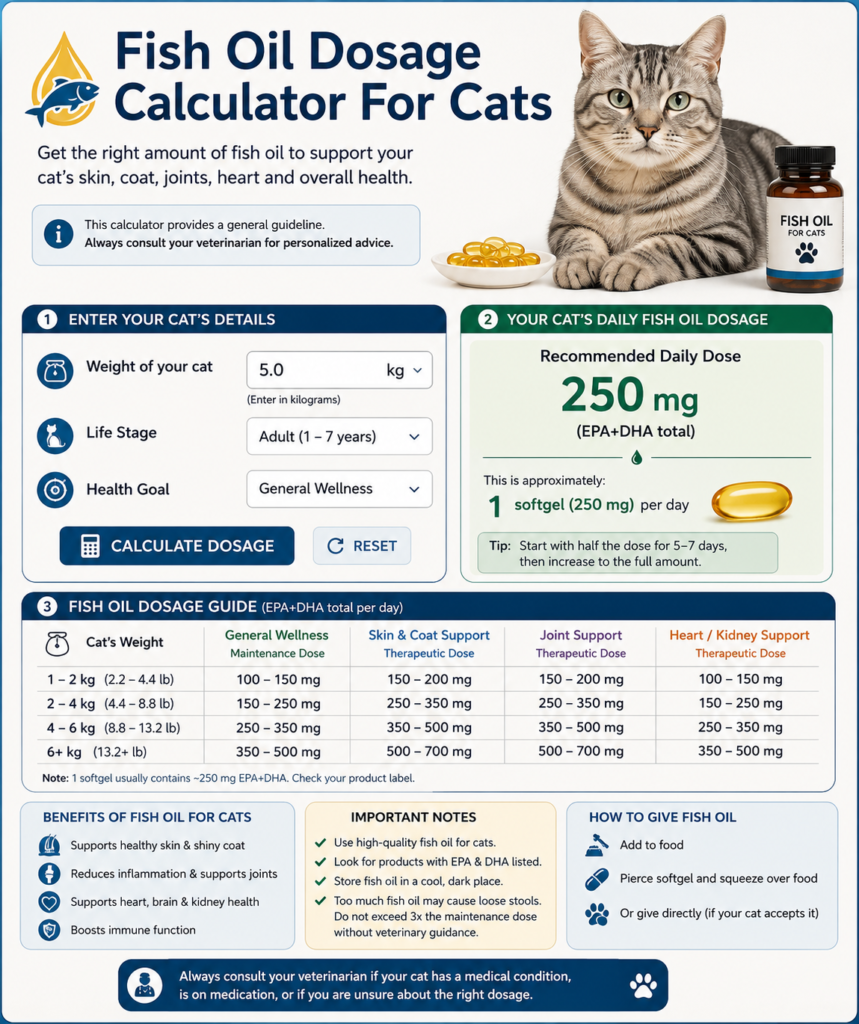
Fish Oil Dosage Calculator For Cats: The Right Dose for a Healthier Cat
Fish oil is one of the most widely recommended nutritional supplements in feline medicine — and for good reason. The omega-3 fatty acids it delivers, particularly EPA (eicosapentaenoic acid) and DHA (docosahexaenoic acid), support an impressive range of biological processes that directly affect how well a cat looks, feels, and ages. From skin and coat health to kidney function, joint comfort, and cardiovascular support, the science behind fish oil supplementation in cats is compelling and continues to grow stronger.
But like any supplement, fish oil only delivers its benefits when given in the right amount — and that’s precisely where a fish oil dosage calculator for cats becomes an essential tool. Rather than guessing or applying human dosage instructions to a much smaller feline body, a cat-specific fish oil calculator provides a personalised, weight-based EPA and DHA target that ensures supplementation is both safe and therapeutically effective.
This guide covers everything worth knowing about fish oil supplementation in cats — from the science of omega-3 fatty acids and their specific benefits, to how the calculator works, to practical guidance on choosing the right product and administering it consistently.
What Makes Fish Oil Valuable for Cats?
Fish oil is derived from the tissues of oily fish — sardines, anchovies, mackerel, salmon, and herring among the most common sources. It is rich in two long-chain polyunsaturated fatty acids that cats cannot synthesise in adequate quantities on their own:
EPA — Eicosapentaenoic Acid
EPA is the primary anti-inflammatory omega-3 fatty acid. It works by modulating the production of eicosanoids — signalling molecules that regulate inflammatory responses throughout the body. By shifting the balance away from pro-inflammatory eicosanoids toward anti-inflammatory ones, EPA helps reduce chronic inflammation that underlies many common feline health conditions including arthritis, allergic skin disease, and kidney disease.
DHA — Docosahexaenoic Acid
DHA is a structural omega-3 fatty acid — a major building block of cell membranes throughout the body, particularly in the brain, retina, and nervous system. In kittens, adequate DHA supports neurological development and visual acuity. In adult and senior cats, DHA helps maintain cognitive function, supports healthy vision, and contributes to the structural integrity of cell membranes in every organ system.
Together, EPA and DHA form the therapeutic core of fish oil supplementation — and a fish oil dosage calculator for cats generates dosage recommendations in milligrams of combined EPA and DHA per day, not simply total fish oil volume.
How Does a Fish Oil Dosage Calculator for Cats Work?
A fish oil dosage calculator for cats uses the cat’s body weight as its primary input and applies veterinary-recommended dosage guidelines to generate a target EPA and DHA intake in milligrams per day.
The standard dosage framework used in feline veterinary nutrition:
Maintenance dose (general health support):
20 to 40 mg of combined EPA and DHA per kilogram of body weight per day
Therapeutic dose (specific health conditions):
50 to 100 mg of combined EPA and DHA per kilogram of body weight per day — always under veterinary supervision
Practical Dosage Examples
| Cat Weight | Maintenance Dose | Therapeutic Dose |
|---|---|---|
| 2 kg (4.4 lbs) | 40–80 mg EPA+DHA | 100–200 mg EPA+DHA |
| 3 kg (6.6 lbs) | 60–120 mg EPA+DHA | 150–300 mg EPA+DHA |
| 4 kg (8.8 lbs) | 80–160 mg EPA+DHA | 200–400 mg EPA+DHA |
| 5 kg (11 lbs) | 100–200 mg EPA+DHA | 250–500 mg EPA+DHA |
| 6 kg (13.2 lbs) | 120–240 mg EPA+DHA | 300–600 mg EPA+DHA |
| 7 kg (15.4 lbs) | 140–280 mg EPA+DHA | 350–700 mg EPA+DHA |
Because dosage scales directly and proportionally with body weight, accurate current weight is the most critical input. The cat BMI calculator provides both a reliable weight measurement and an objective body condition assessment — ensuring the dosage calculation reflects the cat’s actual size and composition rather than an estimated or outdated figure.
The Science-Backed Benefits of Fish Oil for Cats
The case for fish oil supplementation in cats is supported by a substantial and growing body of veterinary research. Here are the key health areas where EPA and DHA have demonstrated meaningful, clinically relevant benefits.
Skin and Coat Health
Perhaps the most immediately visible benefit of fish oil supplementation is improved skin and coat condition. EPA and DHA support the skin’s natural lipid barrier function — reducing transepidermal water loss, decreasing inflammatory responses that drive itching and irritation, and promoting the production of healthy sebaceous oils that give a coat its characteristic lustre and softness.
Cats with chronic allergic skin conditions — atopic dermatitis, miliary dermatitis, eosinophilic granuloma complex — often show meaningful improvement in itch intensity, skin redness, and coat quality within four to eight weeks of consistent fish oil supplementation at appropriate doses. While fish oil rarely eliminates allergic skin disease entirely on its own, it is a valuable component of a comprehensive management protocol.
Cats fed exclusively dry kibble — which typically has very low omega-3 content — are among those most likely to show coat quality improvements with fish oil supplementation, as their baseline omega-3 intake is lowest.
Kidney Disease Management
Chronic kidney disease (CKD) is one of the most common serious health conditions in cats, affecting a significant proportion of cats over seven years of age and the majority of cats in their senior years. EPA and DHA have demonstrated multiple renoprotective effects in research settings:
- Reducing intraglomerular hypertension — elevated pressure within the kidney’s filtration units that accelerates nephron loss
- Decreasing renal inflammatory infiltration
- Supporting healthy renal blood flow through effects on eicosanoid balance
- Potentially slowing the rate of GFR (glomerular filtration rate) decline over time
Many veterinary nephrologists consider omega-3 fatty acid supplementation a standard component of nutritional management for cats with diagnosed CKD — alongside phosphorus restriction, high-quality protein, and blood pressure management. The therapeutic dose range is typically applicable for CKD management, making veterinary guidance essential when supplementing cats with kidney disease.
Joint Health and Osteoarthritis
Osteoarthritis is far more common in cats than traditionally recognised — studies using objective pain assessment methods suggest that more than 60% of cats over six years of age have radiographic evidence of degenerative joint disease. Because cats mask pain so effectively, this condition is dramatically underdiagnosed and undertreated.
EPA’s anti-inflammatory properties help reduce joint inflammation, decrease pain signalling, and improve mobility in cats with osteoarthritis. Multiple studies in companion animals have demonstrated that omega-3 supplementation at therapeutic doses produces measurable improvements in activity level, willingness to jump, and overall mobility — outcomes that directly translate to improved quality of life. The cat quality of life calculator provides a structured framework for monitoring these quality of life improvements over the course of supplementation.
Cardiovascular Health
Heart disease — particularly hypertrophic cardiomyopathy (HCM), the most common feline cardiac condition — affects a significant number of cats, with certain breeds including Maine Coons, Ragdolls, and British Shorthairs facing genetic predispositions. DHA and EPA support cardiovascular function through several mechanisms:
- Reducing triglyceride levels
- Supporting healthy heart rhythm — omega-3s have well-documented antiarrhythmic properties
- Reducing systemic inflammation that contributes to cardiac remodelling
- Supporting healthy endothelial function
Omega-3 supplementation is frequently included in nutritional management protocols for cats with cardiac disease, though the specific dose and appropriateness should always be discussed with a veterinary cardiologist for cats with diagnosed heart conditions.
Cognitive Function and Brain Health
DHA is a major structural component of neuronal cell membranes and plays a critical role in synaptic function — the transmission of signals between nerve cells. In kittens, adequate DHA during development supports learning, memory formation, and visual processing. In senior cats, DHA supplementation has been associated with slowing cognitive decline and improving performance on behavioural assessments of cognitive function.
Feline cognitive dysfunction syndrome — the cat equivalent of dementia — becomes increasingly common in cats over fifteen years of age. While DHA supplementation cannot prevent or reverse cognitive dysfunction, it may help preserve neurological function and slow decline in cats showing early signs of cognitive change. The cat age calculator helps owners understand where their cat sits in its cognitive development and ageing timeline — providing important context when considering DHA-focused supplementation for neurological support.
Inflammatory Bowel Disease
Inflammatory bowel disease (IBD) is a common cause of chronic vomiting, diarrhoea, and weight loss in cats. The anti-inflammatory properties of EPA make fish oil a potentially valuable adjunctive treatment for cats with IBD — helping reduce intestinal inflammation and support mucosal barrier function alongside primary dietary and medical management.
Cancer Support
Emerging research suggests that omega-3 fatty acids may help slow the growth of certain tumour types, improve the nutritional status of cats undergoing cancer treatment, and support immune function during chemotherapy. While fish oil is not a cancer treatment in its own right, it represents a meaningful nutritional support intervention for cats with cancer — one that is generally well tolerated and may complement other treatment approaches.
Choosing the Right Fish Oil Product for Cats
The fish oil supplement market is extensive and highly variable in quality. Not all products are equally appropriate for cats, and selecting a high-quality supplement is as important as calculating the correct dose.
What to Look for on the Label
EPA and DHA content per serving — listed separately
The most critical piece of information on any fish oil label is the specific EPA and DHA content per capsule, per teaspoon, or per millilitre — not simply “total omega-3s” or “total fish oil.” A product listing only total fish oil content without breaking out EPA and DHA separately makes accurate dosing impossible and should be approached with caution.
Third-party testing and certification
Fish oil is susceptible to contamination with heavy metals (mercury, lead, cadmium), PCBs (polychlorinated biphenyls), and other environmental toxins that accumulate in fish tissue. Third-party testing and certification from organisations such as IFOS (International Fish Oil Standards), NSF International, or USP provides assurance that a product has been independently verified for purity, potency, and freshness.
Species of fish used
Smaller, short-lived fish — sardines, anchovies, herring, and mackerel — accumulate fewer environmental toxins than larger, longer-lived species like tuna and salmon, as they have less time to bioaccumulate contaminants. Supplements derived from these smaller fish sources generally carry lower contamination risk and are preferred for regular supplementation.
Freshness indicators
Fish oil oxidises readily, and rancid fish oil loses both potency and safety — oxidised lipids can cause gastrointestinal inflammation and generate harmful free radicals rather than providing anti-inflammatory benefits. Fresh fish oil should have a mild, clean ocean smell — not an overwhelmingly strong or unpleasant odour. Capsules generally stay fresher longer than bottled liquid oil, as they limit exposure to air and light.
Absence of harmful additives
Liquid fish oil products may contain propylene glycol — a preservative that is toxic to cats. Any liquid fish oil product intended for cats must be checked carefully to confirm it does not contain propylene glycol or other cat-unsafe additives.
Fish Oil vs. Algae Oil
Algae oil offers an alternative source of pre-formed EPA and DHA that is increasingly available and well-supported by research. Microalgae are the original source of omega-3 fatty acids in the marine food chain — fish accumulate EPA and DHA by consuming algae, so algae oil essentially provides the same fatty acids without the intermediary step.
For cats with fish allergies or sensitivities — though true fish allergies in cats are less common than popularly believed — algae oil provides a fish-free alternative with equivalent EPA and DHA content. It is also a more environmentally sustainable option, as algae can be cultivated without the fishing pressure associated with fish oil production.
Salmon Oil for Cats
Salmon oil is a widely available and popular fish oil option for cats — many cats find its flavour highly appealing, which can be a meaningful practical advantage when administering supplements to fussy eaters. However, EPA and DHA concentrations in salmon oil vary considerably between products, and quality control is variable across brands. Third-party testing is particularly important for salmon oil products, and EPA and DHA content should always be verified on the label before calculating doses.
Fish Oil vs. Plant-Based Omega-3 Sources
Plant-based omega-3 sources — including flaxseed oil, chia seed oil, and hemp oil — provide alpha-linolenic acid (ALA), a short-chain omega-3 fatty acid. While ALA is technically an omega-3, the conversion pathway from ALA to EPA and DHA in cats is extremely inefficient — even less so than in humans, who already convert ALA to EPA and DHA poorly.
Cats have limited capacity to produce the specific desaturase enzymes required to elongate ALA into EPA and DHA. The practical result is that plant-based omega-3 sources are essentially ineffective as omega-3 supplements for cats — regardless of how much ALA they provide, very little is converted to the EPA and DHA that cats actually need.
This limitation is one of several reasons cats are classified as obligate carnivores with specific nutritional dependencies on animal-derived ingredients. Fish oil — or algae oil providing pre-formed EPA and DHA — is the only appropriate omega-3 supplement for cats.
Administering Fish Oil to Cats: Practical Guidance
Getting fish oil into a cat consistently is one area where practical implementation often matters as much as choosing the right product. Fortunately, many cats respond positively to fish oil’s flavour and aroma — making administration considerably easier than many other supplements or medications.
Liquid Fish Oil
Liquid fish oil can be drizzled directly over wet food or mixed into a small amount of food immediately before serving. Most cats accept liquid fish oil readily when combined with palatable wet food — the fish aroma tends to enhance rather than mask the appeal of the meal. For cats on dry kibble, a small amount of wet food mixed with the fish oil and served alongside the dry food is a practical approach.
Dosing liquid fish oil accurately requires a measuring syringe or calibrated dropper — standard kitchen teaspoons vary significantly in actual volume. Measuring precisely is important both for therapeutic accuracy and to avoid accidental over-supplementation.
Fish Oil Capsules
Capsules can be given whole — hidden in a treat or pill pocket — or pierced and squeezed over food. Many cats will accept a pierced capsule’s contents mixed into wet food without resistance. The capsule shell itself can be discarded or fed alongside the contents, depending on the cat’s willingness.
For cats requiring a dose smaller than a single capsule provides, piercing the capsule and dispensing a partial dose into food is the most practical approach — though accurately measuring a portion of a capsule’s contents requires care.
Veterinary-Formulated Cat Supplements
Several veterinary nutrition companies produce omega-3 supplements specifically formulated for cats — in doses, flavours, and delivery formats designed for feline use. These products typically provide cat-appropriate EPA and DHA concentrations per serving, eliminating the need to calculate portions from human-formulated products. They may represent the most practical option for owners who find dosing standard fish oil products challenging.
Timing and Consistency
Fish oil is a fat-soluble supplement that absorbs best when given with food. Consistent daily administration at the same meal time helps establish routine — which improves compliance and ensures the cat receives a steady, predictable daily EPA and DHA intake rather than sporadic supplementation.
Benefits from fish oil supplementation typically become apparent gradually over four to eight weeks of consistent use. Owners monitoring specific outcomes — coat quality, mobility, kidney function markers — should allow sufficient time before assessing whether the supplementation is producing the desired effect.
Starting Fish Oil Supplementation: Introducing Gradually
As with any dietary addition, introducing fish oil gradually — starting at half the target dose and building up over one to two weeks — reduces the risk of digestive upset. The most common side effects of fish oil introduction are mild gastrointestinal effects including:
- Loose stools or diarrhoea — typically transient as the digestive system adapts
- Mild nausea — occasionally observed as lip licking, reduced appetite, or drooling shortly after supplementation
- Fishy breath or body odour — cosmetically unpleasant but not medically significant
Starting with a conservative dose and increasing gradually minimises these effects significantly for most cats.
Potential Side Effects and Safety Considerations
Fish oil has an excellent safety profile when used at appropriate doses for cats, but several considerations deserve attention — particularly at therapeutic dose levels.
Gastrointestinal Effects
As noted above, loose stools and mild nausea are the most commonly reported side effects — typically occurring during initial supplementation and resolving as the cat’s digestive system adapts. Persistent diarrhoea warrants dose reduction or a change in product.
Blood Thinning Effects
At high therapeutic doses, omega-3 fatty acids have mild anticoagulant effects — reducing platelet aggregation and prolonging bleeding time slightly. This is generally not a concern at maintenance doses in healthy cats, but becomes relevant for:
- Cats scheduled for surgical procedures — fish oil should typically be discontinued one to two weeks before elective surgery
- Cats on anticoagulant medications
- Cats with known clotting disorders or haemophilia
Vitamin E Depletion
High intake of polyunsaturated fatty acids — including EPA and DHA — increases oxidative stress and can deplete vitamin E stores over time, as vitamin E is required to protect these fatty acids from oxidation within the body. Cats on long-term, higher-dose fish oil supplementation may benefit from modest vitamin E supplementation — the appropriate amount should be discussed with a veterinarian, as excessive vitamin E also carries risks.
Caloric Contribution
Fat is calorie-dense, and meaningful doses of fish oil contribute measurable calories to the daily diet — approximately 9 kilocalories per gram of fat. At typical supplementation doses this contribution is small but not entirely negligible for cats on carefully managed caloric restriction programmes. The cat calorie calculator helps owners factor supplement calories into the overall daily intake when managing weight alongside supplementation.
Rancidity Risk
Rancid fish oil is not merely less effective — it actively generates harmful oxidised lipid compounds that can cause gastrointestinal inflammation and contribute to oxidative damage. Proper storage — refrigerated after opening, used within the manufacturer’s recommended timeframe, and checked regularly for signs of rancidity — is essential for safe, effective supplementation.
When Veterinary Guidance Is Essential
While maintenance-dose fish oil supplementation is generally considered safe for most healthy adult cats without veterinary prescription, several situations require veterinary consultation before supplementation begins or is continued:
Cats with diagnosed health conditions — kidney disease, heart disease, IBD, cancer, and clotting disorders all involve specific considerations that affect the appropriateness and dose of fish oil supplementation.
Cats on medications — interactions between fish oil and anticoagulants, NSAIDs, or immunosuppressive medications require veterinary assessment.
Cats scheduled for surgery — anticoagulant effects at higher doses necessitate pre-surgical discontinuation under veterinary guidance.
Kittens — while DHA is important for kitten development, appropriate dosing for very young cats should be discussed with a veterinarian rather than extrapolated from adult guidelines.
Cats showing adverse effects — persistent vomiting, diarrhoea, or other concerning signs during supplementation warrant veterinary evaluation rather than continued self-management.
Monitoring the Effectiveness of Fish Oil Supplementation
Understanding whether fish oil supplementation is producing the desired outcomes requires systematic monitoring — ideally combining subjective owner observations with objective veterinary measurements.
For Skin and Coat Conditions
Monthly coat quality assessments — noting shine, texture, degree of scaling or flaking, and scratch frequency — provide a practical record of response to supplementation. Photographic records taken at consistent intervals can be particularly useful for tracking gradual coat improvements that might otherwise go unnoticed.
For Kidney Disease
Serial measurement of kidney function markers — BUN, creatinine, SDMA, and urine specific gravity — at veterinary visits provides objective data on whether renal function is stable or declining during supplementation.
For Joint Disease and Mobility
Structured mobility assessments — including observation of jumping height and frequency, stair climbing, willingness to play, and grooming of previously hard-to-reach areas — provide meaningful data on whether anti-inflammatory supplementation is improving functional mobility. Formal pain and mobility scoring tools exist and can be used in conjunction with the cat quality of life calculator for a comprehensive assessment.
For Cognitive Function
Behavioural tracking — noting changes in disorientation, sleep-wake cycle disruption, inappropriate vocalisation, and interactive behaviour — helps assess whether DHA supplementation is supporting cognitive function in senior cats.
Final Thoughts
A fish oil dosage calculator for cats removes one of the most significant barriers to effective omega-3 supplementation — uncertainty about how much to give. By anchoring dosage recommendations to body weight and health context, the calculator provides a clear, evidence-based daily target that ensures cats receive enough EPA and DHA to experience genuine therapeutic benefit — without the risks that come with imprecise or excessive dosing.
Fish oil, used correctly and consistently, is one of the most impactful nutritional additions available for cats at virtually every life stage and health status. Combined with a comprehensive approach to feline nutrition — covering caloric needs, body condition, life stage-appropriate feeding, and ongoing health monitoring — fish oil supplementation becomes part of a holistic commitment to giving cats the longest, healthiest, and most comfortable lives possible.