Cat BMI Calculator

Ahmad zee
Table of Contents
Toggle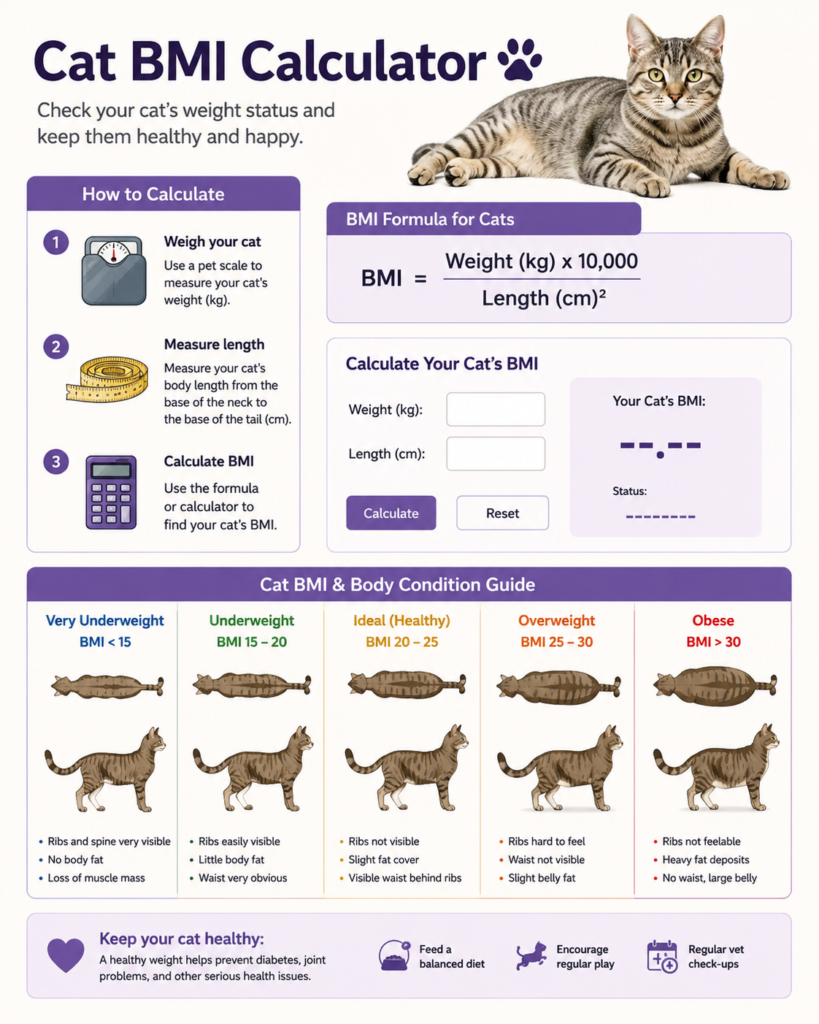
Cat BMI Calculator: Understanding Your Cat’s Body Condition and Healthy Weight
One of the most common health issues facing domestic cats today is one that’s entirely preventable — obesity. An estimated 50 to 60% of cats in developed countries are overweight or obese, making excess body weight one of the single greatest threats to feline health and longevity. Yet because weight gain in cats tends to happen gradually and because many owners normalise a heavier body shape over time, the problem frequently goes unrecognised until significant health consequences have already developed.
A cat BMI calculator — more accurately described in veterinary terms as a body condition score (BCS) tool — provides an objective, structured assessment of a cat’s body composition relative to its size, helping owners identify whether their cat is underweight, at an ideal weight, or carrying excess body fat. This guide covers everything worth knowing about feline body condition assessment, what the scores mean, how to conduct a reliable assessment at home, and what to do when a cat’s weight falls outside the healthy range.
What Is a Cat BMI Calculator?
In human medicine, BMI (Body Mass Index) is calculated by dividing weight in kilograms by the square of height in metres — a formula that provides a standardised weight-to-height ratio applicable across a large, relatively uniform human population. Applying this formula directly to cats is problematic for several reasons: cats vary enormously in skeletal frame size across breeds, body length varies independently of height, and the human BMI formula doesn’t account for feline body composition accurately.
For cats, the more clinically meaningful equivalent is the Body Condition Score (BCS) — a structured assessment system that evaluates fat coverage and muscle mass across specific anatomical landmarks rather than relying on weight-to-height ratios alone. The most widely used BCS systems in veterinary medicine use either a 1 to 5 scale or a 1 to 9 scale, with the midpoint representing ideal body condition.
Some feline BMI calculators also incorporate the Feline Body Mass Index (FBMI) — a formula developed specifically for cats that uses rib cage circumference and leg length measurements to estimate body fat percentage more accurately than weight alone. This cat-specific formula provides a more precise body composition estimate than either the human BMI formula or subjective BCS assessment, though it requires specific measurements rather than a simple weight input.
The Body Condition Score System: How It Works
The body condition score assesses three primary anatomical areas:
Rib Coverage
The ribs are the most important and reliable anatomical landmark for assessing body condition in cats. In a cat at ideal body condition, the ribs should be easily felt with gentle finger pressure but not prominently visible. A thin layer of fat covers the ribs without obscuring them to palpation.
- Underweight — ribs are prominently visible and felt without any pressure; sharp, bony feeling with no fat covering
- Ideal — ribs felt easily with gentle pressure; slight fat covering; not visible through coat
- Overweight — ribs difficult to feel; require firm pressure to detect through fat covering
- Obese — ribs cannot be felt even with firm pressure; buried under significant fat deposits
Waist Definition
When viewed from above, a cat at ideal body condition should show a visible waist tuck behind the ribs — a narrowing of the silhouette between the ribcage and the hips. When viewed from the side, a slight abdominal tuck should be visible — the belly should not hang level with or below the chest.
- Underweight — extreme waist narrowing; prominent hip bones visible from above
- Ideal — visible waist from above; gentle abdominal tuck from the side
- Overweight — waist barely visible or absent from above; abdomen level with chest from the side
- Obese — no waist visible from above; pendulous abdomen hanging below chest level; fat pads visible on abdomen
Overall Muscle Mass and Fat Distribution
The overall assessment also considers muscle mass — particularly over the spine, shoulders, and hindquarters — and the presence of fat deposits in characteristic locations including the base of the tail, the inguinal (groin) region, and the face.
The 1 to 9 Body Condition Score Scale for Cats
The 9-point BCS scale is the most widely used in veterinary practice and provides the greatest resolution for distinguishing between degrees of under and overweight status.
| BCS Score | Description | Body Fat % | Classification |
|---|---|---|---|
| 1 | Ribs, spine, and pelvis visible from distance; no palpable fat; severe muscle loss | <5% | Severely underweight |
| 2 | Ribs, spine easily visible; minimal muscle mass; no fat covering | 5–9% | Underweight |
| 3 | Ribs easily visible; minimal fat covering; obvious waist; abdominal tuck present | 10–14% | Mildly underweight |
| 4 | Ribs easily felt; minimal fat covering; waist visible from above; slight abdominal tuck | 15–19% | Ideal — lean |
| 5 | Ribs felt with slight pressure; waist visible from above; abdominal tuck visible from side | 20–24% | Ideal |
| 6 | Ribs felt with firm pressure; waist barely visible; abdominal tuck minimal | 25–29% | Mildly overweight |
| 7 | Ribs difficult to feel; waist absent; moderate abdominal fat deposits; fat at tail base | 30–34% | Overweight |
| 8 | Ribs very difficult to feel; waist absent; prominent abdominal fat; fat pads on limbs | 35–39% | Obese |
| 9 | Ribs impossible to feel; massive fat deposits; pendulous abdomen; fat on neck and limbs | >40% | Severely obese |
The target range for most cats is BCS 4 to 5 on the 9-point scale — representing ideal body condition with appropriate muscle mass and minimal excess fat.
How to Assess Your Cat’s Body Condition Score at Home
One of the most valuable aspects of the body condition score system is that it can be performed reliably at home by attentive cat owners — no specialist equipment required beyond a gentle pair of hands and an observant eye.
Step 1 — Feel the Ribs
Place both hands on either side of the cat’s ribcage with fingers pointing downward and thumbs meeting on the spine. Apply gentle pressure — similar to the pressure used to feel the knuckles on a loosely closed fist. At ideal body condition, the ribs should feel similar to the knuckles on the back of a hand — distinct bumps with a thin layer of tissue over them.
If the ribs feel like the knuckles on a tightly clenched fist — sharp and bony with no padding — the cat is underweight. If they feel like the palm of the hand — smooth with no distinct bumps detectable — the cat is overweight.
Step 2 — Look From Above
Place the cat on a flat surface and look directly down at the body from above. A cat at ideal body condition should show a visible narrowing behind the ribcage — a defined waist. An overweight cat will have a straight or barrel-shaped silhouette with no waist definition. An underweight cat will show an exaggerated hourglass shape with sharp hip prominence.
Step 3 — Look From the Side
Observe the cat’s profile from the side. The abdomen should show a slight upward tuck behind the lowest point of the ribcage. An overweight or obese cat will have an abdomen that hangs level with or below the chest — sometimes with a visibly pendulous fat pad. An underweight cat will show an exaggerated tuck with the abdomen drawn sharply upward.
Step 4 — Check the Tail Base
Run a hand along the spine toward the tail. Feel the vertebrae along the spine and then the prominence of the pelvis and tail base. At ideal condition, the spine and pelvis are felt easily without sharp prominence. In obese cats, significant fat deposits at the tail base and over the pelvis make these landmarks difficult to feel.
Step 5 — Assess Overall Muscle Mass
Note the muscle coverage over the shoulders, spine, and hindquarters. Muscle wasting — visible as sharp spinal prominence or sunken appearance over the hindquarters — can coexist with excess body fat in senior cats or cats with chronic illness, making it important to assess both fat coverage and muscle mass rather than weight alone.
The Feline Body Mass Index (FBMI): A More Precise Measurement
For owners seeking a more precise body fat percentage estimate than BCS assessment alone provides, the Feline Body Mass Index (FBMI) offers a cat-specific formula using two physical measurements:
Measurements required:
- Rib cage circumference — measured around the widest part of the chest, just behind the front legs
- Leg length — measured from the knee (stifle) to the ankle (hock) of the hind leg
FBMI formula:
FBMI = (Rib cage circumference × 0.7) − (Leg length × 0.88)
This formula was developed and validated specifically for domestic cats and provides a body fat percentage estimate that correlates well with more sophisticated body composition measurements. A cat with an FBMI-estimated body fat percentage above 30% is considered overweight; above 40% is obese.
The FBMI is most useful for tracking body composition changes over time — for example, during a weight loss programme — where small changes in body fat percentage may not be immediately apparent from BCS assessment or body weight alone. Using the cat calorie calculator alongside FBMI tracking allows owners to correlate caloric intake adjustments with measurable body composition changes, creating a quantitative feedback loop for weight management.
Health Consequences of Feline Obesity
Understanding why body condition matters requires appreciating the genuine health consequences of carrying excess body weight — consequences that significantly affect both quality and length of life.
Diabetes Mellitus
Obesity is the single strongest modifiable risk factor for type 2 diabetes mellitus in cats. Excess adipose tissue causes insulin resistance — the body’s cells become less responsive to insulin’s signal to absorb glucose from the blood, forcing the pancreas to produce progressively more insulin to maintain normal blood sugar. When the pancreas can no longer compensate, blood glucose rises chronically — producing diabetes. Obese cats are reported to be four times more likely to develop diabetes than cats at ideal body condition.
Hepatic Lipidosis
Hepatic lipidosis — fatty liver disease — is one of the most serious and potentially fatal conditions associated with feline obesity. When an overweight cat stops eating for any reason — illness, stress, dietary change — the body rapidly mobilises fat stores to meet energy needs. The feline liver is poorly equipped to process large quantities of fat quickly, and fat accumulates within liver cells, causing liver dysfunction that can progress to liver failure within days to weeks. Cats that are overweight are at significantly higher risk of developing hepatic lipidosis if they stop eating, making weight management a potentially life-saving intervention.
Osteoarthritis and Joint Disease
Excess body weight places additional mechanical stress on every joint in the body — particularly the hips, elbows, and spine. In cats already predisposed to arthritis through age or genetics, obesity dramatically accelerates joint degeneration and pain. Because cats are masters at concealing pain, arthritis in overweight cats frequently goes unrecognised until it is quite advanced. The cat quality of life calculator helps owners monitor mobility and comfort over time — providing early signals that joint pain may be contributing to reduced activity or changed behaviour.
Urinary Tract Disease
Obese cats have higher rates of lower urinary tract disease — including feline idiopathic cystitis, urolithiasis (bladder stones), and urethral obstruction. Reduced activity in overweight cats means less frequent urination and more concentrated urine, both of which contribute to the conditions that favour crystal and stone formation.
Skin and Coat Problems
Overweight cats frequently develop grooming difficulties — their excess abdominal fat physically prevents them from reaching large portions of their body surface for normal grooming. This leads to coat matting, skin irritation, and increased risk of skin infections in skin folds — particularly in heavier breeds or cats with especially large abdominal fat deposits.
Respiratory Compromise
Significant excess weight — particularly large abdominal fat deposits — can restrict chest expansion during breathing, reducing respiratory reserve and making anaesthesia significantly more risky. Obese cats undergoing surgical procedures face higher anaesthetic risk than cats at ideal body condition.
Reduced Lifespan
The cumulative effect of all these conditions translates directly into shorter lifespan. Studies in cats have found meaningful associations between excess body weight and reduced longevity — with obese cats living significantly shorter lives on average than their lean counterparts. Weight management is one of the most impactful longevity interventions available to cat owners.
Health Consequences of Being Underweight
While obesity receives more attention — partly because it’s more common — being underweight is equally serious and often reflects underlying illness that requires urgent veterinary attention.
Muscle Wasting and Cachexia
Unintended weight loss in cats — particularly the loss of muscle mass known as cachexia — is one of the earliest and most consistent signs of serious underlying disease. Cancer, kidney disease, hyperthyroidism, inflammatory bowel disease, and diabetes mellitus all commonly cause weight loss as an early clinical sign. A cat that loses more than 10% of its body weight over weeks to months without a dietary explanation requires prompt veterinary investigation.
Nutritional Deficiency
Cats that are underweight due to inadequate food intake may be deficient in essential nutrients — including taurine, arachidonic acid, and vitamin A — that are critical for heart function, immune competence, and organ health. Severe nutritional deficiency can cause irreversible damage to the heart, eyes, and nervous system.
Compromised Immune Function
Adequate body condition is necessary for normal immune function. Underweight cats have reduced immune competence, making them more susceptible to infectious diseases and less able to mount effective responses to pathogens, vaccines, or surgical recovery.
Anaesthetic Risk
Underweight cats — particularly those with significant muscle wasting — face elevated anaesthetic risk comparable to obese cats, due to reduced physiological reserve, altered drug metabolism, and poor temperature regulation.
Ideal Weight Ranges by Cat Breed
While body condition score assessment is more meaningful than weight alone, breed-specific weight ranges provide useful reference context for interpreting assessment results.
| Breed | Typical Healthy Adult Weight Range |
|---|---|
| Domestic Shorthair / Longhair | 3.5 to 5.5 kg (7.7 to 12 lbs) |
| Siamese | 3 to 5 kg (6.6 to 11 lbs) |
| Persian | 3.5 to 5.5 kg (7.7 to 12 lbs) |
| Maine Coon | 5 to 9 kg (11 to 20 lbs) |
| Ragdoll | 4.5 to 9 kg (10 to 20 lbs) |
| Bengal | 4 to 7 kg (8.8 to 15.4 lbs) |
| British Shorthair | 4 to 8 kg (8.8 to 17.6 lbs) |
| Abyssinian | 3 to 5 kg (6.6 to 11 lbs) |
| Scottish Fold | 3 to 6 kg (6.6 to 13.2 lbs) |
| Russian Blue | 3.5 to 5.5 kg (7.7 to 12 lbs) |
| Sphynx | 3.5 to 5.5 kg (7.7 to 12 lbs) |
| Norwegian Forest Cat | 4 to 7 kg (8.8 to 15.4 lbs) |
These ranges are approximate and should be interpreted alongside body condition score assessment rather than in isolation. A Maine Coon at 7 kg may be at ideal body condition; a Domestic Shorthair at the same weight may be significantly overweight.
How Age Affects Healthy Body Condition
A cat’s appropriate body condition target is not entirely static across its lifespan — age introduces nuances that should inform how BCS scores are interpreted and acted upon.
Kittens
Growing kittens should maintain a BCS of approximately 3 to 4 on the 9-point scale — lean enough to allow healthy growth without excess fat accumulation. Overfeeding kittens — a common mistake driven by the instinct to nurture — creates fat cells that persist into adulthood and can set the stage for lifelong weight management challenges.
Young and Middle-Aged Adults
The target BCS of 4 to 5 applies most straightforwardly to healthy adult cats between two and seven years of age. This is the life stage where obesity tends to develop most insidiously — particularly in neutered cats whose metabolic rate is lower than intact cats of the same size. The cat age calculator helps owners contextualise their cat’s current life stage and apply the appropriate BCS targets and monitoring frequency.
Senior Cats
Senior cats — eleven years and above — often begin to lose body condition as metabolic changes, dental disease, reduced digestive efficiency, and chronic illness affect their ability to maintain weight. For senior cats, a BCS of 5 to 6 is sometimes considered more appropriate than the leaner ideal for younger adults — providing a small buffer of body reserves that can support the cat through illness-related appetite reduction or metabolic stress. Unintended weight loss in senior cats should always be investigated rather than attributed simply to ageing.
Managing an Overweight Cat: A Structured Approach
Successfully managing feline obesity requires a systematic, patient approach — crash diets and rapid weight loss are dangerous for cats and counterproductive in the long term.
Step 1 — Establish a Baseline
Weigh the cat accurately and conduct a thorough BCS assessment. Calculate the FBMI if a precise body fat percentage is desired. Establish the cat’s current caloric intake by reviewing food labels and estimating daily consumption including treats and supplemental foods.
Step 2 — Determine Target Weight
Work with a veterinarian to establish a realistic target weight based on BCS assessment and breed-appropriate weight ranges. The target is the weight at which the cat is expected to achieve a BCS of 4 to 5 — not simply a round number or arbitrary goal.
Step 3 — Calculate a Caloric Deficit
A safe rate of weight loss for cats is approximately 0.5 to 2% of body weight per week. Faster weight loss — particularly exceeding 1 to 2% per week — carries a meaningful risk of triggering hepatic lipidosis. The cat calorie calculator helps establish a daily caloric target that creates a safe, gradual deficit from the cat’s current maintenance intake.
Step 4 — Select an Appropriate Weight Management Diet
Weight management cat foods are formulated to reduce caloric density while maintaining adequate protein, fibre, and micronutrient levels — allowing the cat to eat a satisfying volume of food while consuming fewer total calories. High-protein, low-carbohydrate formulations are generally preferred for cats, as protein helps preserve lean muscle mass during weight loss.
Step 5 — Eliminate Hidden Calories
Treats, table scraps, dental chews, and food shared with other pets in the household can contribute significant untracked calories. Reducing or eliminating these extras — or accounting for them within the daily caloric budget — is often the single most impactful change an owner can make.
Step 6 — Increase Activity
Environmental enrichment and play sessions that encourage physical activity help increase caloric expenditure and preserve muscle mass during weight loss. Interactive toys, puzzle feeders, laser pointers, and scheduled play sessions all contribute to a more active lifestyle that supports sustainable weight management.
Step 7 — Monitor and Adjust
Weigh the cat monthly and reassess BCS every four to six weeks. If weight loss is occurring at a safe pace and body condition is improving, maintain the current plan. If weight loss is too rapid, increase food slightly. If no weight loss is occurring after four weeks of compliance, reduce calories further in consultation with the veterinarian.
Managing an Underweight Cat
An underweight cat requires a different and equally careful approach — with veterinary investigation as the essential first step.
Identify the Underlying Cause
Underweight cats should always be evaluated by a veterinarian before a weight gain programme is implemented. The cause of low body weight — whether inadequate food intake, malabsorption, hyperthyroidism, kidney disease, diabetes, or cancer — must be identified and addressed. A weight gain programme that doesn’t address the underlying cause will have limited success.
Increase Caloric Density Gradually
For cats cleared of serious underlying disease, increasing caloric intake gradually — rather than offering unrestricted food access immediately — prevents digestive upset and allows the gastrointestinal system to adapt. High-quality, calorie-dense foods with excellent digestibility support efficient nutrient absorption in cats that have been nutritionally depleted.
Monitor Muscle Mass Separately From Body Weight
In cats recovering from illness-related weight loss, muscle mass recovery lags behind fat mass recovery. Regular BCS assessments that specifically evaluate muscle coverage — not just overall weight — help owners track whether recovery is progressing in the right areas.
Medication Dosing and Body Condition
Body weight is the foundation of virtually every weight-based medication dose calculation — including antihistamines, antibiotics, and pain medications. Accurate, current weight data from regular BCS monitoring ensures that any medication doses are calculated on the most reliable possible baseline. This connection between body condition monitoring and medication safety is one reason the cat Benadryl dosage calculator — and other medication dosage tools — work best when paired with accurate, regularly updated weight records.
For multi-pet households, the same principle applies across species — the dog BMI calculator provides equivalent body condition assessment guidance for canine household members, reinforcing the importance of species-appropriate evaluation tools for each pet.
Final Thoughts
A cat BMI calculator — anchored in the Body Condition Score system and the Feline Body Mass Index — is one of the most practically valuable health monitoring tools available to cat owners. By providing an objective, structured assessment of body composition rather than relying on weight alone or subjective impressions, it helps owners see their cat’s health status clearly and act on what they observe before problems become serious.
In a world where feline obesity is increasingly common and its consequences increasingly well understood, regular body condition monitoring is one of the simplest, most impactful habits a responsible cat owner can adopt. Combined with appropriate caloric management, life stage-appropriate nutrition, regular veterinary care, and a thoughtful approach to physical activity and enrichment, maintaining a healthy body condition score is one of the greatest gifts an owner can give their cat — supporting a longer, healthier, and more comfortable life at every stage.