Cat Quality of Life Calculator

Ahmad zee
Table of Contents
Toggle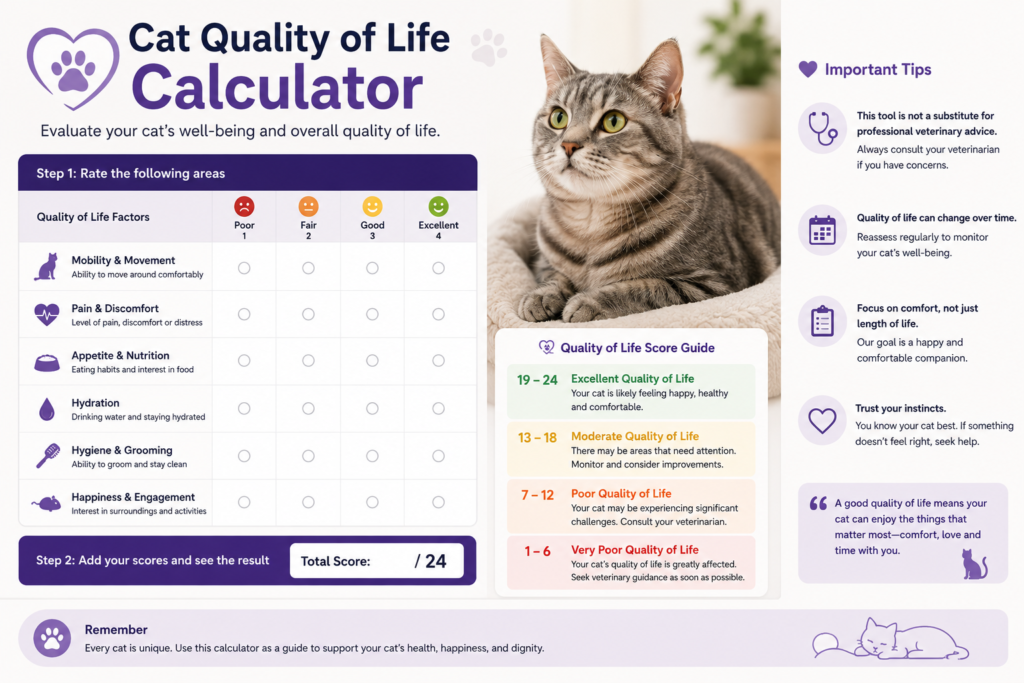
Cat Quality of Life Calculator: A Compassionate Guide to Assessing Your Cat’s Wellbeing
Few moments in a pet owner’s life are as emotionally complex as watching a beloved cat navigate serious illness, chronic pain, or the inevitable decline of old age. When is the right time to pursue aggressive treatment? When does comfort care become the most loving choice? When has the balance tipped irrevocably away from quality of life? These are among the hardest questions any cat owner will ever face — and a cat quality of life calculator exists to provide structured, evidence-based support when emotions alone make clear thinking difficult.
This guide explores what a cat quality of life calculator measures, how it works, what the scores mean, and how owners can use it as part of a broader, compassionate framework for supporting a cat through illness, decline, and the end of life.
What Is a Cat Quality of Life Calculator?
A cat quality of life calculator is a structured assessment tool that helps cat owners and veterinarians evaluate a cat’s overall wellbeing across multiple dimensions of physical and emotional health. Rather than relying on a single measurement or a subjective overall impression, the calculator scores a range of specific indicators — pain levels, appetite, hydration, hygiene, mobility, mental engagement, and the ratio of good days to bad days — and combines them into an overall quality of life score.
The resulting score provides an objective reference point that complements the owner’s subjective experience and the veterinarian’s clinical assessment. It doesn’t make decisions — no calculator can or should do that — but it provides a consistent, repeatable framework that helps owners track changes over time, communicate more clearly with their veterinary team, and approach difficult decisions with greater clarity and confidence.
The most widely used quality of life framework in veterinary medicine is the HHHHHMM Scale, developed by veterinary oncologist Dr. Alice Villalobos. The scale assesses seven core criteria, each scored on a scale of one to ten, for a maximum total score of seventy.
The HHHHHMM Scale: Seven Pillars of Feline Quality of Life
Each letter in HHHHHMM represents one of the seven assessment criteria. Understanding what each criterion measures — and how to observe and score it honestly — is the foundation of using a cat quality of life calculator effectively.
H — Hurt (Pain Management)
Pain is the most fundamental quality of life consideration. A cat that is in unmanaged or poorly managed pain has a severely compromised quality of life regardless of how well other areas are functioning. This criterion assesses whether the cat’s pain is being adequately controlled through medication, palliative care, or other interventions.
Recognising pain in cats is notoriously challenging. Unlike dogs, cats are evolutionarily conditioned to mask pain — a survival strategy in the wild that can make suffering invisible to even the most attentive owner. Signs of pain in cats include:
- Withdrawn or hiding behaviour
- Reduced grooming or failure to groom
- Hunched posture or reluctance to move
- Facial tension — narrowed eyes, flattened whiskers, tense jaw
- Vocalisation when touched or moved
- Aggression or irritability when approached
- Reduced appetite
- Changes in litter box habits driven by pain when posturing
A high score in this category reflects effective pain management and comfort. A low score indicates that pain is present and either inadequately controlled or uncontrollable despite treatment — a significant indicator of compromised quality of life.
H — Hunger (Nutritional Status)
Adequate nutrition is essential to maintaining body condition, energy, immune function, and overall physical resilience. This criterion assesses whether the cat is eating enough to sustain a reasonable body condition.
Cats with serious illness — cancer, kidney disease, liver disease, or severe dental disease — frequently experience reduced appetite or complete anorexia. When a cat stops eating entirely for more than a few days, the risk of hepatic lipidosis (fatty liver disease) becomes significant, adding a life-threatening complication to whatever primary condition the cat is already managing.
Strategies to support appetite in ill cats include:
- Warming food to body temperature to enhance aroma
- Offering a variety of textures and flavours
- Appetite stimulant medications prescribed by a veterinarian
- Assisted feeding through a syringe or feeding tube in appropriate cases
- Addressing underlying causes of nausea or mouth pain that may be suppressing appetite
The cat calorie calculator helps owners understand the minimum caloric intake their cat needs to maintain body condition — providing a useful benchmark for assessing whether current food consumption is adequate or falling critically short.
H — Hydration (Fluid Balance)
Adequate hydration is critical for kidney function, circulation, and overall cellular health. Dehydration is a common and serious complication in many feline illnesses — particularly kidney disease, diabetes, and severe gastrointestinal conditions.
Signs of dehydration in cats include:
- Dry or tacky gums
- Skin that returns slowly when gently tented (pinched)
- Sunken eyes
- Lethargy and weakness
- Reduced or absent urination
- Dark, concentrated urine
In cats with chronic kidney disease — one of the most common serious conditions in senior cats — maintaining hydration is a cornerstone of management. Many owners of cats with CKD learn to administer subcutaneous fluids at home under veterinary guidance, significantly improving hydration status and quality of life.
H — Hygiene (Coat and Skin Condition)
A cat’s ability and willingness to groom itself is one of the most reliable indicators of overall wellbeing. Cats are meticulous groomers by nature — a cat that is too painful, too weak, or too mentally disengaged to maintain basic grooming is communicating significant distress through that absence.
This criterion also covers the owner’s ability to manage hygiene on the cat’s behalf when the cat cannot do so itself — keeping the coat clean and free of matting, preventing urine or faecal soiling of the coat, keeping the skin free of sores and irritation, and maintaining dental hygiene where possible.
For cats that are no longer able to groom themselves effectively, owner-assisted hygiene care becomes an important part of maintaining dignity and physical comfort. Gentle brushing, spot cleaning, and keeping the hindquarters clean in cats with mobility limitations or incontinence all contribute meaningfully to hygiene scores and overall quality of life.
H — Happiness (Mental and Emotional Engagement)
Physical health is only one dimension of quality of life. A cat’s mental and emotional engagement — its interest in its environment, its relationships with family members, its response to favourite activities and stimuli — is an equally important measure of how well it is truly living, not merely surviving.
Signs of mental and emotional engagement include:
- Seeking out interaction with family members
- Showing interest in food, toys, or familiar activities
- Responding to sounds, movement, and environmental stimuli
- Purring, kneading, or displaying other comfort behaviours
- Maintaining preferred sleeping spots and routines
- Showing curiosity about its environment
Signs of mental and emotional withdrawal include:
- Persistent hiding or isolation
- Absence of response to stimuli the cat previously enjoyed
- Vacant or glazed expression
- Loss of all interactive behaviour
- Apparent confusion or disorientation
Cognitive dysfunction syndrome — the feline equivalent of dementia — can cause significant happiness score decline in very senior cats, producing disorientation, vocalisation, and altered sleep-wake cycles that affect both the cat’s wellbeing and the owner’s ability to provide effective care. Understanding where a cat sits in its life stage using the cat age calculator helps contextualise happiness score changes within the broader ageing picture.
M — Mobility (Physical Function)
Mobility encompasses a cat’s ability to move around its environment with reasonable ease and comfort — to reach its food and water, access its litter box, find its preferred resting spots, and engage in basic physical activity without significant pain or difficulty.
Many serious feline illnesses affect mobility — cancer, severe arthritis, neurological conditions, extreme weakness from organ failure, or profound muscle wasting. A cat that cannot reach its litter box independently is at significant risk of soiling, stress, and secondary skin complications. A cat that cannot access food or water without assistance may be receiving inadequate nutrition and hydration.
Mobility aids for cats with reduced function include:
- Ramps or steps to favourite elevated resting spots
- Low-sided litter boxes for cats with hip or joint pain
- Food and water bowls placed at ground level and close to resting areas
- Non-slip mats on smooth floors to reduce slipping and falling
- Assistive support for cats with hindlimb weakness during toileting
M — More Good Days Than Bad (Overall Balance)
The final criterion steps back from specific physical and emotional metrics to ask the most fundamental question: is this cat experiencing more good days than bad? More moments of comfort, engagement, and contentment than moments of pain, distress, or suffering?
This criterion is perhaps the most subjective of the seven — but it’s also the most integrative. Owners who know their cat well are often the best judges of this balance, particularly when they’ve been tracking the other six criteria consistently over time. A cat that has more good days than bad is still finding meaningful quality in its life. A cat whose bad days consistently and significantly outnumber the good has reached a point where the most compassionate course of action needs serious consideration.
Interpreting Quality of Life Scores
The HHHHHMM Scale scores each criterion from one to ten, with higher scores reflecting better quality of life in that area. The maximum total score is seventy.
| Total Score | Interpretation |
|---|---|
| 35 and below | Quality of life is significantly compromised across multiple areas — palliative care goals and end-of-life discussions are appropriate |
| 36 to 50 | Quality of life is moderate — active management of specific areas may improve overall score; close monitoring and regular reassessment essential |
| 51 to 70 | Quality of life is reasonable to good — continue current care plan with regular reassessment as condition evolves |
It’s important to emphasise that no single score reading should drive a decision in isolation. The value of a cat quality of life calculator lies in tracking scores over time — observing trends across weeks and months, identifying which specific criteria are declining, and having structured data to share with the veterinary team when discussing treatment options, palliative care, or end-of-life planning.
A score of thirty-five that has been stable for three months tells a different story than a score of fifty that has dropped fifteen points in six weeks. Trends matter as much as absolute numbers.
When to Start Using a Cat Quality of Life Calculator
Many owners wait until a cat is in obvious decline before reaching for a quality of life assessment tool — but the calculator is most valuable when used proactively, beginning at the point of a serious diagnosis rather than at the end stage of illness.
Starting regular quality of life assessments early establishes a personalised baseline for the individual cat. Because every cat’s personality, temperament, and normal behaviour is different, early assessments capture what “good” looks like for that specific cat — making it far easier to identify meaningful decline when it begins.
Recommended starting points for regular quality of life assessment include:
- At the time of any serious diagnosis — cancer, kidney disease, heart disease, diabetes, or other chronic conditions
- When a cat enters its senior years (eleven years and above)
- When a cat begins to show signs of pain, reduced appetite, or behavioural changes
- When a treatment decision — surgery, chemotherapy, long-term medication — involves trade-offs between benefit and burden
The Role of Body Condition in Quality of Life Assessment
Body condition is one of the most objective, measurable components of overall quality of life — and one that owners can assess at home with reasonable reliability. The cat BMI calculator provides a structured body condition assessment that complements quality of life scoring by quantifying weight and body composition changes over time.
Weight loss in cats — particularly muscle wasting, known as cachexia — is one of the most consistent and significant indicators of declining health and quality of life in serious illness. Muscle loss occurs when the body breaks down muscle tissue for energy, typically in the context of cancer, kidney disease, or other catabolic conditions. A cat losing muscle mass over weeks or months is showing objective evidence of physiological decline that quality of life scores alone may not fully capture.
Regular weight monitoring — weekly or biweekly for cats in active decline — provides the kind of objective data that strengthens quality of life assessments and helps veterinary teams calibrate treatment and nutritional support decisions.
Communicating Quality of Life Concerns With a Veterinarian
One of the most valuable applications of a cat quality of life calculator is as a communication tool between owner and veterinarian. Describing a cat’s condition in emotional terms — “she doesn’t seem like herself” or “I think he’s suffering but I’m not sure” — gives the veterinary team less to work with than a structured score sheet showing consistent declines across specific criteria over a defined period.
Bringing a completed quality of life assessment to a veterinary appointment allows the conversation to focus immediately on the specific areas of concern, the trend direction, and the options available to address declining scores. This structured approach tends to produce more productive, focused discussions — and helps owners feel more confident that their observations are being taken seriously and acted upon with appropriate urgency.
Many veterinary practices now incorporate quality of life assessment tools into their standard care protocols for patients with serious illnesses, recognising that structured owner-reported data provides valuable clinical insight that examination alone cannot always capture.
Palliative and Hospice Care for Cats
When curative treatment is no longer appropriate or desired, palliative and hospice care offer a framework for maximising quality of life through the remainder of a cat’s natural life. A cat quality of life calculator becomes the primary navigation tool during this phase — guiding care decisions based on evolving scores across the seven HHHHHMM criteria.
Palliative care for cats focuses on:
Pain management — ensuring that pain is controlled as effectively as possible through medications, environmental modifications, and supportive therapies. Veterinary pain management options for cats have expanded considerably in recent years, with newer formulations of NSAIDs, opioids, and adjunctive therapies providing more options than were available even a decade ago.
Nutritional support — working to maintain adequate food intake through appetite stimulants, assisted feeding, and diet modifications that maximise palatability and digestibility. The cat calorie calculator helps establish minimum intake targets during this phase.
Hydration support — subcutaneous fluid therapy at home is a common and valuable palliative tool for cats with kidney disease or other conditions causing chronic dehydration.
Environmental modification — adapting the cat’s living environment to accommodate reduced mobility, sensory changes, and comfort needs. Warmth, accessibility, and familiar surroundings contribute meaningfully to quality of life during decline.
Emotional connection — maintaining gentle, positive interaction with the cat as long as it remains welcome and comfortable. Many cats in decline still respond positively to the presence and touch of their family members, and this connection remains one of the most meaningful things an owner can offer.
Making End-of-Life Decisions: A Compassionate Framework
The most difficult application of a cat quality of life calculator is as a support tool for end-of-life decision-making. Euthanasia — the deliberate ending of a cat’s life to prevent further suffering — is one of the most profound responsibilities pet ownership carries, and one that most cat owners will face at some point in their lives.
There is no universally correct moment. Every cat, every illness, and every owner-cat relationship is unique. But quality of life assessment provides a framework that many owners find invaluable during this process.
Several principles guide compassionate end-of-life decision-making for cats:
Prioritise the cat’s experience over the owner’s emotional readiness. The hardest and most loving truth of pet ownership is that the decision to end suffering often comes before the owner feels ready. Waiting until a cat is in obvious, unmistakeable distress may mean waiting too long.
Seek veterinary guidance but trust personal knowledge. Veterinarians provide essential clinical perspective — but owners who know their cat intimately provide equally essential observational data. The best end-of-life decisions integrate both.
Consider the trend, not just the moment. A cat having a relatively comfortable day in the context of a sustained, steep decline in quality of life scores is not evidence that things are improving. Trend direction matters enormously.
Remember that a peaceful death is a final gift. Many cat owners who choose euthanasia for a beloved cat describe the experience — while devastating — as one of the most loving acts they’ve ever performed. Preventing prolonged suffering is an expression of care, not a failure of it.
Supporting Yourself Through a Cat’s Decline
Pet bereavement is a genuine and significant form of grief — one that is sometimes minimised by people who haven’t experienced the depth of the human-animal bond. The anticipatory grief that accompanies a cat’s serious illness and decline is particularly complex, requiring owners to grieve while still providing active care and making difficult decisions.
Strategies that help owners navigate this period include:
Seeking support from understanding friends, family, or communities. Online communities of cat owners navigating similar situations can provide invaluable peer support and practical guidance from people who truly understand.
Working closely with a compassionate veterinary team. A vet practice that takes quality of life seriously and communicates openly about prognosis and options makes the entire process more manageable.
Keeping a journal or log of quality of life scores. Writing down daily observations alongside formal quality of life scores provides an outlet for processing difficult emotions while also creating the structured record that supports good decision-making.
Allowing grief to be what it is. There is no right or wrong way to grieve a cat. The depth of loss reflects the depth of love — and that love deserves to be honoured, not minimised.
Final Thoughts
A cat quality of life calculator is one of the most compassionate tools available to cat owners navigating the hardest chapters of pet ownership. By providing structure, objectivity, and a consistent framework for assessment, it helps owners cut through the emotional fog of serious illness and decline to see their cat’s experience more clearly — and to make decisions that truly prioritise the cat’s wellbeing above all else.
Used proactively, tracked consistently, and integrated with open communication with a trusted veterinary team, a quality of life calculator becomes far more than a scoring tool. It becomes a framework for love in action — a way of honouring the bond between owner and cat by ensuring that every decision, right to the very last one, is made with the cat’s comfort, dignity, and peace at the centre.