Dog Heat Cycle Calculator

Ahmad zee
Table of Contents
Toggle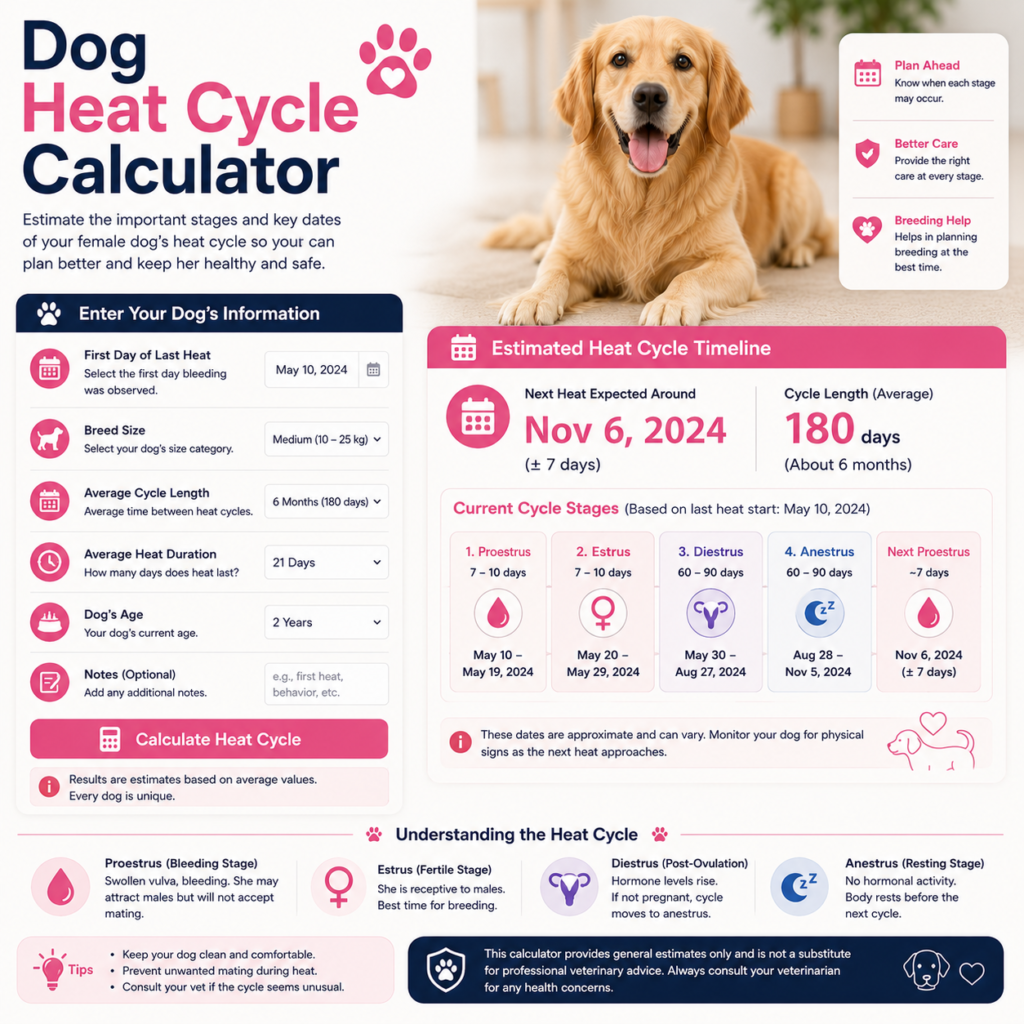
Dog heat cycle calculator: what it is, how it works, and why it matters
Understanding your dog’s reproductive cycle is one of the most practical things you can do as a dog owner — whether you’re planning a litter, trying to prevent an unplanned pregnancy, or simply keeping track of your pet’s health. A dog heat cycle calculator takes the guesswork out of this process by predicting when your dog will enter each phase of her cycle.
cycle calculator?
A dog heat cycle calculator is a tool — usually digital — that estimates the timing of a female dog’s estrous cycle based on two key inputs: the date of her last heat cycle and her typical cycle length. From these two data points, it projects forward to predict the start of her next heat, and breaks down the approximate window of each phase within that cycle.
These calculators are used by veterinarians, professional breeders, and everyday dog owners alike. For breeders, accurate cycle prediction is critical for planning matings and maximizing the chance of a successful pregnancy. For owners who are not breeding, it’s equally useful — knowing when a dog is likely to enter heat helps them take precautions against accidental mating and manage behavioral changes with more patience and preparation.
Quick fact: Most female dogs experience their first heat cycle between 6 and 24 months of age, depending on breed size. Small breeds tend to cycle earlier; giant breeds may not reach their first heat until nearly two years old.
The four phases of the canine heat cycle
The canine estrous cycle is divided into four distinct stages. A good calculator will map out all four, not just the visible “in heat” window.
Proestrus
7–10 days
Swelling and bloody discharge begin. Males are attracted but the female refuses to mate.
Estrus
5–14 days
The fertile window. Discharge lightens. The female accepts mounting. Ovulation occurs.
Diestrus
60–90 days
Post-fertile phase. The body behaves as if pregnant regardless of whether mating occurred.
Anestrus
4–5 months
The resting phase. No sexual activity. The reproductive system recovers before the next cycle.
The estrus phase — the fertile window — is the one most owners focus on, but the entire cycle from one proestrus to the next typically spans around six months in most medium-sized breeds. This is why most intact female dogs come into heat roughly twice a year.
How the calculator works
At its core, a heat cycle calculator uses simple date arithmetic. Here’s the logic behind a reliable one:
- 1Record the last heat start date
The user enters the first day proestrus was observed — typically when swelling or discharge first appeared.
- 2Enter the average cycle length
Most calculators default to 180 days (6 months), but let the user adjust based on their dog’s history. This number gets more accurate the more cycles you’ve tracked.
- 3Calculate the next heat window
The tool adds the cycle length to the last heat date to project when the next proestrus should begin, then offsets forward to estimate the start of estrus (typically 7–10 days later).
- 4Display the fertility window
The most important output: the estimated fertile window, usually days 11–21 of the overall cycle, when ovulation is most likely and the female is receptive to mating.
- 5Project whelping dates (for breeders)
If a mating date is entered, the calculator can project the expected whelping date approximately 63 days later — the average canine gestation period.
Key features to look for
Not all dog heat cycle calculators are built the same. The best ones include a combination of the following:
- ■Adjustable cycle lengthDogs vary widely. A calculator that locks you into a 6-month default will be inaccurate for many individual dogs. Look for one that lets you input your dog’s observed average.
- ■Full phase breakdownA good calculator shows proestrus, estrus, diestrus, and anestrus — not just “next heat date.”
- ■Fertile window highlightingThe optimal mating window is a subset of estrus — typically days 11–14 of the full cycle. A quality tool highlights this specifically.
- ■Whelping date projectionFor breeders, the ability to project expected birth dates from a known or estimated mating date is essential for preparation.
- ■History trackingSome tools allow you to log multiple cycles over time, which helps you refine the average cycle length and improves future predictions.
- ■Reminder notificationsMobile-based calculators often include calendar reminders so you’re not caught off guard when a heat cycle begins.
Breed differences and cycle variation
One of the most important things to understand about dog heat cycles is that they are not universal. Cycle frequency, duration, and fertility window timing all vary considerably by breed size and individual dog.
| Breed size | First heat (approx.) | Cycle frequency | Notes |
|---|---|---|---|
| Small (e.g. Chihuahua) | 4–6 months | 3–4 times/year | Can cycle more frequently than average |
| Medium (e.g. Labrador) | 6–12 months | Twice/year | Closest to the typical 6-month model |
| Large (e.g. German Shepherd) | 12–18 months | Twice/year | First heat may arrive later |
| Giant (e.g. Great Dane) | 18–24 months | Once/year | Less frequent cycles are normal |
| Basenji (special case) | 12–18 months | Once/year | Seasonally driven, typically autumn |
Note: The Basenji is a notable exception to standard canine reproductive patterns. This ancient breed cycles only once per year, usually in autumn, making a standard 6-month calculator inapplicable without adjustment.
Signs your dog is in heat
A calculator gives you predicted dates, but the dog’s body is the ground truth. Here are the signs to watch for that confirm your dog has entered her cycle:
Proestrus signs Vulvar swelling, bloody vaginal discharge, increased licking of the genital area, attraction of male dogs, flagging (tail-raising) beginning to appear, and sometimes clinginess or restlessness.
Estrus signs Discharge becomes straw-colored or pinkish, active acceptance of male dogs, pronounced flagging behavior, and willingness to stand for mounting. This is the fertile window.
Late cycle signs Discharge fades and stops, swelling subsides, the dog begins refusing males again. Diestrus begins whether mating occurred or not.
Behavioral changes to expect
Beyond the physical signs, many dogs show notable behavioral shifts during estrus. Increased affection, restlessness, changes in appetite, or even mild aggression are all common. Some dogs become more vocal. These behavioral shifts, while normal, can be disorienting for first-time owners — which is another reason tracking the cycle in advance helps.
How to use the calculator effectively
Getting the most out of a dog heat cycle calculator comes down to the quality of the data you put in. Here’s how to build a useful tracking practice:
Start logging immediately. The moment you notice the first signs of your dog’s current or next heat cycle, note the exact date. Do this consistently every cycle. After two or three cycles, you’ll have a reliable average interval to plug into the calculator.
Don’t rely solely on the prediction. Use the calendar dates as a planning window, not a hard guarantee. Confirm with physical signs. If you’re breeding, have your vet perform progesterone testing during the predicted estrus window to pinpoint ovulation precisely — this is far more accurate than calendar prediction alone.
Use the whelping projection practically. If you know the mating date, the projected whelping date gives you 63 days to prepare a whelping box, gather supplies, and schedule a pre-whelping vet check. Start counting down at the 58-day mark, as delivery can occur a few days early in some dogs.
Limitations and when to see a vet
A heat cycle calculator is a planning tool, not a diagnostic one. There are several situations where it can’t substitute for veterinary guidance:
Irregular or silent heats are more common than many owners realize. A “silent heat” occurs when a dog goes through estrus with minimal visible signs — no obvious discharge, little behavioral change. The dog is still fertile, but neither the owner nor the calculator will flag it without progesterone testing.
Split heats — where a dog begins a heat cycle, stops partway through, and resumes a few weeks later — are another source of confusion, particularly in young dogs in their first or second cycle. A calculator can’t account for these abnormalities.
If your dog’s cycles are consistently shorter than 4 months or longer than 12 months, if she shows signs of heat but no discharge, or if she has been bred and you want to confirm pregnancy, a veterinary exam is the right next step. Ultrasound can confirm pregnancy as early as day 25, and progesterone testing can confirm ovulation with precision.