Raw Dog Food Calculator

Ahmad zee
Table of Contents
Toggle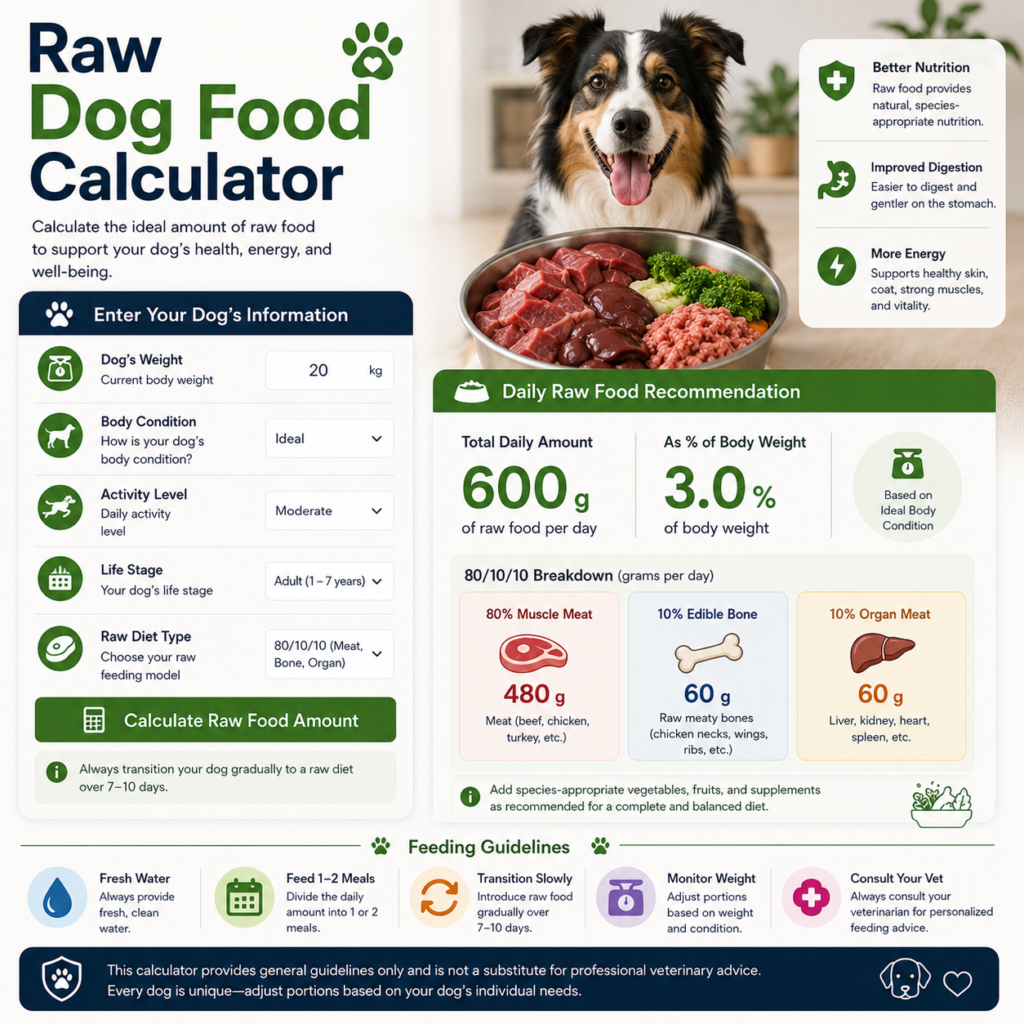
Raw Dog Food Calculator: How to Feed Your Dog a Balanced Raw Diet
Raw feeding has gone from a fringe movement to a mainstream conversation in canine nutrition over the past two decades. More dog owners than ever are exploring the potential benefits of feeding their dogs a diet closer to what their ancestors consumed — whole, minimally processed foods built around raw meat, bone, and organ. But raw feeding done incorrectly carries real risks, and getting portions right is one of the most critical factors separating a genuinely healthy raw diet from one that causes harm.
A raw dog food calculator provides the structured, science-backed starting point that raw feeding needs — translating a dog’s individual characteristics into a daily food target that accounts for life stage, activity level, body condition, and health goals. This guide covers everything worth knowing about raw feeding calculations, from the foundational percentage-based method to the nuances of feeding different life stages and body types.
What Is Raw Dog Food?
Raw dog food — sometimes called a BARF diet (Biologically Appropriate Raw Food or Bones and Raw Food) or a prey model diet — consists of uncooked animal-based ingredients fed in proportions designed to mirror what a dog’s wild ancestors would have consumed.
The core components of a raw diet typically include:
- Muscle meat — the primary protein and fat source, making up the bulk of most raw diets
- Raw meaty bones — a natural source of calcium and phosphorus, providing the mineral balance essential for skeletal health
- Organ meat — nutritionally dense offal including liver, kidney, spleen, and heart, providing concentrated vitamins and minerals
- Vegetables and fruits — included in some raw feeding philosophies (particularly BARF) for fibre, antioxidants, and phytonutrients
- Eggs — a complete protein source and valuable addition to most raw diets
- Fish — particularly oily fish like sardines and mackerel, providing omega-3 fatty acids and additional protein
The two most widely followed raw feeding frameworks differ primarily in whether plant matter is included:
BARF (Biologically Appropriate Raw Food) typically comprises approximately 70% muscle meat, 10% raw edible bone, 10% vegetables and fruit, 5% liver, and 5% other secreting organs — though ratios vary between practitioners.
Prey Model Raw (PMR) more strictly mimics whole prey consumption, targeting approximately 80% muscle meat, 10% raw edible bone, 5% liver, and 5% other secreting organs — with no plant matter included.
Both approaches can support excellent canine health when properly balanced and portioned — and a raw dog food calculator helps ensure portions are calculated correctly regardless of which framework an owner follows.
How Does a Raw Dog Food Calculator Work?
The foundation of raw feeding portion calculation is the percentage of body weight method — a straightforward approach that scales daily food intake to the dog’s current or target body weight.
The standard starting percentages are:
| Dog Type | Daily Raw Food as % of Body Weight |
|---|---|
| Typical adult dog | 2 to 3% |
| Active or working adult | 3 to 4% |
| Sedentary or overweight adult | 1.5 to 2% |
| Puppy (under 6 months) | 8 to 10% |
| Puppy (6 to 12 months) | 6 to 8% |
| Puppy (12 to 18 months, large breeds) | 4 to 6% |
| Senior dog | 1.5 to 2.5% |
| Pregnant dog (last 3 weeks) | 4 to 6% |
| Nursing mother | 6 to 8%+ |
A raw dog food calculator applies these percentages to the dog’s body weight to generate a daily gram or ounce target. For example, a 30 kg adult dog at a standard 2.5% feeding rate would receive 750 grams of raw food per day.
The calculation then breaks this daily total into the correct proportions of muscle meat, bone, organ, and any additional components based on the feeding framework being followed.
Because the entire calculation is anchored to body weight, accurate and current weight data is essential. The dog weight calculator provides a reliable baseline that feeds directly into raw food portion calculations, ensuring daily targets reflect the dog’s actual size rather than an estimated or outdated figure.
The 80/10/10 Rule: Understanding Raw Feeding Ratios
The 80/10/10 ratio is the most widely referenced guideline in prey model raw feeding and serves as the structural backbone of most raw dog food calculators:
- 80% muscle meat — includes heart (technically a muscle meat despite being an organ) and other skeletal muscle meats
- 10% raw edible bone — provides calcium and phosphorus in natural, bioavailable form
- 10% organ meat — split between liver (5%) and other secreting organs such as kidney, spleen, pancreas, or brain (5%)
This ratio is designed to approximate the nutritional profile of whole prey — the evolutionary diet of the domestic dog’s ancestors. When followed consistently across a variety of protein sources, it provides a nutritionally complete foundation for most healthy adult dogs.
For BARF feeders, the ratio is adjusted to incorporate plant matter — typically reducing muscle meat slightly to accommodate vegetables, fruit, eggs, and dairy in small amounts.
Why Accurate Portioning Matters in Raw Feeding
Unlike commercial kibble, where nutrients are standardised and guaranteed analyses are printed on the bag, raw feeding requires the owner to construct a balanced diet from individual components. Portioning errors compound over time — too much bone leads to constipation and calcium excess; too little bone leads to nutritional deficiency and loose stools; too much liver causes vitamin A toxicity; too little organ meat leaves the diet deficient in critical micronutrients.
A raw dog food calculator addresses this by:
- Establishing the correct total daily intake based on body weight and life stage
- Breaking that total into the appropriate component ratios
- Adjusting for body condition — feeding to ideal weight rather than current weight for overweight or underweight dogs
- Providing a structured framework that removes the guesswork from daily feeding decisions
Pairing a raw food calculator with the dog calorie calculator adds an additional layer of precision — allowing owners to cross-reference percentage-based raw feeding targets against caloric needs, which is particularly useful for working dogs, sporting dogs, and dogs with specific health management goals.
Feeding Raw Across Life Stages
Raw feeding requirements change significantly across a dog’s life. A raw dog food calculator that accounts for life stage provides far more useful guidance than a single, static percentage recommendation.
Feeding Raw to Puppies
Puppies have dramatically higher nutritional demands per unit of body weight than adult dogs. They’re simultaneously fuelling rapid skeletal growth, organ development, immune system maturation, and extraordinarily high activity levels — all of which drive up both total food intake and the need for specific nutrients like calcium, phosphorus, DHA, and high-quality protein.
The standard approach for puppies is to feed 2 to 3% of their expected adult body weight rather than their current weight — or alternatively, to use the higher percentage-of-current-weight method outlined earlier. Feeding to expected adult weight prevents the common problem of underfeeding as puppies grow rapidly through their early months.
Large and giant breed puppies require particular attention to bone content in the raw diet. These breeds are sensitive to calcium excess during growth — a risk that’s considerably lower with raw meaty bones than with calcium supplements, but still worth monitoring. Raw feeding proponents often cite this as one of the advantages of prey model feeding for large breeds, as bone-sourced calcium is self-regulating to a degree — puppies will naturally consume less bone when their calcium needs are met.
The dog age calculator helps owners place their puppy accurately within its developmental timeline, which directly informs the appropriate feeding percentage and the point at which to begin transitioning from puppy to adult feeding rates.
Feeding Raw to Active and Working Dogs
Dogs with high activity levels — working dogs, sporting dogs, agility competitors, and dogs doing regular endurance exercise — need meaningfully more food than their sedentary counterparts. For raw-fed working dogs, feeding rates of 3 to 5% of body weight or more are not uncommon, depending on the nature and intensity of the work performed.
Active dogs may also benefit from adjustments to macronutrient ratios — specifically, higher fat content to fuel sustained aerobic work. Fat is the most calorie-dense macronutrient and a dog’s most efficient fuel source for endurance activities. Raw feeders with working dogs sometimes increase the fat content of muscle meat selections or add supplemental fat sources like raw egg yolks or fatty fish to meet elevated energy demands.
Feeding Raw to Senior Dogs
Senior dogs present a nuanced raw feeding challenge. While their caloric needs often decrease as activity levels decline, their protein requirements may actually increase — research consistently shows that older dogs need more high-quality protein, not less, to preserve muscle mass and support immune function.
At the same time, senior dogs with kidney disease require careful management of phosphorus intake — a consideration that directly affects how much bone content is appropriate in the raw diet. Dogs with diagnosed kidney disease should have their raw diet formulated or reviewed by a veterinary nutritionist, as the standard 80/10/10 ratio may not be appropriate for all stages of renal disease.
The dog BMI calculator is particularly valuable for senior raw-fed dogs, providing an objective body condition assessment that helps owners identify muscle loss — which can be masked by fat gain — and adjust feeding accordingly.
Feeding Raw to Pregnant and Nursing Dogs
Pregnancy increases a dog’s nutritional demands progressively throughout gestation, with the most dramatic increase occurring in the final three weeks before whelping. Nursing mothers face even greater demands — milk production is metabolically expensive, and a nursing mother feeding a large litter may need two to three times her pre-pregnancy food intake to maintain her own body condition.
For raw-fed pregnant and nursing dogs, gradual increases in total food quantity are more important than dramatic changes in ratio composition. The quality and variety of protein sources should be maintained or improved, and additional calorie-dense additions like raw eggs and fatty fish are commonly used to support increased energy needs without requiring impractically large meal volumes.
Protein Variety: Why Rotating Raw Proteins Matters
One of the most important principles in raw feeding — and one that a raw dog food calculator supports through its ratio framework — is protein rotation. Feeding a single protein source exclusively, even in correctly balanced ratios, risks creating nutritional imbalances over time, as different meats have different amino acid profiles, fat compositions, and micronutrient concentrations.
Rotating through a variety of protein sources across the week or month helps achieve broader nutritional coverage naturally. Common rotation proteins include:
- Beef — high in zinc, iron, and B vitamins; excellent muscle meat base
- Chicken — widely available and cost-effective; good calcium source through chicken frames and necks
- Turkey — lean protein source; useful for dogs needing lower fat content
- Lamb — rich in iron and B12; higher fat content suits active dogs
- Pork — high in thiamine and selenium; should be frozen before feeding to eliminate parasite risk
- Rabbit — lean, hypoallergenic protein; excellent for dogs with sensitivities
- Venison — lean, novel protein ideal for dogs with food allergies
- Duck — rich in iron and amino acids; higher fat content
- Fish (sardines, mackerel, herring) — primary omega-3 source in most raw diets; typically fed two to three times per week
A good raw dog food calculator accounts for protein rotation by providing component targets in grams rather than locking the owner into a specific protein source — making it easy to rotate proteins while maintaining the correct overall ratios.
Bone Safety in Raw Feeding
Raw meaty bones are a cornerstone of a balanced raw diet — they provide the natural calcium and phosphorus that replaces the synthetic mineral supplementation used in commercial foods. However, bone safety is one of the most important topics for any raw feeder to understand thoroughly.
Safe Bones for Raw Feeding
Appropriate raw bones are those that are soft enough to be consumed and digested safely — not weight-bearing bones from large animals, which can fracture teeth. Safe raw bone options include:
- Chicken necks, wings, backs, and frames
- Turkey necks
- Duck necks and wings
- Rabbit pieces (whole carcass for smaller dogs)
- Pork riblets and trotters
- Lamb ribs and flaps
- Fish (whole small fish, or fish with fine bones)
Bones to Avoid
Large weight-bearing bones — beef femurs, knuckle bones, and similar dense bones — pose a significant tooth fracture risk even when raw. Cooked bones of any kind are dangerous for dogs, as cooking makes bones brittle and prone to splintering in ways that can cause internal injuries. A raw dog food calculator works exclusively with raw edible bone targets — cooked bone is never appropriate as a calcium source in raw feeding.
Bone Content and Stool Consistency
One of the most reliable real-world indicators of whether bone content is calibrated correctly is stool consistency. Raw-fed dogs on appropriate bone levels produce firm, well-formed stools that may be slightly lighter in colour than kibble-fed dogs. Too much bone produces chalky white, crumbly stools and can cause constipation. Too little bone produces loose, dark stools. Adjusting bone content based on stool observation is one of the most practical feedback mechanisms available to raw feeders.
Organ Meat: The Nutritional Powerhouse of Raw Feeding
Organ meats are among the most nutrient-dense foods available — packed with vitamins, minerals, amino acids, and enzymes that are difficult to replicate through any other means. In raw feeding, organs serve as the nutritional supplement equivalent — providing concentrated micronutrients that muscle meat and bone cannot supply in sufficient quantities.
Liver
Liver is the most important and nutritious organ in a raw diet — and also the one that requires the most careful portioning. It’s extraordinarily rich in vitamin A, B12, folate, copper, iron, and zinc. At 5% of the daily diet, it provides an enormous nutritional contribution. Exceeding this amount consistently risks vitamin A toxicity, which can cause bone pain, weight loss, and liver damage in severe cases.
Other Secreting Organs
The remaining 5% of the diet allocated to organs should come from secreting organs other than liver — kidneys, spleen, pancreas, brain, thymus, and testicles. These organs provide a different and complementary set of nutrients, including enzymes, hormones, and additional micronutrients that round out the raw diet’s nutritional profile.
For owners finding it difficult to source a variety of secreting organs, freeze-dried organ supplements can bridge the gap — though whole food sources are always preferred when available.
Transitioning a Dog to Raw Food
Transitioning from commercial kibble to a raw diet requires a thoughtful approach to avoid digestive upset. Dogs’ digestive systems adapt to raw feeding over time, and an abrupt switch can cause temporary vomiting, diarrhea, or excessive gas as gut bacteria adjust.
Fast Transition
Some raw feeding advocates recommend a clean break — stopping kibble entirely and beginning raw feeding immediately. This approach is generally more appropriate for young, healthy dogs with robust digestive systems and no known sensitivities.
Gradual Transition
A gradual transition — introducing raw food in increasing proportions over one to two weeks — is more appropriate for dogs with sensitive stomachs, older dogs, or dogs with a history of digestive issues. Starting with a single, easily digestible protein source (often chicken) before introducing variety helps the digestive system adapt without overwhelm.
Single Protein Introduction
During the transition period, most raw feeding practitioners recommend sticking to a single protein source for the first two to four weeks before beginning rotation. This makes it easier to identify any protein sensitivities and allows the digestive system to stabilise before the complexity of the diet increases.
Pairing the transition plan with the dog food calculator helps owners track caloric intake during the transition phase, ensuring that the shift from a calorie-dense kibble to raw food doesn’t inadvertently underfeed or overfeed the dog during the adjustment period.
Supplements Commonly Added to Raw Diets
A well-constructed raw diet built around varied proteins, appropriate bone content, and quality organ meat should be nutritionally complete for most healthy adult dogs. However, certain supplements are commonly added by raw feeders to address specific nutritional gaps or support particular health goals.
Omega-3 Fatty Acids
Even raw diets that include regular fish may benefit from additional omega-3 supplementation — particularly EPA and DHA — for dogs with inflammatory conditions, joint issues, or skin sensitivities. Sardines in water (with no added salt) are a practical whole-food source; fish oil capsules provide a more concentrated and measurable dose.
Vitamin E
Dogs fed high levels of fish oil or polyunsaturated fatty acids may need supplemental vitamin E to prevent oxidative depletion, as these fats increase oxidative stress if not balanced with adequate antioxidant protection.
Kelp and Alfalfa
These plant-based additions are commonly used in BARF diets to provide trace minerals — particularly iodine from kelp — that may be insufficient in an exclusively meat-based diet.
Probiotics
The gut microbiome shift that occurs during transition to raw feeding, or after illness and antibiotic treatment, can benefit from probiotic supplementation. Species-appropriate probiotics — including Lactobacillus and Bifidobacterium strains — help establish and maintain a healthy balance of gut bacteria in raw-fed dogs.
Food Safety Practices for Raw Feeding
Raw meat handling requires rigorous hygiene practices to protect both the dog and the household from bacterial contamination. The primary pathogens of concern in raw dog food include Salmonella, Listeria, E. coli, and Campylobacter — all of which are present in raw meat and pose risks to immunocompromised humans, young children, and elderly household members even when the dog itself handles them without apparent illness.
Thaw raw food safely. Raw food should be thawed in the refrigerator rather than at room temperature, minimising bacterial multiplication during the thawing process.
Feed in a designated area. Using a mat or feeding area that can be easily cleaned after meals reduces the spread of raw food residue around the home.
Wash hands and surfaces thoroughly. Hands, preparation surfaces, knives, and bowls should be washed with hot soapy water after handling raw food. Food-grade sanitiser provides additional protection in kitchen environments.
Remove uneaten food promptly. Raw food left at room temperature for more than 20 to 30 minutes begins to accumulate bacteria at a faster rate. Any uneaten portion should be removed and refrigerated or discarded rather than left for the dog to return to.
Source from reputable suppliers. Human-grade raw meat from reputable butchers or dedicated raw pet food suppliers carries lower contamination risk than low-grade meat meal alternatives. Knowing the source and quality of raw ingredients is a fundamental part of responsible raw feeding.
Common Raw Feeding Mistakes to Avoid
Feeding only muscle meat. Muscle meat alone is not a complete raw diet. Without bone for calcium and organs for micronutrients, a muscle-meat-only diet creates serious long-term nutritional deficiencies. The 80/10/10 ratio exists precisely to prevent this.
Overfeeding liver. Liver is extraordinarily nutritious but must be kept to approximately 5% of the daily diet. Owners excited by liver’s nutritional density sometimes over-include it, risking vitamin A toxicity over time.
Ignoring body condition feedback. A raw dog food calculator provides a starting point, not a permanent fixed prescription. Dogs should be assessed regularly using the dog BMI calculator and portions adjusted based on whether body condition is improving, worsening, or maintaining the ideal.
Not varying protein sources. Feeding a single protein exclusively — even in correct ratios — limits nutritional breadth. Rotating through a minimum of three to five protein sources over the course of a month provides considerably better nutritional coverage.
Feeding cooked bones. This is one of the most dangerous mistakes in raw feeding. Cooked bones splinter unpredictably and can cause internal lacerations, blockages, and perforations. Only raw bones are appropriate for raw-fed dogs.
Skipping the transition period. Switching abruptly from kibble to raw without a transition period commonly causes significant digestive upset — particularly in older dogs and those with sensitive stomachs. A gradual introduction prevents unnecessary discomfort.
Final Thoughts
A raw dog food calculator is the essential foundation of a safe, nutritionally sound raw feeding programme. By translating body weight, life stage, and activity level into concrete daily targets — and breaking those targets into the correct component ratios — it removes the guesswork that makes raw feeding intimidating for newcomers and helps experienced raw feeders maintain precision as their dog’s needs evolve.
Raw feeding at its best is one of the most thoughtful, health-conscious approaches a dog owner can take to canine nutrition. Combined with regular body condition monitoring, protein variety, responsible food safety practices, and ongoing veterinary oversight, a well-calculated raw diet can support outstanding health, vitality, and longevity across a dog’s entire life.