
Ahmad zee
Table of Contents
Toggle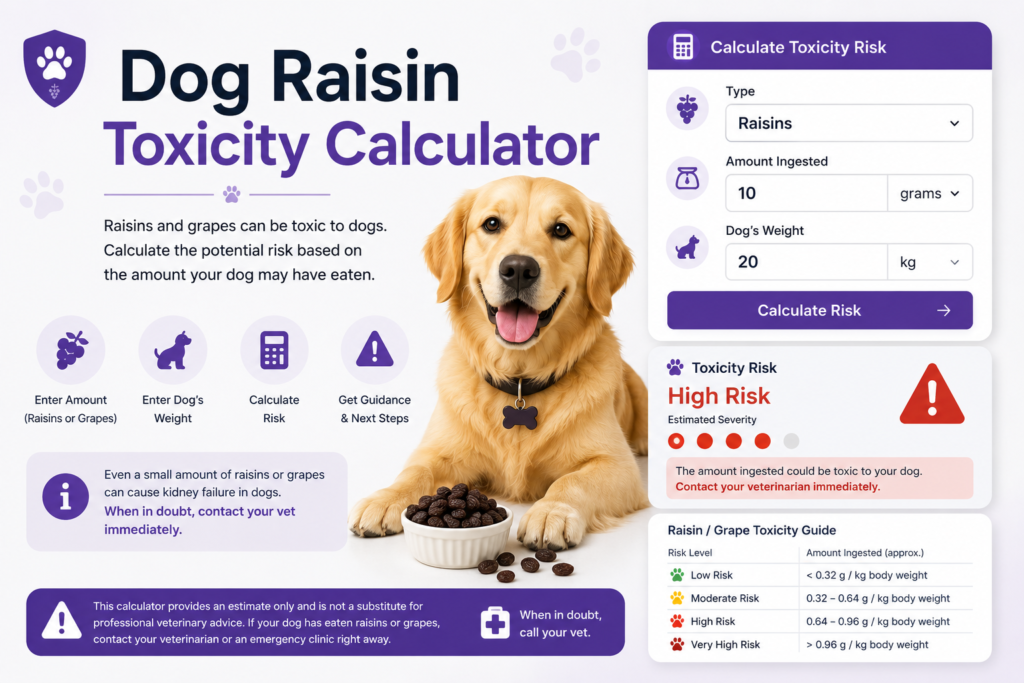
Dog Raisin Toxicity Calculator — What Every Dog Owner Needs to Know
Picture this: a dog owner steps away from the kitchen for just a moment, and comes back to find their dog happily finishing off a handful of raisins that had fallen from the counter. It’s a scenario that plays out in countless homes — and it’s one that can turn genuinely dangerous very quickly. Raisins are one of the most deceptively hazardous foods a dog can ingest, and the scary part is that many people still don’t know just how serious the risk is.
That’s where a Dog Raisin Toxicity Calculator becomes an essential tool — not a luxury, not a novelty, but a real first-response resource that can help a dog owner make faster, better decisions when every minute counts.
What Is a Dog Raisin Toxicity Calculator?
A Dog Raisin Toxicity Calculator is an online tool designed to assess the level of toxicity risk a dog faces after consuming raisins. By entering two key pieces of information — the dog’s body weight and the approximate quantity of raisins ingested — the calculator estimates whether the exposure falls into a low-risk, moderate-risk, or high-risk category.
The output helps dog owners quickly gauge whether they’re dealing with a “watch and wait” situation or a genuine veterinary emergency requiring immediate action. In toxicity cases, time is often the most critical variable — and a calculator that delivers a clear risk assessment within seconds can make a meaningful difference in outcomes.
Why Are Raisins Toxic to Dogs?
This is the question that surprises most people: why would a small, seemingly harmless dried fruit pose such a serious health threat to dogs?
The honest answer is that scientists still haven’t pinpointed the exact toxic compound responsible. Unlike chocolate toxicity — where theobromine is the well-identified culprit — raisin toxicity in dogs remains somewhat mysterious in terms of its precise mechanism. What is known, however, is well-established and deeply concerning.
What the Research Shows
Veterinary toxicologists and poison control centers have documented hundreds of cases in which dogs developed acute kidney failure after ingesting grapes or raisins. The pattern is consistent and alarming:
- Even small quantities can trigger severe kidney damage in some dogs
- There is no established “safe” dose — any amount of raisin ingestion should be treated as potentially dangerous
- The toxic response appears to be idiosyncratic — meaning it doesn’t affect all dogs the same way, and there’s no reliable way to predict which dogs will react severely
This unpredictability is precisely why a Dog Raisin Toxicity Calculator is so valuable. It brings structure and risk framing to a situation where instinct alone isn’t enough.
How Does a Dog Raisin Toxicity Calculator Work?
The calculator operates on the principle that toxicity risk scales with the ratio of the amount ingested to the dog’s body weight. A large dog consuming a single raisin faces a very different risk profile than a small dog consuming a handful of raisins.
Here’s how the process typically works:
Step 1 — Enter the Dog’s Body Weight
Weight is entered in pounds or kilograms, depending on the calculator’s unit settings. Accuracy matters here — even rough estimates are better than no data, but the more precise the weight, the more meaningful the risk output.
Step 2 — Enter the Amount of Raisins Consumed
This is entered in grams or ounces. If the exact amount isn’t known, owners can estimate based on how many raisins are in a typical handful, a small box, or a portion of a snack.
Step 3 — Review the Risk Assessment
The calculator processes the inputs and returns a risk category — typically one of the following:
| Risk Level | Recommended Action |
|---|---|
| Low Risk | Monitor closely; contact a vet if symptoms appear |
| Moderate Risk | Contact a veterinarian or poison control immediately |
| High Risk | Seek emergency veterinary care without delay |
| Severe / Critical | Emergency treatment required; do not wait |
Step 4 — Act on the Result
The calculator’s output is a guide, not a substitute for professional veterinary advice. Regardless of the risk level returned, contacting a vet or animal poison control center is always the recommended follow-up.
Raisin Toxicity vs. Grape Toxicity — Are They the Same?
Yes — and this distinction is important to understand. Grapes and raisins share the same toxic properties in dogs, but raisins carry a significantly higher risk per unit of weight simply because they are dried and therefore concentrated.
A raisin contains the same toxic load as the grape it was made from — but in a fraction of the volume and weight. This concentration effect means that a small quantity of raisins can represent a toxic dose that the same volume of grapes would not.
In practical terms:
- One cup of grapes might weigh around 150 grams
- One cup of raisins might weigh around 145 grams but represents the concentrated toxin load of roughly three to four times as many grapes
This is why raisin ingestion tends to be treated with even greater urgency than grape ingestion — and why using a Dog Raisin Toxicity Calculator specific to raisins (rather than a general food toxicity guide) produces more accurate risk estimates.
What Are the Symptoms of Raisin Toxicity in Dogs?
Recognizing the signs of toxicity quickly gives owners the best chance of getting their dog appropriate care before serious kidney damage sets in. Symptoms typically begin appearing within 6 to 12 hours of ingestion, though in some cases they develop more slowly.
Early Symptoms (Within 6–12 Hours)
- Vomiting — often the first sign, and may contain pieces of raisin
- Diarrhea
- Lethargy and unusual quietness
- Loss of appetite
- Abdominal pain or tenderness
- Excessive drooling
Intermediate Symptoms (12–24 Hours)
- Decreased or absent urination — a critical warning sign of kidney involvement
- Weakness and difficulty walking
- Tremors or muscle twitching
- Pale or discolored gums
- Dehydration
Severe Symptoms (24+ Hours — Indicates Acute Kidney Failure)
- Complete absence of urination
- Seizures
- Loss of consciousness
- Severe weakness or collapse
Any progression toward these later-stage symptoms represents a life-threatening emergency. Immediate veterinary intervention is essential — and the sooner it begins, the better the chances of recovery.
The Role of Body Weight in Raisin Toxicity
Body weight is one of the most critical variables in assessing raisin toxicity risk, which is why it’s a primary input in any Dog Raisin Toxicity Calculator. A dog’s size determines how concentrated the toxic exposure becomes relative to its system.
To understand the difference, consider this comparison:
| Dog Size | Weight | Raisins Consumed | Risk Level |
|---|---|---|---|
| Small (Chihuahua) | 5 lbs / 2.3 kg | 1 raisin | Moderate |
| Medium (Beagle) | 25 lbs / 11 kg | 1 raisin | Low |
| Small (Chihuahua) | 5 lbs / 2.3 kg | 10 raisins | High to Severe |
| Medium (Beagle) | 25 lbs / 11 kg | 10 raisins | Moderate to High |
| Large (Labrador) | 70 lbs / 32 kg | 10 raisins | Low to Moderate |
Note: These ranges are illustrative. Always use a calculator and consult a vet for real situations.
This table illustrates something critical: small dogs are at far greater risk from the same amount of raisin ingestion than large dogs. For owners of small breeds in particular, using a Dog Raisin Toxicity Calculator at the first sign of ingestion isn’t optional — it’s urgent.
To better understand a dog’s size category and how weight interacts with health risk, a Dog BMI Calculator provides useful context about a dog’s body composition and helps ensure the weight entered into a toxicity calculator is current and accurate.
Foods Commonly Containing Raisins — Hidden Dangers
One of the most overlooked aspects of raisin toxicity is how many everyday human foods contain raisins — often in quantities large enough to be dangerous, especially for smaller dogs.
Common Raisin-Containing Foods to Watch Out For
- Trail mix — often packed with raisins alongside nuts and seeds
- Oatmeal raisin cookies — one of the most common accidental ingestion sources
- Fruit cake and holiday breads — especially prevalent during certain seasons
- Cereal and granola — many popular varieties contain significant raisin content
- Bagels and bread — raisin bagels and cinnamon raisin bread are widely available
- Salads — some contain raisins or dried currants as toppings
- Stuffing and savory dishes — raisins appear in certain traditional recipes
- Snack bars and energy bars — raisins are common binding ingredients
Many of these foods are routinely left on counters, in bags, or at table level — well within a curious dog’s reach. Awareness of where raisins hide is just as important as knowing what to do after ingestion occurs.
What to Do If a Dog Eats Raisins — A Step-by-Step Response Guide
Knowing the right sequence of actions in the moments after raisin ingestion can genuinely change a dog’s outcome.
Step 1 — Stay Calm and Assess
Panicking wastes precious time. Take a breath and try to determine as accurately as possible how many raisins were eaten and when ingestion likely occurred.
Step 2 — Use a Dog Raisin Toxicity Calculator
Enter the dog’s weight and estimated raisin quantity. The resulting risk assessment will inform how urgently professional help is needed.
Step 3 — Contact a Veterinarian or Animal Poison Control
Even if the calculator returns a low-risk result, calling a vet is the right move. They can advise whether induced vomiting is appropriate (it often is within the first two hours), what to monitor for, and whether a clinic visit is warranted.
Animal poison control hotlines are available 24/7 in most countries and can provide immediate guidance while an owner is en route to a veterinary clinic.
Step 4 — Do Not Induce Vomiting Without Professional Guidance
While inducing vomiting is sometimes recommended after raisin ingestion, it’s not always safe or appropriate — especially if the dog is already showing symptoms, has a pre-existing condition, or if significant time has passed since ingestion. Always confirm with a vet before attempting this at home.
Step 5 — Monitor Closely
Whether at home or at the clinic, monitoring for the early symptoms listed above is essential in the hours following ingestion. Changes in urination frequency or output are particularly important signals to track — reduced urination is one of the earliest signs of kidney distress. Keeping a dog properly hydrated during this period is also important, and a Dog Water Intake Calculator can serve as a helpful reference for understanding normal hydration needs by size and weight.
Can Dogs Recover From Raisin Toxicity?
The answer depends significantly on how quickly treatment is initiated. Dogs treated promptly — ideally within a few hours of ingestion — have considerably better outcomes than those where treatment is delayed.
When Treated Early
- Vomiting may be induced to remove raisins from the stomach before absorption
- Activated charcoal may be administered to reduce further toxin uptake
- IV fluid therapy is initiated to protect kidney function and flush the system
- Blood work monitors kidney values closely over 48–72 hours
With aggressive early treatment, many dogs make a full recovery, particularly those who ingested smaller amounts relative to their body weight.
When Treatment Is Delayed
Once acute kidney failure has set in, the prognosis becomes significantly more guarded. Dogs that develop complete kidney shutdown (anuria) face serious long-term consequences, and recovery at this stage is far less certain.
This reality reinforces a central message: raisin ingestion is a time-sensitive emergency, and a Dog Raisin Toxicity Calculator is one of the fastest ways to move from uncertainty to action.
Raisin Toxicity in Relation to Other Food Toxicities
Raisins are not the only common human food that poses a serious threat to dogs. Several other household foods carry comparable or related risks:
- Onions and garlic — cause red blood cell damage and can lead to hemolytic anemia. The Dog Onion Toxicity Calculator helps assess risk from allium family ingestion in much the same way a raisin calculator does for grape-derived foods.
- Chocolate — contains theobromine, which affects the nervous system and heart
- Xylitol — an artificial sweetener found in many sugar-free products that causes dangerous drops in blood sugar
- Macadamia nuts — can cause weakness, vomiting, and neurological symptoms
- Avocado — contains persin, which is toxic to many animals
Understanding which foods are dangerous — and having the right calculators and resources on hand before an incident happens — is the most effective form of pet safety.
How Age and Health Status Affect Raisin Toxicity Risk
While no dog is immune to raisin toxicity, certain dogs may face elevated risk based on their age and existing health conditions.
Puppies
Young dogs have less developed organ systems and lower body weight, making them particularly vulnerable to toxic exposure. Even trace amounts of raisins in a small puppy warrant immediate veterinary attention.
Understanding a puppy’s developmental stage helps contextualize these risks. A Dog Age Calculator can help owners identify where their dog sits in its biological life journey — a useful reference when communicating with a vet about age-related vulnerability.
Senior Dogs
Older dogs may already have reduced kidney function due to natural aging. Raisin toxicity in a senior dog with pre-existing renal compromise can escalate to kidney failure more rapidly than in a healthy adult dog.
Dogs With Pre-Existing Kidney Conditions
Any dog already managing kidney disease or reduced renal function is at compounded risk. For these dogs, the threshold for seeking emergency care should be even lower than the calculator’s general guidance suggests.
Prevention — The Best Strategy of All
While knowing how to respond to raisin ingestion is essential, preventing it in the first place is always the preferred outcome.
Practical Prevention Tips
- Store raisins and raisin-containing foods in sealed containers in high cabinets or the refrigerator — never on counters or low shelves
- Educate all household members, including children and visiting guests, about the danger raisins pose to dogs
- Check ingredient lists on packaged foods, especially snack bars, cereals, and baked goods, before leaving them accessible
- Be extra vigilant during holidays and gatherings, when raisin-containing foods like fruitcake, trail mix, and baked goods are more frequently present
- Keep the number of a veterinarian and animal poison control readily accessible — not just saved in a phone, but somewhere it can be found quickly in a moment of stress
Keeping a Dog Healthy Beyond Toxicity Awareness
Toxicity awareness is one dimension of responsible dog ownership — but it fits within a broader picture of proactive health management. Owners who are tuned in to their dog’s diet, weight, hydration, and age-related needs are generally better positioned to respond well in emergencies because they already have accurate baseline information on hand.
Tools like a Dog Calorie Calculator support this broader commitment to health by helping owners manage daily nutrition thoughtfully — ensuring their dog maintains a healthy weight and receives the right energy intake for its size and activity level. A well-nourished dog with a healthy body and well-functioning organs will generally have a stronger baseline from which to recover if an accidental toxin exposure does occur.
Final Thoughts
Raisins are one of the most dangerous foods a dog can consume — and the combination of their concentrated toxicity, unpredictable individual response, and widespread presence in everyday human foods makes them a uniquely serious hazard. A Dog Raisin Toxicity Calculator gives dog owners something invaluable in that critical window after ingestion: fast, clear, data-based guidance that replaces panic with informed action.
No tool replaces veterinary care — but having a resource that quickly translates “my dog just ate raisins” into a specific risk category can be the difference between delayed response and immediate, potentially life-saving intervention. For any dog owner, bookmarking a Dog Raisin Toxicity Calculator is a small step that could one day make an enormous difference.