Dog BMI Calculator

Ahmad zee
Table of Contents
Toggle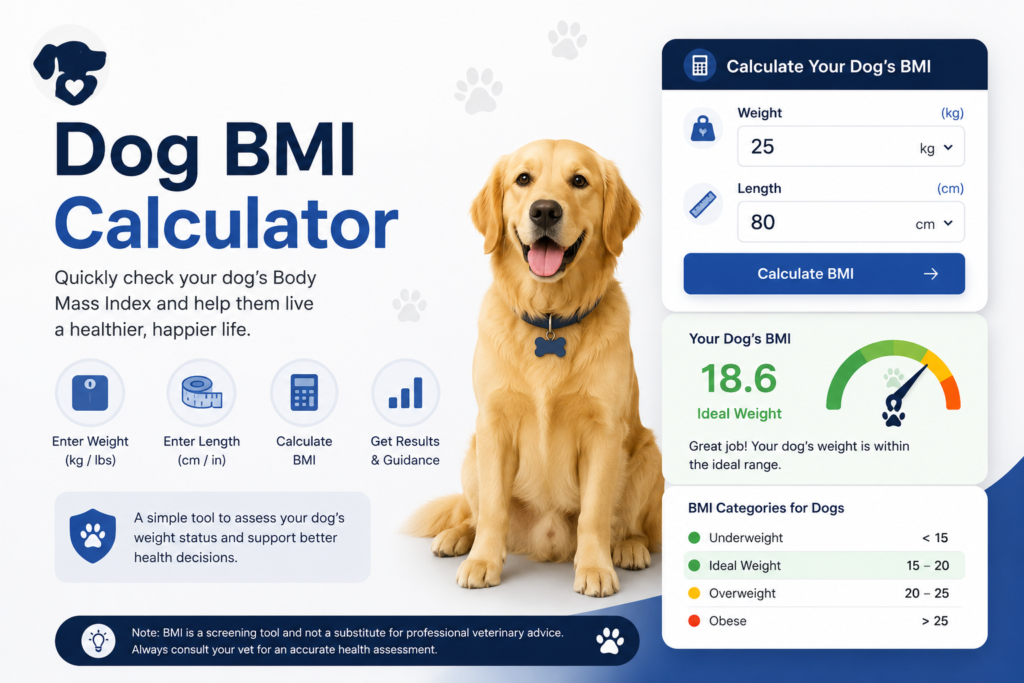
Dog BMI Calculator — Is Your Dog at a Healthy Weight?
Most dog owners would do anything for their four-legged companions — the walks, the vet visits, the carefully chosen food. But one aspect of canine health that often slips under the radar is body weight management. Not just whether a dog looks “too thin” or “a little chubby,” but whether its body composition is genuinely healthy for its size and breed. That’s exactly where a Dog BMI Calculator steps in — and why more pet owners and veterinary professionals are turning to it as a practical, everyday health tool.
What Is a Dog BMI Calculator?
A Dog BMI Calculator is a digital tool that estimates a dog’s Body Mass Index — a numerical measure that reflects whether a dog’s weight is proportionate to its body size. By entering a few basic details, owners receive a quick snapshot of their dog’s body condition, helping them understand whether their pet falls into an underweight, healthy, overweight, or obese category.
While BMI in humans is calculated using height and weight, canine BMI calculations typically factor in the dog’s weight alongside its body measurements — most commonly chest or rib cage girth — to generate a more breed-appropriate result.
It’s a simple tool with genuinely meaningful output, and it puts useful health information directly into the hands of everyday dog owners.
Why Monitoring a Dog’s BMI Matters
Weight-related health issues are among the most common problems seen in veterinary clinics today. Studies suggest that over 50% of dogs in many countries are overweight or obese — and many owners genuinely don’t realize it. That’s not a failure of love; it’s often a failure of accurate measurement.
A Dog BMI Calculator provides an objective reference point that removes the guesswork. Here’s why that matters:
Weight Problems Are Easy to Miss
Dogs gain weight gradually. A pound here, another one a few months later — it’s rarely dramatic. Without a consistent tracking method, many owners don’t notice the shift until a vet flags it. A BMI tool encourages regular monitoring so that small changes are caught before they become bigger problems.
Excess Weight Shortens a Dog’s Life
Research consistently links canine obesity with shortened lifespans. Overweight dogs are at significantly higher risk for:
- Type 2 diabetes
- Joint disease and arthritis
- Heart and respiratory conditions
- Liver disease
- Certain cancers
- Reduced immune function
On the flip side, underweight dogs face their own set of risks — weakened immunity, muscle loss, poor coat condition, and compromised organ function. A Dog BMI Calculator helps identify both ends of the spectrum.
It Supports Proactive, Not Reactive, Care
One of the biggest advantages of using a BMI tool is that it empowers owners to act before a health problem becomes entrenched. Rather than waiting for a vet to raise concerns, owners can track their dog’s body condition between appointments and adjust care routines accordingly.
How Does a Dog BMI Calculator Work?
The mechanics behind a Dog BMI Calculator are straightforward. Most tools require two primary inputs:
- The dog’s weight — typically entered in pounds or kilograms
- A body measurement — usually the chest circumference or rib cage girth, measured in inches or centimeters
Some advanced calculators also ask for the dog’s breed or size category to refine the output, since body composition norms vary considerably across breeds.
Once these values are entered, the calculator uses an established formula to produce a BMI score, which is then mapped against a reference scale — usually broken into categories such as:
| BMI Category | What It Means |
|---|---|
| Underweight | Dog is below the healthy weight range for its size |
| Ideal / Healthy | Dog is within the optimal weight range |
| Overweight | Dog carries excess weight that may affect health |
| Obese | Dog is significantly above healthy weight; veterinary guidance recommended |
The result is delivered instantly, giving owners clear, actionable information without requiring a clinic visit.
Dog BMI vs. Body Condition Score (BCS) — What’s the Difference?
Veterinarians often use a tool called the Body Condition Score (BCS) to assess canine weight health. It’s a 9-point scale based on physical observation and palpation — how easily a vet can feel the ribs, see the waistline, and assess fat coverage.
A Dog BMI Calculator differs in an important way: it’s quantitative. It produces a number based on measurements, making it easier to track changes over time and compare results across visits. BCS, while valuable, depends on a trained eye and hands-on assessment.
Used together, these two methods give the most complete picture of a dog’s body condition. The BMI Calculator is the everyday tracking tool; the BCS assessment is the professional confirmation.
What’s a Healthy BMI for a Dog?
Healthy BMI ranges for dogs aren’t one-size-fits-all. They vary based on breed, sex, age, and build. However, most general-use Dog BMI Calculators are built with these variables in mind.
As a broad guide:
- Small breeds (under 20 lbs) tend to have naturally lean, compact frames, and their healthy BMI range reflects that.
- Medium breeds (20–50 lbs) fall into a moderate range with some natural variation depending on musculature.
- Large and giant breeds (50 lbs and above) have wider BMI reference ranges given the significant variation in bone density and muscle mass.
Age also plays a role. Senior dogs naturally lose muscle mass over time, which can affect BMI interpretation. For a clearer picture of how age interacts with body condition, pairing the BMI tool with a Dog Age Calculator helps owners understand whether changes in body composition align with normal aging or signal a concern worth addressing.
Signs That a Dog May Be Outside the Healthy BMI Range
While a calculator provides precise measurements, there are physical signs owners can watch for between check-ins.
Signs of an Overweight Dog
- Ribs are difficult to feel beneath a layer of fat
- No visible waist when viewed from above
- Abdomen appears rounded or saggy when viewed from the side
- Reluctance to exercise or tires quickly
- Labored breathing during light activity
- Waddling gait
Signs of an Underweight Dog
- Ribs, spine, and hip bones are visibly prominent
- Little to no fat covering felt over the ribcage
- Loss of muscle mass, especially in the hindquarters
- Dull, brittle coat
- Low energy and lethargy
- Poor wound healing
If a dog shows several of these signs, running the numbers through a Dog BMI Calculator and scheduling a vet visit is the right next step.
How to Measure a Dog for BMI Calculation
Accurate measurement is the foundation of an accurate BMI result. Here’s a simple guide to getting the inputs right:
Step 1 — Weigh the Dog
Use a pet scale or a bathroom scale (weigh yourself first, then weigh yourself holding the dog, and subtract). Record the weight in the units the calculator requires.
Step 2 — Measure the Chest Girth
Using a soft measuring tape, wrap it around the dog’s chest just behind the front legs, at the widest point of the rib cage. Ensure the tape is snug but not tight, and that the dog is standing in a relaxed, natural position. Record this measurement.
Step 3 — Enter the Values
Input both figures into the Dog BMI Calculator, select the appropriate breed size or category if prompted, and hit calculate.
Step 4 — Interpret the Result
Review which BMI category the result falls into, and use the output to guide any adjustments to the dog’s diet, exercise routine, or veterinary follow-up.
Using BMI Results to Improve a Dog’s Health
Getting a BMI result is only the beginning. The real value lies in what’s done with that information.
If the Dog Is Overweight
The two most effective interventions are dietary adjustment and increased physical activity. Reducing portion sizes and switching to lower-calorie food options are common first steps. A Dog Calorie Calculator is a practical companion tool here — it helps owners work out exactly how many calories their dog needs each day based on weight, age, and activity level, removing the guesswork from feeding decisions.
For owners who want to go deeper into nutritional planning, a Dog Food Calculator can help determine the right type and quantity of food to support gradual, healthy weight loss without nutritional deficiency.
If the Dog Is Underweight
Increasing caloric intake is the obvious first step, but the quality of those calories matters enormously. Protein-rich, nutrient-dense foods are typically prioritized. Identifying the underlying cause of underweight status is equally important — parasites, dental pain, digestive issues, and chronic illness can all suppress appetite and affect weight.
If the Dog Is at a Healthy BMI
Maintaining that balance requires consistent habits. Regular weigh-ins, portion awareness, and age-appropriate exercise all contribute to keeping a dog in its ideal range. Staying hydrated is also part of the picture — a Dog Water Intake Calculator helps owners ensure their dog is drinking the right amount of water daily, which supports metabolism, digestion, and overall body function.
Other Health Tools That Complement a Dog BMI Calculator
A Dog BMI Calculator works best as part of a broader health monitoring routine. Several other tools pair naturally with it:
- Dog Age Calculator — Contextualizes BMI results by identifying the dog’s biological life stage, since weight management priorities shift between puppyhood, adulthood, and senior years.
- Dog Calorie Calculator — Translates BMI results into specific daily caloric targets, making it easier to plan meals with precision.
- Dog Food Calculator — Helps owners select the right food portions and types to meet their dog’s weight and health goals.
- Dog Water Intake Calculator — Ensures hydration keeps pace with any dietary or exercise changes made in response to BMI results.
For dog owners who want to stay on top of all aspects of health — not just weight — keeping a toxin awareness tool bookmarked is also wise. A Dog Onion Toxicity Calculator helps owners quickly assess risk if their dog accidentally ingests onions or related foods, which can be especially important for dogs whose diets are being adjusted with homemade or fresh food options.
How Often Should Dog BMI Be Checked?
There’s no single universal recommendation, but a general guideline that many veterinarians support looks something like this:
- Puppies: Monthly — given how rapidly their bodies change during the first year
- Adult dogs (1–7 years): Every 2–3 months, or whenever a noticeable change in appearance or behavior is observed
- Senior dogs (7+ years): Monthly or every 6–8 weeks, as body composition tends to shift more readily in older animals
Outside of scheduled checks, any sudden or unexplained weight change — gain or loss — is worth investigating promptly, both with a BMI tool and with veterinary guidance.
Common Myths About Dog Weight and BMI
“My dog is big-boned, not overweight.”
While dogs do vary in bone structure, the phrase “big-boned” is frequently used to rationalize excess fat. Bone density rarely accounts for significant weight differences between dogs of the same breed and height. A BMI Calculator cuts through this rationalization with objective data.
“If my dog is active, their weight doesn’t matter.”
Activity level helps, but it doesn’t override dietary excess. An overweight dog that exercises is healthier than one that doesn’t — but it’s still at elevated risk for the conditions associated with excess body fat. Activity and body weight are both important, and neither substitutes for the other.
“My vet would have told me if my dog was overweight.”
Vets are excellent at identifying serious health concerns, but weight conversations aren’t always a top priority in short appointments. Owners who proactively track their dog’s BMI between visits bring more useful data to those appointments and are better positioned to have productive conversations about weight management.
“Small dogs don’t really have weight problems.”
Small breeds are just as susceptible to obesity as their larger counterparts — sometimes more so, since even a pound or two of excess weight represents a significant percentage of their total body mass. A 10 lb dog gaining 2 lbs is the equivalent of a 150 lb human gaining 30 lbs.
Final Thoughts
A Dog BMI Calculator is one of the most practical, low-effort health tools available to modern dog owners. It takes less than two minutes to use, requires only a scale and a measuring tape, and delivers information that can genuinely influence how a dog is fed, exercised, and cared for at every stage of life.
For dogs who can’t express how they’re feeling in words, objective health metrics like BMI offer a meaningful window into their wellbeing. And for owners who want to give their dogs the longest, healthiest, most comfortable life possible — that window is well worth looking through.