Dog Quality of Life Calculator

Ahmad zee
Table of Contents
Toggle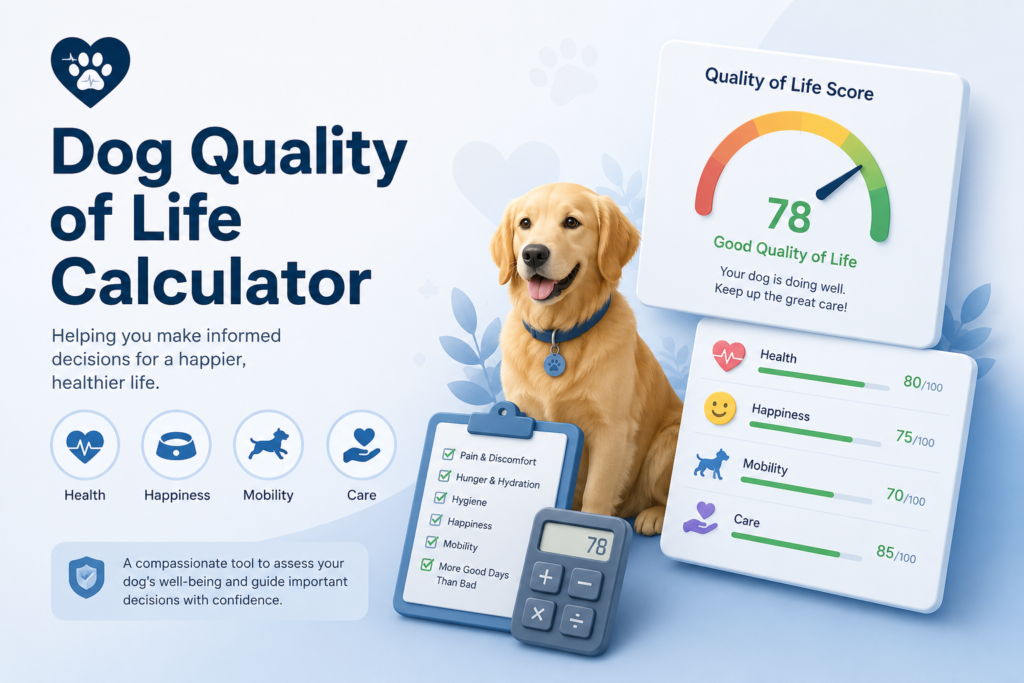
Dog Quality of Life Calculator — Helping Owners Make the Most Loving Decisions
There are moments in every dog owner’s journey that no one truly prepares them for. As a beloved companion grows older, becomes ill, or faces a serious diagnosis, the question that weighs heaviest on the heart is also the hardest one to answer: Is my dog still having a good life? A Dog Quality of Life Calculator exists precisely to help owners navigate that deeply emotional — and profoundly important — question with more clarity, compassion, and confidence.
What Is a Dog Quality of Life Calculator?
A Dog Quality of Life Calculator is a structured digital assessment tool that helps dog owners evaluate their pet’s overall well-being across several key dimensions of daily life. Rather than relying solely on gut feeling — which, while meaningful, can be clouded by grief, hope, or denial — the calculator brings a layer of thoughtful, systematic reflection to the process.
The tool does not replace veterinary guidance. What it does is give owners a framework: a set of meaningful questions that prompt honest observation and help translate those observations into something measurable and actionable.
Veterinary professionals sometimes refer to this type of assessment as a “HHHHHMM Scale” evaluation — a scale developed by Dr. Alice Villalobos that measures Hurt, Hunger, Hydration, Hygiene, Happiness, Mobility, and More good days than bad. Many Dog Quality of Life Calculators are built around this framework or a variation of it.
Why Quality of Life Assessment Matters
Dogs are remarkably stoic creatures. They often mask discomfort, continue greeting their owners at the door even through pain, and wag their tails even on difficult days. This natural resilience — while endearing — makes it genuinely hard for even the most attentive owner to know what a dog is truly experiencing.
This is where a Dog Quality of Life Calculator becomes not just helpful, but necessary. It encourages owners to look beyond surface-level happiness and examine the full picture of a dog’s physical and emotional state. The result is a more honest, well-rounded understanding that supports better decision-making — whether that means pursuing new treatment options, adjusting daily care, or beginning the difficult conversation about end-of-life planning.
Who Should Use a Dog Quality of Life Calculator?
While this tool is most commonly associated with aging or terminally ill dogs, it’s actually valuable across a broader range of situations. Owners may find it genuinely useful when:
- Their dog has received a serious or chronic diagnosis such as cancer, kidney failure, heart disease, or severe arthritis
- Their dog is visibly struggling but still has moments of joy and engagement
- They are trying to determine whether a current treatment plan is improving or declining their dog’s daily experience
- They feel uncertain about whether their dog’s needs are being fully met
- They are preparing emotionally for the possibility of euthanasia and want to approach that decision thoughtfully
It’s also worth noting that quality of life assessments aren’t only for end-of-life situations. A younger dog recovering from surgery or living with a chronic condition can benefit from periodic evaluations to ensure that care strategies are working.
Key Dimensions Evaluated in a Dog Quality of Life Calculator
Most well-designed Dog Quality of Life Calculators assess a dog’s well-being across several interconnected categories. Each one captures a different aspect of the dog’s daily experience.
1. Pain and Discomfort (Hurt)
This is typically the first and most heavily weighted category. The assessment asks owners to observe behavioral signs of pain — reluctance to move, changes in posture, vocalization, changes in breathing, or withdrawal from interaction. Dogs in significant, unmanaged pain score low in this area, which carries serious weight in the overall evaluation.
Pain management is a cornerstone of quality of life care. Veterinarians may recommend medications, physiotherapy, acupuncture, or environmental modifications depending on the source and severity of discomfort.
2. Nutrition and Appetite (Hunger)
A dog’s relationship with food is deeply tied to its quality of life. A dog that has lost interest in eating — or is physically unable to eat without distress — is experiencing a significant decline in one of life’s most fundamental pleasures. Owners are asked to consider whether their dog is eating voluntarily, accepting hand-feeding, or requiring tube feeding to sustain nutrition.
Keeping track of daily food intake is important during this stage. Tools like a Dog Calorie Calculator can help owners ensure that a dog in declining health is still receiving appropriate caloric support — not too much, not too little — tailored to its current weight and activity level.
3. Hydration
Proper hydration is essential for organ function, comfort, and overall vitality. Dehydration in dogs can be observed through skin elasticity testing, dry or tacky gums, and sunken eyes. The calculator asks owners to assess whether their dog is drinking adequately or showing signs of dehydration, and whether any interventions — such as subcutaneous fluids — are needed.
4. Hygiene and Physical Cleanliness
A dog’s ability to maintain basic physical dignity matters. This category covers whether the dog is experiencing uncontrolled elimination, whether wounds or pressure sores are developing from prolonged time lying down, and whether the dog appears clean and comfortable. Dogs who are unable to be kept clean and comfortable without significant distress face a meaningful quality of life challenge.
5. Emotional Happiness and Engagement
Perhaps the most touching category to assess, this dimension asks owners to observe their dog’s emotional state. Does the dog still show interest in its surroundings? Does it respond to familiar voices, toys, or smells? Does it seek out human connection? A dog that still expresses curiosity, affection, and engagement — even in reduced form — is showing signs of emotional vitality that matter deeply in the overall assessment.
6. Mobility and Physical Function
Can the dog move around without severe distress? Can it stand, reposition itself, and access food, water, and its preferred resting spots? Dogs who have lost significant mobility — and for whom assistive devices or human support are no longer adequate — may be experiencing a level of physical limitation that affects their overall sense of dignity and independence.
Keeping an eye on a dog’s body condition during this period is also helpful. A Dog BMI Calculator can assist owners and veterinarians in tracking whether a dog is losing muscle mass or body condition over time — a common and concerning development in chronically ill dogs.
7. More Good Days Than Bad
This is ultimately the most human — and most honest — measure of all. When owners step back and look at the past week or two, are there more days filled with small joys, engagement, and comfort than there are days marked by suffering, withdrawal, or distress? This simple but profound question sits at the heart of quality of life decision-making.
How a Dog Quality of Life Calculator Works
Most calculators use a numerical scoring system to make the evaluation process more structured. Here’s a typical approach:
- Each category is rated on a scale, commonly 1 to 10, where higher scores reflect better quality of life in that dimension
- Scores are totaled at the end of the assessment
- A total score above a defined threshold — often 35 out of 70 — generally indicates an acceptable quality of life
- Scores below that threshold prompt a more urgent conversation with a veterinarian about comfort care, palliative options, or humane euthanasia
It’s important to remember that these numbers are guides, not verdicts. A score of 34 does not automatically mean a dog’s life should end any more than a score of 36 guarantees it’s thriving. The numbers are conversation starters — tools for reflection, not replacements for professional advice.
The Emotional Side of Using This Calculator
Let’s be honest — filling out a Dog Quality of Life assessment is not easy. For many owners, it’s one of the most emotionally demanding things they’ll ever do. The process of honestly answering questions about pain, loss of function, and fading happiness requires a kind of courage that deserves recognition.
Some owners find it helpful to complete the assessment with a trusted friend or family member. Others prefer to do it quietly, alone, with the dog nearby. Some veterinary clinics offer to walk through the evaluation together, turning it into a shared, supported conversation.
Whatever the approach, the act of doing the assessment is itself an act of love. It says: I see you. I want to understand what you’re experiencing. And I’m going to do right by you.
Using Multiple Tools Together for Comprehensive Dog Care
A Dog Quality of Life Calculator works best as part of a broader, thoughtful approach to dog care — not as a standalone tool used only in crisis. Combining it with regular health monitoring throughout a dog’s life builds a more complete picture of how the dog is doing at every stage.
For example:
- A Dog Age Calculator helps owners understand where their dog sits in its biological life cycle — a 10-year-old Great Dane is in a very different life stage than a 10-year-old Chihuahua, and care expectations should reflect that.
- A Dog Food Calculator supports nutritional planning as a dog’s dietary needs evolve with age and health status.
- A Dog Onion Toxicity Calculator adds a layer of everyday safety awareness, helping owners quickly assess whether accidental exposure to harmful foods has put their dog at risk — a concern that’s especially important for older dogs with compromised immune systems.
Together, these tools support an integrated, attentive approach to dog ownership across every life stage.
When to Talk to a Veterinarian
A Dog Quality of Life Calculator is a powerful supplement to veterinary care — not a substitute for it. Whenever an assessment reveals concerning scores, or when an owner’s observations raise new questions, the next step should always be a conversation with a trusted veterinary professional.
Veterinarians can offer:
- Clinical perspective on pain management options
- Guidance on palliative and hospice care for dogs
- Honest input on prognosis and likely trajectory
- Emotional support for the owner navigating a difficult decision
- Referrals to veterinary oncologists, internists, or pain specialists when appropriate
Many vets deeply appreciate when owners come in having already done a quality of life assessment — it shows engagement, reflection, and a genuine desire to make the best decision for the dog.
Common Questions About Dog Quality of Life Assessment
How often should the assessment be completed?
For dogs with a known illness or in declining health, completing a quality of life evaluation every one to two weeks is a common recommendation. This frequency allows owners to track trends — whether things are gradually improving, holding steady, or declining — rather than making decisions based on a single snapshot in time.
Can the assessment be used for dogs of any age?
Yes. While the calculator is most frequently used for senior or ill dogs, it can provide valuable insights for dogs of any age facing chronic health challenges, post-surgical recovery, or significant behavioral changes.
What if different family members score the dog differently?
This is actually quite common — and informative. When family members complete the assessment independently and compare results, any large discrepancies are worth discussing. They often reveal differences in perspective, observation, or emotional readiness that are important to acknowledge and work through together.
Is a low score always a reason to consider euthanasia?
Not necessarily. A low score is a signal that the current approach to care may not be adequately supporting the dog’s well-being. It opens the door to conversations about pain management adjustments, palliative interventions, or hospice care. Euthanasia may ultimately be the most loving choice — but a quality of life score alone does not determine that. It’s one piece of a larger, deeply personal conversation.
Final Thoughts
A Dog Quality of Life Calculator is one of the most compassionate tools available to modern dog owners. It transforms an impossibly difficult question — Is my dog suffering? Is this still a good life? — into a structured, honest, and ultimately loving act of reflection.
For dogs who have given their owners years of unconditional loyalty, joy, and companionship, a thoughtful quality of life assessment is a fitting way to honor that bond. It ensures that the decisions made in a dog’s final chapter — whatever those decisions may be — are made with open eyes, full hearts, and the dog’s best interests at the center.
Every dog deserves that. And every owner who uses this kind of tool is showing, in one of the most meaningful ways possible, that they understand what it truly means to care.