Swine Gestation Calculator

Ahmad zee
Table of Contents
Toggle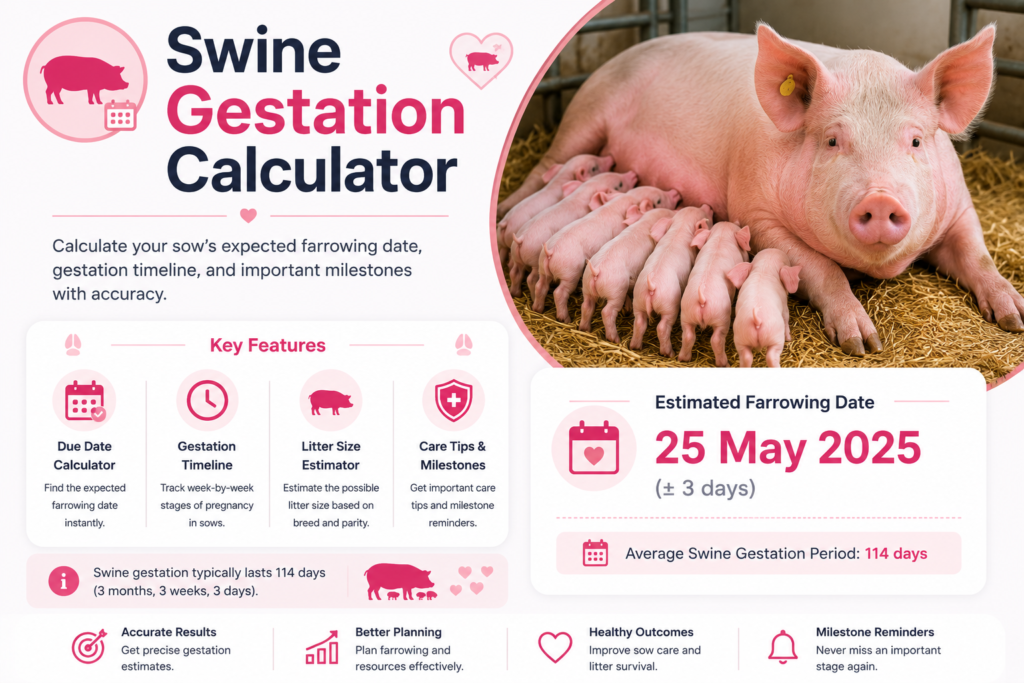
Swine Gestation Calculator: The Complete Guide to Pig Pregnancy and Farrowing
On a pig farm — whether a sprawling commercial operation or a small backyard setup — few things are more important than knowing exactly when a sow is due to farrow. Miss the window and a sow may deliver unattended, putting a valuable litter at unnecessary risk. Get ahead of it with the right tools, and farrowing becomes one of the most manageable and rewarding parts of pig production. A swine gestation calculator is exactly that tool — turning a breeding date into a reliable farrowing schedule, a week-by-week care plan, and a clear preparation timeline, all at once.
This guide covers everything pig producers and smallholders need to know about using a pig gestation calculator, understanding the swine gestation period, recognizing signs of pregnancy, managing a pregnant sow, and preparing for a smooth, successful farrowing.
What Is a Swine Gestation Calculator?
A swine gestation calculator is a digital planning tool that estimates a sow’s farrowing date based on her breeding or service date. By entering the date the sow was mated — whether by natural service with a boar or through artificial insemination — the calculator applies the average pig gestation period to generate a projected farrowing date along with a structured pregnancy timeline.
For commercial producers managing large sow herds, a pig farrowing calculator is an indispensable scheduling tool. It allows farrowing rooms to be allocated in advance, staff rosters to be organized around predicted farrowing dates, and feed and medication protocols to be timed accurately across multiple animals with different service dates.
For smallholders with just one or two sows, the same tool provides a clear window of when to expect piglets and when to begin specific preparations — making the lead-up to farrowing far less stressful and much better organized.
These tools are part of the broader collection of Animal Pregnancy Calculators on the biology hub — a centralized platform covering gestation tracking across livestock, companion animals, and small pets in a single, easy-to-use location.
What Is the Swine Gestation Period?
The swine gestation period is famously remembered through one of agriculture’s most practical mnemonics:
3 months, 3 weeks, and 3 days
That adds up to exactly 114 days — or approximately 16 weeks — from the date of successful mating to farrowing. The normal range spans from approximately 111 to 120 days, with most sows delivering between 113 and 115 days after breeding.
Here’s a quick reference overview:
| Parameter | Details |
|---|---|
| Average swine gestation period | 114 days |
| Normal range | 111–120 days |
| Gestation period in months | 3 months, 3 weeks, 3 days |
| Gestation period in weeks | Approximately 16 weeks |
| Average litter size | 8–14 piglets |
| Age at sexual maturity (gilts) | 5–7 months |
| Recommended first breeding age | 7–8 months |
| Weaning-to-service interval | 4–7 days |
Understanding how long pigs are pregnant is foundational to any farrowing management plan. Because the pig gestation length is consistent and reliable across most breeds, a pig due date calculator based on the service date produces estimates that are accurate enough to build a complete farrowing schedule around.
Different pig breeds show minimal variation in swine gestation length, making the 114-day average applicable across the majority of domestic breeds — from Large White and Landrace to Duroc, Hampshire, and heritage breeds. Gilt (first-parity) pregnancies tend to run very close to the 114-day average, as do multiparous sows in good body condition.
How to Use a Pig Gestation Calculator
Using a pig pregnancy calculator is one of the most straightforward applications in livestock management. Here’s how it typically works:
- Enter the service or breeding date — the date the sow was mated with the boar or inseminated via artificial insemination (AI).
- Generate the farrowing date estimate — the calculator adds 114 days to produce a projected farrowing window.
- Build the management timeline — use the output to schedule pre-farrowing nutrition changes, sow relocation to the farrowing house, vaccinations, and monitoring intensification.
Practical tips for getting the most from a swine gestation calculator:
- For sows that receive multiple AI doses or are naturally served over two consecutive days, use the date of first insemination for the most conservative estimate.
- Mark the projected farrowing date on the production calendar and count back 7 days to set a reminder for moving the sow to the farrowing crate or pen.
- Use the calculator output to batch farrowings across the herd, grouping sows with similar service dates for more efficient farrowing room management.
- Cross-reference the projected date with physical signs of approaching farrowing in the final week for the most accurate real-time monitoring.
For farms managing several species of livestock simultaneously, the Goat Gestation Calculator and Sheep Gestation Calculator operate on the same simple format — making cross-species pregnancy tracking seamless across one platform.
Signs and Symptoms of Pig Pregnancy
Confirming pregnancy early and monitoring its progress accurately helps producers adjust feeding, housing, and health management in a timely manner. Here are the most reliable pregnant sow symptoms and signs to watch for across the different stages:
Early Pregnancy Signs (Days 1–30)
- Failure to return to estrus — the most practical early indicator; a sow that was successfully mated should not show signs of heat (estrus) 18–24 days after service; return to estrus within this window suggests the mating was unsuccessful
- Behavioral change — some sows become quieter or slightly more withdrawn in early pregnancy
- No outward physical changes — the abdomen shows no visible change in the early weeks; weight gain is barely measurable at this stage
Mid-Pregnancy Signs (Days 31–85)
- Gradual abdominal enlargement — the sow’s belly begins to expand visibly from around day 35–40, becoming progressively more pronounced through mid-pregnancy
- Steady weight gain — a well-fed sow in good body condition should gain appropriately through mid-gestation without becoming over-conditioned
- Mammary gland development — the teats begin developing and elongating, particularly in gilts, from around mid-pregnancy
- Increased appetite and feed efficiency — energy and protein requirements rise as the piglets develop
Late Pregnancy Signs (Days 86–114)
- Significant udder development and engorgement — the mammary glands fill noticeably in the final 2–3 weeks and become increasingly firm as farrowing approaches
- Milk let-down — in the final 12–24 hours before farrowing, milk can often be expressed from the teats by gentle pressure; this is one of the most reliable pre-farrowing indicators
- Vulval swelling and relaxation — the vulva swells and the surrounding pelvic musculature relaxes as farrowing approaches
- Restlessness and nesting behavior — sows become increasingly restless in the hours before farrowing, rooting at bedding and attempting to build a nest
- Flank movement and visible piglet activity — piglet movements may be visible as rippling movements across the sow’s flanks in the final days
- Drop in body temperature — core temperature may decrease slightly in the 12–24 hours before farrowing
Pregnancy Confirmation Methods
For more reliable early confirmation, particularly on high-performing commercial farms:
- Ultrasound scanning — the most reliable method; a Doppler or real-time ultrasound can confirm pregnancy from as early as day 25–30 and is widely used in commercial production
- Return-to-estrus checking — simple, low-cost, and effective as a first-pass confirmation method
- Blood or urine estrone sulfate testing — can confirm pregnancy from around day 25–30 with high accuracy
- Visual observation and abdominal palpation — useful from mid-pregnancy onward but not reliable in early stages
Swine Pregnancy Stages: Week by Week
The pig pregnancy week by week breakdown helps producers align management inputs — nutrition, health, housing, and monitoring — with what’s happening developmentally inside the sow at each phase:
Weeks 1–2 (Days 1–14): Fertilization and Early Embryo Development
Fertilization occurs within hours of mating. The fertilized embryos travel to the uterus and space themselves out along both uterine horns for implantation. This early spacing is critical — embryos that cluster too close together during implantation are at risk of early embryonic mortality.
Management priorities during this window include minimizing stress, maintaining consistent feeding routines, and avoiding abrupt changes to the sow’s social environment. Heat stress during the implantation window significantly increases early embryo loss — a particularly important consideration in hot climates or summer production systems.
Weeks 3–4 (Days 15–28): Implantation and Embryonic Development
The embryos implant in the uterine wall and begin developing basic organ systems. Organ formation — including the heart, central nervous system, and major organ primordia — occurs during this phase. Nutritional quality matters more than quantity at this stage; avoid overfeeding, which increases early embryo loss risk.
The sow should be checked for return to estrus around day 18–21 as the primary early pregnancy confirmation step.
Weeks 5–8 (Days 29–56): Fetal Development and Skeletal Formation
The embryos transition into recognizable fetal piglets during weeks 5–8. Skeletal structures begin calcifying, limbs develop, and individual piglet features emerge. Litter size is essentially set by the end of this period — no new embryos are added after implantation, and any early embryo losses have already occurred.
The sow’s abdomen begins showing visible expansion from around week 5–6. Feeding during gestation should follow a controlled intake program — overfeeding during mid-gestation leads to excessive body condition that increases farrowing difficulty and reduces lactation performance.
Weeks 9–12 (Days 57–84): Rapid Fetal Growth
Fetal piglets grow rapidly during this phase, developing muscle mass, organ complexity, and immune tissue. The sow’s nutritional requirements increase steadily. Mammary gland tissue begins developing visibly. Body condition scoring should be conducted regularly during this window to ensure the sow is on track for an optimal body condition score (BCS) of 3.0–3.5 at farrowing.
Weeks 13–16 (Days 85–114): Pre-Farrowing Phase — The Critical Final Window
Approximately two-thirds of total piglet birth weight is gained during the final four weeks of gestation — making this the most nutritionally critical phase of the entire swine gestation period. Energy and protein intake must be adequate to support rapid fetal growth without over-conditioning the sow.
Farrowing preparation begins in earnest during this phase. The sow should be moved to the farrowing house approximately 5–7 days before her projected farrowing date to allow her to adjust to the new environment before labor begins. Hygiene, colostrum availability, and climate control in the farrowing house become top priorities as the due date approaches.
Farms managing multiple sows across different production stages may find the Feed Conversion Ratio Calculator a useful tool for evaluating feeding efficiency during gestation and lactation — helping producers optimize feed programs without over- or underfeeding.
Sow Pregnancy Care Tips
Sound management throughout the pig pregnancy timeline directly determines farrowing outcomes, piglet survival rates, and the sow’s long-term productive life. Here are the most important care practices to follow across the gestation period:
Nutrition Management
- Follow a controlled gestation feeding program — most commercial sow feeding programs provide 1.8–2.5 kg/day of a balanced gestation diet for sows in good body condition; adjust upward for thin sows, downward for over-conditioned animals
- Increase feed in the final 2–3 weeks — transition to a higher-energy lactation diet or increase gestation feed allowance from approximately day 90–100 to support rapid fetal growth without causing constipation
- Prevent constipation pre-farrowing — constipation around farrowing increases the risk of stillbirths and post-farrowing complications; bran or fiber additions and adequate water intake help prevent this
- Fresh water at all times — water requirements increase significantly in late gestation; ensure water flow rates are adequate, particularly in hot conditions
- Vitamin and mineral supplementation — iron, selenium, vitamin E, and B vitamins are particularly important for reproductive performance and piglet vitality; follow a veterinary-guided supplementation program specific to the farm’s production system
Housing and Environment
- Maintain appropriate housing temperature — sows in gestation are most comfortable between 16–20°C (61–68°F); heat stress above 25–27°C during gestation reduces conception rates, increases early embryo mortality, and reduces litter size
- Provide adequate space — whether in group housing or individual stalls, space allocation directly affects sow welfare and reproductive performance
- Minimize social stress in group housing — mixing unfamiliar sows during early pregnancy dramatically increases the risk of embryo loss; avoid regrouping sows in the first 28 days post-service
- Move sow to farrowing house at day 107–109 — early enough for the sow to settle but not so early that unnecessary time in the farrowing crate increases welfare concerns
Health Management
- Pre-farrowing vaccination — vaccines against Escherichia coli, Clostridium, parvovirus, and other pathogens relevant to the farm’s disease profile are typically administered 4–6 weeks before the projected farrowing date; the timing ensures adequate maternal antibody transfer to piglets via colostrum
- Parasite control — treat sows for internal and external parasites before entering the farrowing house; mange and worm burdens both negatively affect reproductive performance and piglet health
- Hoof care — lame sows eat less, move less, and are at greater risk of reproductive complications; feet should be checked and treated before late gestation
- Record keeping — accurate service date records are the foundation of any reliable pig farrowing date calculator output; poor record-keeping leads to missed farrowing dates and unattended deliveries
Preparing the Farrowing Area
A well-prepared farrowing environment is one of the most significant investments a pig producer can make in piglet survival. The farrowing house should be fully cleaned, disinfected, dried, and warmed before the sow arrives.
Farrowing area checklist:
- Thorough cleaning and disinfection of farrowing crates or pens between batches — allow at least 7 days for drying and warming before the next sow enters
- Optimal farrowing room temperature of 18–20°C for the sow, with a piglet creep area maintained at 30–32°C using a heat lamp or under-floor heating
- Clean, dry bedding where applicable — straw in loose-housed systems; clean bare floors in crated systems
- Functioning water supply with adequate flow rate
- Pre-farrowing stockpile of essential farrowing supplies:
- Clean towels for drying piglets
- Iodine for navel treatment
- Ear notching or tagging equipment for litter identification
- Lubricant and gloves for manual assistance if needed
- Oxytocin for veterinary-directed use in cases of uterine inertia
- Colostrum supplement or donor colostrum in case of sow colostrum insufficiency
- Piglet resuscitation equipment
- Digital scale for recording individual piglet birth weights
- Farrowing records sheet for logging birth times, weights, and stillbirths
- Emergency veterinary contact details posted prominently
What to Expect During Farrowing
Farrowing typically unfolds in three distinct stages:
Stage 1: Pre-Labor and Cervical Dilation
The sow becomes increasingly restless — rising, lying down, rooting at bedding, and showing nesting behavior. Milk can usually be expressed from the teats. This stage can last from 2 to 12 hours, during which the cervix dilates and the piglets move into position in the birth canal. The sow should not be disturbed unnecessarily but should be monitored closely.
Stage 2: Active Delivery of Piglets
Piglets are delivered alternately from both uterine horns, typically in intervals of 10–20 minutes between each birth. Intervals of up to 30–45 minutes between piglets are within the normal range early in the litter, but longer intervals in the middle or toward the end of farrowing can indicate uterine fatigue or obstruction.
Most sows farrow their entire litter within 2–6 hours, though litters of 14 or more piglets may take longer. Normal presentation is either head-first or rear-feet-first — both are acceptable in pigs.
If a sow has been straining actively for more than 30–45 minutes without delivering a piglet, or if birth intervals exceed 45–60 minutes with visible signs of straining, veterinary or experienced producer assistance is needed.
Stage 3: Placenta Expulsion
The placenta (afterbirth) is typically expelled in sections throughout the farrowing process and as a final mass within 1–4 hours of the last piglet being born. Remove placentas from the pen promptly — sows that consume them may develop digestive issues. Retained placenta beyond 12 hours warrants veterinary attention.
Immediate Post-Farrowing Priorities
The first few hours after farrowing are critical for piglet survival:
- Ensure every piglet receives colostrum within the first 6 hours — colostrum is the single most important determinant of neonatal piglet survival and long-term health; piglets that fail to receive adequate colostrum have dramatically lower survival rates
- Dry and warm piglets immediately — use clean towels to dry each piglet and place them under the heat lamp promptly; chilled piglets cannot suckle effectively and are at high risk of crushing by the sow
- Treat navels with iodine — navel dipping within the first hour dramatically reduces the risk of joint ill and septicemia in newborn piglets
- Record birth weights — individual birth weights are a powerful early predictor of piglet survival; piglets under 1 kg at birth have significantly higher pre-weaning mortality rates
- Perform litter equalization if needed — redistributing piglets across sows with similar litter sizes improves the survival rate of smaller or weaker piglets in large litters
- Monitor the sow for post-farrowing fever — a temperature above 39.5°C (103°F) 12–24 hours post-farrowing may indicate mastitis, metritis, or agalactia (MMA syndrome)
Common Swine Pregnancy and Farrowing Complications
Even on well-managed farms, complications arise. Recognizing them quickly makes a meaningful difference in outcomes:
- Mastitis-Metritis-Agalactia (MMA) Syndrome — one of the most common post-farrowing conditions in sows; characterized by reduced or absent milk production, uterine infection, and udder inflammation; requires prompt veterinary treatment with antibiotics and anti-inflammatories
- Uterine inertia — the uterus fails to contract effectively during farrowing, leading to prolonged delivery intervals and increased stillbirth risk; treated with veterinary-directed oxytocin administration
- Dystocia (difficult birth) — a piglet lodged in the birth canal requires manual assistance; common in large single piglets or in gilts with narrow pelvic canals
- Stillbirths — a normal rate of 5–8% stillbirths per litter is typical in commercial production; rates above this level warrant a review of farrowing management, nutrition, and disease status
- Savaging — some gilts, particularly first-parity animals, may attack their piglets immediately after farrowing; requires immediate separation and close monitoring
- Hypoglycemia in piglets — newborn piglets have minimal body fat reserves and can become hypoglycemic within hours if colostrum intake is inadequate; treatment involves oral glucose supplementation
- Neonatal diarrhea — E. coli scours in piglets 1–3 days of age; prevention via pre-farrowing vaccination of the sow and hygiene management in the farrowing house
When to Call a Veterinarian
Prompt veterinary support can prevent individual complications from becoming herd-level problems. Contact a veterinarian immediately if:
- The sow has been in active straining labor for more than 30–45 minutes without delivering a piglet
- More than 45–60 minutes passes between piglets with visible signs of straining
- Manual examination reveals an obstructing piglet that cannot be easily repositioned
- The sow develops a fever above 39.5°C (103°F) in the 24 hours after farrowing
- Milk production fails to establish within 12–24 hours of farrowing
- The sow shows signs of uterine infection — foul-smelling discharge, lethargy, loss of appetite — post-farrowing
- Retained placenta is present beyond 12 hours
- Stillbirth rates are consistently above normal levels across multiple sows
- A sow collapses or becomes unresponsive at any stage of gestation or farrowing
Related Livestock Tools for Pig Producers
Managing sow pregnancies is one piece of a broader production management picture. The Livestock Calculators section on the biology hub offers a suite of practical tools for pig and livestock producers — including the Animal Mortality Rate Calculator, Feed Conversion Ratio Calculator, and Livestock Fence Cost Calculator — all designed to support efficient, data-driven farm management.
For farms diversifying into other livestock species, the Sheep Gestation Calculator provides the same reliable farrowing-date equivalent for ewes, applying a 147-day average gestation to generate lambing date estimates — complementing a swine operation’s seasonal breeding calendar.
Frequently Asked Questions About Swine Gestation
How accurate is a swine gestation calculator?
A pig gestation calculator is highly reliable for estimating farrowing dates because the swine gestation period is remarkably consistent across breeds. Most sows farrow within 1–3 days of the projected date, making the 114-day average a solid planning baseline. For maximum reliability, accurate service date records are essential.
Can a sow get pregnant immediately after weaning her litter?
Yes — most sows return to estrus within 4–7 days of weaning and can be successfully re-mated at that point. This short weaning-to-service interval is one of the key features of efficient commercial sow production, allowing multiple litters per year.
How many litters can a sow produce per year?
With a gestation period of 114 days and a lactation period of 21–28 days, a sow on a typical commercial production system can produce approximately 2.2–2.4 litters per year. Each litter averages 8–14 piglets depending on breed, parity, and management.
How many piglets does a sow typically have?
Average litter sizes range from 8–14 piglets born alive, depending on the sow’s breed, parity (number of previous litters), and nutritional status. Gilts (first-parity sows) typically produce smaller litters of 8–10 piglets, while experienced sows in peak production (parities 3–6) often reach 12–14 or more born alive.
What is the difference between a gilt and a sow?
A gilt is a female pig that has not yet had her first litter. Once she has farrowed her first litter, she is classified as a sow. Gilts are typically first mated at 7–8 months of age when they reach an appropriate weight (usually 130–140 kg) to ensure adequate pelvic development for safe farrowing.
What does the “3 months, 3 weeks, 3 days” rule mean?
This well-known farming mnemonic means that the swine gestation period is 3 months + 3 weeks + 3 days = 114 days. It’s a simple mental calculation farmers have used for generations to estimate farrowing dates without needing a calculator — though a digital pig gestation calculator makes the process even faster and more accurate when managing multiple sows.
How is the swine gestation period different from other livestock?
The pig gestation period of 114 days is shorter than the goat average of 150 days, the sheep average of 147 days, and significantly shorter than the cow’s average of 283 days. This shorter gestation combined with large litter sizes and a short weaning-to-service interval makes pigs among the most reproductively efficient of all farm livestock species.
Conclusion
A swine gestation calculator is one of the most practical and high-value tools available to pig producers of any scale. By converting a service date into a reliable farrowing schedule, it enables farms to plan farrowing house allocations, staff rosters, feeding program transitions, and health interventions with precision — rather than relying on rough estimates or memory.
The consistency of the pig gestation period — reliably clustering around the memorable 3-months-3-weeks-3-days mark of 114 days — means that a well-maintained service record and a reliable pig pregnancy calculator together provide everything needed to build a comprehensive, season-long farrowing calendar. Add attentive sow monitoring, proactive nutritional management in the critical final four weeks, a clean and well-prepared farrowing environment, and fast veterinary support when complications arise — and the foundations of a high-performing, productive sow herd are firmly in place.
Explore the complete suite of Animal Pregnancy Calculators and Livestock Farm Tools to keep every sow — and every other animal on the farm — tracked, supported, and ready for a productive season.