Guinea Pig Pregnancy Calculator

Ahmad zee
Table of Contents
Toggle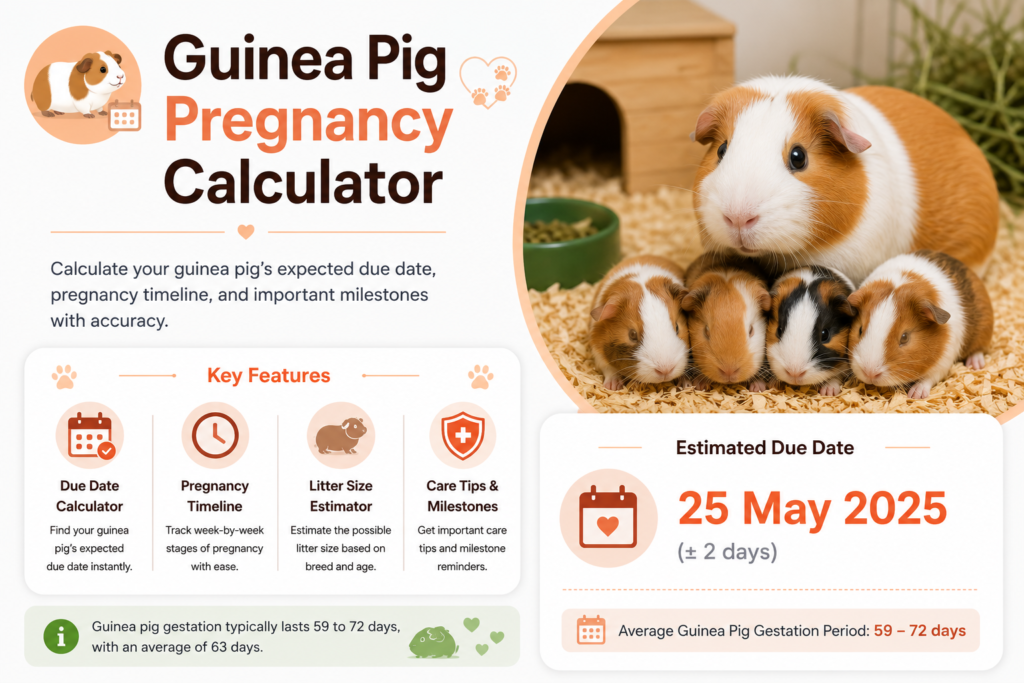
Guinea Pig Pregnancy Calculator: Your Complete Guide to Cavy Pregnancy
Guinea pigs are gentle, social, and surprisingly complex little animals — and when one of them is expecting, the experience can be both exciting and nerve-wracking for any owner. Unlike many small pets, guinea pig pregnancies carry unique risks that make tracking and preparation genuinely important rather than optional. A guinea pig pregnancy calculator gives owners the clearest possible picture of when to expect the litter, what’s happening inside the mother at each stage, and exactly when to start getting ready.
This comprehensive guide covers everything a cavy owner needs to know — from how a guinea pig gestation calculator works and what the cavy gestation period actually looks like, to signs of pregnancy, week-by-week development, and how to give both the mother and her pups the best possible start.
What Is a Guinea Pig Pregnancy Calculator?
A guinea pig pregnancy calculator is a digital tool that estimates a sow’s (female guinea pig’s) due date based on her breeding or mating date. By entering the date the guinea pig was mated, the calculator applies the average guinea pig gestation period to generate a projected birth date and a week-by-week pregnancy timeline.
Because guinea pig pregnancies are longer than most owners expect — and because they carry some of the highest complication rates among small pet rodents — having an accurate guinea pig due date calculator is more than just a convenience. It’s a practical planning tool that helps owners prepare the right environment, adjust nutritional support at the right time, and recognize warning signs before they become emergencies.
These tools are part of the wider family of Animal Pregnancy Calculators available on the biology hub — covering gestation tracking for a broad range of species, from rabbits and cats to livestock like goats and sheep, all in one accessible location.
What Is the Guinea Pig Gestation Period?
The guinea pig gestation period is one of the longest among small rodents — a fact that surprises many first-time cavy owners. On average, a guinea pig pregnancy lasts between 59 and 72 days, with most litters arriving around 63–68 days after mating.
Here’s a quick reference breakdown:
| Parameter | Details |
|---|---|
| Average guinea pig gestation period | 63–68 days |
| Normal range | 59–72 days |
| Gestation period in weeks | Approximately 9–10 weeks |
| Average litter size | 2–4 pups (range: 1–8) |
| Pup development at birth | Precocial — fully furred, eyes open, mobile |
| Sexual maturity (sow) | As early as 4–6 weeks of age |
| Recommended breeding age (sow) | 3–7 months |
Understanding how long guinea pigs are pregnant is especially important because the length of the pregnancy is directly tied to pup development. Unlike rabbits or mice, whose offspring are born helpless and hairless, guinea pig pups are precocial — born fully furred, with eyes open, and capable of walking within hours of birth. This remarkable developmental state is only possible because of the extended cavy gestation period that allows near-complete development inside the womb.
Guinea pig gestation length can vary slightly by litter size — larger litters sometimes arrive a few days earlier, while sows carrying single pups may carry slightly longer. A cavy pregnancy calculator that acknowledges this range gives a more realistic planning window than one presenting a single fixed date.
How to Use a Guinea Pig Pregnancy Calculator
Using a guinea pig gestation calculator is quick and requires minimal input. Here’s how the process typically works:
- Enter the mating date — the date the sow was housed with the boar (male guinea pig) or the confirmed date of mating.
- Generate the due date estimate — the calculator adds the average guinea pig gestation period to produce a projected birth window.
- Review the pregnancy timeline — more detailed tools map out developmental milestones week by week, flagging when to make nutritional adjustments, separate the boar, and set up the birthing space.
Practical tips for using a guinea pig pregnancy calculator effectively:
- If the sow was housed with a boar over multiple days and the exact mating date is unclear, use the first day of cohabitation as the start date for the most conservative estimate.
- Because the normal range is 59–72 days, owners should begin close monitoring from day 55 onward rather than waiting for the projected date.
- Use the due date to work backwards and set reminders — for example, separating the boar by week 6, increasing vitamin C supplementation in the final weeks, and setting up the birthing area by week 8.
For owners caring for multiple small animal species at once, the Rabbit Gestation Calculator follows the same simple format for tracking rabbit pregnancies, and the full suite of small animal gestation tools is accessible in one place on the biology hub.
Signs and Symptoms of Guinea Pig Pregnancy
Recognizing a pregnant guinea pig early is important — especially because guinea pigs can become pregnant again almost immediately after giving birth, and because late-pregnancy complications require prompt action. Here are the most common pregnant guinea pig signs to watch for across the different stages:
Early Signs (Weeks 1–4)
- No visible physical changes — the early weeks of a guinea pig pregnancy show very little outward change; the sow’s abdomen remains relatively normal
- Mild appetite increase — food intake may begin rising subtly from around week 3 onward
- Behavioral changes — some sows become slightly more territorial or less tolerant of cage companions in early pregnancy
- Weight gain begins — gradual weight increase is often the first measurable sign; weekly weigh-ins on a digital kitchen scale can help detect this early
Mid-Pregnancy Signs (Weeks 5–7)
- Visible abdominal enlargement — the sow’s sides begin to visibly widen, particularly in the lower half of the abdomen
- Significant weight gain — the sow may gain 50–100% of her pre-pregnancy body weight by the end of a full-term guinea pig pregnancy, especially when carrying a larger litter
- Palpable fetal movement — from around week 6 onward, gentle observation of the sow’s abdomen may reveal visible or palpable movement from the pups
- Increased thirst and water consumption — fluid intake rises noticeably as the pups grow
- Widening of the pelvis — the pelvic bones (pubic symphysis) begin separating in preparation for birth; in late pregnancy, this gap can be felt as a separation of around 2–3 finger widths
Late Pregnancy Signs (Weeks 8–10)
- Pronounced barrel-shaped abdomen — the sow looks strikingly round and heavy in the final weeks; a litter of 3–4 large pups creates a visibly dramatic silhouette
- Reduced mobility — the sow moves more slowly and carefully, and may spend more time resting
- Nipple enlargement and milk development — the mammary glands become more prominent and begin producing colostrum as the birth date approaches
- Restlessness and nesting behavior — some sows display increased restlessness or seek out corners of the enclosure in the hours before giving birth
- Loss of appetite in the final 24–48 hours — many sows go off food in the immediate pre-birth window
Pregnancy Confirmation Methods
- Veterinary ultrasound — the most reliable method, typically effective from around day 21–28; also useful for detecting complications like dystocia risk in large-litter pregnancies
- Weekly weight monitoring — a consistent upward trend in body weight over several weeks is a strong non-invasive indicator
- Gentle abdominal palpation — from around week 5–6 onward, experienced handlers may feel individual pups; however, this requires a very gentle touch and is best left to a veterinarian
Guinea Pig Pregnancy Stages: Week by Week
The guinea pig pregnancy week by week timeline is both longer and more developmentally complete than most comparable small animals. Here’s what’s happening inside the sow at each stage:
Weeks 1–2: Fertilization and Implantation
Fertilization occurs rapidly after mating, and the embryos travel to the uterus for implantation within the first week. No physical signs are visible and the sow’s routine should remain unchanged. Avoid unnecessary stress, cage rearrangements, or introductions of new animals during this sensitive window.
Weeks 3–4: Early Organ Development
The embryos begin forming basic organ systems — the heart, nervous system, and limb buds are among the first structures to develop. The sow’s food intake begins to rise. This is the right time to confirm pregnancy through a veterinary visit and to begin increasing the nutritional quality — rather than just quantity — of her diet.
Weeks 5–6: Rapid Skeletal and Muscular Growth
Fetal skeletons calcify and muscle tissue develops rapidly. The sow’s abdomen begins expanding visibly from the sides. Weekly weigh-ins become increasingly useful for tracking progress. This is also the time to separate the boar permanently if he is housed with the sow — guinea pigs can mate again within hours of giving birth, and back-to-back pregnancies are extremely dangerous for the sow’s health.
Weeks 7–8: Fetal Fur and Feature Development
The pups develop their characteristic fur coats and individual coloration patterns during weeks 7 and 8. Eyes, ears, and digits are fully formed. The sow’s weight may have increased dramatically at this point. Vitamin C supplementation becomes increasingly important — guinea pigs cannot synthesize vitamin C independently, and deficiency during late pregnancy can affect both the sow and the developing pups.
Weeks 9–10: Final Growth and Pre-Birth Preparation
The pups reach near-full birth size and are fully precocial by this stage — they are essentially miniature versions of adult guinea pigs waiting to emerge. The sow’s pelvic symphysis widens noticeably. The birthing area should be fully prepared, and the sow should be monitored closely from day 55 onward for signs of impending labor.
Guinea Pig Pregnancy Care Tips
Appropriate care throughout the guinea pig pregnancy timeline is essential — both for the sow’s survival and for pup health outcomes. Guinea pig pregnancy is genuinely higher-risk than pregnancy in many other small pets, making attentive management a priority rather than an afterthought:
Nutrition
- Increase quality, not just quantity — offer unlimited high-quality grass hay (timothy hay is ideal), fresh leafy greens, and a small amount of fortified pellets throughout the pregnancy
- Vitamin C is non-negotiable — guinea pigs cannot produce their own vitamin C; offer fresh bell peppers, leafy greens, and consider a veterinary-approved vitamin C supplement throughout pregnancy and nursing; deficiency causes scurvy, which is particularly dangerous during pregnancy
- Calcium-rich foods in late pregnancy — small amounts of kale, spinach, or other calcium-rich vegetables support skeletal development of the pups; avoid overdoing it, as excess calcium causes other issues
- Fresh water at all times — hydration needs increase significantly as the pregnancy progresses, especially in the final weeks
Housing and Environment
- Separate the boar by week 6 — this is one of the most critical management steps; a boar housed with a sow risks immediately impregnating her post-partum, which is life-threatening
- Remove cage levels and ramps — heavily pregnant sows should not climb ramps or navigate multi-level enclosures; a single-level, spacious, well-bedded enclosure is safest
- Provide soft, deep bedding — paper-based or fleece bedding supports comfort and provides material for the sow to nest in before birth
- Minimize handling — especially in the final 2–3 weeks; gentle observation is preferable to frequent picking up
- Maintain stable temperature — guinea pigs are sensitive to temperature extremes; the enclosure should remain between 65–75°F (18–24°C)
Monitoring
- Weigh the sow weekly throughout pregnancy on a digital kitchen scale; record the weights to track progress and detect any plateau or decline
- Check pelvic gap daily from day 55 — a gap of 2–3 finger widths (approximately 2–3cm) suggests birth is imminent within 24–48 hours
- Watch for early warning signs of pregnancy toxemia — lethargy, muscle weakness, loss of appetite, and labored breathing in the final weeks are red flags requiring immediate veterinary attention
Understanding Guinea Pig Pregnancy Toxemia
Pregnancy toxemia — also called pregnancy ketosis — is one of the most serious risks associated with guinea pig pregnancy and deserves specific attention. It occurs most commonly in the final 2–3 weeks of gestation, typically in obese sows, those carrying large litters, or those experiencing nutritional stress.
Risk factors include:
- Obesity prior to or during pregnancy
- Sudden changes in diet or feeding routine
- Stress from handling, cage changes, or environmental disruption
- Inadequate caloric intake in late gestation
- First-time pregnancies (primiparous sows)
- Large litter sizes
Warning signs:
- Sudden loss of appetite or complete food refusal
- Lethargy or muscle weakness
- Labored or rapid breathing
- Muscle tremors
- Loss of balance or coordination
- Collapse
Pregnancy toxemia in guinea pigs can progress from early symptoms to a life-threatening crisis within 24–48 hours. Any sow displaying these symptoms in late pregnancy should be seen by a veterinarian immediately — this is a genuine emergency, not a “wait and see” situation.
Preparing for Birth
The birth area should be fully prepared by week 8 of the pregnancy, giving the sow time to settle into the space before labor begins.
Birth preparation checklist:
- Clean, single-level enclosure with soft, deep paper or fleece bedding
- Remove any cage accessories or structures the sow could injure herself on
- Fresh water positioned at ground level — a sow in late pregnancy may struggle to reach elevated water bottles
- Unlimited hay available at all times
- A warm, quiet, low-traffic location away from other animals and household noise
- Digital thermometer to monitor ambient temperature
- Clean, soft cloths for drying pups if needed
- A digital kitchen scale for weighing pups at birth
- Vitamin C solution on hand
- Emergency veterinary contact information posted visibly
Unlike some animals, guinea pigs generally do not require nesting materials to be provided — the sow will use existing bedding as she sees fit. The priority is cleanliness, warmth, and minimal disturbance.
What to Expect During Guinea Pig Birth
Guinea pig birth is typically fast — most litters are delivered within 30 minutes, though this can extend to 2–3 hours for larger litters. The process generally unfolds as follows:
Pre-labor signs (hours before birth):
- The sow becomes restless and may circle repeatedly
- Appetite drops significantly
- The pelvic gap is at maximum width
- The sow may vocalize softly
During birth:
- Each pup is born encased in a thin amniotic sac, which the sow opens and consumes immediately (a normal and important behavior)
- The sow licks each pup vigorously to stimulate circulation and breathing
- Pups are typically delivered every 3–7 minutes, though intervals up to 30 minutes between pups can be normal
- Each pup is followed by its placenta, which the sow also consumes
What owners should do during birth:
The sow should be left completely undisturbed unless a genuine emergency arises. Watching from a quiet distance is fine, but intervening unnecessarily causes stress that can disrupt the birth process. If a sow has been in active labor for more than 20–30 minutes without delivering a pup, or if she appears in extreme distress, veterinary assistance is needed immediately.
Caring for Newborn Guinea Pig Pups
One of the most remarkable things about guinea pig births is how developed the pups are at arrival. Within minutes of being born, pups are typically alert and mobile. Within a few hours, most begin nibbling on hay and solid food alongside nursing from their mother.
Newborn pup care essentials:
- Leave pups with the sow — she will nurse them and keep them warm; do not separate them unless absolutely necessary
- Colostrum is critical — pups should nurse from the sow within the first few hours to receive immune-protective colostrum; if a pup fails to nurse, veterinary guidance on supplemental feeding is needed
- Weigh pups daily for the first week to confirm steady weight gain; healthy pups should begin gaining weight within 24 hours
- Remove the boar — if not already done (and it absolutely should have been by week 6), the boar must be separated immediately after birth to prevent the sow from being re-mated
- Begin solid food introduction — pups can begin eating hay, leafy greens, and pellets within their first 24 hours; ensure food is accessible at ground level
- Supplement vitamin C for pups — from week 1, pups benefit from vitamin C-rich foods to support healthy development
Pups are typically weaned by 3–4 weeks of age, at which point males and females should be separated to prevent unintended breeding — female pups can reach sexual maturity as early as 4–6 weeks old.
Common Guinea Pig Pregnancy Complications
Beyond pregnancy toxemia, a number of other complications can arise during a guinea pig pregnancy:
- Dystocia (difficult birth) — the most common serious complication; risk is highest when a sow over 7 months of age is bred for the first time, as the pelvic symphysis may not separate adequately; can require emergency veterinary intervention including cesarean section
- Stillbirth — not uncommon, particularly in large litters or when pups are very large; one or more stillborn pups in an otherwise healthy litter is not unusual
- Mastitis — udder infection post-birth; signs include hard, hot, swollen mammary glands and reluctance to nurse
- Post-partum hemorrhage — heavy bleeding after birth requires immediate veterinary attention
- Pup rejection — occasional in first-time mothers; affected pups require supplemental feeding and warmth
When to See a Veterinarian
A pre-pregnancy veterinary check-up is strongly recommended for any sow planned for breeding. During pregnancy and birth, seek veterinary care immediately if:
- The sow shows signs of pregnancy toxemia in late gestation
- Active labor has lasted more than 20–30 minutes without delivering a pup
- More than 30 minutes pass between pups with visible signs of straining
- The sow collapses or becomes unresponsive
- Heavy or persistent bleeding occurs at any stage
- A pup appears limp, cold, or unable to move after birth
- The sow refuses food for more than 12–24 hours in late pregnancy
Related Small Animal Tools
For owners of multiple small pets, the Animal Pregnancy Calculators section on the biology hub makes tracking gestation timelines across different species straightforward and organized. The Rabbit Gestation Calculator is particularly useful for households that keep both rabbits and guinea pigs — the two species have similar gestation lengths but distinct pregnancy care requirements.
For owners interested in understanding their guinea pig’s age in human terms, the Guinea Pig Years to Human Years Calculator offers a fun and informative way to contextualize a cavy’s life stage — a helpful tool when assessing whether a sow is at an appropriate age and health stage for breeding.
Frequently Asked Questions About Guinea Pig Gestation
How accurate is a guinea pig pregnancy calculator?
A guinea pig gestation calculator provides a reliable estimated birth window based on the mating date and average cavy gestation period. Because the normal range spans 59–72 days, owners should begin active monitoring from day 55 onward rather than waiting for a single projected date.
Can guinea pigs get pregnant while nursing?
Yes — a sow can be re-mated within hours of giving birth during a fertile window known as the post-partum estrus. Back-to-back pregnancies are extremely dangerous and can be fatal. Separating the boar before birth is essential.
How many pups do guinea pigs typically have?
Most litters contain 2–4 pups, though litters of 1–8 are all within the normal range. Larger litters tend to contain smaller individual pups, while smaller litters produce larger, heavier pups.
Is it safe to breed a guinea pig for the first time after 7 months of age?
It is generally considered risky. If a sow has not been bred before approximately 6–7 months of age, the pelvic symphysis may have permanently fused, making natural birth dangerous or impossible. Most veterinarians recommend first breeding between 3–5 months of age if breeding is intended.
How long do guinea pig pups stay with their mother?
Pups are typically weaned by 3–4 weeks of age. However, they should remain with the sow until weaning is complete. After weaning, males and females must be separated immediately to prevent early and dangerous pregnancy in young females.
What’s the difference between a guinea pig gestation period and a rabbit gestation period?
The Rabbit Gestation Calculator works with an average gestation of 28–35 days — considerably shorter than the guinea pig’s 59–72 day average. However, rabbit kittens are born helpless and hairless, while guinea pig pups are born fully developed — a direct result of the longer gestation.
Conclusion
A guinea pig pregnancy calculator is one of the most practical tools a cavy owner can use when managing a pregnant sow. By translating a mating date into a clear due-date window and a week-by-week care timeline, it gives owners the structure they need to prepare the right environment, deliver the right nutritional support at the right time, and recognize complications before they become crises.
Guinea pig pregnancy is uniquely demanding compared to many other small pets — the combination of a long gestation period, high complication risk, and the critical early breeding age window makes preparation and monitoring genuinely important. With the right tools, knowledge, and veterinary support in place, owners can give their sow and her pups the healthiest and safest start possible.
Explore the full suite of Animal Pregnancy Calculators and Biology Tools to keep every pregnancy — across every species — tracked, supported, and on schedule.