Cow Gestation Calculator

Ahmad zee
Table of Contents
Toggle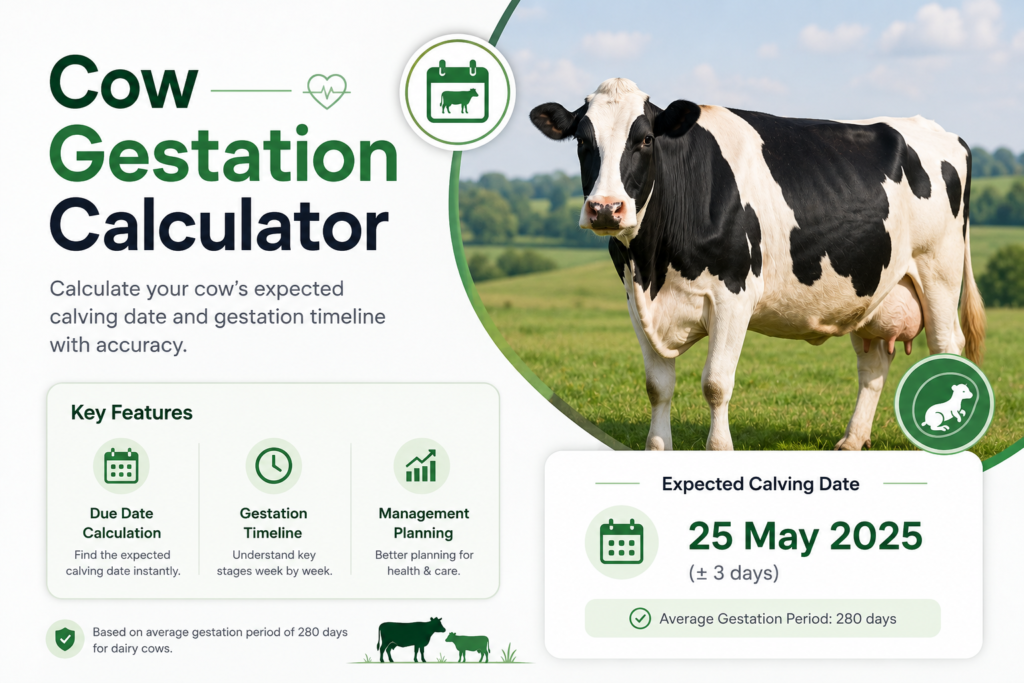
Cow Gestation Calculator: The Complete Guide to Cattle Pregnancy Management
Introduction to Cow Gestation
Managing cattle reproduction is one of the most important responsibilities a livestock farmer or rancher takes on. Whether running a small family farm or a large commercial beef or dairy operation, knowing exactly where each cow stands in her pregnancy timeline makes a significant difference in animal welfare, farm planning, and profitability. A cow gestation calculator simplifies this process dramatically, giving cattle producers a reliable, easy-to-use tool for predicting calving dates and managing the entire bovine pregnancy from breeding through birth.
A cow gestation calculator works by taking the breeding or insemination date as its starting point and calculating the expected calving date based on the standard bovine gestation period. The result is a clear, actionable timeline that helps farmers prepare nutritional programs, schedule veterinary visits, arrange calving facilities, and plan labor needs well in advance.
This complete guide explores everything cattle producers, veterinary students, and livestock enthusiasts need to know about cow gestation, how a cow gestation calculator works, and how to use that knowledge to raise healthier calves and build more productive herds.
Understanding Bovine Gestation: The Basics
Before exploring how a cow gestation calculator functions, building a solid foundation in bovine reproductive biology helps producers use the tool with greater confidence and interpret its results more accurately.
How Long Is a Cow’s Gestation Period?
The average bovine gestation period lasts approximately 283 days, which translates to roughly nine months and ten days. However, the normal range spans from about 279 to 287 days, and gestation lengths outside this range — while less common — still occur in healthy cattle. A cow gestation calculator uses the 283-day average as its primary reference point while accounting for the natural variation present in real cattle populations.
Several factors influence exactly how long an individual cow carries her calf, including:
- Breed: Different cattle breeds have characteristic gestation lengths that vary somewhat from the overall average
- Sex of the calf: Bull calves (males) tend to be carried slightly longer than heifer calves (females)
- Number of calves: Twin pregnancies are often carried for slightly shorter periods than single pregnancies
- Dam’s age and parity: First-calf heifers sometimes have slightly shorter gestation periods than mature cows
- Nutritional status: Severe nutritional deficiencies can affect gestation length in some cases
Breed-Specific Gestation Differences
One of the most significant sources of gestation variation across cattle is breed. Dairy breeds and beef breeds differ noticeably in their average gestation lengths, and this has practical implications for how a cow gestation calculator should be applied.
Dairy Breeds Holstein cows, the most common dairy breed worldwide, average approximately 279 to 280 days of gestation — noticeably shorter than the overall cattle average. Jersey cows average around 278 days, while Brown Swiss cows carry calves slightly longer at around 290 days.
Beef Breeds Angus cattle average approximately 281 days of gestation. Hereford cows average around 285 days. Simmental cattle tend toward longer gestations, averaging approximately 289 days. Charolais cows fall near 289 days as well. Brahman and Bos indicus breeds average among the longest gestation periods, often reaching 292 days or more.
When using a cow gestation calculator, selecting the correct breed or entering a breed-specific gestation length rather than relying on the generic average produces more accurate calving date predictions.
How a Cow Gestation Calculator Works
A cow gestation calculator transforms the breeding date into a predicted calving date through a straightforward calculation process. Understanding the mechanics behind the tool helps users apply it correctly and trust its output.
Required Input Information
Most cow gestation calculators require just one essential piece of information: the breeding date. This date refers to the day natural service or artificial insemination (AI) occurred. When conception is confirmed but the breeding date is uncertain, the estimated date of conception — as determined by rectal palpation or ultrasound examination — can substitute effectively.
Some more sophisticated cow gestation calculators also accept:
- Breed selection: Allows the calculator to apply a breed-specific gestation length rather than the generic average
- Conception method: Natural service vs. artificial insemination (though this typically doesn’t affect gestation length)
- Single vs. twin pregnancy: When twin pregnancy is confirmed, some calculators adjust the predicted calving window accordingly
What the Calculator Produces
Once the breeding date is entered, a cow gestation calculator generates:
- Expected calving date: The primary output, calculated by adding the standard gestation period to the breeding date
- Calving window: A range of dates reflecting natural gestation variation, typically spanning approximately one week on either side of the central estimate
- Gestation milestones: Key dates in the pregnancy timeline when specific management actions become important
- Days remaining: A countdown to the expected calving date, helpful for planning immediate next steps
Accuracy and Limitations
A cow gestation calculator provides highly useful estimates rather than guaranteed dates. The precision of the output depends entirely on the accuracy of the input date. When the exact breeding date is known — as is typical with artificial insemination programs where each cow’s breeding date is recorded precisely — the calculated calving date falls within a narrow, reliable window for most animals.
With natural service in group breeding situations, where a bull runs with a group of cows for an extended period, the exact conception date may be unknown. In these situations, pregnancy diagnosis with gestational age estimation by a veterinarian provides the most accurate basis for calving date prediction.
The Bovine Reproductive Cycle
Understanding the cow’s reproductive cycle gives producers the biological context needed to use a cow gestation calculator most effectively and to recognize signs of fertility and pregnancy at each stage.
The Estrous Cycle
Female cattle cycle through estrus (heat) approximately every 21 days, with a normal range of 18 to 24 days. The estrous cycle consists of several phases:
Proestrus lasts approximately three days as follicle development accelerates and estrogen levels begin rising. Behavioral changes are minimal during this phase.
Estrus — the period of sexual receptivity — lasts approximately 12 to 18 hours in most cattle. Standing heat, where the cow stands motionless when mounted by another animal, represents the hallmark behavioral sign of estrus and marks the optimal breeding window.
Metestrus follows estrus as the corpus luteum (CL) begins forming on the ovary. Ovulation typically occurs 10 to 12 hours after the end of standing estrus.
Diestrus represents the longest phase, lasting approximately 13 to 15 days as the corpus luteum grows and produces progesterone to maintain potential pregnancy. If pregnancy doesn’t occur, the corpus luteum regresses and the cycle begins again.
Detection of Estrus
Identifying cows in estrus — so they can be bred at the right time — represents one of the most important and challenging tasks in cattle reproductive management. Methods include:
- Visual observation: Watching for standing heat and associated behaviors such as chin-resting, mounting other cows, and restlessness
- Tail paint or chalk marks: Rubbed off when cows are mounted by pen mates, providing visual evidence of mounting activity
- Electronic activity monitors: Accelerometers and pedometers that detect the increase in activity and mounting events associated with estrus
- Progesterone testing: Blood or milk progesterone levels drop sharply at the onset of estrus
- Ovulation synchronization protocols: Hormonal treatments that synchronize estrus across groups of cows, allowing timed artificial insemination without individual estrus detection
Fertilization and Early Pregnancy
Following successful breeding, fertilization occurs in the oviduct within hours of ovulation. The fertilized embryo travels to the uterus over approximately four days, developing through early cell division stages during transit. Embryo implantation — attachment to the uterine wall — occurs around day 19 to 20 of pregnancy in cattle, somewhat later than in many other domestic species.
The period from fertilization through approximately day 45 represents the embryonic period, during which all major organ systems develop. This period carries the highest risk of early embryonic loss, with 20 to 40 percent of fertilized embryos typically lost before day 60 in commercial cattle populations.
Pregnancy Diagnosis in Cattle
Confirming pregnancy and accurately staging gestational age provides the foundation for precise cow gestation calculator use. Several methods are available, each with distinct advantages depending on the stage of pregnancy and available resources.
Rectal Palpation
Rectal palpation — direct examination of the reproductive tract through the rectal wall — has served as the traditional cattle pregnancy diagnosis method for decades. An experienced practitioner can detect pregnancy reliably from approximately 35 days of gestation onward by feeling characteristic changes in the uterus, cervix, and ovaries through the rectal wall.
Rectal palpation also allows experienced practitioners to estimate gestational age based on uterine size, position, and the palpable characteristics of the developing fetus and fetal membranes. This gestational age estimate, combined with a cow gestation calculator, produces a predicted calving date even when the breeding date is unknown.
Transrectal Ultrasound
Transrectal ultrasound has become increasingly common in cattle reproductive management, offering several advantages over traditional rectal palpation. Ultrasound can detect pregnancy as early as 25 to 28 days of gestation — earlier than reliable palpation is possible. It also allows visualization of embryonic heartbeat, fetal viability, twin pregnancies, and fetal sex determination at appropriate gestational ages.
Fetal sex determination by ultrasound is possible between approximately 55 and 80 days of gestation when the genital tubercle — the structure that develops into either the penis or clitoris — can be visualized and distinguished in its characteristic position relative to the umbilical cord or tail. Knowing fetal sex well in advance of calving provides valuable information for herd management and calf marketing decisions.
Blood and Milk Pregnancy Tests
Commercial pregnancy tests based on detecting pregnancy-associated glycoproteins (PAGs) in blood or milk have gained significant popularity in cattle operations. These tests can detect pregnancy as early as 28 days after insemination and offer the advantage of allowing samples to be collected and analyzed without specialized equipment at the farm level.
Blood PAG tests show high accuracy from approximately 28 days of gestation onward. Milk PAG tests are convenient for dairy operations where milk is already being collected routinely. Neither test provides gestational age information, so combining them with a cow gestation calculator requires knowing the breeding date to determine where in gestation the confirmed pregnancy sits.
Week-by-Week Bovine Pregnancy Timeline
A cow gestation calculator becomes most valuable when users understand what’s happening biologically at each stage of pregnancy. This knowledge guides nutritional management, veterinary care timing, and calving preparation.
First Trimester (Days 1–90)
Days 1–19: Fertilization occurs, and the embryo develops through early cell division stages while traveling through the oviduct to the uterus. The embryo remains free-floating in the uterine lumen during this period, nourished by uterine secretions called histotroph.
Days 19–45: Embryo attachment and placentation begin as the embryo elongates dramatically and establishes connections with the uterine wall. The placentomes — specialized attachment structures unique to ruminant placentation — begin forming during this period.
Days 45–90: The embryonic period transitions to the fetal period as all major organ systems have formed and fetal growth begins in earnest. By day 90, the calf fetus weighs approximately 100 to 150 grams and is visibly recognizable as bovine.
Early pregnancy loss risk is highest during the first trimester. Stress, illness, nutritional deficiency, and infectious diseases all contribute to embryonic and early fetal loss during this vulnerable period.
Second Trimester (Days 91–180)
The second trimester brings rapid fetal growth and development. The fetal skeleton begins calcifying, hair follicles develop, and organ systems mature progressively. By day 180, the fetus weighs approximately 3 to 4 kilograms.
Nutritional management during the second trimester receives less attention than the first or third trimesters but remains important. Cows in good body condition at breeding who maintain adequate nutrition through the second trimester typically have fewer complications in the third trimester and at calving.
Third Trimester (Days 181–283)
The third trimester brings the most dramatic fetal growth of the entire pregnancy. Approximately 70 percent of the calf’s birth weight is gained during the final two months of gestation. A calf born at an average birth weight of 40 to 45 kilograms adds most of that weight between days 210 and 283 of gestation.
This accelerating fetal growth dramatically increases the cow’s nutritional requirements during the final two months of pregnancy. Insufficient nutrition during this period — a condition called protein or energy deficiency in late gestation — can lead to reduced calf birth weight, impaired calf immune function, reduced colostrum quality, and increased calving difficulty.
Nutritional Management During Bovine Gestation
Proper nutrition throughout the gestation period directly influences calf health at birth, cow performance at calving, and subsequent reproductive performance in the next breeding season.
Early to Mid-Gestation Nutrition
Cows in early to mid-gestation have relatively moderate nutritional requirements, provided they enter pregnancy in adequate body condition. Maintaining a body condition score (BCS) of 5 to 6 on a 9-point scale throughout the breeding season and first half of gestation supports normal embryonic development and reduces early pregnancy loss.
Forage quality and availability typically meet the nutritional needs of cows in early to mid-gestation without supplementation in most well-managed operations. When forage quality is poor or availability is restricted, supplementing with additional protein, energy, or specific minerals becomes necessary.
Late Gestation Nutrition: The Critical Period
The final 60 days before calving represent the most nutritionally demanding period of bovine gestation. During this period, rapidly growing fetal tissue compresses the rumen, limiting the cow’s physical capacity to consume forage at the same time that her nutritional requirements are peaking.
A well-designed late gestation nutrition program should:
- Provide adequate metabolizable protein to support fetal growth and colostrum production
- Supply sufficient energy to maintain body condition without excessive fat deposition
- Ensure adequate vitamin and mineral supplementation, particularly selenium, vitamin E, and copper
- Avoid overfeeding energy in the final weeks before calving, which increases the risk of dystocia in beef breeds and metabolic disease in dairy breeds
Body Condition Scoring at Calving
Body condition score at calving represents one of the most reliable predictors of postpartum reproductive performance. Cows calving in BCS 5 to 6 on a 9-point scale return to cyclicity faster, conceive earlier in the subsequent breeding season, and produce more milk for their calves compared to thin or over-conditioned cows.
Using a cow gestation calculator to identify the expected calving date allows producers to schedule body condition assessments at approximately 60 days before the predicted calving date — the optimal time to make nutritional adjustments if body condition is outside the target range.
Preparing for Calving: Using the Cow Gestation Calculator
The most practical application of a cow gestation calculator involves using the predicted calving dates to schedule and coordinate all the preparation tasks that need to happen before calves arrive.
Facilities Preparation
Calving facilities should be clean, dry, well-bedded, and ready for use at least two weeks before the earliest predicted calving dates in any given group of cows. Necessary preparations include:
- Cleaning and disinfecting calving stalls or pens from the previous season
- Stockpiling adequate clean bedding material
- Checking and repairing calving equipment including OB chains, calf pullers, and warming boxes
- Testing heat lamps and heating systems used for chilled calf recovery
- Ensuring adequate lighting for nighttime calving observation
Supplies and Equipment
A well-stocked calving supply kit prevents scrambling at critical moments. Essential items include:
- Obstetrical (OB) chains, handles, and lubricant for assisted deliveries
- Esophageal feeder for colostrum administration to weak calves
- Colostrum replacer or frozen colostrum for calves unable to nurse
- Ear tags, tattoo equipment, and identification records for newborn calves
- Thermometer for checking calf and cow temperature
- Injectable selenium and vitamin E for calves born in deficient areas
- Veterinarian’s emergency contact information prominently displayed
Monitoring Schedule Intensification
As the predicted calving date approaches, increasing the frequency of cow checks allows earlier detection of cows in labor and reduces the time a cow spends struggling unassisted. During the final two weeks before predicted calving dates, increasing monitoring to every four to six hours — including nighttime checks — dramatically reduces calf losses from undetected dystocia or hypothermia.
A cow gestation calculator makes this intensified monitoring schedule manageable by clearly identifying which cows in the herd are approaching their due dates at any given time, allowing producers to prioritize observation resources effectively.
Signs of Approaching Parturition
Understanding the physical signs that indicate calving is imminent helps producers interpret what the cow’s body is communicating in the days and hours leading up to birth.
Signs Appearing One to Two Weeks Before Calving
Udder development (springing): The udder fills with colostrum and enlarges noticeably, sometimes dramatically, in the weeks before calving. First-calf heifers typically show more dramatic udder development than mature cows.
Relaxation of the pelvic ligaments: The ligaments on either side of the tailhead — the sacrosciatic ligaments — relax and soften in the final days before calving, causing the area around the tailhead to appear sunken or hollowed. Experienced producers can monitor this change as a reliable indicator of approaching parturition.
Vulvar relaxation and swelling: The vulva elongates and becomes noticeably swollen and soft as calving approaches, reflecting the effects of relaxin and estrogen on the reproductive tract.
Signs Appearing Within 24 Hours of Calving
Mucus discharge: A thick, ropy mucus discharge from the vulva indicates that the cervix is beginning to dilate as the cow approaches active labor.
Behavioral changes: Many cows become restless, separate themselves from the herd, repeatedly lie down and rise, and show signs of discomfort as labor progresses. Some cows vocalize more than usual.
Wax on teats: In dairy breeds particularly, a waxy plug may appear at the teat ends as colostrum fills the teats under increasing udder pressure.
The Three Stages of Bovine Labor
Stage One involves uterine contractions beginning and the cervix dilating to allow passage of the calf. This stage typically lasts two to six hours in cows and four to eight hours in first-calf heifers. The cow appears uncomfortable and restless but shows no visible straining.
Stage Two involves active expulsion of the calf. The water sac (chorioallantois) typically ruptures during this stage, releasing fetal fluids. Active straining begins, and the calf should be delivered within 30 to 60 minutes of the onset of visible straining in normal presentations. First-calf heifers may take somewhat longer.
Stage Three involves expulsion of the fetal membranes (placenta), which normally occurs within 2 to 8 hours of calf delivery. Retained fetal membranes — those not expelled within 12 to 24 hours of calving — require veterinary attention.
When to Intervene During Calving
Knowing when to assist and when to allow nature to proceed represents one of the most important skills in cattle management. Intervening too early disrupts normal labor progression, while intervening too late allows preventable calf death or dam injury.
Intervention Guidelines
Veterinary guidelines generally recommend calling for assistance or beginning intervention when:
- The cow has been in active labor (visible straining) for more than 30 minutes without delivering the calf
- The water sac has been visible for more than 30 minutes without the calf appearing
- Part of the calf is visible but delivery isn’t progressing
- The calf appears malpositioned (legs not presented correctly)
- The cow shows signs of exhaustion or extreme distress
Dystocia Risk Factors
Understanding which cows and situations carry higher dystocia risk allows producers to monitor these animals more closely. Key risk factors include:
- First-calf heifers (significantly higher dystocia rates than mature cows)
- Small heifer frame relative to expected calf size
- Large-framed or heavy-birth-weight sires
- Twin pregnancies (higher dystocia and calf loss rates)
- Overconditioning of the dam
Postpartum Management for Cows and Calves
Successful calving is just the beginning — the hours and days immediately following birth are critical for calf health and the cow’s return to reproductive soundness.
Newborn Calf Care
Ensure adequate colostrum intake: Colostrum — the antibody-rich first milk — must be consumed within the first six hours of life for optimal passive immunity transfer. Calves should consume approximately 10 percent of their body weight in colostrum during the first 12 hours of life. Calves unable to nurse effectively should be tube-fed using an esophageal feeder.
Provide a warm, dry environment: Newborn calves, especially those born in cold weather, require a dry, wind-protected environment. Wet, chilled calves rapidly develop hypothermia and become unable to nurse, creating a life-threatening situation that requires immediate intervention.
Navel disinfection: Dipping the navel cord in 7 percent iodine solution within the first hour after birth reduces the risk of navel ill — bacterial infection entering through the navel stump — which can cause joint infections and systemic illness.
Monitoring the Cow Postpartum
The postpartum period presents its own health challenges for the cow. Monitoring for retained fetal membranes, uterine infection (metritis), milk fever (hypocalcemia), and displaced abomasum allows early detection and treatment of these common conditions before they severely affect health and reproductive performance.
The voluntary waiting period — the time after calving before the cow is eligible for rebreeding — typically lasts 45 to 60 days in most beef operations and 50 to 60 days in dairy operations. Planning this interval into the breeding calendar, starting from the calving date predicted by the cow gestation calculator, helps producers develop realistic breeding season schedules for each cow’s second pregnancy.
Using the Cow Gestation Calculator Alongside Other Livestock Tools
Cattle producers managing diverse livestock operations benefit from using a cow gestation calculator in conjunction with other management tools available on the omnicalculator.store platform.
Producers raising multiple species alongside cattle can manage reproductive timelines across their entire operation using complementary tools for other species. The Mare Gestation Calculator helps horse owners predict foaling dates with the same precision that the cow gestation calculator brings to cattle calving management, making multi-species farm planning much more organized.
For farms managing sheep alongside cattle, the Sheep Gestation Calculator provides breed-specific lambing date predictions that work in harmony with cattle calving predictions, allowing producers to coordinate labor and facility needs across both species simultaneously.
Farms operating goat herds alongside cattle benefit from the Goat Gestation Calculator, which accounts for the caprine gestation period of approximately 150 days — very different from the 283-day bovine gestation — ensuring kidding and calving season planning doesn’t create scheduling conflicts.
For producers interested in tracking cattle herd health metrics alongside reproductive performance, the Animal Mortality Rate Calculator provides a structured way to monitor and analyze calf and cow mortality data, helping identify management areas where improvements could reduce losses during the calving season.
Operations tracking feed efficiency and nutritional management alongside gestation planning can use the Feed Conversion Ratio Calculator to evaluate how efficiently different feeding programs support the increased nutritional demands of pregnant and lactating cows across different gestation stages.
Managing Calving Seasons With a Cow Gestation Calculator
One of the most powerful applications of a cow gestation calculator in commercial cattle operations involves planning and managing the calving season itself.
Controlled Breeding Seasons
Restricting the breeding season to 45 to 90 days rather than allowing year-round breeding creates a compact, predictable calving season that simplifies management enormously. When all cows in a group are bred within a defined window, the cow gestation calculator generates predicted calving dates that all fall within a similar timeframe, allowing concentrated monitoring, staffing, and facility use.
Synchronized Breeding Programs
Estrous synchronization and timed AI programs allow producers to breed entire groups of cows on specific dates, creating precise breeding date records for every cow in the group. When these precise breeding dates are entered into a cow gestation calculator, the resulting calving date predictions carry maximum accuracy — typically within three to five days of the actual calving date for most cows.
Identifying Late-Calving Cows
In operations with defined breeding seasons, cows that were bred late in the season — either because they were late returning to estrus or because they required multiple breeding attempts — will have later predicted calving dates than herd-mates. A cow gestation calculator clearly identifies these late-calving cows, allowing producers to track whether these animals are consistently late calvers who might benefit from reproductive evaluation.
Record Keeping Integration
Modern cattle management software integrates cow gestation calculator functionality directly into herd record systems, automatically generating predicted calving dates when breeding records are entered and updating individual animal records throughout the pregnancy. This integration eliminates manual calculation entirely and ensures calving predictions are always current.
Common Questions About Cow Gestation Calculators
Can a Cow Gestation Calculator Account for Twins?
Most standard cow gestation calculator tools use single-calf gestation assumptions. Twin pregnancies in cattle are typically carried for slightly shorter periods — often two to five days less than single pregnancies — so producers who know a cow is carrying twins may want to shift the predicted calving window slightly earlier than the standard calculation suggests.
What If the Breeding Date Is Uncertain?
When exact breeding dates are unknown — common in natural service situations — having a veterinarian estimate gestational age by rectal palpation or ultrasound provides a close approximation. Entering the estimated conception date based on that gestational age assessment into a cow gestation calculator generates a useful predicted calving window even without precise breeding records.
How Often Should Pregnant Cows Be Checked?
Most veterinarians recommend pregnancy diagnosis between 35 and 60 days after breeding, with a recheck between 90 and 120 days to confirm continued pregnancy and identify any late embryonic losses. Final pre-calving examination two to four weeks before the predicted calving date ensures the cow is in good health heading into parturition.
Conclusion: Making Every Calving Season Count
A cow gestation calculator is far more than a simple date-prediction tool — it’s a cornerstone of organized, proactive cattle reproductive management. By converting breeding dates into accurate calving predictions and milestone timelines, this practical tool helps cattle producers at every level — from small farms with a handful of cows to large commercial operations with hundreds of breeding females — plan ahead, prepare thoroughly, and respond appropriately to the challenges that inevitably arise during calving season.
The 283-day journey from breeding to birth involves constant biological change in both cow and developing calf. Understanding that journey, stage by stage, allows producers to provide the right nutrition, monitor health effectively, and prepare facilities and supplies at exactly the right time. A cow gestation calculator makes this understanding actionable by anchoring it to specific, real calendar dates.
Whether working with purebred beef cattle, commercial cow-calf pairs, or dairy cows, every producer who uses a cow gestation calculator consistently and accurately gains a meaningful management advantage — more calves born healthy, fewer emergencies caught too late, and a calving season that unfolds with confidence rather than uncertainty.