Punnett Square Calculator

Ahmad zee
Table of Contents
Toggle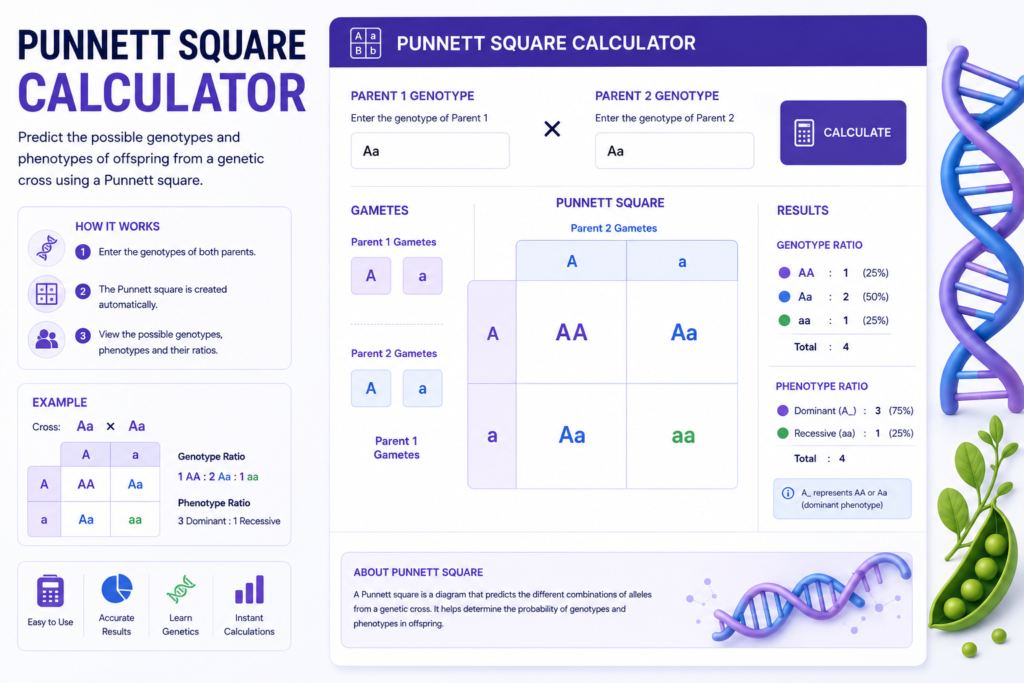
Punnett Square Calculator: Master Genetic Predictions With This Essential Tool
Introduction to Punnett Squares
Understanding heredity and genetic inheritance represents one of biology’s most important concepts, yet many students find the calculations intimidating. A Punnett square calculator transforms this complexity into simplicity, allowing learners to visualize and predict genetic outcomes effortlessly. This powerful educational tool has revolutionized how students and educators approach genetics, making it possible for anyone to understand inheritance patterns without getting bogged down in mathematical complexity.
The Punnett square calculator serves as a digital companion to classical genetics education, automating what would otherwise require careful grid construction and meticulous tracking of allele combinations. By leveraging this technology, students focus on understanding genetic principles rather than spending hours on repetitive calculations.
Understanding the Punnett Square Basics
Before exploring how a Punnett square calculator works, grasping the fundamental concept of a Punnett square becomes essential. A Punnett square represents a simple grid-based method for predicting genetic outcomes when two organisms reproduce. This elegant tool, developed in the early twentieth century, remains relevant and useful nearly a century later.
What Makes Punnett Squares Valuable
The Punnett square provides a visual representation of probability in genetics. Rather than relying on complex formulas or abstract thinking, learners can see exactly how alleles from each parent combine to produce offspring genotypes. This visual approach makes genetic concepts tangible and intuitive.
The Allele Concept
Understanding alleles forms the foundation for using any Punnett square calculator effectively. Alleles represent different versions of the same gene. For example, a flower plant might carry an allele for red petals and an allele for white petals. Each parent contributes one allele for each gene to its offspring, and the Punnett square shows all possible combinations.
How Traditional Punnett Squares Work
Before examining how a Punnett square calculator automates the process, understanding manual Punnett square construction provides valuable context. Traditional Punnett squares rely on a grid system where parent alleles are listed along the top and left side of the grid.
Grid Construction
For a monohybrid cross (examining one trait), a basic Punnett square requires a 2×2 grid, creating four possible offspring combinations. The grid layout remains consistent: parent genotypes line the edges, while the interior cells show every possible genetic combination in offspring.
The Step-by-Step Process
Creating a traditional Punnett square involves several steps. First, identify the alleles each parent carries. Then, determine possible gametes each parent can produce. Next, construct a grid with appropriate dimensions. Finally, fill each cell by combining one allele from each parent. This manual process, while educational, becomes time-consuming and error-prone with complex crosses.
Introducing the Punnett Square Calculator
A Punnett square calculator eliminates the tedious aspects of manual construction while preserving the educational value of the Punnett square method. Modern Punnett square calculators range from simple online tools to sophisticated software applications, each designed to make genetic prediction accessible.
What a Calculator Does
A Punnett square calculator automates grid construction and fills cells with all possible offspring genotypes. Users input parental genotypes, and the calculator instantly generates results, displaying genotypic ratios, phenotypic ratios, and probability percentages.
Types of Calculators Available
Different Punnett square calculator versions serve different educational levels and purposes. Basic calculators handle monohybrid crosses, while advanced versions manage dihybrid, trihybrid, and even more complex crosses. Some calculators include features like mutation tracking, incomplete dominance, and codominance modeling.
Using a Punnett Square Calculator: Step-by-Step Guide
Effectively using a Punnett square calculator requires understanding its interface and features. Most calculators follow a similar workflow, though specific steps may vary.
Step 1: Identify Your Genes and Alleles
Before using any Punnett square calculator, clearly define which gene you’re examining and which alleles you’re working with. Use consistent notation: uppercase letters typically represent dominant alleles, while lowercase letters represent recessive alleles.
Step 2: Determine Parent Genotypes
Each parent has two alleles for any given gene (with rare exceptions). A homozygous parent carries two identical alleles (AA or aa), while a heterozygous parent carries different alleles (Aa). Your Punnett square calculator needs accurate parental genotypes to produce correct results.
Step 3: Enter Information Into the Calculator
Most Punnett square calculator interfaces feature straightforward input fields. Simply enter each parent’s genotype in the designated spaces. The calculator typically accepts both uppercase and lowercase letters, though some prefer one format over another.
Step 4: Select Cross Type
Specify whether you’re examining a monohybrid cross (one trait), dihybrid cross (two traits), or more complex scenarios. The Punnett square calculator adjusts its grid size and calculations accordingly. A monohybrid cross produces a 2×2 grid, while a dihybrid cross requires a 4×4 grid.
Step 5: Review Calculated Results
Once you submit your information, the Punnett square calculator displays results instantly. The visual grid shows all possible offspring genotypes, making patterns immediately apparent.
Step 6: Interpret the Output
Most Punnett square calculator tools provide numerical results showing genotypic ratios and phenotypic ratios. Some advanced calculators offer additional information like probability percentages for each outcome.
The Mathematics Behind Punnett Square Calculations
Understanding the mathematical principles underlying a Punnett square calculator deepens appreciation for how this tool works and increases confidence in its results.
Probability and Genetics
Punnett squares fundamentally represent probability calculations. Each parent contributes one allele randomly to each offspring. The Punnett square calculator demonstrates that for each allele position, there’s a 50% probability of receiving either parental allele.
Classic Monohybrid Cross Ratios
When a heterozygous parent (Aa) crosses with another heterozygous parent (Aa), the resulting 3:1 phenotypic ratio emerges predictably. A Punnett square calculator reveals this elegant mathematical relationship visually: three offspring display the dominant phenotype while one displays the recessive phenotype.
Complex Dihybrid Ratios
In dihybrid crosses between heterozygous parents (AaBb × AaBb), the classic 9:3:3:1 phenotypic ratio emerges. This ratio reflects the independent assortment of two genes, creating four phenotypic classes in mathematically precise proportions. A Punnett square calculator automatically calculates these complex ratios.
Educational Benefits of Using a Punnett Square Calculator
Incorporating a Punnett square calculator into genetics education offers numerous advantages:
Time Efficiency
Manual Punnett square construction consumes hours of classroom time. A Punnett square calculator completes in seconds what might require fifteen minutes of careful hand calculations, freeing time for deeper conceptual exploration.
Accuracy Improvement
Human error decreases dramatically when using a Punnett square calculator. Misaligned grids, miscounted combinations, and arithmetic errors become impossible with automated calculations.
Visualization Enhancement
Color-coded grids and visual representations help students, particularly visual learners, understand genetic concepts intuitively. A well-designed Punnett square calculator displays results in ways that make patterns obvious.
Scenario Exploration
Students can rapidly test multiple scenarios using a Punnett square calculator. “What if” exploration becomes feasible—testing different parental genotypes, examining multiple generations, or exploring unusual inheritance patterns takes moments rather than hours.
Concept Reinforcement
Rather than getting lost in calculation mechanics, students using a Punnett square calculator maintain focus on understanding why certain ratios emerge and what those ratios mean biologically.
Monohybrid Crosses and Simple Predictions
The simplest Punnett square calculator applications involve monohybrid crosses, examining how a single trait passes from parents to offspring. These crosses provide ideal starting points for learning genetic principles.
The Classic Aa × Aa Cross
When two heterozygous parents reproduce, their offspring display a 3:1 phenotypic ratio. A Punnett square calculator shows this pattern emerging from a 1:2:1 genotypic ratio (1 AA : 2 Aa : 1 aa). Understanding why this specific ratio emerges requires understanding how alleles segregate during reproduction.
Test Crosses
Geneticists use test crosses to determine an organism’s genotype by crossing it with a homozygous recessive individual. A Punnett square calculator instantly reveals what offspring ratios would result, helping predict whether an organism is homozygous dominant or heterozygous.
Homozygous × Homozygous Crosses
When two homozygous parents reproduce—whether both dominant (AA × AA) or one dominant and one recessive (AA × aa)—all offspring inherit identical allele combinations. A Punnett square calculator makes these predictable outcomes immediately obvious.
Dihybrid Crosses: Examining Multiple Traits
More complex Punnett square calculator applications involve dihybrid crosses, where two traits are tracked simultaneously. These crosses reveal Mendel’s law of independent assortment.
The 4×4 Grid Structure
Dihybrid crosses require a 4×4 Punnett square, containing sixteen cells instead of four. A Punnett square calculator handles this increased complexity effortlessly, generating grids that would take extensive time to construct manually.
The 9:3:3:1 Ratio
The classic dihybrid cross between AaBb × AaBb parents produces a 9:3:3:1 phenotypic ratio. This elegant mathematical relationship demonstrates how two genes assort independently, creating four distinct phenotypic classes. A Punnett square calculator reveals why this specific ratio emerges from the underlying genetics.
Exploring Gene Interactions
Some dihybrid crosses involve gene interactions where one gene influences another gene’s expression. A Punnett square calculator can help visualize these complex scenarios, though interpreting results requires understanding epistasis and other interaction types.
Advanced Features in Modern Punnett Square Calculators
Contemporary Punnett square calculator tools offer far more functionality than basic grid generation:
Multiple Inheritance Patterns
Advanced calculators handle incomplete dominance, where heterozygotes display intermediate phenotypes, and codominance, where both alleles express equally. These features expand the calculator’s usefulness beyond simple dominant-recessive inheritance.
Mutation Tracking
Some Punnett square calculator applications allow users to introduce mutations and observe their effects on offspring. This feature helps students understand how mutations alter genetic outcomes.
Multi-Generation Analysis
Sophisticated Punnett square calculator tools track inheritance across F1, F2, and subsequent generations, helping students understand how traits persist or disappear through multiple generations.
Probability Calculations
Many Punnett square calculator tools display probability percentages for each outcome, translating the visual grid into numerical probabilities that students can compare.
Printable Results
Quality Punnett square calculator applications allow users to save or print results, creating study materials and documentation for assignments.
Comparing Different Punnett Square Calculators
Multiple Punnett square calculator options exist, each with distinct advantages:
Essential Features to Look For
Any reliable Punnett square calculator should:
- Accept clear user input for parental genotypes
- Display an accurate grid visualization
- Show both genotypic and phenotypic results
- Calculate probability percentages
- Handle multiple cross types
User Interface Considerations
The best Punnett square calculator features:
- Intuitive design requiring minimal instruction
- Clear labeling of alleles and gametes
- Color-coding to distinguish genotypes
- Mobile compatibility for diverse learning environments
- Fast processing times
Educational Features
The most valuable Punnett square calculator tools include:
- Explanatory text accompanying results
- Links to related genetic concepts
- Practice problems and examples
- Glossary definitions
- Video tutorials or guides
Common Mistakes When Using Punnett Square Calculators
Even with automated tools, users sometimes misinterpret results or enter incorrect information:
Allele Notation Errors
Inconsistent notation causes problems. Some Punnett square calculator users forget that uppercase represents dominant alleles and lowercase represents recessive alleles. Establishing clear notation before using the calculator prevents confusion.
Incorrect Genotype Input
Users occasionally misidentify parent genotypes. Before using any Punnett square calculator, verify parental genetic information from reliable sources. Incorrect input inevitably produces incorrect output.
Misinterpreting Ratios
Understanding what phenotypic and genotypic ratios actually mean challenges some students. A 3:1 ratio doesn’t mean exactly three offspring will display one phenotype—it means that, on average and over large numbers of offspring, this proportion emerges.
Ignoring Assumptions
Standard Punnett square calculator tools assume complete dominance and independent assortment. Real genetics sometimes reveals more complex inheritance patterns that violate these assumptions. Understanding your calculator’s limitations prevents misinterpretation.
Forgetting Context
A Punnett square calculator shows possible genetic outcomes, not certainties. Real offspring numbers fluctuate randomly around predicted ratios, especially with small sample sizes. Recognizing this distinction prevents overconfidence in predictions.
Real-World Applications of Punnett Square Analysis
Beyond classroom settings, Punnett square calculator concepts have practical applications:
Agricultural Breeding Programs
Farmers and plant breeders use Punnett square principles to develop crop varieties with desired traits. They predict genetic outcomes when crossing different plant varieties, selecting parents likely to produce offspring with ideal characteristics.
Animal Husbandry
Livestock breeders apply Punnett square concepts to develop animals with favorable traits—dairy cattle producing more milk, beef cattle with optimal meat quality, or poultry with higher egg production.
Medical Genetics
Genetic counselors predict inheritance patterns for hereditary conditions using Punnett square principles. Understanding what genetic combinations parents might produce helps families make informed reproductive decisions.
Conservation Biology
Wildlife managers use Punnett square concepts to manage genetic diversity in endangered species, selecting breeding pairs likely to maintain genetic health in small populations.
Evolutionary Studies
Understanding how traits pass through populations requires grasping Punnett square principles. Evolutionary biologists use these concepts to track how allele frequencies change over generations.
Understanding Genetic Variations and Exceptions
While standard Punnett squares assume simple dominant-recessive inheritance, genetics displays greater complexity:
Incomplete Dominance
In incomplete dominance, heterozygotes display phenotypes intermediate between homozygous phenotypes. Red flowers crossed with white flowers might produce pink flowers. A Punnett square calculator handling incomplete dominance shows three phenotypic classes instead of two.
Codominance
Codominance occurs when both alleles express equally in heterozygotes. Blood type AB represents codominance—individuals display both A and B antigens. Understanding codominance requires modifying basic Punnett square interpretation.
Sex-Linked Inheritance
Genes located on sex chromosomes follow different inheritance patterns than autosomal genes. A Punnett square calculator designed for sex-linked traits accounts for this difference, using different notation for X-linked genes.
Lethal Alleles
Some allele combinations prove lethal, preventing normal offspring development. A Punnett square calculator showing lethal allele crosses demonstrates how expected ratios shift when certain genotypes don’t survive.
Connecting to Broader Genetics Concepts
Punnett square mastery opens doors to understanding more complex genetics topics. Understanding monohybrid crosses prepares students for exploring dihybrid crosses and independent assortment, which examine how two genes assort during reproduction.
Additionally, grasping Punnett square principles provides foundation for understanding genetic linkage, where genes on the same chromosome don’t assort independently, modifying expected Punnett square ratios.
Students interested in molecular genetics should explore DNA to mRNA conversion and how genetic sequences translate into protein production, connecting inheritance patterns to molecular biology.
For those studying evolutionary biology, Hardy-Weinberg equilibrium calculations build on Punnett square concepts, examining how allele frequencies change in populations.
Practice Problems Using Punnett Square Calculators
To solidify understanding, work through these practice problems:
Problem 1: Basic Monohybrid Cross A gardener has two pea plants. One plant is homozygous for yellow seeds (YY) and the other is homozygous for green seeds (yy). Using a Punnett square calculator, predict the F1 generation’s phenotype and genotype.
Problem 2: Heterozygous Cross Two pea plants, both heterozygous for seed color (Yy), reproduce. Use your Punnett square calculator to determine offspring genotypic and phenotypic ratios.
Problem 3: Test Cross Analysis A plant displays the dominant phenotype but you don’t know if it’s homozygous (AA) or heterozygous (Aa). Using a Punnett square calculator, analyze what results you’d expect from crossing this plant with a homozygous recessive plant (aa). How would these results help determine the unknown plant’s genotype?
Problem 4: Three-Generation Analysis In the F1 generation described in Problem 2, two offspring reproduce. Use your Punnett square calculator to predict F2 generation ratios. How do F2 ratios compare to F1?
Troubleshooting Common Punnett Square Calculator Issues
Sometimes users encounter unexpected results or functionality problems:
Unexpected Ratios
If your Punnett square calculator produces unexpected ratios, first verify parental genotypes. Double-check that you’ve correctly identified which alleles are dominant and recessive. Consider whether the cross might involve incomplete dominance or other non-standard inheritance patterns.
Input Format Problems
Different Punnett square calculator tools accept input in different formats. Some require capital letters, others accept lowercase. Some might have specific formatting requirements. Consult your calculator’s instructions if you’re unsure about proper input format.
Grid Display Issues
If your Punnett square calculator’s grid displays incorrectly on your device, try refreshing your browser or accessing the tool from a different device. Mobile compatibility varies among online calculators.
Missing Features
If your Punnett square calculator doesn’t offer features you need—like handling incomplete dominance or tracking multiple generations—try alternative calculator tools designed for your specific needs.
The Future of Punnett Square Calculator Technology
As technology advances, Punnett square calculator tools continue evolving:
Artificial Intelligence Integration
Future Punnett square calculator applications might employ AI to suggest the most likely parental genotypes given observed offspring phenotypes, working backward from results to identify genetic composition.
Virtual Reality Representations
Advanced Punnett square calculator tools might use VR to visualize genetic inheritance in three dimensions, helping learners grasp spatial relationships in genetic concepts.
Real Genetic Data Integration
Sophisticated Punnett square calculator applications might connect to genomic databases, allowing analysis of actual human or organism genetic data.
Predictive Modeling
Future tools might predict not just immediate offspring but extend analysis across multiple generations, showing how genetic variation persists or disappears through lineages.
Teaching With Punnett Square Calculators
Educators can effectively incorporate Punnett square calculator tools into their teaching:
Demonstration Tool
Use a Punnett square calculator during lectures to instantly illustrate genetic concepts, showing how different parental genotypes produce different offspring ratios.
Practice Platform
Have students use Punnett square calculators for practice problems, providing immediate feedback on their predictions before they spend time on manual calculations.
Assessment Tool
Create assessment questions asking students to predict Punnett square results, explaining their reasoning. This assesses understanding rather than calculation ability.
Exploration Device
Allow students to freely explore Punnett square calculator scenarios, encouraging questions like “What if we changed one parent’s genotype?” or “How would this inheritance pattern change?”
Conclusion: Empowering Genetics Learners
The Punnett square calculator represents a transformative educational tool that makes genetics accessible and engaging. By automating calculations, these tools free learners to focus on understanding genetic principles, recognizing patterns, and applying knowledge to real-world situations.
Whether you’re a high school student encountering genetics for the first time, an advanced learner exploring inheritance complexity, or an educator teaching the next generation of biologists, a quality Punnett square calculator enhances learning experiences and builds confidence in genetic analysis. These tools don’t replace understanding—they support it, allowing you to work through more examples, test more scenarios, and ultimately grasp genetic concepts more deeply.
The elegance of Punnett squares lies in their simplicity and power. With just a grid and basic understanding of alleles, you can predict inheritance patterns across generations. By leveraging modern Punnett square calculator technology, you harness this power instantly, focusing your mental energy on comprehension rather than computation. As you continue your genetics education journey, remember that the goal isn’t performing calculations—it’s understanding heredity’s remarkable patterns and principles that govern all life.