
DNA Concentration Calculator: The Complete Guide to Accurate Nucleic Acid Quantification
What Is a DNA Concentration Calculator and Why Is It Essential?
Nucleic acid quantification sits at the very foundation of molecular biology. Before a researcher can run a PCR reaction, set up a restriction digest, prepare a sequencing library, or transfect cells with a plasmid, they need to know exactly how much DNA they are working with. Too little DNA and the reaction fails. Too much and the results become unreliable, reagents are wasted, and downstream analysis gets complicated. That is where a DNA concentration calculator becomes indispensable.
A DNA concentration calculator is a tool that converts raw absorbance or fluorescence measurements into meaningful concentration values, expressed in standard units such as nanograms per microliter (ng/µL) or micrograms per milliliter (µg/mL). It removes the manual arithmetic from the quantification workflow, reduces transcription errors, and gives researchers a fast, reproducible way to verify the quality and quantity of their nucleic acid samples before committing them to expensive or time-sensitive downstream applications.
From academic research laboratories to clinical genomics facilities and pharmaceutical manufacturing environments, a DNA concentration calculator is one of the most frequently used computational tools in the molecular biologist’s daily workflow.
The Science Behind DNA Quantification
How DNA Absorbs Ultraviolet Light
The most widely used method for measuring DNA concentration relies on the fact that nucleic acids absorb ultraviolet light at a characteristic wavelength of 260 nanometers (nm). This absorbance arises from the aromatic rings of the nitrogenous bases — adenine, thymine, guanine, and cytosine — which are highly efficient UV absorbers. The relationship between absorbance and concentration follows the Beer-Lambert Law:
A = ε × c × l
Where A is the measured absorbance, ε is the molar extinction coefficient (a constant specific to the type of nucleic acid), c is the concentration of the sample, and l is the path length of the light through the sample, typically 1 cm in a standard cuvette.
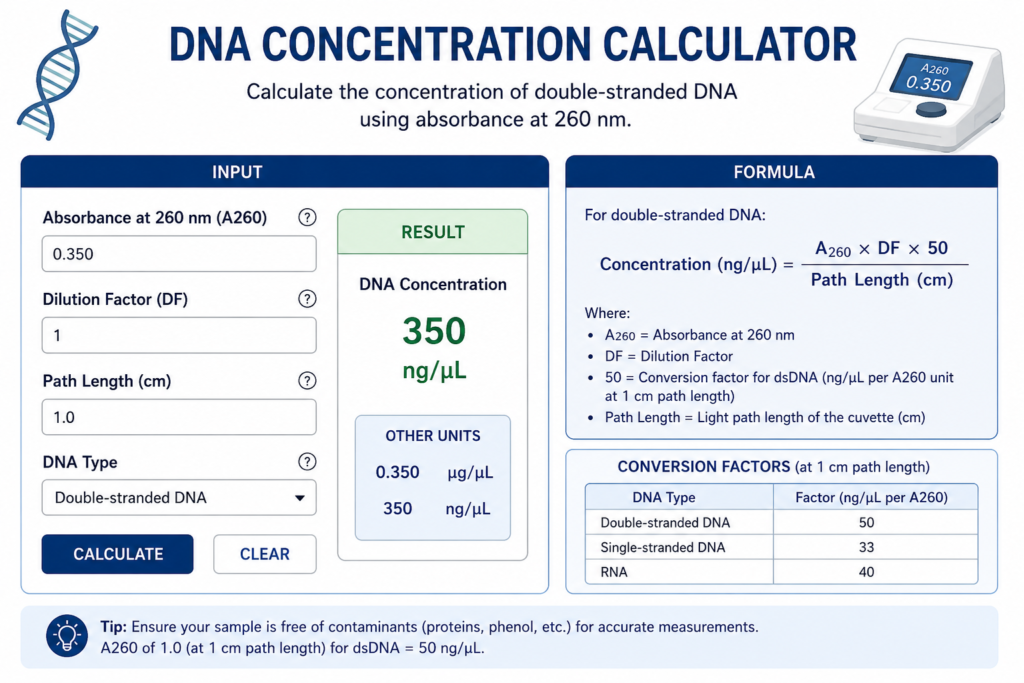
A DNA concentration calculator applies this relationship automatically. For double-stranded DNA (dsDNA), the widely accepted conversion factor is that an absorbance of 1.0 at 260 nm corresponds to approximately 50 ng/µL. For single-stranded DNA (ssDNA), the equivalent factor is approximately 33 ng/µL, and for RNA it is approximately 40 ng/µL. By multiplying the measured A₂₆₀ value by the appropriate conversion factor and the dilution factor, the calculator returns the concentration of the original sample.
The Role of the 260/280 Ratio in Purity Assessment
A DNA concentration calculator does more than simply quantify DNA — it also helps assess sample purity. Proteins absorb strongly at 280 nm due to the aromatic amino acids tryptophan and tyrosine. By measuring absorbance at both 260 nm and 280 nm, the calculator can compute the A₂₆₀/A₂₈₀ ratio, which serves as an indicator of protein contamination.
A pure dsDNA sample typically yields a 260/280 ratio between 1.8 and 2.0. Values significantly below 1.8 suggest protein contamination or the presence of phenol carryover from extraction procedures. Values above 2.0 may indicate RNA contamination. This purity metric is particularly important before applications that are sensitive to protein inhibition, such as enzymatic reactions or next-generation sequencing library preparation.
The 260/230 Ratio and Organic Contaminants
A second purity metric that many DNA concentration calculators report is the A₂₆₀/A₂₃₀ ratio. Organic compounds commonly carried over from nucleic acid extraction kits — including guanidinium salts, EDTA, carbohydrates, and phenol — absorb at approximately 230 nm. A 260/230 ratio between 2.0 and 2.2 is generally considered acceptable for a clean DNA sample. Lower ratios indicate the presence of these contaminants and may signal the need for additional purification steps before the sample is used in sensitive downstream assays.
Key Inputs for a DNA Concentration Calculator
Absorbance Value at 260 nm
The primary input for any spectrophotometry-based DNA concentration calculator is the absorbance reading at 260 nm, obtained from a UV spectrophotometer or a microvolume instrument such as the NanoDrop. This value must be measured within the linear range of the instrument — typically between 0.1 and 1.0 absorbance units — to ensure accuracy. Readings outside this range should prompt the researcher to dilute the sample (if too concentrated) or concentrate it (if too dilute) before remeasuring.
Sample Type Selection
Not all nucleic acids share the same extinction coefficient, so a DNA concentration calculator must know what type of nucleic acid is being measured. The main options are double-stranded DNA, single-stranded DNA, single-stranded RNA, and oligonucleotides. Selecting the wrong sample type will produce an incorrect concentration estimate — for example, applying the dsDNA factor to an RNA sample would underestimate the true RNA concentration by approximately 20%.
Dilution Factor
If the sample was diluted before measurement — a common practice when working with highly concentrated samples that would otherwise saturate the detector — the dilution factor must be entered into the DNA concentration calculator so that it can back-calculate the concentration of the original undiluted stock. Forgetting to account for the dilution factor is one of the most common sources of error in nucleic acid quantification workflows.
Path Length Correction
Some microvolume spectrophotometers, including the NanoDrop series, use a very short path length — typically 0.2 mm or 1 mm rather than the standard 10 mm cuvette path — and correct for this internally. When using a standard cuvette-based spectrophotometer, the path length is fixed at 1 cm and no correction is needed. However, when using plate reader-based absorbance systems with variable liquid volumes, path length normalization becomes important. Advanced DNA concentration calculators allow users to specify the path length to ensure accurate results across different instrument types.
Practical Applications of a DNA Concentration Calculator
PCR and qPCR Template Preparation
Polymerase chain reaction is perhaps the single most common downstream application that requires precise DNA quantification. Template concentration has a direct effect on PCR efficiency and specificity. Most standard PCR protocols call for 1–100 ng of template DNA per reaction, while quantitative PCR (qPCR) is even more sensitive to input concentration because accurate quantification depends on starting from a precisely defined copy number.
Using a DNA concentration calculator to normalize template input before setting up PCR reactions reduces inter-assay variability and makes it far easier to troubleshoot reactions that fail to amplify or produce non-specific products.
Next-Generation Sequencing Library Preparation
Next-generation sequencing (NGS) is one of the most demanding applications in terms of DNA quantification accuracy. Library preparation protocols require precise input amounts — typically in the range of 1 ng to 1 µg depending on the protocol and starting material — and the final library must be quantified and normalized to a defined concentration before pooling and sequencing. Both under- and over-loading a sequencing flow cell has significant consequences for data quality and yield.
A DNA concentration calculator is used at multiple stages of the NGS workflow: quantifying the input genomic DNA, checking the concentration of the adaptor-ligated library, and calculating the dilution needed to reach the loading concentration specified by the sequencing instrument manufacturer.
Cloning and Restriction Digestion
In molecular cloning workflows, the molar ratio of insert to vector DNA is a critical determinant of ligation efficiency. Calculating this ratio requires knowing the mass concentration of each fragment, which a DNA concentration calculator provides, as well as the fragment lengths, which allow mass concentration to be converted to molar concentration. Many advanced DNA concentration calculators include a molar conversion feature that accepts fragment length in base pairs and returns the concentration in picomoles per microliter (pmol/µL) or nanomolar (nM), making ligation ratio calculations straightforward.
Forensic DNA Analysis
In forensic science, DNA quantification is a regulated step performed before STR profiling, Y-chromosome analysis, or mitochondrial sequencing. The quantity and quality of DNA recovered from a crime scene sample directly determines which analytical workflow is appropriate and whether a full or partial DNA profile can be generated. Validated quantitative PCR-based methods are the current gold standard for forensic DNA quantification, but the DNA concentration calculator remains a valuable tool for initial screening of extracted samples.
Gene Therapy and Viral Vector Manufacturing
In the biopharmaceutical industry, the manufacturing of gene therapy products based on adeno-associated virus (AAV) or lentiviral vectors requires precise quantification of the DNA components used in production. Plasmid DNA concentration must be verified before transfection, and the genomic titer of purified vector preparations is tightly controlled to meet product specifications. A DNA concentration calculator, used in conjunction with both spectrophotometric and fluorometric quantification methods, supports the quality control documentation required for regulatory submissions.
Fluorometric Methods and Their Calculators
When Spectrophotometry Is Not Enough
While UV absorbance is fast and convenient, it is not always the most appropriate quantification method. Spectrophotometry measures all UV-absorbing material in a sample, which means it cannot distinguish between intact DNA and free nucleotides, RNA, or degraded fragments. For highly impure samples or when very low concentrations need to be measured accurately, fluorometric quantification using intercalating dyes offers superior specificity and sensitivity.
Instruments such as the Qubit fluorometer use fluorescent dyes that bind selectively to dsDNA, ssDNA, or RNA and emit a signal proportional to the amount of the target molecule present. A DNA concentration calculator designed for fluorometric data takes the raw relative fluorescence units (RFU) from the standard curve and returns the concentration of the target nucleic acid, corrected for any background fluorescence.
Combining Both Methods for Maximum Confidence
Many experienced molecular biologists recommend using both spectrophotometric and fluorometric quantification in parallel when working with critical samples. The NanoDrop provides a fast purity assessment and approximate concentration, while the Qubit gives a more accurate measurement of intact, double-stranded DNA. Using a DNA concentration calculator with both datasets allows researchers to detect discrepancies that might indicate significant RNA or degraded DNA contamination, prompting additional purification before the sample is used in sensitive applications.
Final Thoughts
A DNA concentration calculator is far more than a simple arithmetic shortcut. It is a gateway to data quality — a tool that ensures every downstream molecular biology experiment starts from a well-defined, accurately characterized sample. Whether the application is routine PCR, cutting-edge single-cell sequencing, clinical diagnostics, or pharmaceutical manufacturing, the ability to quickly and accurately quantify DNA concentration is a skill that underpins reproducible, trustworthy science. Investing the time to understand what goes into a DNA concentration calculator — the physics of UV absorbance, the meaning of purity ratios, the importance of dilution factors — pays dividends in every experiment that follows.