
Ligation Calculator: The Complete Guide to Optimizing DNA Ligation for Molecular Cloning
What Is a Ligation Calculator and Why Should Researchers Use One?
Molecular cloning is one of the cornerstones of modern biology, and at the heart of nearly every cloning experiment lies a deceptively simple but technically demanding step — the ligation reaction. Getting this step right requires more than good technique and quality reagents. It requires precise calculation of the molar ratio between the DNA fragments being joined. That is exactly what a ligation calculator is designed to do.
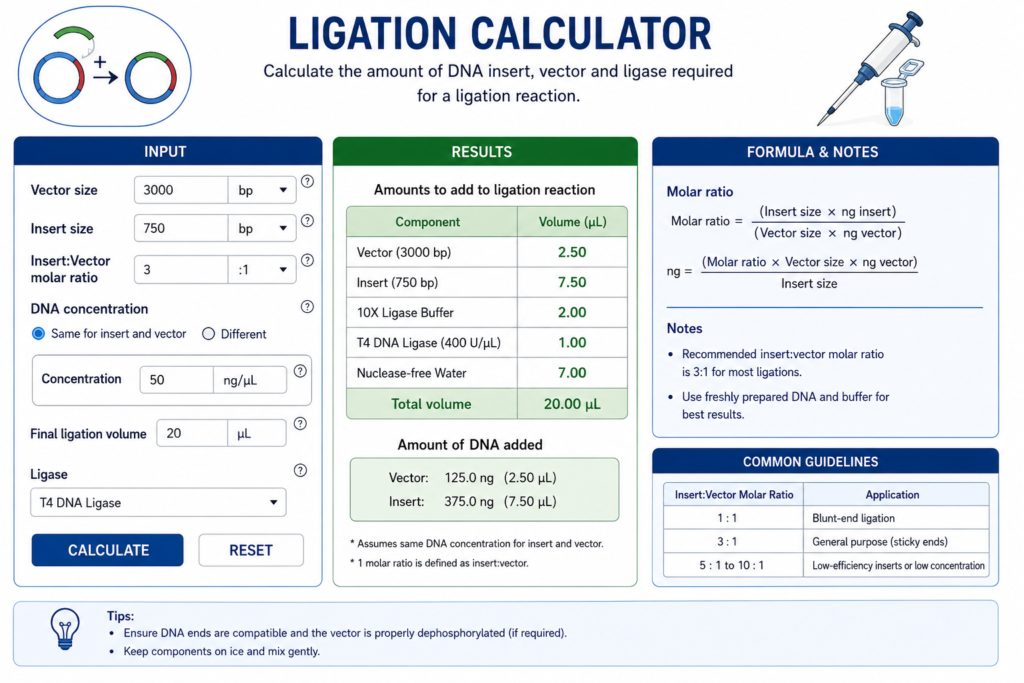
A ligation calculator is a computational tool that helps researchers determine the correct amounts of vector and insert DNA to combine in a ligation reaction to achieve an optimal molar ratio. Rather than manually converting mass concentrations into molar quantities and performing ratio arithmetic under time pressure, scientists can enter their known values and receive immediate, reliable guidance on how to set up their reaction. The result is a more efficient workflow, higher ligation efficiency, and ultimately a greater chance of picking the correct clone on the first attempt.
From undergraduate teaching labs performing their first cloning experiments to seasoned protein engineers constructing complex multi-fragment assemblies, a ligation calculator is a tool that improves outcomes at every level of experience.
The Biology of DNA Ligation
What Happens During a Ligation Reaction
DNA ligation is the process by which two DNA fragments with compatible ends are covalently joined by the enzyme DNA ligase. In the context of molecular cloning, this typically means joining a linearized vector — a plasmid that has been cut open with one or more restriction enzymes — with a DNA insert that carries the gene or sequence of interest.
DNA ligase catalyzes the formation of a phosphodiester bond between the 3′-hydroxyl group of one DNA strand and the 5′-phosphate group of the adjacent strand at a nick or break point. In the presence of ATP as an energy cofactor, the enzyme seals the gap between the two fragments, creating a continuous, circular DNA molecule that can be transformed into a bacterial host for amplification and selection.
The efficiency of this reaction depends on several factors: the quality and purity of the DNA, the compatibility of the end types, the activity of the ligase enzyme, the temperature and duration of incubation, and — critically — the relative molar amounts of vector and insert present in the reaction. This last factor is where the ligation calculator plays its most important role.
Cohesive Ends vs. Blunt Ends
Not all ligation reactions are created equal. The type of DNA ends generated by restriction enzyme digestion has a profound effect on ligation efficiency, and a good ligation calculator will account for this distinction.
Cohesive ends, also called sticky ends, are generated when a restriction enzyme cuts asymmetrically within its recognition sequence, leaving short single-stranded overhangs of two to four nucleotides. These overhangs can base-pair with complementary sequences on another fragment, temporarily holding the two molecules together and dramatically increasing the probability of successful ligation. Most standard cloning workflows take advantage of cohesive end ligation because of its superior efficiency.
Blunt end ligation, by contrast, involves fragments with no overhangs. While universal in the sense that any two blunt-ended fragments can in principle be joined, blunt end ligation is significantly less efficient than cohesive end ligation because the two molecules must collide and align without the assistance of complementary base pairing. This lower efficiency means that blunt end reactions typically benefit from higher insert-to-vector ratios and longer incubation times — considerations that a ligation calculator helps quantify precisely.
The Mathematics Inside a Ligation Calculator
Molar Ratio: The Central Concept
The most important concept underlying any ligation calculator is the insert-to-vector molar ratio. This ratio describes how many moles of insert fragment are present for every mole of vector in the reaction. Because the goal is to have one insert molecule available for every vector molecule that needs to be filled, the ideal ratio is typically between 3:1 and 10:1 (insert:vector), with 5:1 being a widely used starting point for cohesive end ligations.
The reason a simple mass ratio is not sufficient is that DNA molecules of different sizes contain different numbers of moles for the same mass. A 500 base pair insert and a 4,000 base pair vector at equal masses are not present at equal molar concentrations — the insert is present at eight times as many moles as the vector. A ligation calculator corrects for this by using fragment length to convert mass concentration into molar concentration.
The Core Formula
The formula at the heart of every ligation calculator is:
Mass of insert (ng) = Molar ratio × (Size of insert in bp / Size of vector in bp) × Mass of vector (ng)
This equation ensures that the insert mass used in the reaction corresponds to the desired molar excess over the vector. A ligation calculator automates this calculation, requiring the user only to input the vector size in base pairs, the insert size in base pairs, the amount of vector DNA to use, and the desired molar ratio. The calculator returns the precise mass of insert DNA to add.
For example, if a researcher wants to set up a ligation with 50 ng of a 4,000 bp vector and a 500 bp insert at a 5:1 molar ratio, the ligation calculator would determine that approximately 6.25 ng of insert is required. Without the calculator, converting these values manually is straightforward — but under the pressure of setting up multiple reactions simultaneously, manual calculations are where errors creep in.
Total Reaction Volume Considerations
A well-designed ligation calculator also helps researchers manage total reaction volume. Standard T4 DNA ligase reactions are typically performed in a total volume of 10 to 20 µL. If the volumes of vector and insert required to deliver the calculated masses exceed the total reaction volume, the DNA samples are too dilute and may need to be concentrated before the ligation can be set up correctly. A ligation calculator that incorporates concentration values — not just masses — can flag this problem before reagents are wasted.
Practical Applications of a Ligation Calculator
Standard Restriction Enzyme Cloning
The most common use case for a ligation calculator is standard restriction enzyme-based cloning, where a PCR product or genomic fragment is digested with one or two restriction enzymes and ligated into a similarly digested vector. The ligation calculator ensures that the insert and vector are combined at the correct molar ratio, maximizing the probability that transformed colonies will carry the desired recombinant plasmid rather than re-circularized empty vector.
Using a ligation calculator as part of a standardized cloning workflow reduces the colony screening burden — fewer colonies need to be picked and analyzed to find a positive clone when the ligation reaction was set up correctly from the start.
Multi-Fragment Assembly
Modern cloning strategies increasingly involve assembling more than two fragments simultaneously. Gibson Assembly, Golden Gate cloning, and similar isothermal assembly methods join multiple fragments in a single reaction, relying on overlapping sequences rather than restriction sites. While these methods have their own specialized calculators, the underlying principle — ensuring equimolar or defined molar ratios between all fragments — is the same one that drives a traditional ligation calculator.
For multi-fragment assemblies, the ligation calculator extends naturally to handle three, four, or more fragments, calculating the required mass of each based on its length and the desired molar equivalence.
Directional vs. Non-Directional Cloning
When performing directional cloning — inserting a fragment in a defined orientation using two different restriction enzymes — a ligation calculator helps researchers verify that both enzyme digests have gone to completion and that the fragment masses used correspond to the correct molar ratio. Non-directional cloning with a single enzyme requires additional strategies to minimize re-ligation of the empty vector, such as dephosphorylation with alkaline phosphatase. A ligation calculator helps ensure that even in these more challenging setups, the insert-to-vector ratio is optimized to give the best possible outcome.
TA Cloning and Topoisomerase-Based Methods
TA cloning takes advantage of the non-templated adenine overhang added by Taq polymerase to PCR products, allowing direct insertion into linearized vectors with complementary thymine overhangs — no restriction enzyme digestion required. Similarly, topoisomerase-based TOPO cloning systems use activated vector molecules that join to PCR products through a covalent enzyme intermediate.
Even in these simplified systems, a ligation calculator remains useful for determining the optimal molar ratio of PCR product to vector, which directly affects the proportion of recombinant colonies obtained after transformation.
Common Mistakes a Ligation Calculator Helps Prevent
Several of the most frequent errors in molecular cloning workflow are directly related to ligation setup, and a consistently used ligation calculator eliminates most of them.
Using a mass ratio instead of a molar ratio is the single most common conceptual mistake. Researchers who add equal masses of vector and insert are unknowingly creating a large molar excess of the smaller fragment. A ligation calculator makes the distinction explicit by requiring fragment sizes as inputs and performing the molar conversion automatically.
Ignoring the concentration of the DNA stocks leads to setting up reactions with theoretical volumes that are physically impossible to pipette — for example, 0.02 µL. A ligation calculator that displays required volumes alongside masses makes these impractical setups visible immediately, prompting a concentration or dilution step before the reaction is set up.
Forgetting to account for the vector-to-insert size difference when working with unusually large inserts or very small vectors is another pitfall. Large inserts relative to the vector require proportionally more mass to achieve a given molar ratio — a relationship that is easy to underestimate without the calculator’s guidance.
Choosing a Ligation Calculator: What to Look For
A range of ligation calculators are available from reagent suppliers and academic institutions. New England Biolabs (NEB), Addgene, and several university bioinformatics portals offer free, browser-based ligation calculators that are widely trusted in the research community.
The most useful ligation calculators allow input of DNA concentrations in ng/µL alongside fragment sizes in base pairs, calculate both mass and volume of each component, support variable molar ratios to allow optimization across a range of conditions, and flag reactions where the required volumes are impractical given the input concentrations.
Some advanced tools also include controls for the total reaction volume and the volumes of ligase buffer and enzyme, generating a complete reaction setup table that can be used directly at the bench without further calculation.
Final Thoughts
The ligation calculator is a small tool with an outsized impact on cloning success. By replacing manual molar ratio arithmetic with an accurate, instantaneous calculation, it removes one of the most common sources of error from a workflow where every step matters. Whether a researcher is performing a routine subcloning task, assembling a complex multi-gene construct, or troubleshooting a cloning experiment that has repeatedly failed to yield positive colonies, checking the ligation setup with a reliable ligation calculator is always a worthwhile first step. It is the kind of tool that, once adopted as a standard part of the cloning workflow, quickly becomes impossible to work without.